
Game review
Dirty Business Review
6 / 10
- Developer
- Plan Dirty Games
- Publisher
- Plan Dirty Games
- Released
- 22 July 2026
- Platforms
- ["Windows"]
- Genre
- Simulation
Schedule 1's Shadow Looms Large
Dirty Business entered Early Access on July 22, 2026, from developer Plan Dirty Games, pitching a criminal-empire management sim built around a hidden underground hangar: grow and process drugs, print counterfeit weapons and cash, run a cartel airstrip, and manage a growing roster of hired staff, solo or in co-op. Reviews are split at 73% positive across 397, and the single most repeated word across nearly every one of them, positive and negative, is a comparison to Schedule 1, the breakout drug-dealing sim that has clearly set the bar this game is being measured against. A large chunk of the negative reviews are essentially "just go play Schedule 1 instead," while a meaningful number of positive reviews go out of their way to insist this is a different kind of game and shouldn't be dismissed by that comparison alone.
A Genuinely Wide Spread of Illegal Enterprises
Where Dirty Business earns its most detailed praise is in the sheer breadth of criminal production lines on offer, and the fact that each one is its own multi-step process rather than a single "press button, get product" loop. Reviewers single out weed cultivation with several distinct strains, a step-by-step LSD synthesis process with its own timing pressure, a weapon 3D-printer with a wide catalog of guns, a banknote-counterfeiting operation, and an acid-based evidence-disposal system for melting down incriminating items, each described as feeling like a distinct activity worth returning to rather than a copy-pasted variant of the others. Airplane smuggling runs to a separate "Smuggler's Island," complete with a fuel-management wrinkle, draw specific praise as one of the only activities that gets players out of the underground base entirely.
A Grind Gated Hard Behind Levels
The most consistent structural complaint is pacing. Several detailed reviews note that the first hired worker for the base weed line doesn't unlock until roughly level 13, and other production lines like LSD require a further 14 levels on top of unlocking the line itself before a dedicated worker becomes available, meaning long stretches of manual, repetitive labor before the game's automation systems kick in. Reviewers who pushed through describe genuinely large paydays and satisfying scaling once workers are unlocked, but the consensus is that early progression drags on far longer than it needs to, and more than one reviewer explicitly asks the developer to let players choose which systems to unlock rather than gating everything behind a single level track.
Inventory Friction, and a Watering Can That Won't Refill
Control and inventory complaints turn up constantly, and they're specific enough to be more than noise: switching held items drops whatever was previously in hand, packaging requires repeatedly reselecting the same inventory slot rather than holding it, and object placement doesn't reliably snap to the room's grid, leaving furniture visibly crooked unless players discover an undocumented workaround. The single most-repeated specific gripe, showing up across a striking number of otherwise unrelated reviews, is that the game's watering can cannot be refilled and must be repurchased once empty, a design choice reviewers call baffling for a game whose first real activity is growing plants. None of these individually breaks the game, but reviewers agree they compound into real friction during normal play.
Co-op Has Real Rough Edges
Given how heavily co-op is marketed, its current state draws pointed criticism. Multiple reviewers report that players frequently can't interact with the same objects at the same time, that tutorials interrupt or block each other in a shared session, and that AI-controlled worker behavior, already inconsistent solo, gets noticeably worse with more players in the base. One reviewer summarizes the current co-op experience as feeling closer to an early demo than a finished Early Access feature, while still crediting the underlying concept with real potential once these systems are ironed out.
An Actively Patched Early Access Cycle
Running through much of the positive side of the sample is real trust in the developer's pace of updates. Reviewers point to a steady stream of numbered patches addressing worker behavior, inventory systems, and bug fixes on close to a weekly cadence since launch, and several reviewers who list genuine complaints explicitly say they're keeping their review positive because the pattern of fixes so far has been substantive rather than cosmetic. That said, negative reviews are just as willing to note that $14.99 feels steep for content some describe as closer to a free demo than a full Early Access purchase in its current state.
Balance Issues Beyond the Grind
Beyond raw pacing, several detailed reviews flag specific economic imbalances that a straightforward level-gate fix won't solve on its own. The weapon 3D printer is repeatedly named as by far the most profitable activity in the game, leaving other production lines, particularly the evidence-disposal and covert-dealer systems, described as actively unrewarding or even money-losing once time and risk are factored in. Employee wages are automatically deducted, but the company's own operating funds reportedly need to be manually topped up, an inconsistency more than one reviewer calls out as an odd oversight rather than a deliberate design choice. Combined with worker AI that several reviewers describe as inconsistent about how much of a harvest or order actually gets processed correctly, these are balance problems layered on top of, not caused by, the game's slower-than-ideal pacing.
Verdict
Dirty Business has a genuinely appealing pitch, an underground criminal empire with a wider spread of parallel illegal enterprises than its most obvious point of comparison, and reviewers who push past its early grind describe real depth once workers and automation come online. But the Schedule 1 comparisons aren't unfair: clunky inventory handling, a punishing early-game unlock pace, unfinished co-op interactions, and a long list of small but constantly-repeated annoyances (that watering can, again) mean this is very much a ground-floor Early Access purchase right now, one whose value depends heavily on how much you trust the developer's visibly active patch cadence to keep closing the gap.
Screenshots
-
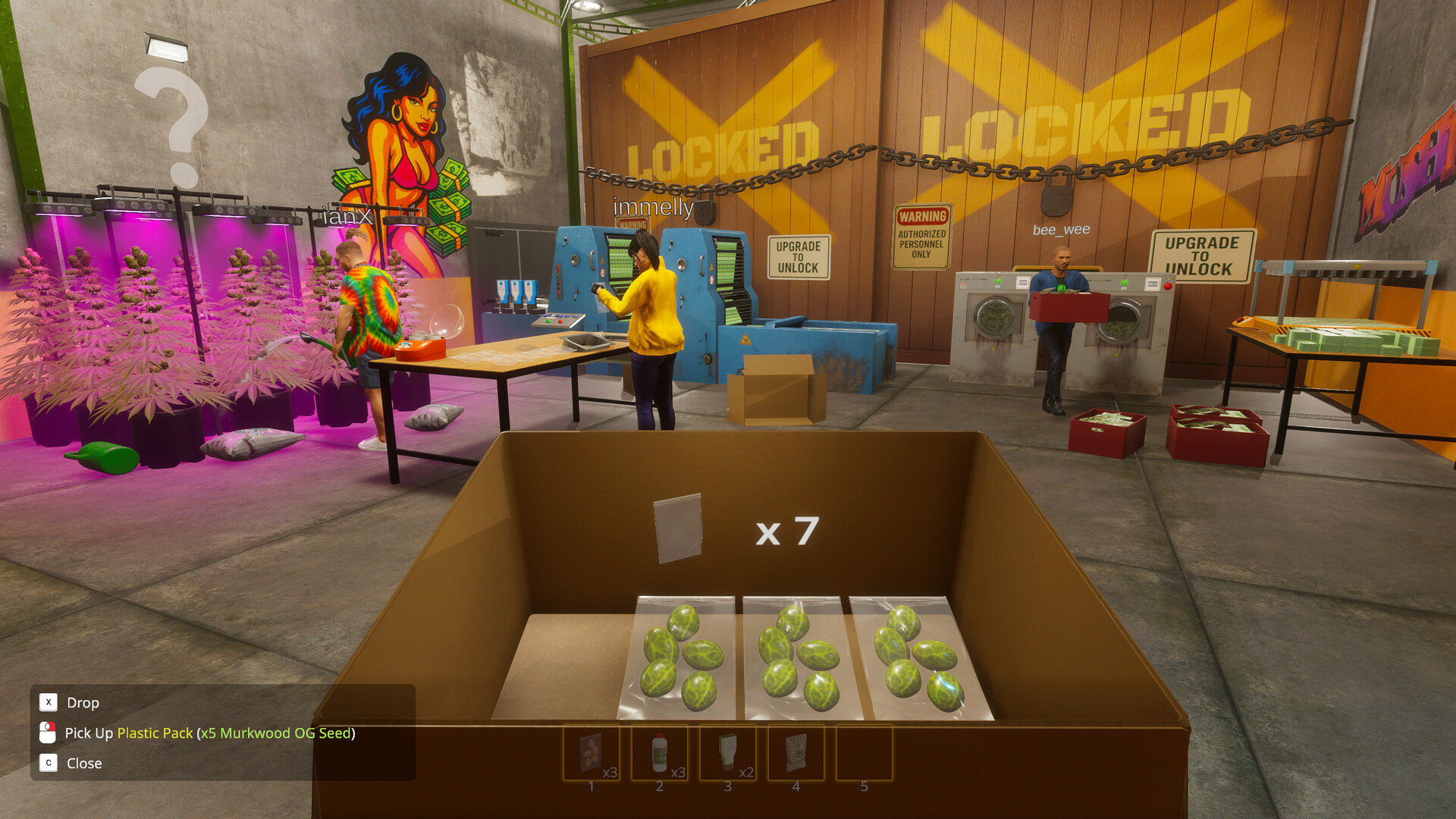
A co-op session packaging product for shipment, with two of the base's production areas still locked behind upgrades.Image: Plan Dirty Games via Steam -

A smuggling run landed on Tempest Isle, one of the few activities that gets players out of the underground base.Image: Plan Dirty Games via Steam -
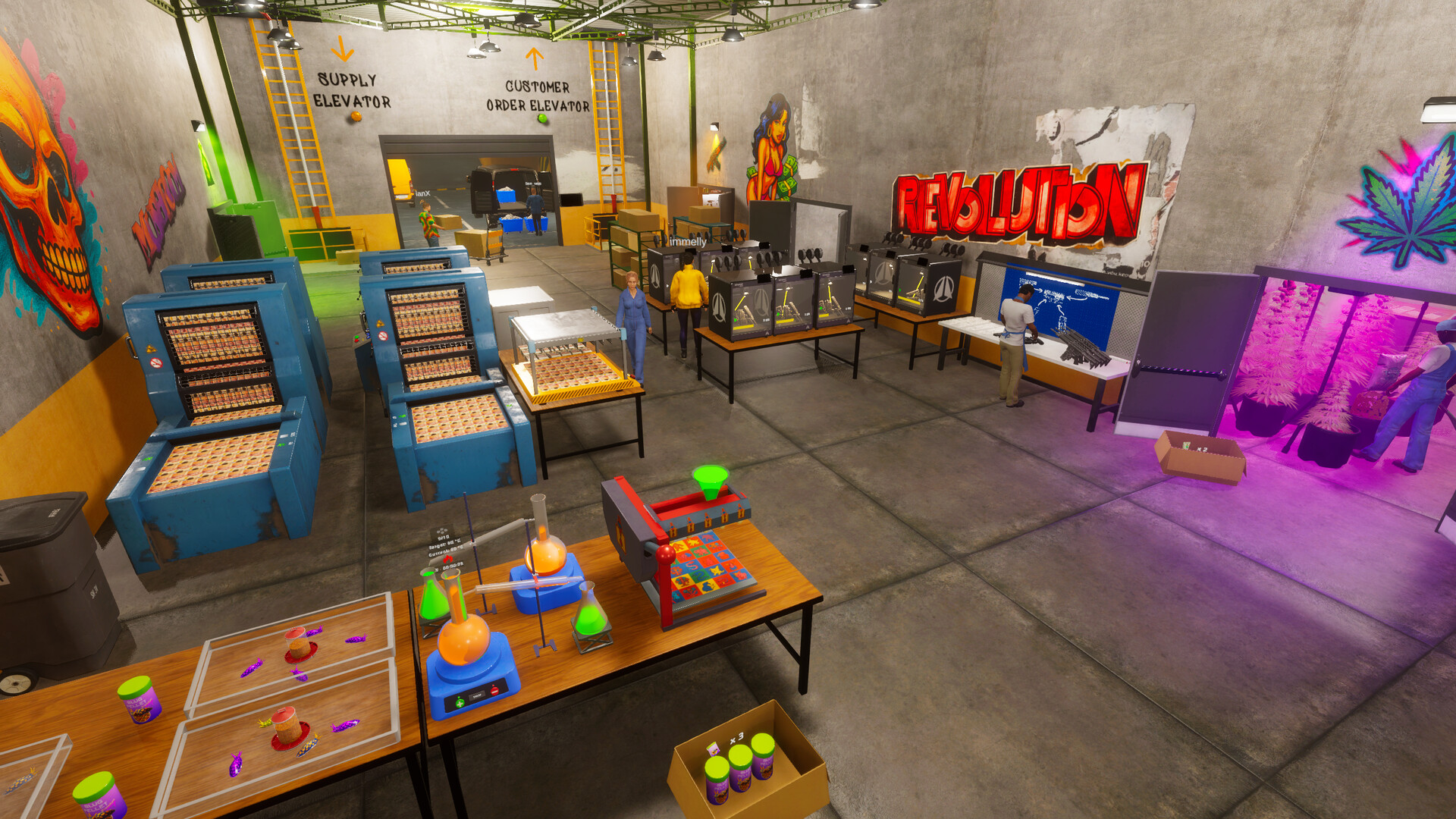
The base's layout in full, with weapon printing, chemical synthesis, and plant growing all running in parallel.Image: Plan Dirty Games via Steam