Game review
Diaspora
7 / 10
- Developer
- Hosted Games
- Publisher
- Hosted Games
- Released
- 6 August 2026
- Platforms
- Windows, macOS, Linux
- Genre
- Interactive Fiction
- Monetisation
- One-time purchase. No DLC and no in-app purchase category listed on the storefront.
- Players
- Single-player only
The short version
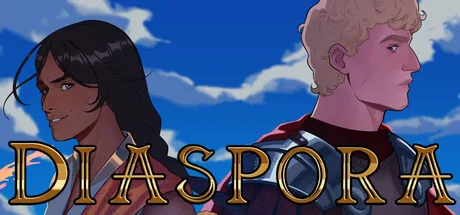
Diaspora is a text-only ChoiceScript novel — no graphics, no sound, entirely prose and branching choices — about a clan driven from its homeland by war, sailing south to build a new life beside an empire that doesn't want them and raiders who used to be them. It shipped on Steam 6 August 2026 after roughly nine years of open development, and the strongest verifiable thing about it isn't the game itself, which nobody outside its beta readers has had time to assess, but its co-writer's track record: JJ Laurier's previous Hosted Games release, Fields of Asphodel, sits Very Positive on Steam at 85.7%. That's real signal in a review that otherwise has almost nothing else to weigh.
The other half of that sentence matters too. There is, as of writing, no Steam user-review corpus for Diaspora at all, no critic coverage, and every one of its sixteen achievements sits at 0% completion because the game is a day old. Score this as a launch-day bet on format and pedigree, not a verdict on the finished prose.
Biggest strengths
- Co-writer JJ Laurier's previous Hosted Games title, Fields of Asphodel, holds a verified Very Positive rating (66 of 77 Steam reviews, 85.7%) on the same imprint and a comparably huge word count
- Sixteen Steam achievements point at real structural branching — separate paths for siding with the empire or the raiders, sparing or killing a named character, at least two distinct magic routes (shaman, ward, valravn)
- Nine years of public work-in-progress chapters drew specifically positive forum feedback on pacing and prose before this release, not just enthusiasm for the premise
Biggest weaknesses
- Zero Steam user reviews and no critic scores exist at time of writing, so bugs, pacing problems and ending quality are all currently unverifiable
- Hosted Games is Choice of Games' self-published, revenue-share imprint rather than its in-house editorial line, which is a real quality-control difference worth knowing before treating this as a curated CoG release
- English only — no other language support is listed, which narrows the audience for a million-word-scale reading commitment
Who it's for: Readers of choice-based interactive fiction — Choice of Games and Hosted Games regulars especially — who want a long, politically-branching fantasy story about culture clash and don't need graphics or voice acting to stay invested for dozens of hours.
Our recommendation: A reasonable buy at the introductory discount if you already know you like this format, on the strength of one author's proven track record on the same imprint. Everyone else should wait for a real review sample, since almost nothing about this specific game's pacing, bugs or ending quality is independently confirmed yet.
7 / 10
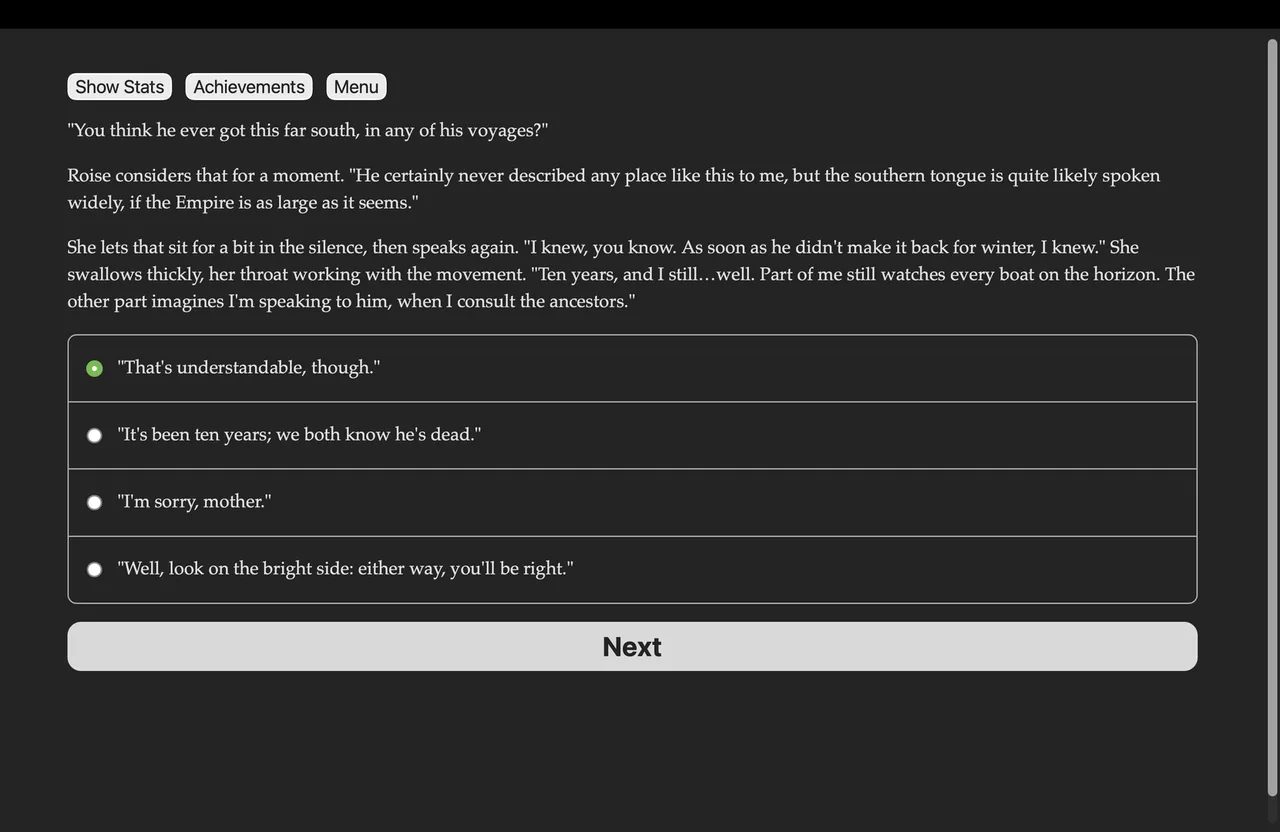
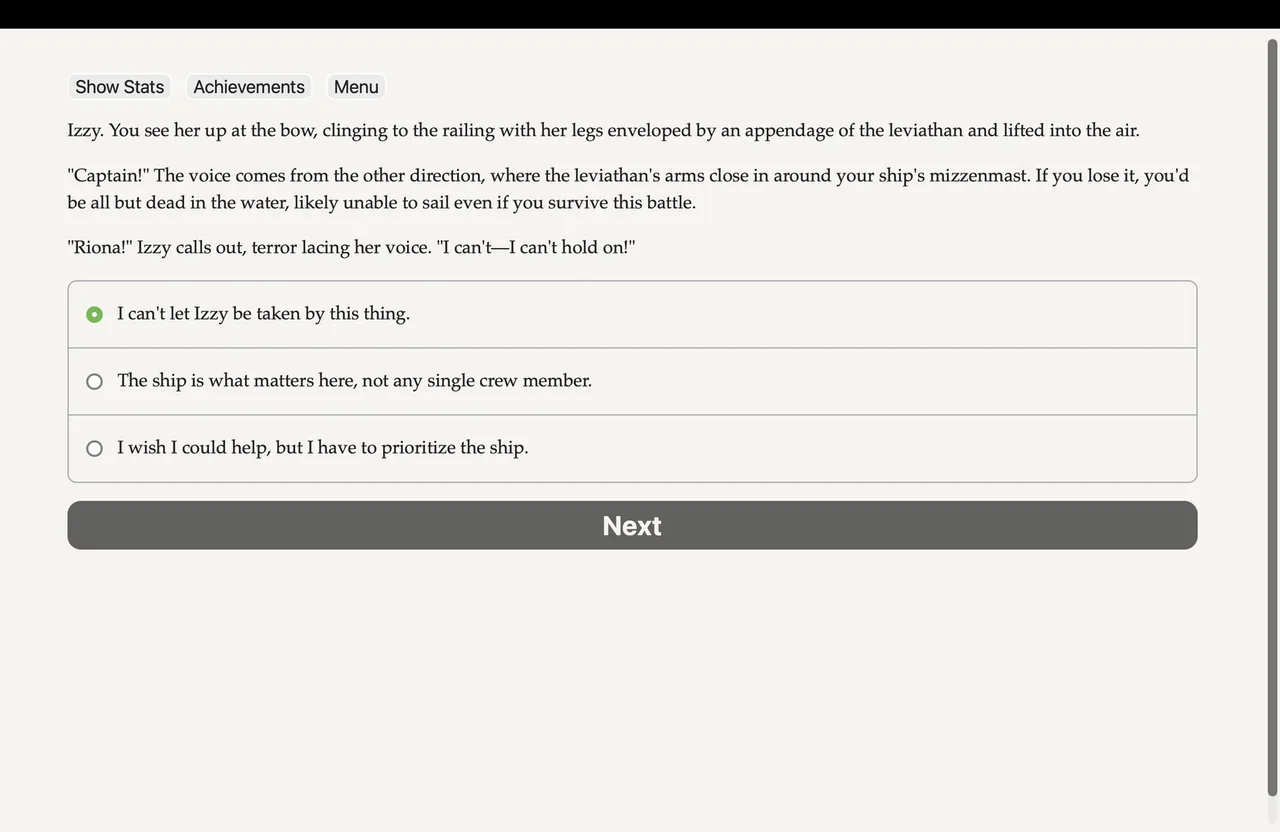
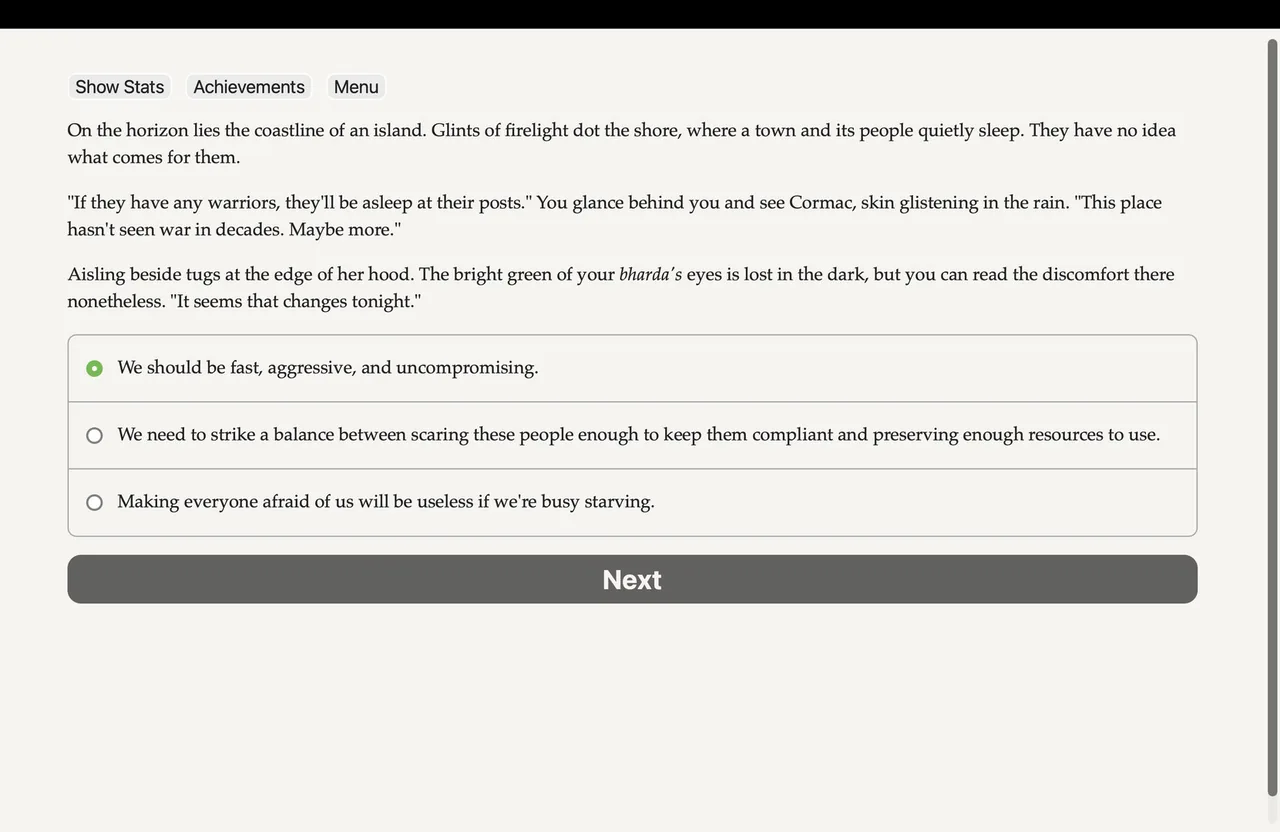
Diaspora's Steam page says, without hedging, that it is "entirely text-based, without graphics or sound effects, and fueled by the vast, unstoppable power of your imagination." That's an unusually honest piece of expectation-setting for a storefront — no screenshots dressed up to suggest more than there is, no ambiguity about what a buyer is getting. It's also the reason this review has to be built almost entirely out of documented facts rather than a verdict on how the writing actually reads, because the game is one day old and nobody outside its beta-testing circle has had the chance to form one yet.
What it is
You lead the survivors of Clan Maghnus, driven from their homeland by war, on a sea voyage south to a coastline your vanished father once explored. A regional empire controls the nearest city; the raiders who used to prey alongside your own people now want it back. From there the choices fan out: seal an alliance with the empire or throw in with the raiders, hunt down an ancient artifact, fight a sea monster, sail into a storm chasing old magic, and decide — repeatedly, across a game Hosted Games bills at roughly one million words — whether your clan holds its traditions or reinvents itself. Character creation lets you play male, female or nonbinary, and romance across gay, straight, bi or asexual options, stated plainly on the store page rather than tucked into a wiki somewhere.
That word count is worth one honest caveat, general to the format rather than specific to this game: ChoiceScript totals like this almost always sum every branch together, not what one playthrough delivers. Expect a fraction of a million words in any single read. Even discounted heavily, that's still likely to be one of the longer text games this site has covered.
Nine years in public, and what that's actually worth
The clearest fact available about Diaspora isn't in its Steam listing — it's on the Choice of Games forum, where the work-in-progress thread opened 18 May 2017 and ran, with updates, until a "first draft complete" post in February 2024. That's most of a decade of visible, chapter-by- chapter development in front of an audience that could and did comment on it. The commentary that survives is specific rather than generic: readers praised the pacing of the early demo and said it drew them in "a way not many other WIPs here on the site have managed," and there was real enthusiasm for the game's central provocation — playing a raiding culture sympathetically rather than as an obvious villain faction. There were also complaints typical of any long-running WIP: typos, and broken links at chapter transitions during the beta build. Whether either persisted into the finished Steam release is not something available right now confirms one way or the other.
Nine years of public writing is real evidence of commitment. It is not, on its own, evidence of quality — plenty of long-gestating passion projects ship rough, and plenty ship exactly as good as their fans hoped. What tips this from "unknown quantity" toward "reasonable bet" is the second writer's résumé.
The one piece of real pedigree
Diaspora has two credited authors, Vincent Cunningham and JJ Laurier. Nothing independently verifiable turned up for Cunningham beyond this release. Laurier, however, shipped a previous Hosted Games title on Steam: Fields of Asphodel, a 1.3-million-word interactive novel about an arranged marriage to the God of the Dead. Checked directly against Steam's review API, it holds 66 positive reviews against 11 negative — 85.7%, a genuine Very Positive rating, on a comparably enormous word count and the same self-publishing imprint Diaspora ships under.
That matters more than it might sound like, because it's the only piece of this review that isn't either marketing copy or unmoderated forum enthusiasm. One half of the writing team has already proven they can finish a game this size and have it land well with real Steam buyers. It doesn't guarantee Diaspora repeats that — co-authored projects don't always share credit for quality evenly — but it's a materially stronger starting point than a debut team with no shipped track record at all.
The imprint distinction worth knowing
Hosted Games is Choice of Games' revenue-share label for community-submitted ChoiceScript titles, distinct from Choice of Games' own in-house line. Both use the same engine and reach the same storefronts, but Hosted Games titles don't carry the same in-house editorial process as a mainline CoG release. That's not a knock on any individual game — Fields of Asphodel's reception shows the imprint can produce genuinely well-liked work — but it's a fact worth stating plainly rather than assuming away, especially for readers unfamiliar with how this corner of the interactive-fiction market is structured.
What the achievement list implies
With no reviews to draw on, Steam's sixteen achievement names are the best available hint at Diaspora's actual branching. Pairs like sideiskendi / sideempire and spareelif / killelif point at a real faction choice and at least one character whose fate depends on your decisions. Shaman, ward and valravn suggest more than one route through the magic system rather than a single scripted path. Mercy, duty, withguile, burnitdown, duel and commander read like distinct approaches to the same late-game conflict rather than padding. All sixteen currently sit at 0% global completion, which only confirms the obvious: this is launch-day data, not a shape of how players are actually finishing the game.
Monetisation
This part is fully settled and it's good news. A single upfront price, no DLC, no in-app purchase category, no premium currency anywhere on the listing. The introductory price is NZ$12.56 (33% off NZ$18.75) through 13 August 2026, after which it reverts to full price. That sits above what most Hosted Games titles ask on mobile storefronts, which typically run a few dollars — a fair reading is that the price is tracking the claimed word count and the standalone PC positioning rather than signalling anything about quality either way.
The part nobody can verify yet
Stated as plainly as the rest of this review: at time of writing, Diaspora has no Steam user reviews, no critic coverage, and no post-launch data of any kind beyond a flat achievement curve that simply reflects a one-day-old game. Nothing available contradicts the WIP-era praise or Laurier's prior track record. Nothing outside those two things confirms the final release plays as well as either would suggest. A reader checking back in a few weeks will have a far more reliable picture than this one.
Final verdict
Diaspora earns a 7.0 on the strength of what's actually checkable: a co-writer with a verified Very Positive Hosted Games release behind her, nine years of specifically-praised public development rather than a game that appeared from nowhere, and a story structure — political sides, spareable characters, multiple magic paths — that the achievement list backs up as more than marketing language. It's honestly billed, single-price, and squarely aimed at readers who already know they like choice-based interactive fiction.
It doesn't score higher because there is, right now, no independent confirmation of any of it. No Steam reviews exist to say whether the prose holds up across a million words, whether the WIP-era bugs got fixed, or whether the ending you're steered toward feels earned. If you already read Choice of Games and Hosted Games regularly, this is a reasonable buy at the introductory discount on pedigree alone. If you don't, there's no cost to waiting a few weeks for a real review sample to exist before spending on a story this long from a team that's two-thirds unproven.
Price and monetisation checked 7 August 2026.
Pros and cons
Pros
- Co-writer JJ Laurier's previous Hosted Games title, Fields of Asphodel, holds a verified Very Positive rating (66 of 77 Steam reviews, 85.7%) on the same imprint and a comparably huge word count
- Sixteen Steam achievements point at real structural branching — separate paths for siding with the empire or the raiders, sparing or killing a named character, at least two distinct magic routes (shaman, ward, valravn)
- Nine years of public work-in-progress chapters drew specifically positive forum feedback on pacing and prose before this release, not just enthusiasm for the premise
- A single upfront price with no DLC, no in-app purchase category and no premium currency anywhere on the storefront listing
- Character creation covers male, female or nonbinary protagonists and gay, straight, bi or asexual romance options, stated plainly on the store page rather than buried in a wiki
Cons
- Zero Steam user reviews and no critic scores exist at time of writing, so bugs, pacing problems and ending quality are all currently unverifiable
- Hosted Games is Choice of Games' self-published, revenue-share imprint rather than its in-house editorial line, which is a real quality-control difference worth knowing before treating this as a curated CoG release
- English only — no other language support is listed, which narrows the audience for a million-word-scale reading commitment
- Early work-in-progress feedback flagged typos and broken chapter-transition links during development; whether those were resolved before this release isn't something the storefront or a review sample currently confirms
- Entirely text-based with no graphics or audio, which the store page states upfront but is still worth spelling out for readers coming from Wanderer's usual gathering-and-combat RPG beat
Screenshots
-
DiasporaImage: Hosted Games via Steam -
DiasporaImage: Hosted Games via Steam -
DiasporaImage: Hosted Games via Steam -
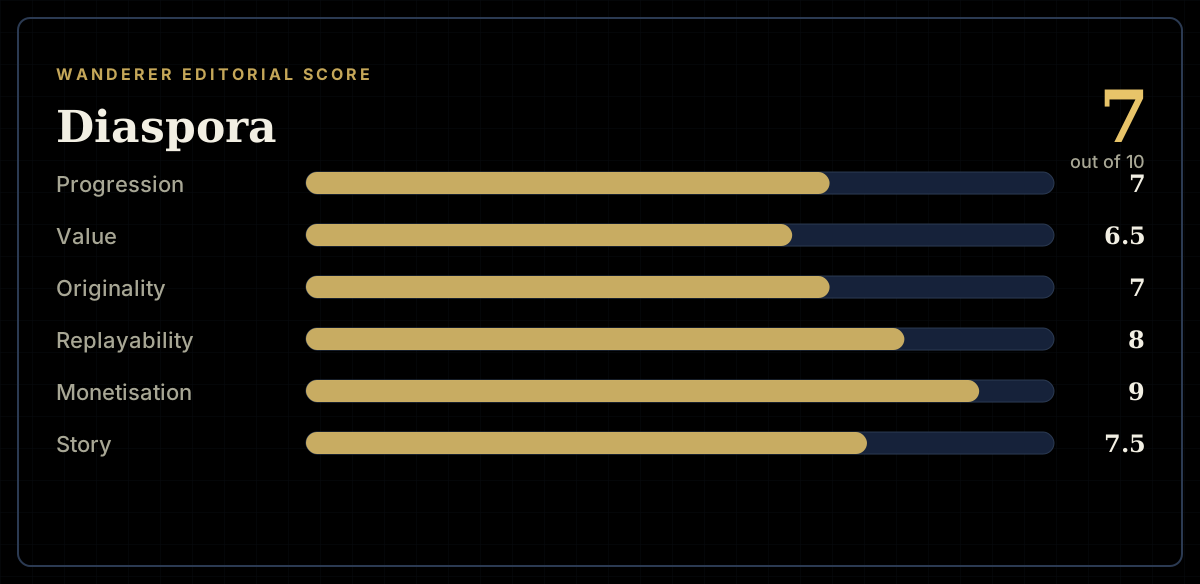
How the review scores each part of the gameWanderer Editorial -
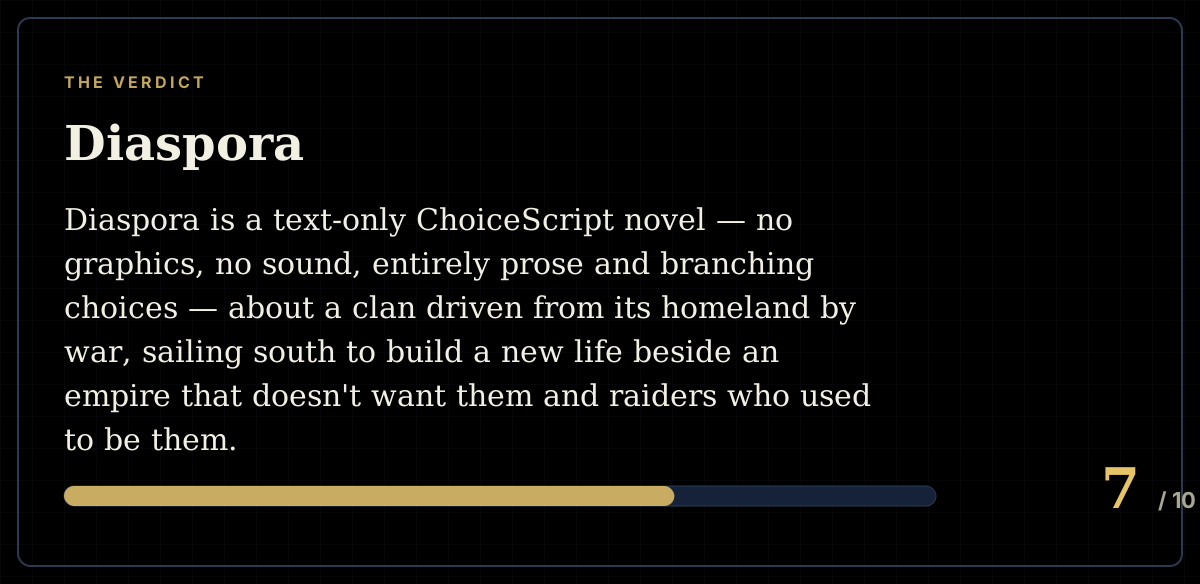
The short versionWanderer Editorial