Game review
Delos: Space Traffic Control
5 / 10
- Developer
- hv
- Publisher
- hv
- Released
- 7 April 2025
- Platforms
- Windows
- Genre
- Simulation, Space Sim, Strategy
- Monetisation
- One-time purchase. No DLC, no in-game purchases.
- Players
- Single-player. The station has a global text chat and a persistent leaderboard for longest-running stations, but only one person ever controls any given station.
The short version
Delos puts you alone in a comms chair above a small station orbiting Mars, granting docking and takeoff requests through two jump gates, assigning ships to a left or right berth, and keeping a resources bar and a credits bar from hitting zero while a third strike ends the run. That premise is a genuine real-time management sim — Steam's own vote-weighted tags rank it **Simulation (69 votes)**, **Space Sim (62)** and **Strategy (59)** at the top, with **Incremental** sitting eighth of twelve at 33 votes and **Clicker** nowhere on the list at all. Whatever an aggregator has filed it under, its own players didn't vote it that way.
What they did vote, at 80% positive, is that the ten or twenty minutes of station-controlling on offer is well made and genuinely atmospheric. What the same corpus keeps saying underneath that score is that ten or twenty minutes is all there is, and has been all there is since the developer's last patch landed eleven days after launch and nothing has shipped since.
Biggest strengths
- A genuinely distinctive real-time premise — granting clearances, assigning berths and juggling two resource meters as a station's sole controller
- Confident sci-fi art direction: a detailed 3D station, moody planetary backdrops and camera work several reviewers call out unprompted
- An atmospheric, well-liked soundtrack with a licensed jukebox track, praised in reviews that otherwise have little else to praise
Biggest weaknesses
- Content ends exactly where the tutorial does — two berths, two ship types, two meters, and nothing new after that
- No update of any kind since 18 April 2025, and reviewers logging in as recently as mid-2026 report the identical build
- Never labelled Early Access despite reviewers repeatedly saying it should have been, and several calling it abandonware outright
Who it's for: Anyone curious what a tightly-scoped, single-sitting take on air-traffic-control-style station management looks like, and willing to treat NZ$4.49 as the price of a short, attractive proof of concept rather than a full game.
Our recommendation: Buy it for one evening if the premise appeals and the price feels disposable — several of its own critics say it's worth that much. Don't buy it expecting the game to grow; nothing has been added in well over a year, and the developer's own update history shows the project stopped, not paused.
5 / 10
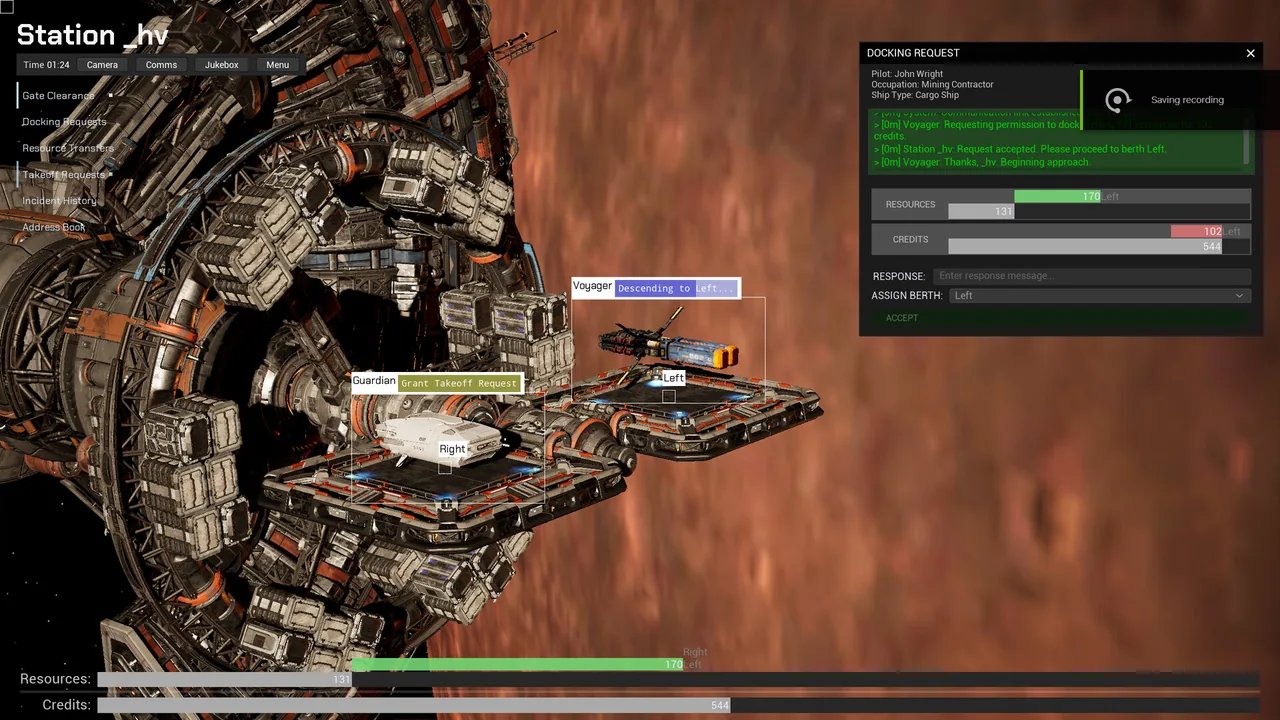
The fifth of Delos's five official screenshots shows a station's docking rig lit up against a Mars-red horizon, a cargo hauler easing toward a berth marked "Right" while a comms panel logs the handshake in real time. It looks, for all the world, like the opening frame of a much bigger game — the kind of confident sci-fi art direction that makes you want to know what happens next. The honest answer, fifteen months after that screenshot was taken, is nothing. Nothing happened next.
What it actually is
Delos's own short description is unambiguous: you are a space traffic controller, directing docking, allocating resources and preventing collisions "in a real-time strategy setting." That's not marketing gloss — it's exactly what the loop does. Ships announce themselves through two jump gates (one toward Earth, one toward Phobos and a nearby waypoint), and each one is either a supply ship carrying resources or a commercial ship carrying credits. You accept or decline docking requests, assign the ship to your station's left or right berth, authorise resource or credit transfers once it's docked, and eventually grant its takeoff request so the next arrival has somewhere to land. Get it wrong — send a ship to the gate it didn't ask for, let a transfer run out of credits mid-exchange, let two ships collide at the same berth — and it logs an incident. Three incidents end the run, with a summary screen showing how many ships you serviced and how long your station stayed open.
That's a real management sim, not an idle one, and Steam's own community agrees. The vote-weighted tags pulled from the store page's tag-modal script — not the ordered pills shown by default, which reflect the developer's own choices — put Simulation on top with 69 votes, then Space Sim (62), Strategy (59), 3D (56) and Sci-fi (53). Incremental does appear, eighth of twelve tags at 33 votes, roughly half of Simulation's total — a real but distinctly minority reading. Clicker isn't among the twelve tags at all. Whatever an aggregator's automated genre pass decided, the people who actually played it voted for a traffic-control sim first and an incremental game a distant way down the list. It belongs in the same conversation as this library's automation and logistics reviews — Factorio, Satisfactory, Dyson Sphere Program — though its scope sits at the opposite end of that spectrum: a single station, two berths, one sitting.
Everyone plays it for about the same length of time
The usual way to read a small review corpus is to compare the playtime of its critics against its fans — a long-playtime negative usually means a real wall somewhere in the mid-game, while a short-playtime one usually means an onboarding problem. Delos doesn't split that way. Its eleven negative reviews have a median playtime of 24 minutes; its forty-five positive reviews have a median of 55 minutes. Both numbers are tiny, and neither group is meaningfully more invested than the other — a handful of positive reviewers logged serious hours (604 minutes, 2,039 minutes), but they're outliers pulling up an otherwise short list, not evidence of deep systems underneath. Nobody in this corpus, happy or unhappy, played very much of this game, because there isn't very much of it to play.
What separates the two groups isn't time spent, it's what they expected going in. The positive reviews read like proof-of-concept endorsements: "I think id call this a vibe simulator or a proof of concept more than anything else right now but it absolutely nails it," one writes, adding that it's "100% worth the $3 they are selling it for" purely on the strength of what's there. The negative reviews describe the identical handful of systems and conclude the opposite. "Play the tutorial and you've played the entire game," one puts it, going on to note the loop is just two ship types and two meters to juggle. Another, from more than a year after launch: "So uh, I have done everything there is to do." Same station, same twenty minutes, opposite verdicts — because one group is grading a demo and the other is grading a finished product, and the store page never settles which one it is.
Eleven days, then silence
Delos's own news feed makes the case better than any review does. Between 24 March and 7 April 2025 — launch day — the developer posted daily patches: crash fixes, a settings menu, ship collision handling, an incident and game-over system, a jukebox with licensed music, chat notifications and a leaderboard congratulating the top players by name. The pace continued for eleven days after launch: new destinations, a redesigned tutorial and camera system, berth-specific panels, and — on 18 April 2025 — ship thruster sound and visual effects, the seventeenth and, to date, final post on the page. Nothing has been posted since.
That gap is now well over fifteen months long, and the negative-review corpus dates it independently and repeatedly. "Abandoned in barebones state by the developer shortly after launch that should have been labeled Early Access. No updates a year since," reads one. "Non stop updates at the start of the year, to absolute crickets. This has gone nowhere," reads another. A third, from mid-2026: "No new updates in over a year. Currently there is no game to play, just an idea of a game." The complaint isn't that the game is bad — it's that a project which looked, for eleven days, like it was building toward something, simply stopped, at a price and under a genre label that gives buyers no warning of that.
What the eleven days actually built
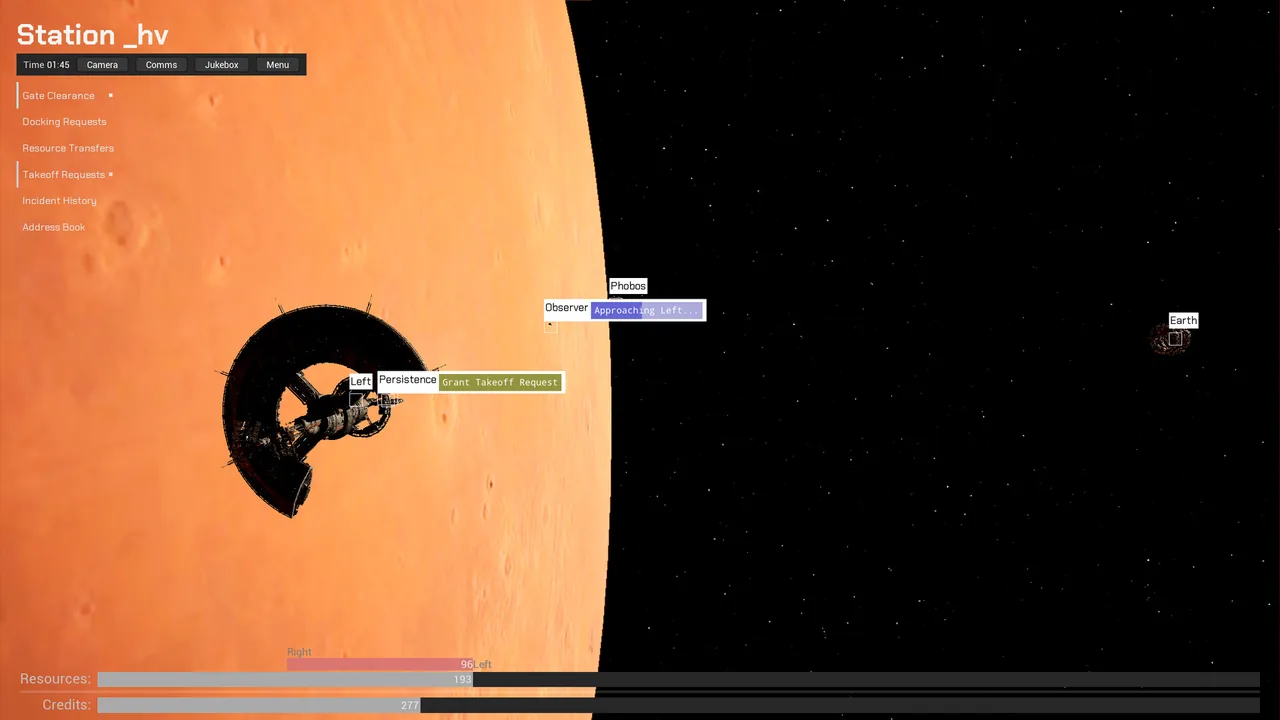
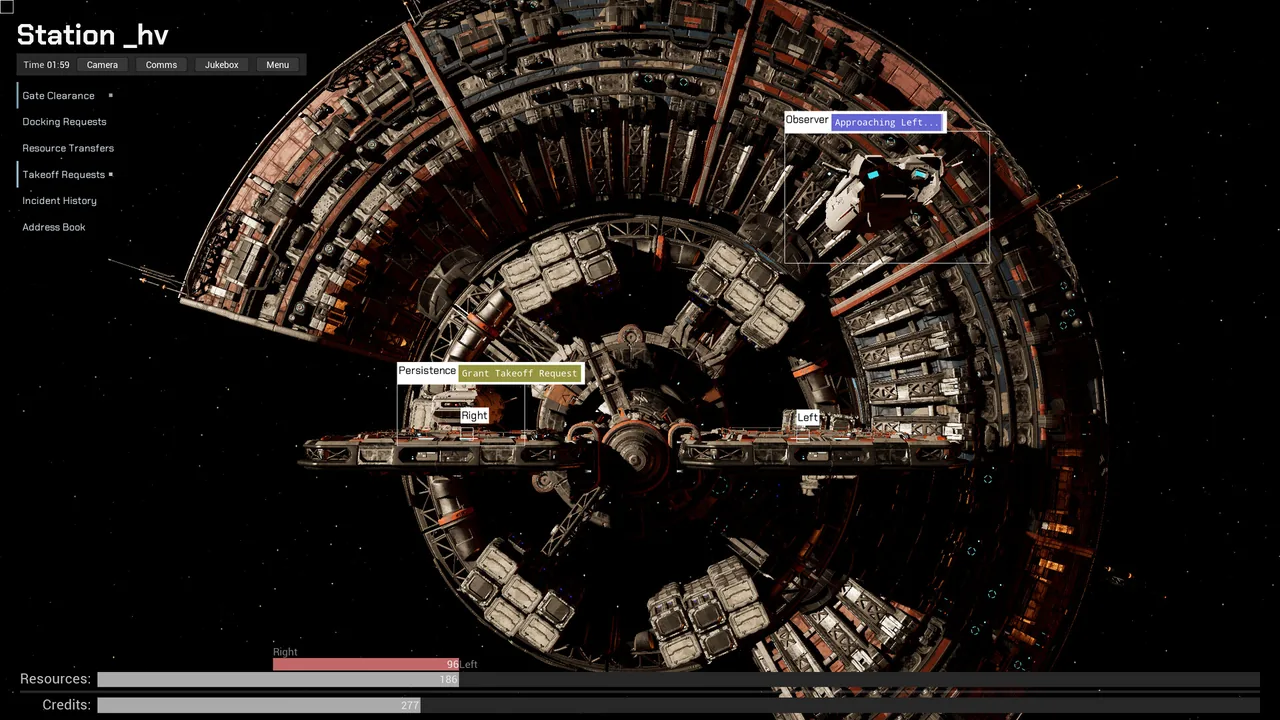
It would be unfair to let the abandonment story crowd out what those eleven days produced, because it's genuinely well-crafted. The station itself is a detailed 3D model — docking rings, cargo containers, thruster glow — shot against planetary backdrops that shift as you switch camera views between gate, berth and station-wide angles. The comms system layers docking requests, incident logs and a scrolling green terminal chat over the 3D view convincingly, and the ambient soundtrack draws specific, unprompted praise across multiple reviews: "nice visuals and great spacey soundtrack sets the vibe," reads one; another calls it "dripping with sci fi styling." A licensed jukebox track from the artist State Azure was added in one of the final updates, alongside separate volume sliders for music, SFX and UI — a small but real accessibility touch most games this size skip entirely.
The interface holds up reasonably well for a station handling two ships at once, which is most of what the current build asks of it. It starts to strain exactly where you'd expect: the docking-request panel in the game's own promotional screenshots sits directly on top of an approaching ship's status chip, and a busier station would stack these further. It's a legitimate readability concern, but it's one the negative-review corpus barely gets to raise, because most of its authors never found the station busy enough to trigger it — they ran out of new things to do first.
Final verdict
Delos earns a 5. The eleven days of development visible in its news feed show a developer with real instincts for atmosphere, interface and a distinctive premise — and 80.4% of the people who bought it agree, for as long as it takes to see everything there is to see, which is not long. It doesn't score higher because "not long" is the whole review: there's no progression to chase, no unlock structure, no second system layered under the first once you understand it, and no sign the developer intends to add one. A game with this little content, sold without an Early Access label and unsupported for over a year, is asking to be judged as a finished product even though its own most engaged players keep describing it as a demo.
Buy it if a tightly-scoped, single-sitting take on space traffic control sounds like a fair trade for NZ$4.49 — several of its harshest critics say exactly that before listing everything wrong with it. Skip it if you want the "vibe simulator" its own fans call it to become the deeper economic sim its early patch notes hinted at; nothing in the last fifteen months suggests that's coming.
Pros and cons
Pros
- A genuinely distinctive real-time premise — granting clearances, assigning berths and juggling two resource meters as a station's sole controller
- Confident sci-fi art direction: a detailed 3D station, moody planetary backdrops and camera work several reviewers call out unprompted
- An atmospheric, well-liked soundtrack with a licensed jukebox track, praised in reviews that otherwise have little else to praise
- Cheap enough at NZ$4.49 that even reviewers calling it unfinished still call it fair value for what exists
- Eleven days of near-daily, responsive patches at launch show real design instincts when the developer was actively working on it
Cons
- Content ends exactly where the tutorial does — two berths, two ship types, two meters, and nothing new after that
- No update of any kind since 18 April 2025, and reviewers logging in as recently as mid-2026 report the identical build
- Never labelled Early Access despite reviewers repeatedly saying it should have been, and several calling it abandonware outright
- No progression, no achievements and no unlock structure once the loop is understood, which takes a handful of minutes
- Multiple floating comms panels can stack directly on top of each other during a busy stretch, exactly when clarity matters most
Screenshots
-
Delos: Space Traffic ControlImage: hv via Steam -
Delos: Space Traffic ControlImage: hv via Steam -
Delos: Space Traffic ControlImage: hv via Steam -
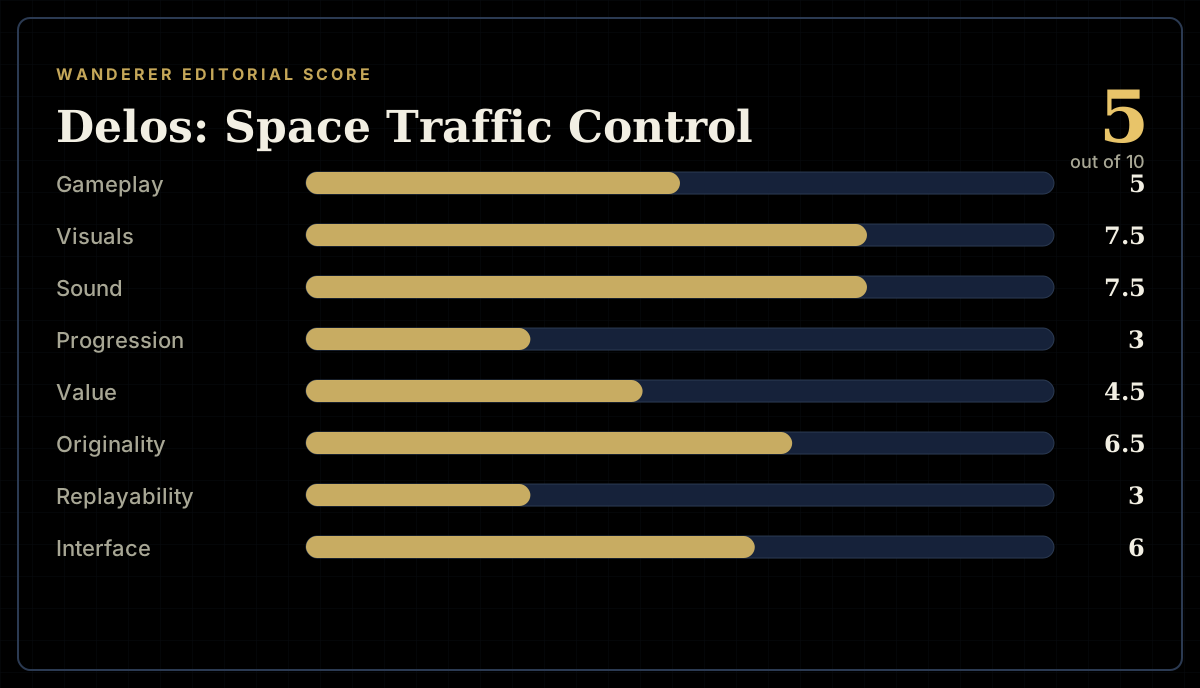
How the review scores each part of the gameWanderer Editorial -
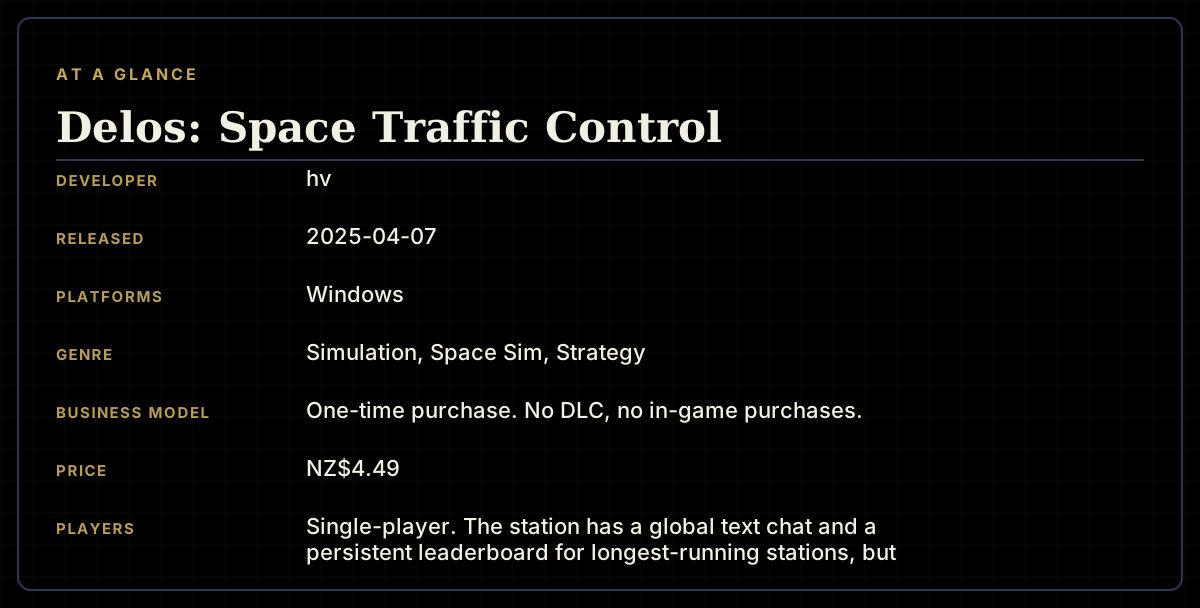
The facts at a glanceWanderer Editorial -
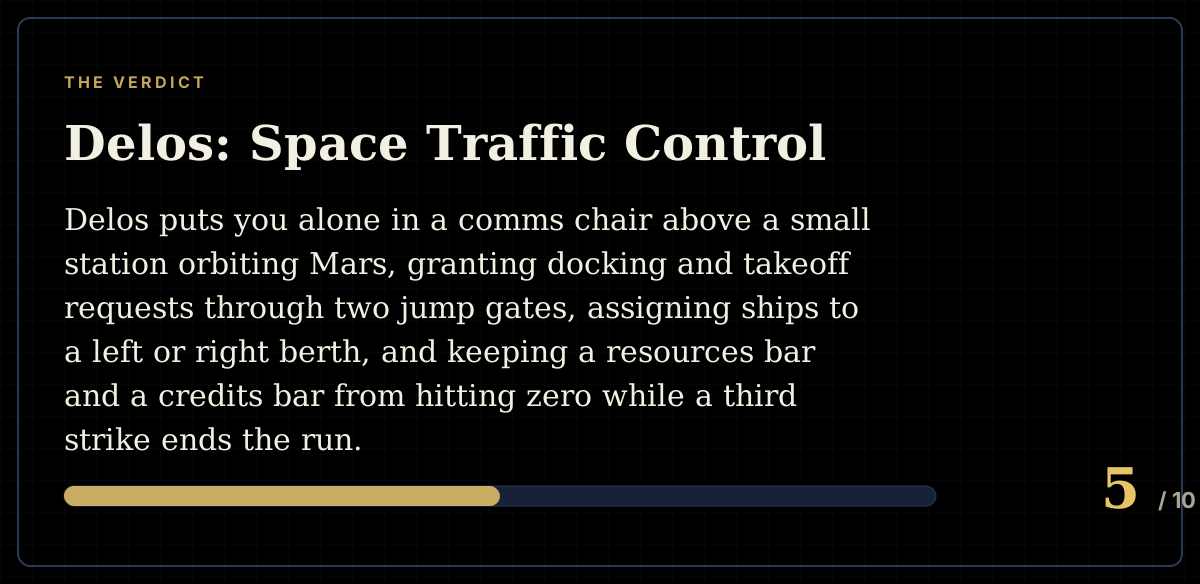
The short versionWanderer Editorial