
Game review
Creatures of Ava
6 / 10
- Developer
- Inverge Studios
- Publisher
- 11 bit studios
- Released
- 7 August 2024
- Platforms
- Windows, Steam Deck
- Genre
- Non-violent creature-collector action-adventure
- Monetisation
- One-time purchase, no in-game store or additional currency purchases
- Players
- Single-player only
The short version
Creatures of Ava casts you as Vic, a researcher arriving on a dying planet to save its inhabitants from a spreading blight called the Withering — not by fighting them, but by learning their songs, earning their trust, and guiding them to safety. This review's sample responds to that premise with genuine warmth, several reviewers describing real emotional attachment to the game's creature cast and praising its rare commitment to a non-violent core loop. What tempers that affection, repeated across a large portion of the sample, is a specific structural complaint: the moment-to-moment gameplay of chasing a creature, mimicking its call, and using its ability to solve an environmental puzzle is widely described as shallow and repetitive once its novelty wears off, compounded by a concrete design flaw where creatures sent away from a completed zone cannot be retrieved later.
Biggest strengths
- The creature designs, world-building, and overall art direction draw near-universal, heartfelt praise, with multiple reviewers describing genuine emotional attachment to specific creatures and real sadness at finishing the game
- The commitment to non-violent gameplay is credited by many reviewers as a genuinely rare and welcome design choice within the broader creature-collector genre, several explicitly seeking the game out for that reason alone
- Family and co-viewing play is specifically praised by multiple reviewers, including parents describing repeated playthroughs enjoyed together with children
Biggest weaknesses
- A large portion of this review's sample describes the core gameplay loop — chase a creature, mimic its song, use its ability to solve a puzzle — as becoming repetitive and mechanically shallow once the initial novelty fades, with several reviewers explicitly wishing for a middle "mixed" review option
- A specific, concrete design flaw is repeatedly reported: creatures sent away from a zone once it's been completed cannot be retrieved later, which can accidentally and permanently block full completion or specific achievements if a needed creature or ability was left behind
- Combat, while intentionally non-lethal, is described by multiple reviewers as mechanically thin, largely amounting to holding down a single attack button with occasional dodging, offering little tactical depth even on its own defensive terms
Who it's for: Players specifically seeking a genuinely non-violent creature-collector experience with strong emotional and environmental themes, who prioritize atmosphere and world-building over mechanical depth or combat challenge.
Our recommendation: A beautiful, sincere, and genuinely rare non-violent creature-collector worth playing for its atmosphere and emotional core — just plan your exploration carefully if you intend to fully complete it, since leaving a zone before you're truly done can permanently close off content.
6 / 10
Creatures of Ava asks a genuinely rare question for its genre: what if saving a world's creatures didn't mean fighting them at all? You play Vic, a researcher arriving on the dying planet Ava to rescue its inhabitants from a spreading blight, learning each creature's song and earning its trust rather than capturing it by force. This review's sample responds to that premise with real, sincere warmth — and identifies, with equal consistency, exactly where the game underneath that premise runs thinner than its heart suggests.
A rare commitment that earns real devotion
The non-violent core concept draws deeply personal praise from this review's sample. "Maybe it's just me, but I don't really want to fight or kill things. At least I don't anymore. The world is just too full of violence. I am so happy to have found this game. Welcome to a world where you get to explore, learn, and pet creatures," one reviewer writes. Another describes a rarer kind of endorsement: "I played through the whole game with my daughter and she is constantly asking me to play 'the animal game'. We are now on our second play through and still enjoying this game together." A third reviewer captures a genuinely bittersweet emotional response: "I don't like this game. I don't like games that remind me how easy it is to get attached to characters made out of pixels and voxels. I always end up disappointing myself with that attachment, which slowly grows only to leave me with a huge void in my heart by the end of the g[ame]" — the kind of complaint that's really the highest possible praise.
The repetition complaint that spans both samples
Set against that emotional connection, a large and consistent portion of reviewers — including many who ultimately recommend the game — describe the actual gameplay loop wearing thin. "Personally I found that after a few hours it was getting repetitive -- the central concept is just solve some puzzles using creature abilities and rescue a number of those creatures," one reviewer writes. Another, more pointed: "The gameplay is as bland as can be. Everything about the gameplay is super rote and meaningless! You got a new spell to slow down time on stuff? It is meant to be used against very specific doors that shut down before you can enter." A third reviewer wishes for exactly the kind of nuanced verdict this review aims for: "I wish Steam would have a mix button; it would suit this game. The game itself is beautiful, the creatures are cute, and neat soundtrack; but it feels hollow."
A specific, concrete design flaw worth flagging directly
Beyond general repetitiveness, several reviewers independently identify one specific structural problem serious enough to treat as a distinct concern rather than folding it into the broader critique. "My experience was tainted by the fact you cannot return to an area once you've played through that sect[ion, and creatures you've sent away don't come back]," one reviewer writes. Another explains the practical consequence directly: "There's a mechanic of sending creatures away from an area and once you do, they don't return. The problem arises when you need the creatures to get to certain areas that you didn[n't yet fully explore]." A third reviewer, having attempted full completion, reports the exact failure mode this design creates: "I captured every creature I could, and got all the chimes, statues, censers, and upgrades before leaving an area... That is until I gated myself" out of finishing specific goals by moving forward too early. This is a genuinely actionable warning for anyone planning to pursue full completion — the game's structure can quietly punish natural, curious exploration in a way its cozy tone doesn't prepare you for.
A shallow combat system, on its own terms
Even judged purely as a non-violent alternative to typical genre combat, several reviewers find the defensive systems underdeveloped. "The combat is quite shallow as it comes down to mainly holding left mouse button, occasionally dodging and using spells," one reviewer writes, a fair assessment distinct from any complaint about violence itself — this is a critique of mechanical depth, not tone.
Real, specific technical complaints
A handful of reviewers report concrete technical issues. One writes directly to the developers about a specific Steam Deck limitation: "The largest issue comes with the reduced graphical option settings on the Steam Deck version of the game... it says it's verified," despite offering fewer options than the PC version. Another reports persistent traversal stuttering they attribute to the underlying engine, and a separate reviewer documents a specific achievement-blocking bug tied to a creature with an extremely narrow, easy-to-miss photography window, forcing an unwanted do-over for completionists.
What the achievement data confirms
Steam's own completion figures support the reviewer-described pattern of early enthusiasm giving way to declining engagement. An early photography milestone sits at 67.6%, already suggesting a meaningful drop-off from initial purchase, and full achievement completion collapses to just 1.6% — consistent with reviewer reports that the game's back half, and its optional completionist content specifically, ask for more patience with the repetitive core loop than most players are willing to give, compounded by the reported creature-retrieval design flaw.
A genuinely well-supported, recognized release
Whatever this review's gameplay-depth criticisms, Creatures of Ava has received real critical and developer investment. This review can confirm the game won a Games for Impact award at Gamescom 2024, a genuine industry acknowledgment of its thematic ambitions. Its partner-events feed also documents free post-launch content updates, an official soundtrack release, and continued developer momentum into an already-announced subsequent project, confirming this wasn't a neglected release.
Final verdict
Creatures of Ava succeeds beautifully at what it most wants to be: a genuinely rare, non-violent creature-collector with real emotional weight and gorgeous creature design, earning sincere affection from this review's sample. Its underlying gameplay loop is fairly and consistently described as thinner than its heart, and its creature-retrieval design flaw is a concrete, actionable warning worth heeding before you commit to full completion — but for players specifically seeking its central premise, this remains a worthwhile, sincere recommendation.
Pros and cons
Pros
- The creature designs, world-building, and overall art direction draw near-universal, heartfelt praise, with multiple reviewers describing genuine emotional attachment to specific creatures and real sadness at finishing the game
- The commitment to non-violent gameplay is credited by many reviewers as a genuinely rare and welcome design choice within the broader creature-collector genre, several explicitly seeking the game out for that reason alone
- Family and co-viewing play is specifically praised by multiple reviewers, including parents describing repeated playthroughs enjoyed together with children
- The game received formal recognition, winning a Games for Impact award at Gamescom 2024, a credible signal of broader critical regard beyond this review's own sample
- Steam's own partner-events feed documents genuine post-launch investment, including free content updates adding collectibles and new explorer content, an official soundtrack release, and continued developer momentum into a subsequent project announcement
Cons
- A large portion of this review's sample describes the core gameplay loop — chase a creature, mimic its song, use its ability to solve a puzzle — as becoming repetitive and mechanically shallow once the initial novelty fades, with several reviewers explicitly wishing for a middle "mixed" review option
- A specific, concrete design flaw is repeatedly reported: creatures sent away from a zone once it's been completed cannot be retrieved later, which can accidentally and permanently block full completion or specific achievements if a needed creature or ability was left behind
- Combat, while intentionally non-lethal, is described by multiple reviewers as mechanically thin, largely amounting to holding down a single attack button with occasional dodging, offering little tactical depth even on its own defensive terms
- At least one reviewer documents a specific achievement-blocking bug tied to a creature with only one narrow, missable opportunity to photograph correctly, forcing an unwanted restart to complete full collection goals
- Several reviewers report technical issues including reduced graphics options on the officially Steam Deck-verified version and noticeable traversal stuttering, with at least one attributing the latter to the underlying game engine
Screenshots
-

Creatures of AvaImage: 11 bit studios via Steam -

Creatures of AvaImage: 11 bit studios via Steam -

Creatures of AvaImage: 11 bit studios via Steam -
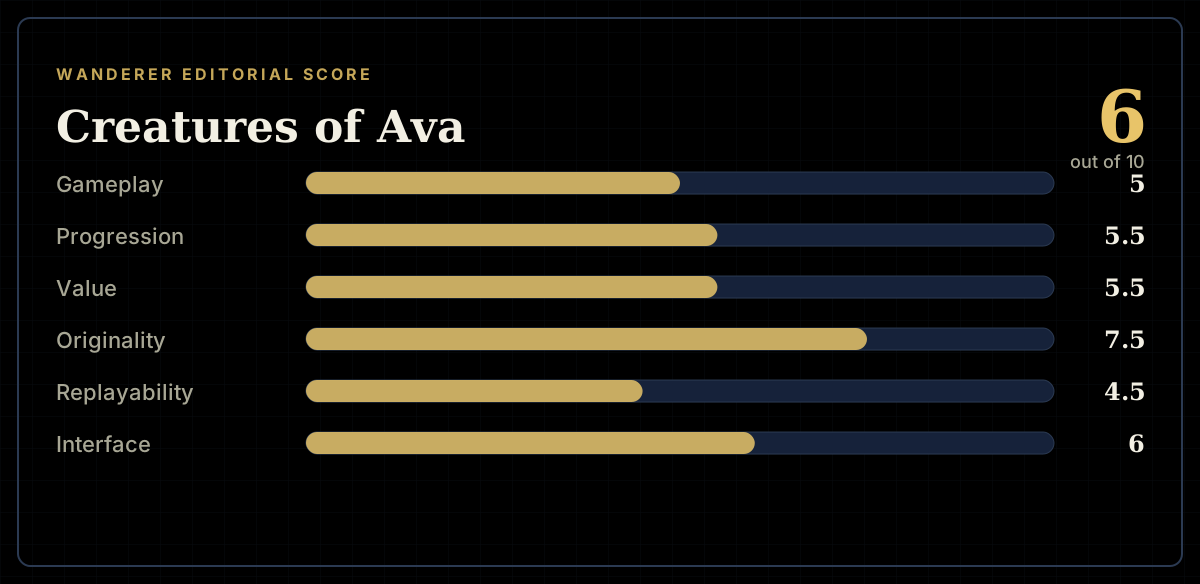
How the review scores each part of the gameWanderer Editorial -
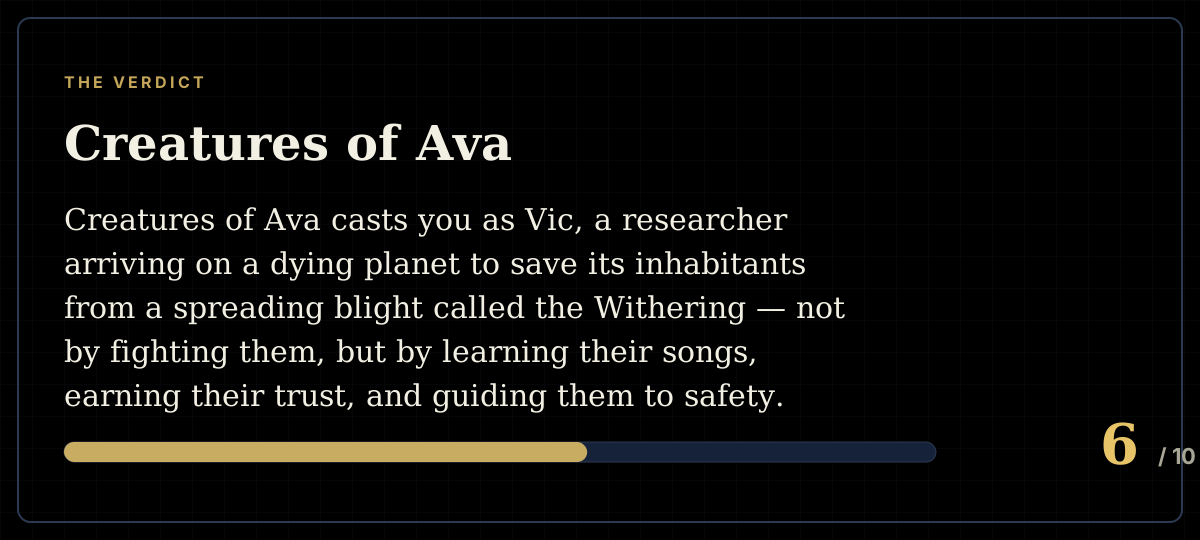
The short versionWanderer Editorial