Game review
Crafting Idle Clicker
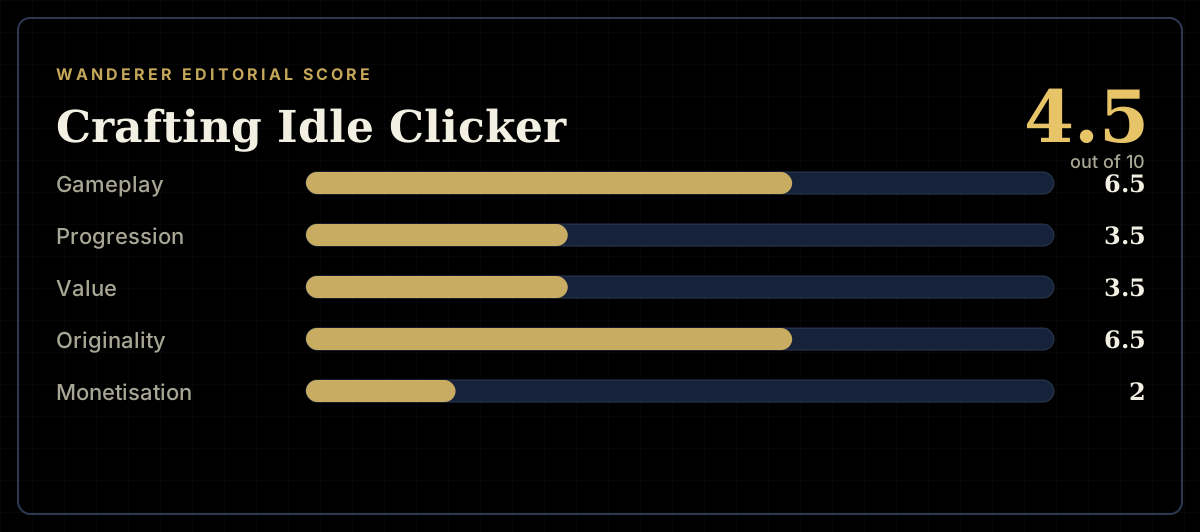
4.5 / 10
- Developer
- Bling Bling Games GmbH
- Publisher
- Bling Bling Games GmbH
- Released
- 4 June 2020
- Platforms
- Windows
- Genre
- Idle Tycoon, Production-Chain Clicker
- Monetisation
- Free-to-play with in-app purchases (diamonds/gems); multiple reviewers describe near-constant monetisation prompts
- Players
- Single-player
The short version
Crafting Idle Clicker asks you to build and optimise a multi-stage production line — raw materials into intermediate goods into finished products — which even its harshest critics describe as genuinely well-designed. That praise is consistently followed by "but": a Mixed 44.8% across 516 reviews, weighed down by monetisation reviewers call relentless (diamonds gate everything from speed-ups to daily rewards) and, more seriously, a documented reliability problem — the game's top-voted review, at 225 votes, describes losing an entire weekend of event progress to a failed save despite manually saving before logging off. This is a mobile port, and several reviewers who enjoyed the original Android version say the Steam release feels more aggressively monetised than the one they remember, not less.
Biggest strengths
- The core crafting-chain system — raw materials refined through multiple tiers into sellable finished goods — draws specific, detailed praise even from the game's harshest critics, including the top-voted negative review itself
- Real depth for players willing to engage with it: positive reviewers with 494 and 1,733 hours logged describe genuine strategic complexity in production-line optimisation that keeps them coming back
- Free to install, and reviewers who treat the microtransactions as skippable rather than mandatory report a legitimately playable, if slower, experience
Biggest weaknesses
- The single most-upvoted review in the entire corpus (225 votes) reports a serious reliability problem: an entire weekend's worth of event progress lost to a failed save, despite manually saving before logging off — a materially different, more serious complaint than typical free-to-play friction
- Monetisation is described as constant and aggressive across dozens of independent reviewers — "Hey! Wanna buy gems?" prompts, daily rewards gated behind paid currency, and progress that reviewers say slows to a crawl without spending
- A specific, disruptive mechanic draws repeated complaint: the game's active-play window reportedly closes automatically every 30-60 seconds, which reviewers say actively interrupts hands-on play rather than just nudging players toward idling
Who it's for: Players specifically drawn to deep, multi-tier crafting-chain optimisation who can tolerate, or actively ignore, constant monetisation prompts — several long-playtime positive reviewers describe exactly that trade-off and say it's worth making. A poor fit for anyone who wants a relaxed, low-friction idle experience, or who needs to trust that logged-in progress will actually be there the next day.
Our recommendation: Approach cautiously, and save obsessively regardless of what the game tells you. The crafting system underneath is real and reviewers who push past the monetisation friction find genuine depth, but the save-reliability complaint from the game's most-upvoted review is serious enough that this shouldn't be anyone's only outlet for meaningful time invested.
4.5 / 10
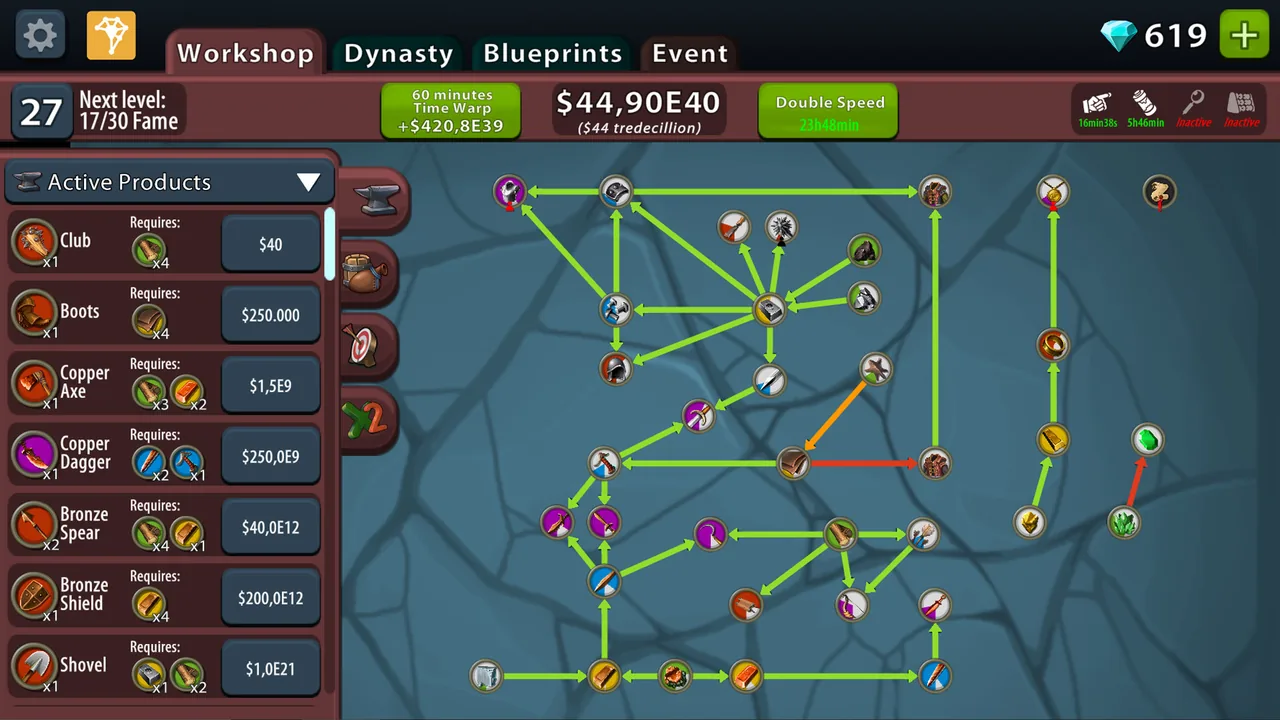
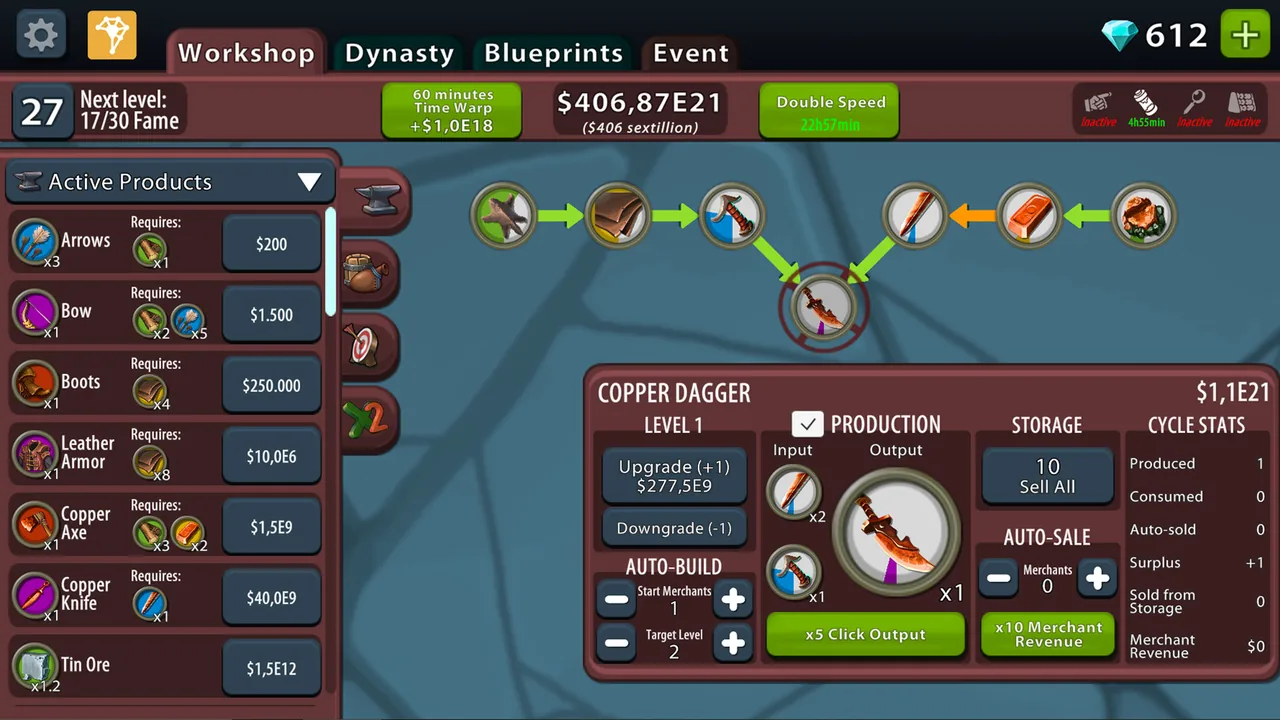
Crafting Idle Clicker's pitch is more structurally interesting than most of the genre: instead of a flat upgrade tree, you build an actual production chain — mine or gather raw materials, refine them into intermediate goods, refine those again into finished products worth selling, each tier its own small optimisation puzzle. It's a mobile game brought to Steam on 4 June 2020, free to play with in-app purchases, and 516 reviews later it sits at a Mixed 44.8%. Read the corpus and a pattern emerges fast: reviewers agree the crafting system is genuinely good, and disagree sharply about everything built around it.
Even the harshest review starts with praise
The single most-upvoted review in the entire corpus — 225 votes, more than double the runner-up — opens by calling it "an interesting game with a well-planned system of crafting," and means it. That's not an isolated compliment: positive reviewers with 494 and 1,733 hours logged independently describe real, sustained strategic depth in optimising the production chain, the kind of praise that's hard to fake across reviewers who don't know each other. If Crafting Idle Clicker were judged purely on its central mechanic, this would be a strong recommendation.
Where it falls apart: monetisation, and something worse
It isn't judged purely on its central mechanic, because the same reviewers who praise the crafting system spend the rest of their reviews describing what surrounds it. "Hey! Wanna buy gems? Hey! Wanna buy gems?" reads one 17-vote negative, mimicking the game's own prompts. "The monetisation is way too aggressive for a non-competitive F2P game; it's always right in your face, begging you, pestering you, pleading with you," reads another, at 95 votes. Daily rewards, normally a free-to-play genre's one guaranteed generosity, are reported as gated behind paid currency by multiple independent reviewers. A specific, disruptive mechanic recurs too: several reviewers describe the game's active-play window auto-closing every 30 to 60 seconds, which they say actively interrupts hands-on engagement rather than simply nudging players toward idling — a strange design choice for a game whose whole genre is built around letting players choose their own level of engagement.
More serious than any of that is what the top-voted review actually gives as its reason for stopping: "the game is not very reliable about saving your progress. I quit after I spent all weekend working on an event to earn the event rewards, only to log in on Monday and find out that the game had not recorded any of it and I had wasted my entire weekend (and yes, I had manually saved prior to logging off)." That's not a monetisation complaint or a design disagreement — it's a specific, credible report of a save-reliability failure costing a player real, invested time, and it's the review the community found most worth reading before buying.
A mobile game that reviewers say got worse on the way over
A recurring thread worth naming specifically: reviewers who played the original Android version before trying the Steam release describe the port as feeling more aggressively monetised than the game they remembered, not less. One points to a structural reason why: mobile versions of games like this commonly offer rewarded-video-ad options as a free path to premium currency, and Steam has no equivalent, so the same monetisation design that was tolerable alongside a free ad-watching option "makes it look like a giant micro transaction wall" once that option disappears. It's a specific, plausible mechanism for why a genuinely liked mobile game can arrive on Steam feeling meaningfully worse.
Final verdict
Crafting Idle Clicker has a real idea at its core, and reviewers across the spectrum agree on that much — the multi-tier production chain is more thoughtfully built than most of this genre bothers with. But it's wrapped in monetisation that a large, consistent share of its own players call excessive, missing the free-currency paths its mobile version apparently had, and carrying at least one serious, specific report of losing real progress to an unreliable save system. The crafting system earns the benefit of the doubt; nothing else here quite does.
Pros and cons
Pros
- The core crafting-chain system — raw materials refined through multiple tiers into sellable finished goods — draws specific, detailed praise even from the game's harshest critics, including the top-voted negative review itself
- Real depth for players willing to engage with it: positive reviewers with 494 and 1,733 hours logged describe genuine strategic complexity in production-line optimisation that keeps them coming back
- Free to install, and reviewers who treat the microtransactions as skippable rather than mandatory report a legitimately playable, if slower, experience
- Steam Achievements, Trading Cards and Leaderboards give the game structure beyond pure idle number-watching
Cons
- The single most-upvoted review in the entire corpus (225 votes) reports a serious reliability problem: an entire weekend's worth of event progress lost to a failed save, despite manually saving before logging off — a materially different, more serious complaint than typical free-to-play friction
- Monetisation is described as constant and aggressive across dozens of independent reviewers — "Hey! Wanna buy gems?" prompts, daily rewards gated behind paid currency, and progress that reviewers say slows to a crawl without spending
- A specific, disruptive mechanic draws repeated complaint: the game's active-play window reportedly closes automatically every 30-60 seconds, which reviewers say actively interrupts hands-on play rather than just nudging players toward idling
- Reviewers who played the original mobile version specifically say the Steam port feels more aggressively monetised than the Android release they remember, with one noting Steam's lack of rewarded-ad options (common on mobile) removes a free path to currency that the original platform offered
- Recent English-language sentiment (45 of the last 100 reviews positive) sits close to the 44.8% lifetime figure, showing the reception has settled rather than recovered — these aren't teething problems from a rough launch
Screenshots
-
Crafting Idle ClickerImage: Bling Bling Games GmbH via Steam -
Crafting Idle ClickerImage: Bling Bling Games GmbH via Steam -
Crafting Idle ClickerImage: Bling Bling Games GmbH via Steam -
How the review scores each part of the gameWanderer Editorial -
The short versionWanderer Editorial