Game review
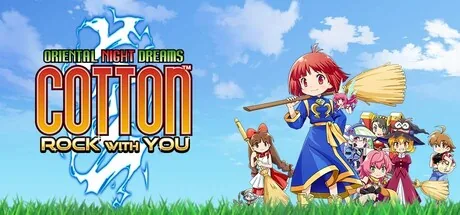
COTTOn RockWithYou -ORIENTAL NIGHT DREAMS-
7.5 / 10
- Developer
- Studio Saizensen
- Publisher
- SUCCESS Corp.
- Released
- 5 August 2026
- Platforms
- Windows, PlayStation 5, Nintendo Switch 2
- Genre
- Shoot 'Em Up
- Monetisation
- One-time purchase. No DLC and no in-app purchase category listed on the storefront; the only add-on offer is a bundle with the previous game, not extra content for this one.
- Players
- Single-player only, per Steam's own category listing
The short version
COTTOn RockWithYou -ORIENTAL NIGHT DREAMS- is the sixth mainline entry in a cute-em-up series that started in 1991, built by the same Studio Saizensen team whose 2021 predecessor, Cotton Rock'n'Roll: Superlative Night Dreams, landed at a solid 78-80 on Metacritic. This entry trades the series' usual fairytale kingdom for a torii-gates-and-lantern Japan setting, and its headline feature is a ten-pilot roster where several ships aren't just reskins but entire borrowed mechanics — one grazes bullets Psyvariar-style to power up, one fishes enemies out of the sky Umihara Kawase-style, one runs on ZANFINE's time system.
That's a genuinely unusual design bet for a shmup, and the pedigree behind it is real. What isn't real yet is a review corpus: the game is two days old on Steam with a small handful of user reviews and no critic scores, so there's nothing here beyond documented design and franchise history to weigh it against. Score this as a snapshot built on a strong track record, not a verdict on the actual bullet patterns.
Biggest strengths
- Ten playable ships at launch (fifteen once unlocked) with genuinely different mechanical identities, not palette swaps of the same shot pattern
- Borrows specific systems wholesale from Psyvariar, Umihara Kawase and ZANFINE rather than just referencing them cosmetically, which is an unusually generous piece of fan service
- Fully voiced story scenes bracket all sixteen stages, with eight subtitle languages including English, so the presentation budget clearly went beyond the minimum a niche shmup needs
Biggest weaknesses
- Launched with essentially no review corpus (a small handful of Steam user reviews, no critic scores at time of writing), so almost nothing about bugs, difficulty balance or long-term reception is independently verifiable yet
- Full price sits at the higher end for a 2D arcade shoot-'em-up, and the loop-then-choose-route structure after the first clear is a smaller amount of raw content than the ten-ship roster might suggest
- The predecessor's polygonal art direction drew mixed reactions from critics even inside a generally favourable reception, and it's not yet clear how much of that carries into this entry's screenshots
Who it's for: Existing Cotton, Umihara Kawase, Psyvariar or ZANFINE fans, and shoot-'em-up players who want a scoring-focused, character-variety-driven cute-em-up rather than a modern bullet-hell punisher. Less suited to players who want a single, deeply tuned ship to master, or anyone put off by a full-price tag on a genre that's often sold much cheaper.
Our recommendation: Worth watching closely if you liked Cotton Rock'n'Roll or any of the games it borrows characters from — the team's last outing earned its praise honestly. Everyone else should wait a week or two for a real user-review sample to form before paying full price for a niche genre entry with almost no public reception yet.
7.5 / 10
A cute-em-up celebrating a 35th anniversary is, by definition, not trying to reinvent anything. COTTOn RockWithYou -ORIENTAL NIGHT DREAMS- knows exactly what a Cotton game is supposed to be — a candy-colored vertical-scrolling shooter starring a witch chasing a magical treat through a fantasy world, her fairy sidekick Silk in tow — and its one real swing for the fences is deciding that ten different pilots should feel like ten different games glued together, several of them running mechanics lifted wholesale from other cult shoot-'em-ups. That's a distinctive idea for a series this old to still be having. Whether it lands is something almost nobody has had the chance to find out yet.
What Cotton is, and why "35th anniversary" matters here
The Cotton series dates back to 1991's Cotton: Fantastic Night Dreams, and this is its sixth mainline entry. The team making it now — Studio Saizensen, working with original publisher SUCCESS Corp. — is the same one behind 2021's Cotton Rock'n'Roll: Superlative Night Dreams, which marked the series' 30th anniversary and was, by the numbers, the first new mainline Cotton game in over two decades. That game reached Steam in January 2023 after arcade and console releases the year before, and it landed well: 78 on Metacritic for the Switch version, 80 for PlayStation 4, with critics singling out the character roster and gameplay depth as the strongest elements. That's the direct precedent RockWithYou is building on, five years and one anniversary number later, with the same director (Toshinobu Kondo) and producer (Shinya Nagatomo) credited again.
That history is worth stating plainly, because it's the strongest piece of evidence available about a two-day-old game. A studio that has already made one well-received Cotton game, with the same leadership returning, is a meaningfully different proposition from a first attempt at the franchise. It doesn't guarantee this entry is as good — teams stumble on sequels constantly — but it's real signal in a review that otherwise has very little to go on.
The pitch: a roster built from borrowed mechanics
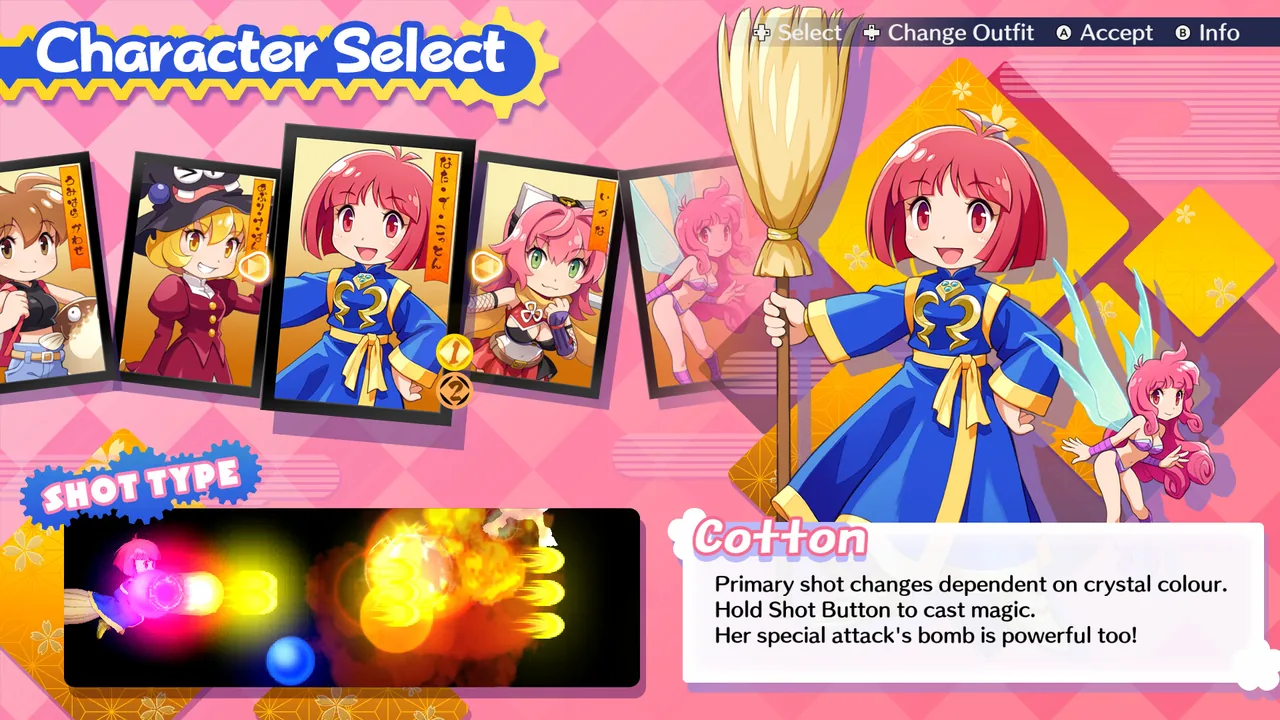
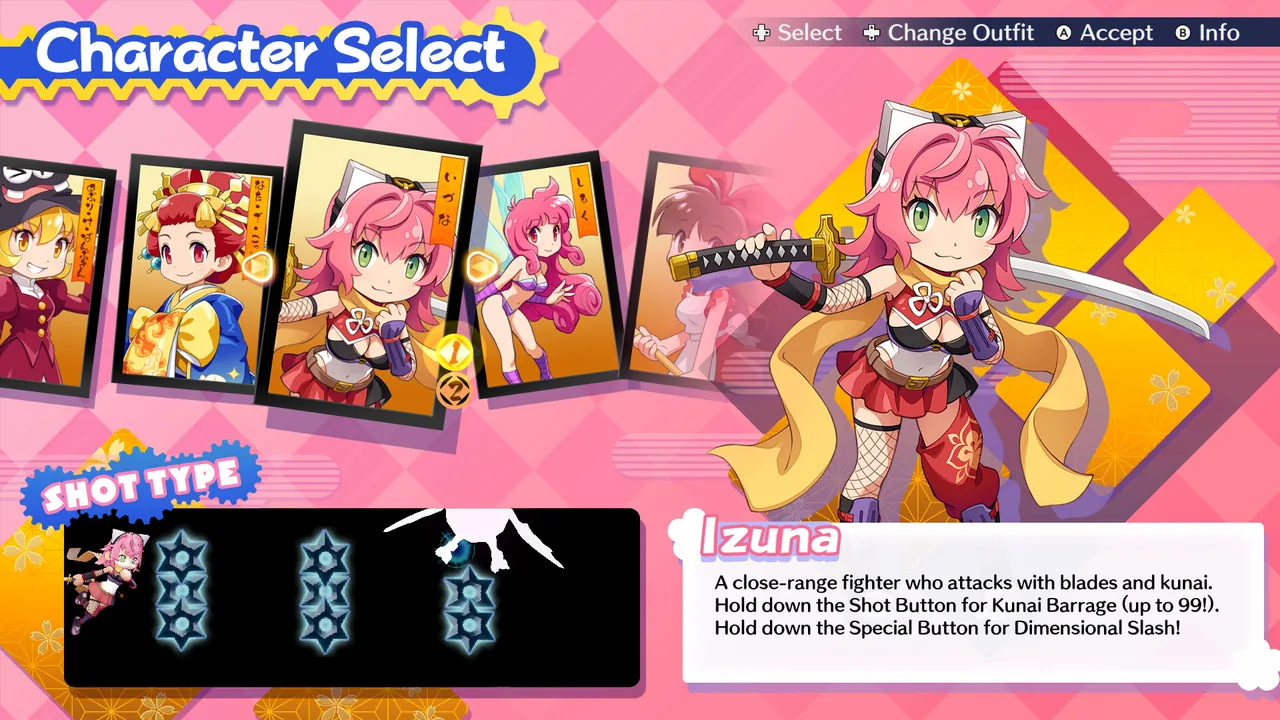
RockWithYou's stated selling point is its cast, and it's more ambitious than a typical shmup roster swap. According to the storefront's own character breakdown, this isn't ten ships with different stat sliders — several pilots import an entire mechanical identity from elsewhere in the genre. Ria (and the new Ria3) graze enemy bullets to build a "BUZZ" power meter, straight out of Success's own Psyvariar series. Kawase, the crossover guest from Umihara Kawase, fires a grappling lure that catches enemies and stores them in a backpack rather than shooting them outright. Fine runs on a time-based system borrowed from ZANFINE. Izuna, imported from the Izuna action-RPG series, fights in close range with a sword backed up by ranged kunai throws — a genuinely different combat shape from anything else in the lineup. Add Appli, Luffee (from Doki Doki Poyacchio) and returning final-boss-turned-playable Tacoot, and the ten-character launch roster (expanding to fifteen with unlocks and costume variants) reads as a genuine crossover event dressed up as a single game, not a marketing line stretched over reskins.
That's worth taking seriously as a design choice. Most shoot-'em-ups differentiate characters with shot spread, speed and a special bomb; building four or five of your cast around entirely different core verbs is a bigger commitment, and a harder one to balance. It also means the game's difficulty and pacing will vary enormously by who you're flying — a Psyvariar-style grazing mechanic rewards aggressive, close play in a way a standard bullet-avoidance ship never will. Nothing publicly available yet says whether that balance actually holds up character to character; it's simply the most interesting question the game raises, and one only a much larger player base will be able to answer.
Structure, presentation and the Japan setting
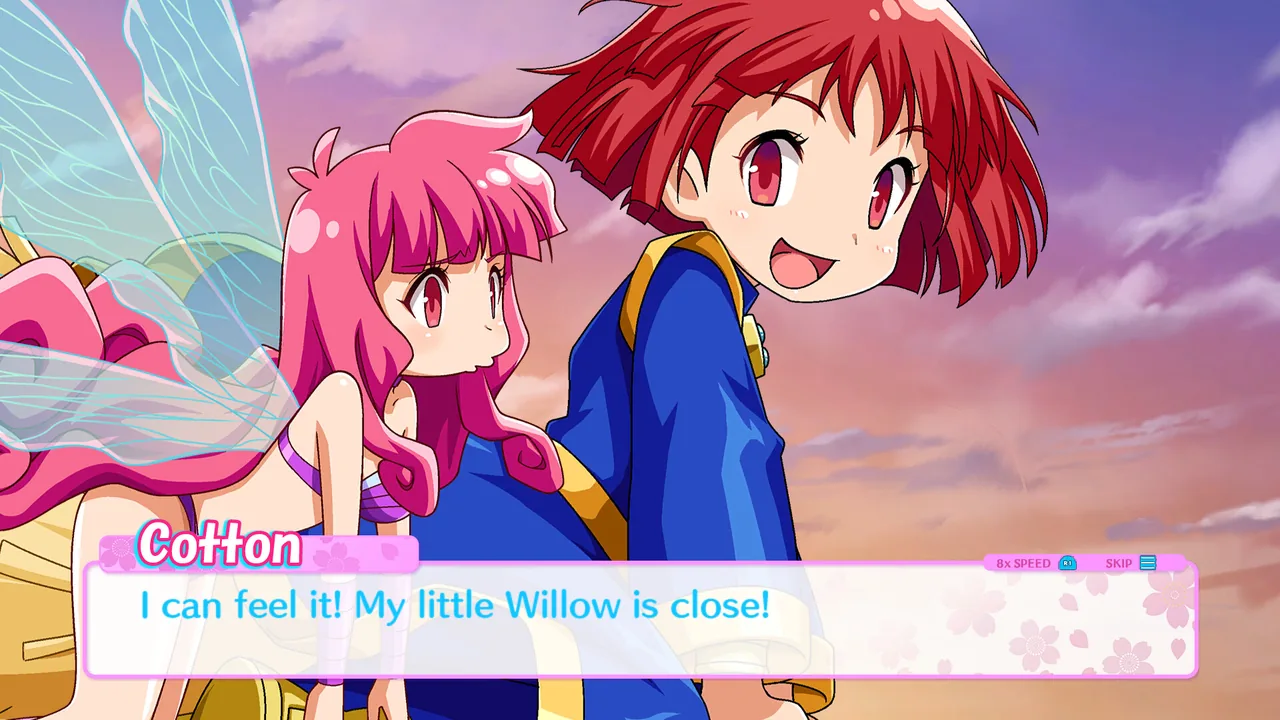
The stated content shape is sixteen stages: eight main stages plus two bonus stages, with the first loop unlocking a choice between "Logic" and "Law" routes on replay — a structure aimed squarely at score-attack replay rather than a single linear campaign. Story Mode offers three difficulty tiers with fully voiced scenes bracketing each stage, and there's a separate Training Mode for practicing specific stages with adjustable settings, plus online and offline leaderboards. For a niche arcade shooter, that's a reasonably complete package on paper: enough structure to support both a casual clear and a scoring-focused replay loop, without pretending to be a longer game than it is.
Visually, this entry swaps the series' usual fairytale-kingdom backdrop for torii gates, festival lanterns and Japanese seasonal scenery, rendered in the same colorful, high-detail anime style Studio Saizensen used on the previous game. It's worth flagging honestly that Rock'n'Roll's own critical reception, strong as it was, wasn't unanimous on presentation — some reviewers found its polygonal character models and busy screen compositions a harder sell than the 2D-sprite Cotton games of the '90s and 2000s. Whether that carries forward here isn't something the launch screenshots alone can settle, and it's exactly the kind of detail a wider critic pool will surface in the coming weeks.
Language support is generous for the genre: eight subtitle languages including English, Simplified and Traditional Chinese, Korean, French, Spanish and Portuguese, alongside full Japanese voice acting. That's a real investment for a release this size, and it signals SUCCESS is treating the Western release as a genuine market rather than an afterthought port.
The part nobody can verify yet
This is the section that has to be stated plainly rather than smoothed over: at the time of writing, two days after release, COTTOn RockWithYou has a review sample small enough to count on one hand, all of it positive, and no critic scores anywhere. That's not unusual for a launch this fresh, and it's not a red flag on its own — but it means every claim above about how the borrowed mechanics actually play, how the difficulty curve holds up, whether the "Logic" and "Law" routes offer meaningfully different content, and whether the polygonal art style reads better or worse than the last game, is currently undocumented. Nothing in the available sources contradicts the game being exactly as good as its pedigree suggests. Nothing confirms it either.
Monetisation, which is the one area fully settled
Here the storefront listing is unambiguous, and it's good news: a single upfront price, no listed DLC, no in-app purchase category, and no premium currency anywhere in the feature list. The one adjacent offer is a bundle pairing this game with its 2021 predecessor at a combined discount — that's a value option for newcomers, not a monetisation lever inside RockWithYou itself. For a studio whose last entry earned genuine critical goodwill, shipping a straightforward one-time purchase rather than trying to extend it with post-launch currency or battle-pass structures is worth crediting on its own terms.
The price itself sits at the higher end for the genre — roughly NZ$53 (NZ$42.79 during the current 20%-off launch window, through 19 August) or US$34.99 (US$27.99 discounted) — which is a real premium next to the indie shmups that typically retail for a third of that. Whether the sixteen stages, ten-to-fifteen-character roster and dual-route replay structure justify that gap is a question about content volume the storefront answers reasonably well on paper; it's a question about actual value that only time played will answer.
Final verdict
Score COTTOn RockWithYou for what's actually verifiable: a sixth mainline entry in a 35-year-old series, built by the same director-producer pairing whose last Cotton game earned a genuinely strong critical reception, attempting something more ambitious with its roster than the previous entry did by importing whole mechanical identities from other cult shoot-'em-ups rather than just their character designs. That's a stronger starting position than most launch-week reviews get to work with, and it's why this isn't scored as a coin flip.
It's held back from a higher number by the obvious gap: there is essentially no independent verification yet of how any of this actually plays, a premium price tag for a niche genre, and a predecessor whose art style wasn't a unanimous critical hit even inside its overall success. Score this a 7.5 as a bet backed by real prior work rather than hype, and treat it as a figure worth revisiting once a proper review and player base exists — which, if Rock'n'Roll's own launch trajectory is any guide, could move this number in either direction faster than most games this site covers.
Price and monetisation checked 7 August 2026.
Pros and cons
Pros
- Ten playable ships at launch (fifteen once unlocked) with genuinely different mechanical identities, not palette swaps of the same shot pattern
- Borrows specific systems wholesale from Psyvariar, Umihara Kawase and ZANFINE rather than just referencing them cosmetically, which is an unusually generous piece of fan service
- Fully voiced story scenes bracket all sixteen stages, with eight subtitle languages including English, so the presentation budget clearly went beyond the minimum a niche shmup needs
- The direct predecessor from the same director and producer landed at 78-80 on Metacritic, which is real evidence the team can finish a Cotton game well, not just marketing
- No DLC, no in-app purchases and no premium currency anywhere on the storefront listing — a single upfront price and nothing further to sell you
Cons
- Launched with essentially no review corpus (a small handful of Steam user reviews, no critic scores at time of writing), so almost nothing about bugs, difficulty balance or long-term reception is independently verifiable yet
- Full price sits at the higher end for a 2D arcade shoot-'em-up, and the loop-then-choose-route structure after the first clear is a smaller amount of raw content than the ten-ship roster might suggest
- The predecessor's polygonal art direction drew mixed reactions from critics even inside a generally favourable reception, and it's not yet clear how much of that carries into this entry's screenshots
- Windows-only on PC with no Mac or Linux listed, and only partial controller support flagged rather than full native support
Screenshots
-
COTTOn RockWithYou -ORIENTAL NIGHT DREAMS-Image: SUCCESS Corp. via Steam -
COTTOn RockWithYou -ORIENTAL NIGHT DREAMS-Image: SUCCESS Corp. via Steam -
COTTOn RockWithYou -ORIENTAL NIGHT DREAMS-Image: SUCCESS Corp. via Steam -
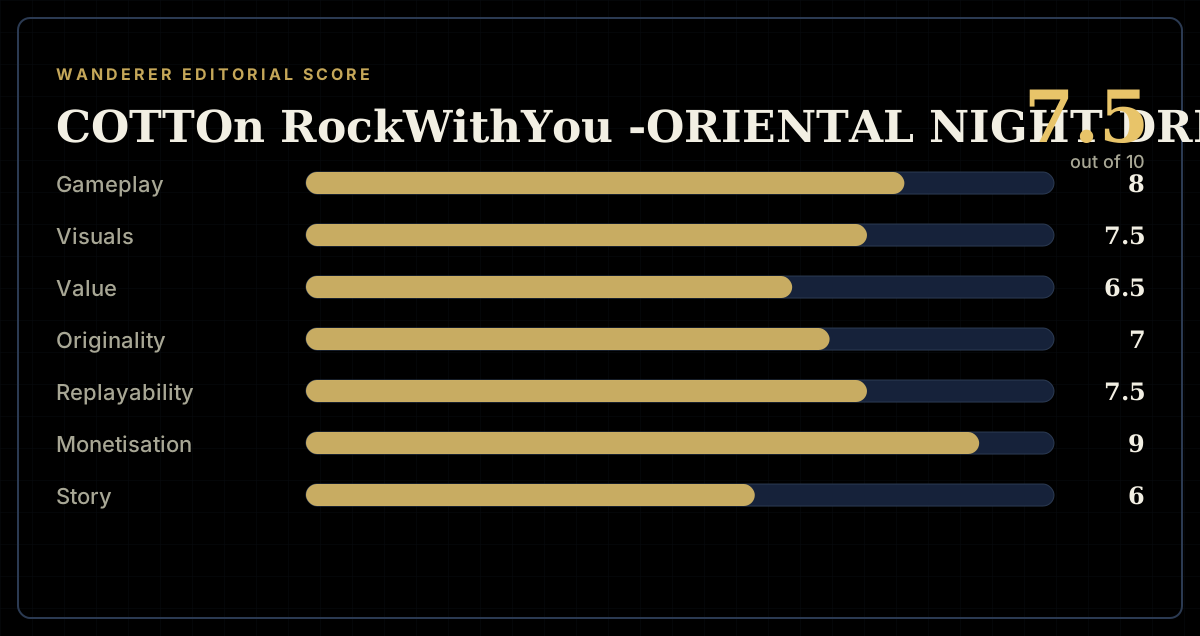
How the review scores each part of the gameWanderer Editorial -
The short versionWanderer Editorial