Game review
Claritas - Dungeon Crawler RPG
7.2 / 10
- Developer
- playclaritas
- Released
- 27 January 2025
- Platforms
- Windows, macOS, Linux
- Genre
- Turn-Based Dungeon Crawler RPG
- Monetisation
- One-time purchase. Four optional Extra Hero Pack DLCs (four heroes each) are sold separately at NZ$2.99 apiece — no ads, no premium currency, no battle pass in the base game.
- Players
- Single-player only
The short version
Claritas strips the dungeon crawler down to its most addictive parts: pick a party from a large roster of classes, explore fog-of-war grids for loot and events, dump the rewards into a skill tree you can freely rebuild at any time, and go again on a harder map. It's a formula the genre has run for decades, and Claritas doesn't reinvent it — the maps are plain single-tile squares and the story is close to nonexistent — but the build variety and the respec-anytime skill points give it real staying power, and the Steam reviewer sample logs playtimes that back that up, several well past the 40-hour mark.
What it doesn't do is explain itself. Every review in its small sample, positive or not, describes learning the game's systems by trial and error, and the one negative review in that sample is exactly that failure mode: two fights in and out, calling it "uber-simple." At nine dollars with no live-service strings attached, that's a cheap way to find out whether the loop clicks for you — but it will lose players in the first twenty minutes who needed the game to meet them halfway.
Biggest strengths
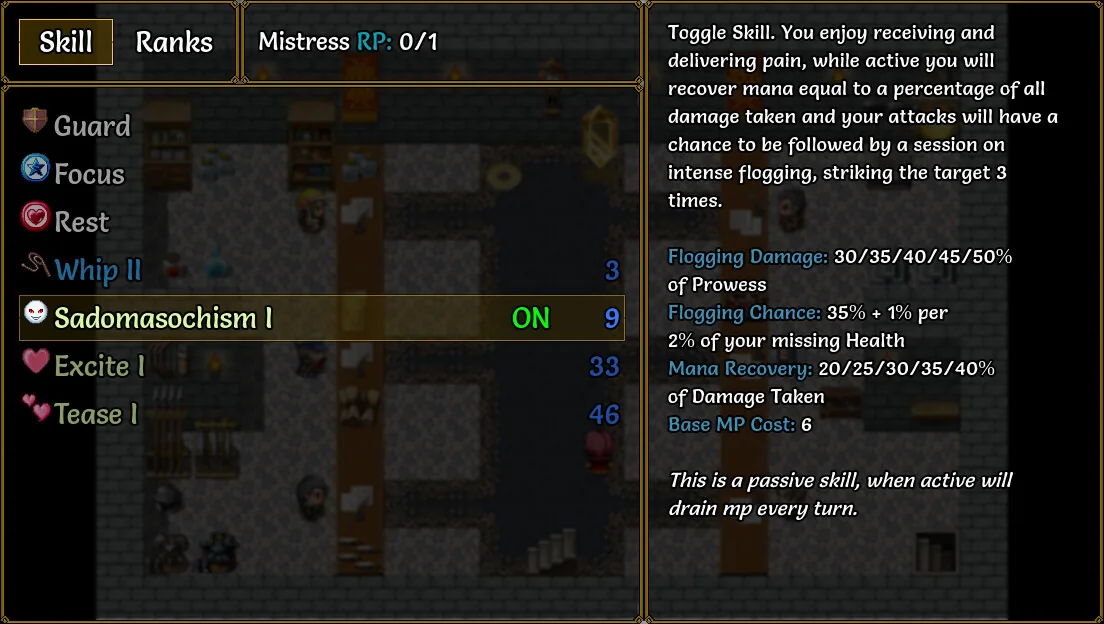
- A genuinely deep skill tree for the price — abilities per hero, freely redistributable points, and permanent party-wide perks layered on top of individual builds
- The loot-and-grind loop is sticky for the audience it's built for: reviewers in the small Steam sample log playtimes stretching from single digits past 90 hours
- One-time purchase with no ads or premium currency, and the optional Extra Hero Pack DLCs are priced modestly rather than pushed
Biggest weaknesses
- Near-zero onboarding; the game expects you to learn its systems by trial and error, and at least one player bounced off entirely inside the first two fights
- Dungeons are plain single-tile square grids under fog of war, and more than one positive review calls the maps uninspired
- The difficulty curve steepens fast — Steam's own achievement data shows completion collapsing from the first map tier to the tenth
Who it's for: Genre veterans who already know how to read a dungeon crawler's systems without a tutorial, and anyone who wants a cheap, ad-free numbers-go-up loop to grind on the side.
Our recommendation: Buy it if you already like the genre and can tolerate a rough first half hour; skip it if you need a game that teaches you how to play it.
7.2 / 10
Introduction
Claritas is a 2D, turn-based dungeon crawler from the small, self-published studio playclaritas. It shipped out of Early Access on 27 January 2025 for Windows, macOS and Linux, sold once for NZ$8.99 with no subscription and no premium currency. The pitch, straight from its own store page, is unfussy: assemble a party from a roster of classes, send them into procedurally-explored dungeons, and spend what you find on a skill tree you're free to rebuild at any time. There's no voiced story to speak of and barely any dialogue — this is a numbers-and-builds game first, and it knows it.
It's also a small release. At the time of writing it carries only 15 English-language Steam reviews, 14 of them positive — enough for Steam's "Positive" tag, not enough for a confident statistical read. This review draws on all 15 of them (I read every one), on the game's own store page and DLC listings, and on Steam's public achievement-completion data, which turns out to say almost as much about the game's shape as the reviews do.
Combat and party building
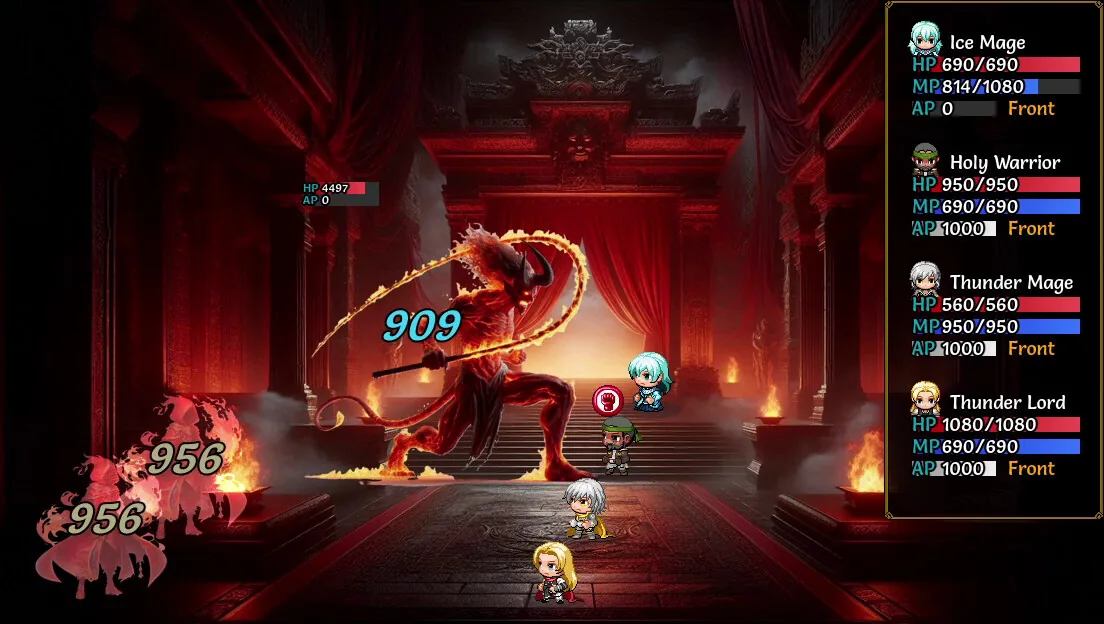
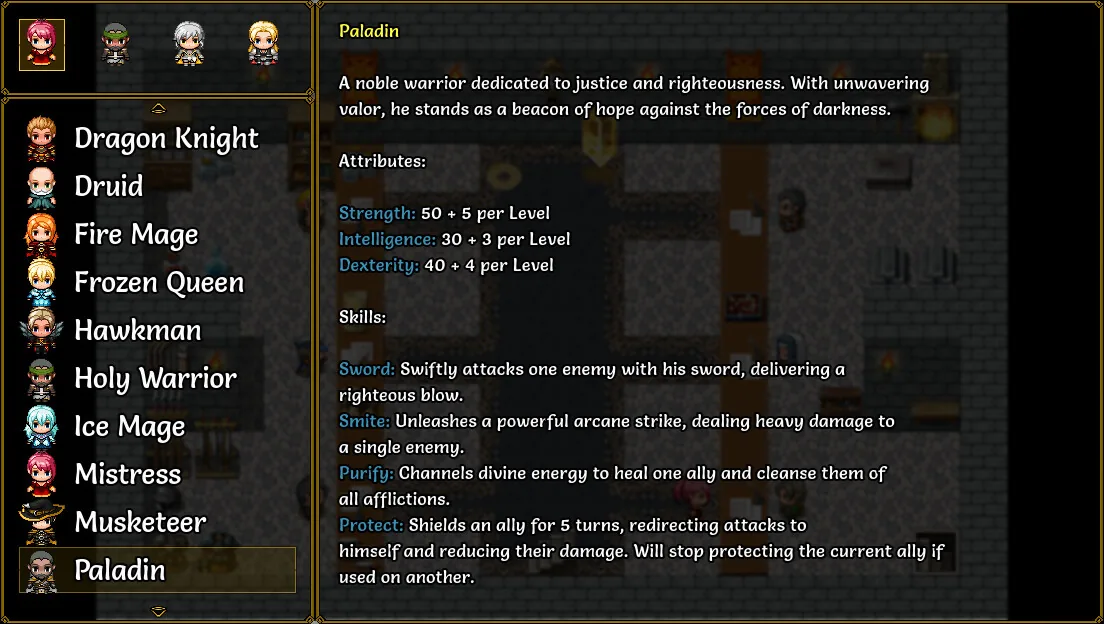
The core loop is: pick a party, walk a square grid dungeon that's covered in fog of war until you step on it, and fight whatever the tile reveals. Steam's own description promises "multiple playable characters, each with four unique abilities," and reviewers who've spent real time with it describe a roster large enough to matter — one puts it at twenty heroes in the base game, split across elemental and role archetypes (mage, knight, cleric and support-style kits recur through the achievement list, with names like Fire Mage, Ice Mage, Paladin, Witch and Dragon Knight). Every hero earns skill points on level-up, and — the detail every positive review calls out — those points can be freely redistributed at any time. That single design choice does a lot of work: it turns "I built this character wrong" from a run-ending mistake into an afternoon's respec, and it's the reason reviewers describe experimenting with builds rather than looking one up and committing. On top of individual kits sits a layer of permanent, party-wide perks, plus gear that drops from chests and bosses scaled to the dungeon tier you're clearing.
Where the loop gets its texture is the random events scattered through each dungeon alongside combat: travelling merchants, rituals that summon a boss fight early, village-party style encounters that a couple of reviewers single out as a nice unpredictable beat in what is otherwise a very repeatable grind. Nobody in the sample describes the exploration itself as interesting — the maps are, in one reviewer's words, "not exactly inspired," just a fog-covered square per zone — so the events carry more of the moment-to-moment variety than the geography does.
Progression and the grind
This is where Claritas earns its keep, and where the evidence is unusually good for a release this size: Steam publishes global achievement-completion percentages, and Claritas has ten discrete "cleared all maps at tier N" achievements running from tier 1 to tier 10. The drop-off is steep — 57.7% of players who've earned any achievement have cleared tier 1, 28.4% tier 2, 18.4% tier 3, 13.6% tier 4, and it keeps roughly halving from there down to 1.7% at tier 10. Read together with the mastery-tier hero achievements (things like "Witch III" or "Paladin III" sitting in the 11–21% range, and several late-game unlocks below 1%), the picture is a long, genuinely difficult grind rather than a short game padded with busywork — which matches what the reviews say directly. Playtimes logged by this small sample range from under six hours up to roughly 91 hours, with more than one reviewer past the 40-hour mark and still describing the core loop as satisfying rather than exhausted. For a nine-dollar one-time purchase, that's a strong hours-to-cost ratio if the loop suits you.
The catch, and it comes up in nearly every review including the enthusiastic ones, is that the game explains almost none of this up front. "Very minimal explanation of the systems... a learn-as-you-go type of thing" is how one reviewer puts it, and it's echoed by others noting that "some things could be explained a bit better." One reviewer who voted the game down did so after two fights and eighteen minutes, calling the combat "uber-simple" and the whole thing "very underwhelming" — which reads less like a disagreement about the systems themselves and more like someone who needed the game to show its hand faster than it does. A separate cluster of reviews flags that "battles can get a little bit sloggish" once the honeymoon period with a new build wears off, and one calls out that the game overall "needs a bit of polish."
Presentation and accessibility
Claritas doesn't spend its budget on art direction — this is a plain, functional 2D presentation, consistent with a small self-published studio, and no reviewer in the sample singles out the visuals as a strength or a real weakness. Where the release punches above its size is elsewhere: full controller support including DualShock and DualSense input, Steam Cloud saves, and Steam Achievements and Family Sharing all present at launch, alongside subtitle and audio localisation across more than two dozen languages according to its store listing. That's a broader accessibility footprint than most releases this size ship with, even if the tutorialisation inside the game itself is the weak link the reviews keep returning to.
Monetisation
The base game is a single NZ$8.99 purchase with no in-game currency and no ads. Beyond that, playclaritas sells four "Extra Hero Pack" DLCs, each adding four heroes for NZ$2.99 — sixteen extra characters for roughly NZ$12 on top of the base price if you want the full roster. None of it is pushed inside the game itself in the reviews sampled here, and the per-pack pricing is modest rather than aggressive; it reads as a normal way for a small team to keep funding content for a game with a niche but committed audience, not as a game withholding features to sell them back.
What players say
Fourteen of the fifteen English-language reviews in this sample are positive, and the praise is consistent rather than scattered: build variety, the freedom to respec, a satisfying loot-and-grind cycle, and honest value for the asking price. "You really can't beat the price for how much content is here," as one puts it. The criticism inside those same positive reviews is just as consistent: thin explanation of the systems, plain maps, and battles that can slog once the initial build excitement fades. The single negative review is really a different complaint — it's an early bounce from someone the opening minutes didn't hook — rather than evidence the deeper loop fails to hold up, which the playtime data suggests it does for the audience that sticks around.
Final verdict
Claritas is a small, honestly-priced dungeon crawler that trusts its skill tree and its loot loop to do the entertaining, and largely gets away with it — the achievement data alone shows a real core of players grinding all the way to the hardest map tiers. It asks a lot of patience from anyone in the first half hour, though, and offers almost nothing to reward that patience beyond the promise that the systems get better once you've worked them out yourself. If you already know you like this genre, or you're happy to learn a game by poking at it rather than being taught, nine dollars is very little to risk. If you need a crawler that meets you halfway, this isn't the one that will change your mind about the genre.
Pros and cons
Pros
- A genuinely deep skill tree for the price — abilities per hero, freely redistributable points, and permanent party-wide perks layered on top of individual builds
- The loot-and-grind loop is sticky for the audience it's built for: reviewers in the small Steam sample log playtimes stretching from single digits past 90 hours
- One-time purchase with no ads or premium currency, and the optional Extra Hero Pack DLCs are priced modestly rather than pushed
- Full controller support, including DualShock and DualSense, and Steam Cloud saves — unusual polish for a release this size
Cons
- Near-zero onboarding; the game expects you to learn its systems by trial and error, and at least one player bounced off entirely inside the first two fights
- Dungeons are plain single-tile square grids under fog of war, and more than one positive review calls the maps uninspired
- The difficulty curve steepens fast — Steam's own achievement data shows completion collapsing from the first map tier to the tenth
- The review sample this piece draws on is very small, so treat the read on long-term balance as provisional
Screenshots
-
Claritas - Dungeon Crawler RPGImage: playclaritas via Steam -
Claritas - Dungeon Crawler RPGImage: playclaritas via Steam -
Claritas - Dungeon Crawler RPGImage: playclaritas via Steam -
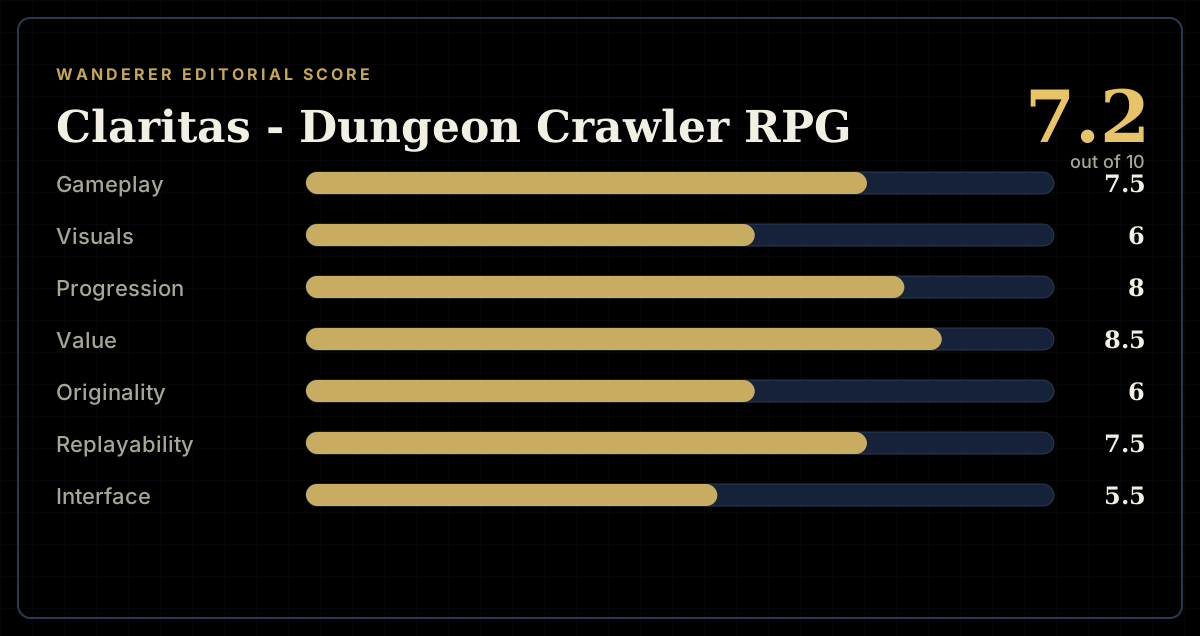
How the review scores each part of the gameWanderer Editorial -
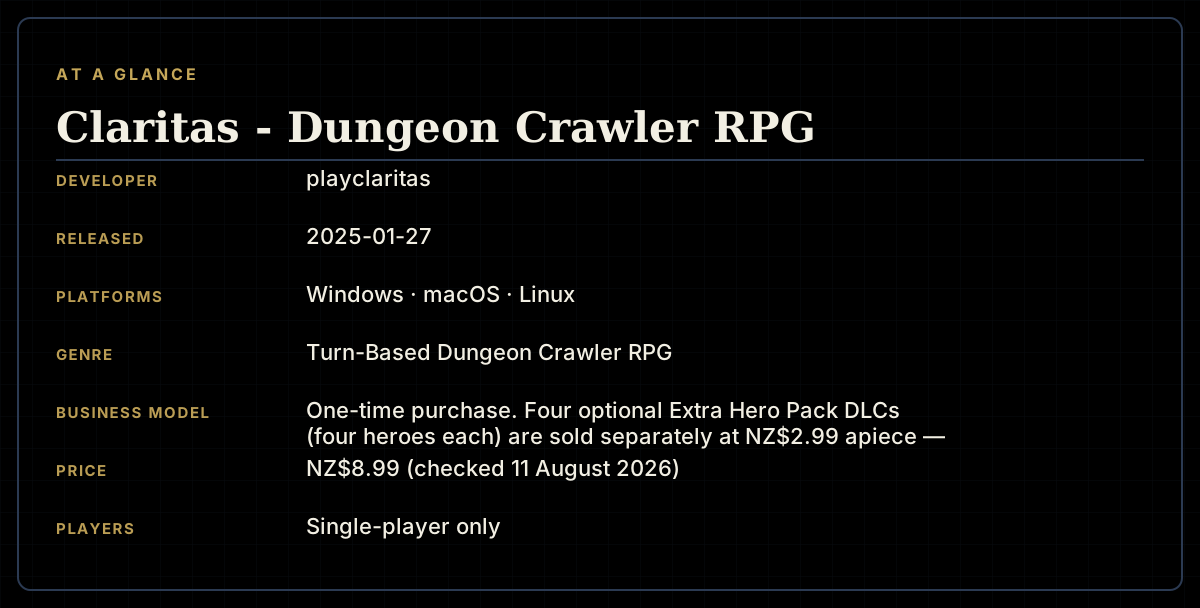
The game at a glanceWanderer Editorial -
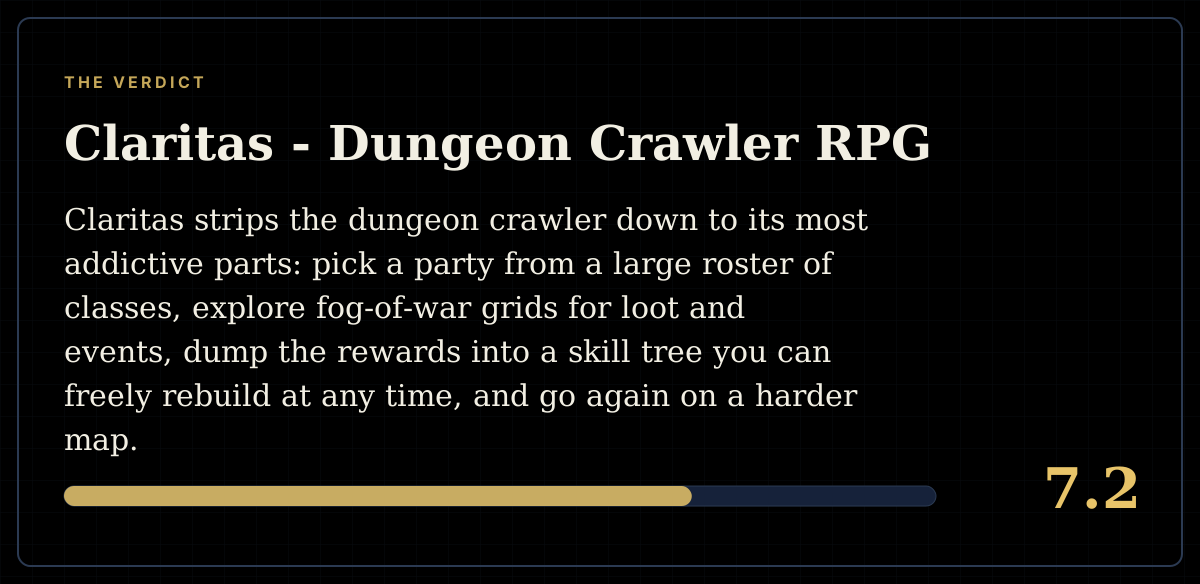
The short versionWanderer Editorial