
Game review
castle idler
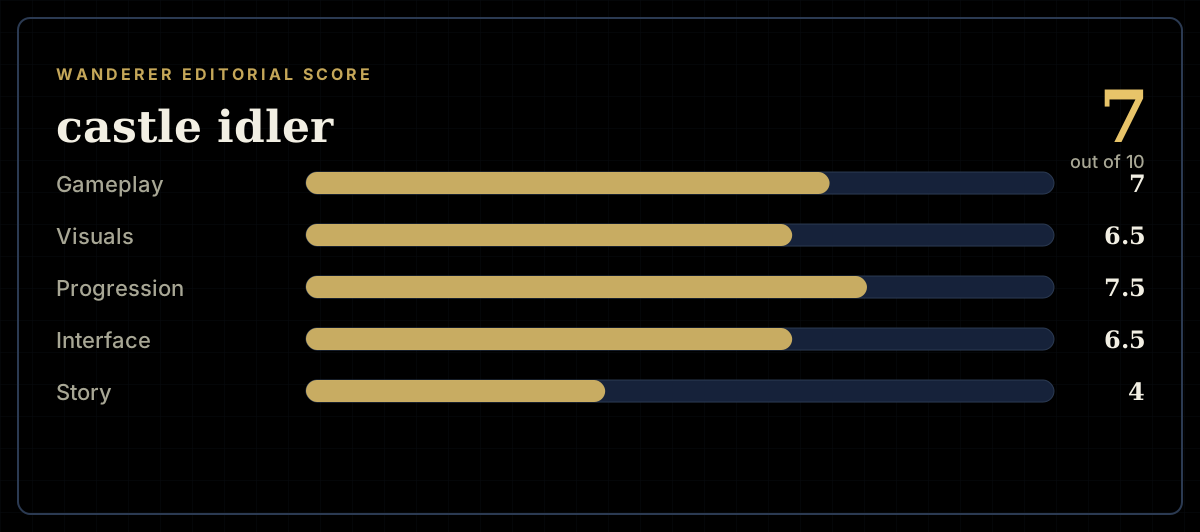
7 / 10
- Developer
- Soy Boy Games
- Publisher
- Soy Boy Games
- Released
- 24 April 2026
- Platforms
- [Windows, Mac]
- Genre
- Strategy
- Monetisation
- $3.99
- Players
- false
The short version
castle idler is a clever, cheap hybrid of tower defense, incremental progression, and puzzle-solving that mostly delivers on its relaxing pitch, though later levels can tip from strategic into rigid, demanding one specific build rather than rewarding open-ended experimentation.
Biggest strengths
- A genuinely distinctive killstreak-based win condition instead of standard tower-defense waves, which several reviewers say makes losing feel less punishing and the whole game more relaxing
- A well-regarded prestige and skill tree system that rewards experimenting with different tower and passive combinations across roughly 32 to 33 stages
- An inexpensive, tightly scoped package, most reviewers finish in two to five hours, that a wide range of reviewers across many languages call worth the asking price
Biggest weaknesses
- A recurring complaint that later levels effectively demand one specific, developer-intended build or prestige combination, turning strategic freedom into trial-and-error guesswork
- Several reviewers argue the marketing oversells how relaxing and short the game is, since the back third can slow to a demanding, grindy crawl
- No fast-forward or speed-up option, which a number of reviewers flag as a missing quality-of-life feature for a game built around background idling
Who it's for: Fans of incremental and idle games who want a puzzle-like twist involving genuine build optimization, rather than a purely passive numbers-go-up experience.
Our recommendation: Buy it
7 / 10
No waves, just a streak to chase
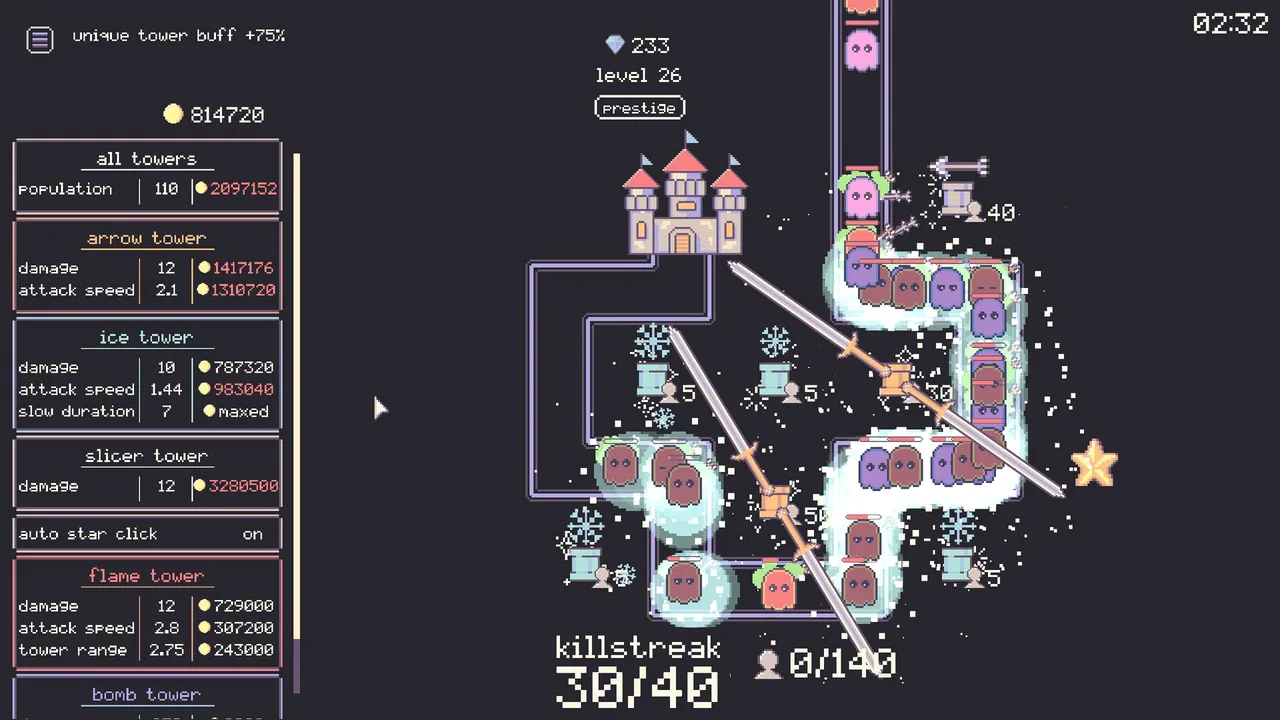
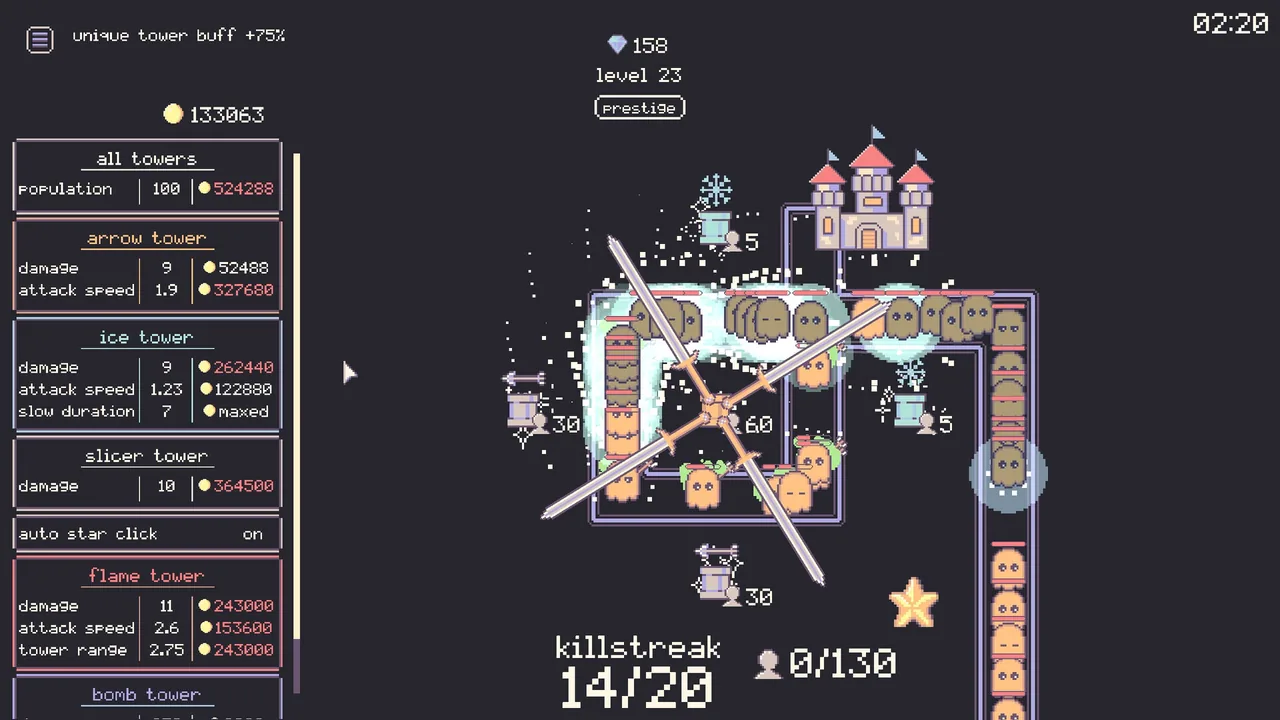
castle idler, released April 24, 2026 by solo developer and publisher Soy Boy Games after a run of public demo builds through late 2025 and early 2026, reframes tower defense around a single idea: instead of surviving waves, you're chasing an uninterrupted killstreak. Enemies that reach your castle don't end the run, they just reset your streak counter, so failure is a setback rather than a game over. Across roughly 33 stages, you place and upgrade towers, then periodically prestige to spend earned currency on a passive skill tree that reshapes your strategy for the next attempt. At $3.99, it launched to a Mostly Positive reception, 182 reviews, around 80%, with reviewers largely won over by the concept even where the execution wobbles late.
A killstreak instead of a game over
The no-lose structure is the game's clearest hook, and reviewers across the sample consistently credit it with making the whole experience feel calmer than typical tower defense. Losing your streak just means retrying with adjusted tower placement or a different prestige build, not restarting a whole level, and several reviewers explicitly frame this as the reason they could enjoy a genre they normally find too punishing. One reviewer sums up the appeal directly: it removes the usual tower-defense stress of a last wave undoing an otherwise successful run, replacing it with iterative, low-stakes experimentation instead.
Prestige as the real game
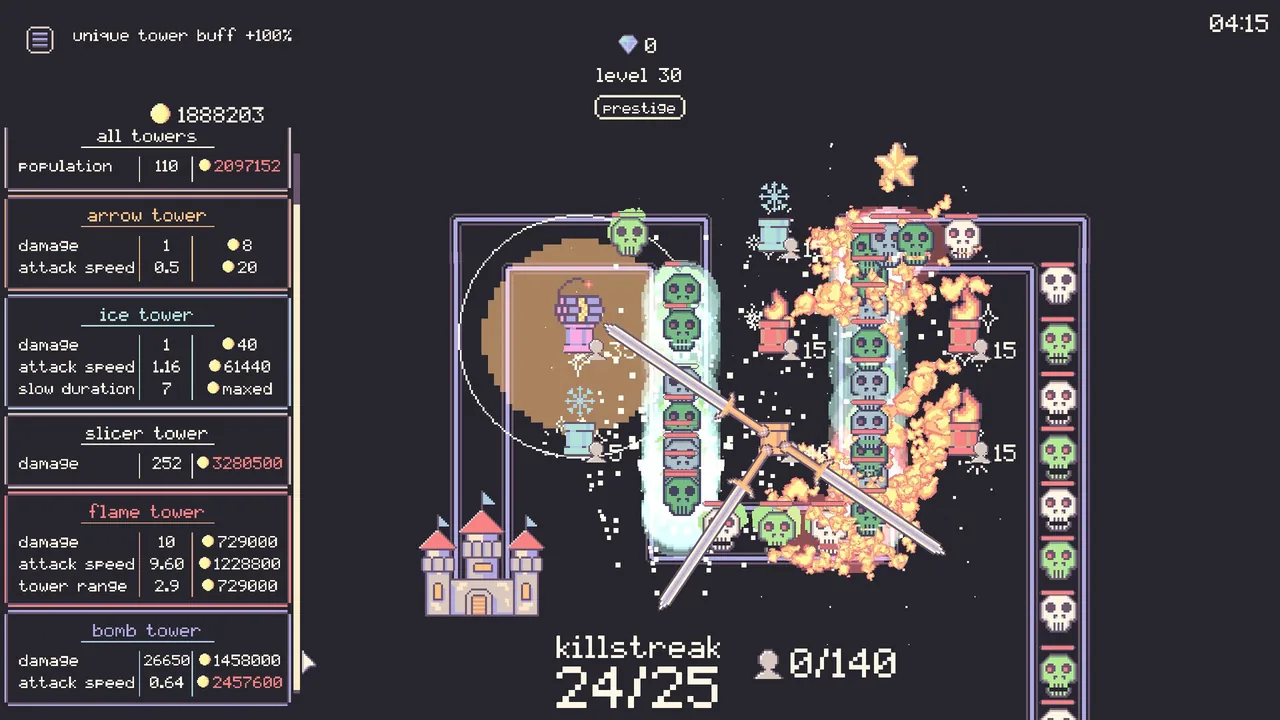
The skill tree and prestige system draw the strongest praise in the sample, with multiple reviewers calling it the strongest part of the design. Rather than a single fixed loadout, prestiging lets you commit to specific synergies, coin generation, poison damage, fire combos, and reshuffle your approach entirely between attempts. Several reviewers describe the resulting loop as closer to a puzzle game than a traditional idler: figure out which passive combination a given level actually wants, then execute it precisely. One reviewer put it bluntly, calling the late game "a puzzle game designed as a tower defense game," and meant it as praise for the satisfaction of finally cracking a stubborn stage.
When strategy curdles into one right answer
That same puzzle-like structure is also the game's most consistent point of friction. A meaningful share of reviewers, in English, German, Russian, and Simplified Chinese alike, report that later levels don't so much reward experimentation as demand one specific, developer-intended build, with any deviation making a stage effectively unbeatable without extensive grinding. One negative review states this plainly: failing to prestige and place towers exactly as the designer intended leaves no effective fallback way to grind through gradually. That's a real tension with the game's advertised pitch as short and relaxing, since it means some players hit a wall that only a particular, sometimes non-obvious build can clear.
Marketing versus reality
Related to that friction, several reviewers push back specifically on how the store page frames the experience. One detailed German-language review argues the game is neither as short nor as relaxing as advertised, since the pace slows considerably once repeated prestige cycles become mandatory rather than optional. A Russian-language reviewer makes a similar point at length, arguing the back half undermines the "short and relaxing" premise printed on the store page. These aren't isolated complaints, they surface across multiple languages, and they matter because the appeal for a chunk of the game's audience is explicitly the low-pressure idle framing that later stages can strain against.
Missing the fast-forward button
A smaller but specific complaint concerns quality of life: castle idler has no speed-up or fast-forward option, which several reviewers flag as a strange omission for a game that leans so heavily on letting it run in the background to accumulate currency. Given how many reviewers describe deliberately leaving the game open at work or alongside other tasks, a time-acceleration option seems like a natural fit that's currently absent.
Rough edges and outright dislikes
The negative end of the sample includes a spread of complaints beyond the build-rigidity issue: one player reports the game crashing on startup after previously working fine, a few describe the core loop as simply boring or too basic once the novelty wears off, and a handful in Simplified Chinese specifically call out the mismatch between the store page's "relaxing, no waves" framing and the more demanding puzzle-solving reality of later stages. None of these dominate the sample, but they're consistent enough to note.
Value and length
Most reviewers report finishing in two to five hours, occasionally stretched longer by background idling, and the near-universal consensus is that the price is fair for what's delivered. Several reviewers specifically wish for more levels or a sequel, treating the short runtime as a compliment to the design rather than a shortfall, while a smaller group finds the ending arrives too soon relative to how demanding the final stretch becomes.
Who should build this castle
castle idler suits players who want a cheap, puzzle-flavored spin on tower defense with genuine strategic depth in its prestige system, and who don't mind the possibility of a few stages that require real trial-and-error to crack. Players looking for a purely passive, always-progressing idle experience, or one that stays relaxing all the way through, should go in aware that the back third asks more of you than the marketing suggests.
The verdict
castle idler earns its praise for a clever killstreak-based twist on tower defense and a prestige system with real strategic teeth, but the same system that makes early levels satisfying can turn late-game stages into a search for one specific correct answer. At $3.99, it's still an easy recommendation for genre fans willing to meet it partway.
Pros and cons
Pros
- A genuinely distinctive killstreak-based win condition instead of standard tower-defense waves, which several reviewers say makes losing feel less punishing and the whole game more relaxing
- A well-regarded prestige and skill tree system that rewards experimenting with different tower and passive combinations across roughly 32 to 33 stages
- An inexpensive, tightly scoped package, most reviewers finish in two to five hours, that a wide range of reviewers across many languages call worth the asking price
- Runs comfortably in the background while idling, which many reviewers specifically praise as ideal for multitasking during work or other games
Cons
- A recurring complaint that later levels effectively demand one specific, developer-intended build or prestige combination, turning strategic freedom into trial-and-error guesswork
- Several reviewers argue the marketing oversells how relaxing and short the game is, since the back third can slow to a demanding, grindy crawl
- No fast-forward or speed-up option, which a number of reviewers flag as a missing quality-of-life feature for a game built around background idling
- A minority report crashes on launch and general repetitiveness once the core loop of prestige-then-retry sets in
Screenshots
-
castle idlerImage: Soy Boy Games via Steam -
castle idlerImage: Soy Boy Games via Steam -
castle idlerImage: Soy Boy Games via Steam -
How the review scores each part of the gameWanderer Editorial -
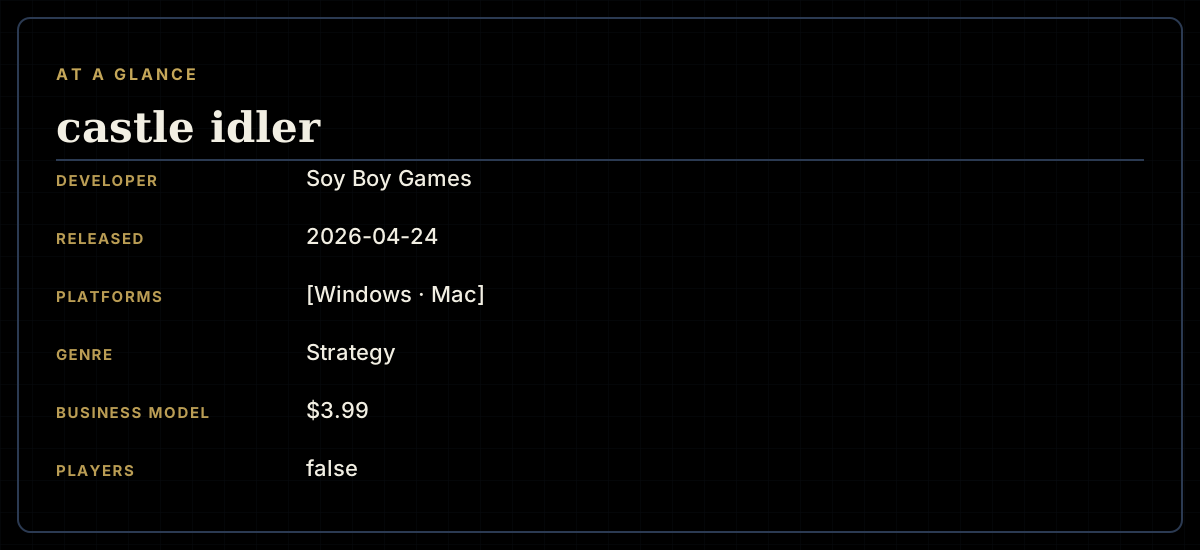
Key facts at a glanceWanderer Editorial -
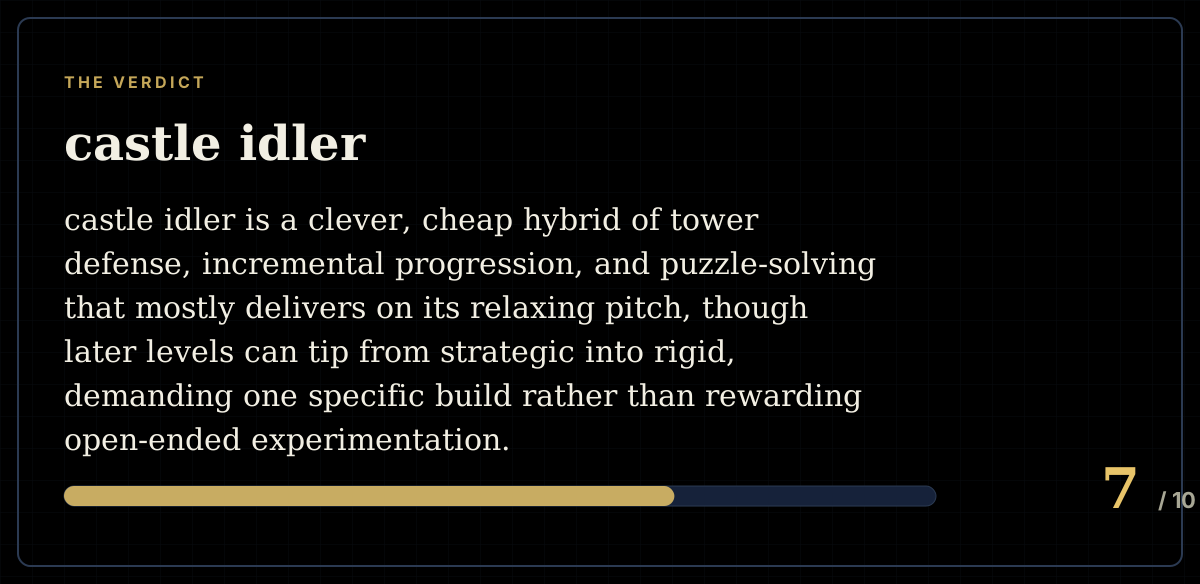
The short versionWanderer Editorial