Game review
Burrows of Cairntir Review
6.5 / 10
- Developer
- Cairntir Games
- Publisher
- Cairntir Games
- Released
- 14 September 2026
- Platforms
- ["Windows"]
- Genre
- RPG
Six Mythologies, One Very Old-School Format
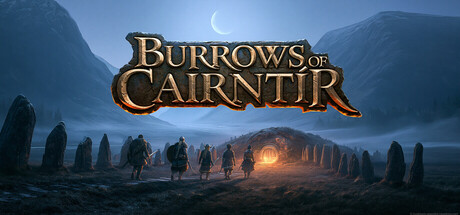
Burrows of Cairntir wears its inspiration openly: a first-person, turn-based dungeon crawler built, in the solo developer's own words, on "the older 1990's game format" and the choose-your-own-adventure structure that defined it. Rather than a single fantasy setting, the game splits its sixty handcrafted dungeons across six real-world mythologies — Celtic, Norse, West African, Japanese, Chinese, and Greek & Roman — reimagined through a horror lens rather than played straight. The pitch text doesn't shy away from that tonal shift, describing a cursed Greek house occupied by the risen dead and an underworld god who refuses mercy "with total and unhurried calm" — the kind of framing that treats familiar myths as source material for dread rather than folklore trivia.
Building a Character the Old-Fashioned Way
The systems underneath that premise are dense by design: character creation, ninety-six spell lines to master, equipment crafting and enchanting, recruitable followers, and a Grand Arena for testing builds outside the main dungeon crawl. That's an ambitious spread of interlocking systems for a solo-developed release, and it signals a clear intent to replicate the kind of granular, stat-heavy RPG design that genre veterans associate with games like Wizardry or Might and Magic rather than a leaner modern dungeon crawler. Turn-based combat is the backbone of it all, built around player choices that shape how each of the game's eight-enemy encounter gauntlets plays out — a structure the developer has already been actively rebalancing since launch, softening early fights while keeping the later stretch of any given dungeon run appropriately dangerous.
Class identity is one area the developer has clearly been paying close attention to post-launch. The Archer rework is the clearest example: rather than leaving it as a generic ranged option, the class now has its own signature basic attack that weakens enemy defenses on hit, plus a dedicated poison-damage ability that rewards attrition-focused play over pure burst damage. Patch notes also describe magic synergy changes tying certain trained skills together, suggesting the spellcasting side of the game is being tuned toward builds that reward specialization rather than simply stacking the highest-numbered spell available. For a game built around ninety-six separate spell lines, that kind of deliberate cross-system tuning matters — a spell list that size is only as good as the build variety it actually supports.
An Active First Week
What stands out most about Burrows of Cairntir isn't the pitch, it's the pace of support behind it. In the days immediately following its September 14 launch, the developer shipped a steady run of patches: bug fixes for mismatched dungeon room scenes, a new random-encounter system that seeds dungeons with traps and lucky finds between fights, a full GUI overhaul simplifying character creation and combat menus, and an archery rework that gave the Archer class its own distinct identity with new attacks and poison-based abilities. That's an unusually fast and transparent cadence for a solo project's first week, and it lines up with a developer's note posted the same week explaining that the game is "three and a half months" old as a project and openly still young, with bug fixes and expansion promised as an ongoing commitment rather than a one-time launch obligation.
A Big Claim for a Young, Solo-Built Game
Sixty handcrafted dungeons and "more than 100 hours of gameplay" is a substantial claim for any RPG, let alone one built solo in roughly three and a half months of development. It's not an impossible one — dungeon crawlers built on repeatable room and encounter templates can generate real playtime without every inch being bespoke — but it's worth going in with tempered expectations about how varied those hundred-plus hours actually feel moment to moment, especially this early in the game's post-launch lifecycle when major systems like the GUI and class balance are still being actively reworked. The developer's own framing, promising future expansion packs and calling the current release "functional and stable" rather than complete, is an honest way to set that expectation, and it's a more trustworthy signal than most launch-week marketing copy tends to offer.
The new random dungeon event system, added just a day after launch, is a small but telling addition in this context: pressure plates, falling rocks, mana-draining runes, and healing springs now have a rare chance to interrupt straightforward exploration, deliberately capped at roughly one or two per full dungeon run so the feature stays a surprise rather than becoming a slog. It's the kind of low-cost, high-impact addition that a solo developer can ship quickly to make sixty largely hand-built dungeons feel a little less uniform between visits, and its arrival within 48 hours of launch is further evidence that this is a project being actively shaped by what's missing rather than one coasting on its initial feature list.
One Early Voice, One Clear Complaint
Burrows of Cairntir's public review base is limited to a single review so far, posted in Simplified Chinese, which praises the game's visual style as beautiful while raising a specific and reasonable interface complaint: it would benefit from a more legible, less decorative font, and from keeping both visuals and text on screen together rather than forcing players to scroll to read dungeon narration. That single complaint tracks closely with the GUI overhaul the developer shipped just days later, which specifically targeted readability and replaced "the old decorative font with something easier to read throughout" — a promising sign that early player feedback is actually reaching the developer and getting acted on quickly, even if it doesn't yet amount to a broad enough sample to say how the game is landing overall.
Verdict
Burrows of Cairntir is an ambitious, deliberately old-fashioned dungeon crawler that leans on real-world mythology reframed as horror, built by a solo developer moving at a genuinely fast post-launch patch cadence. Its scope — sixty dungeons, dozens of spell lines, six distinct cultural settings — is the kind of promise that's easy to make and hard to fully deliver on, especially from a single developer only a few months into the project, and the interface issues flagged in its lone early review are a fair reminder that the game is still finding its footing. At $19.99, it's a reasonable bet for dungeon-crawler purists willing to accept some early rough edges in exchange for a developer who's visibly listening and iterating fast.