Game review
Break Shoot
6.8 / 10
- Developer
- UPTRAND
- Publisher
- UPTRAND
- Released
- 26 April 2026
- Platforms
- [Windows]
- Genre
- Action
- Monetisation
- Paid
- Players
- false
The short version
Break Shoot bolts a satisfying roguelike build system onto a billiards-scoring hook and, for its first handful of runs, the combination is genuinely addictive, but a thin pool of abilities and light late-game variety mean the loop wears thinner than the games it's clearly chasing.
Biggest strengths
- A snappy, satisfying core loop of stacking ball abilities and accessories to chain collision-based combos
- Cool music and genuinely satisfying sound design that reviewers repeatedly call out as a highlight
- Approachable and easy to learn even for players with no billiards background or roguelike-deckbuilder experience
Biggest weaknesses
- A limited pool of ball abilities means builds start to repeat and runs feel similar after five to ten successful attempts
- The billiards theming functions more as set dressing than a meaningful mechanical layer once abilities take over scoring
- Visual and UI presentation leans heavily on Balatro's established look, which several reviewers feel undercuts the game's own identity
Who it's for: Balatro fans looking for a shorter, lower-stakes roguelike to fill the gap between runs, rather than a game built to hold attention for dozens of hours.
Our recommendation: Recommended
6.8 / 10
Billiards by way of Balatro
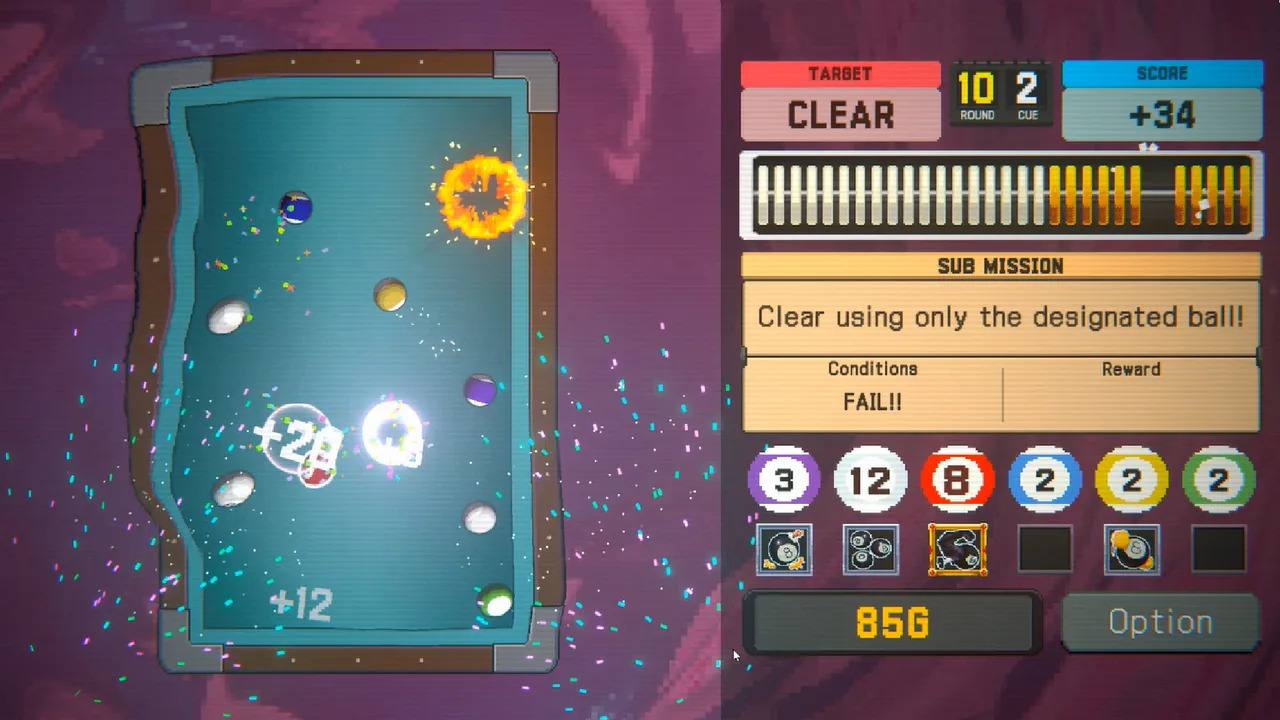
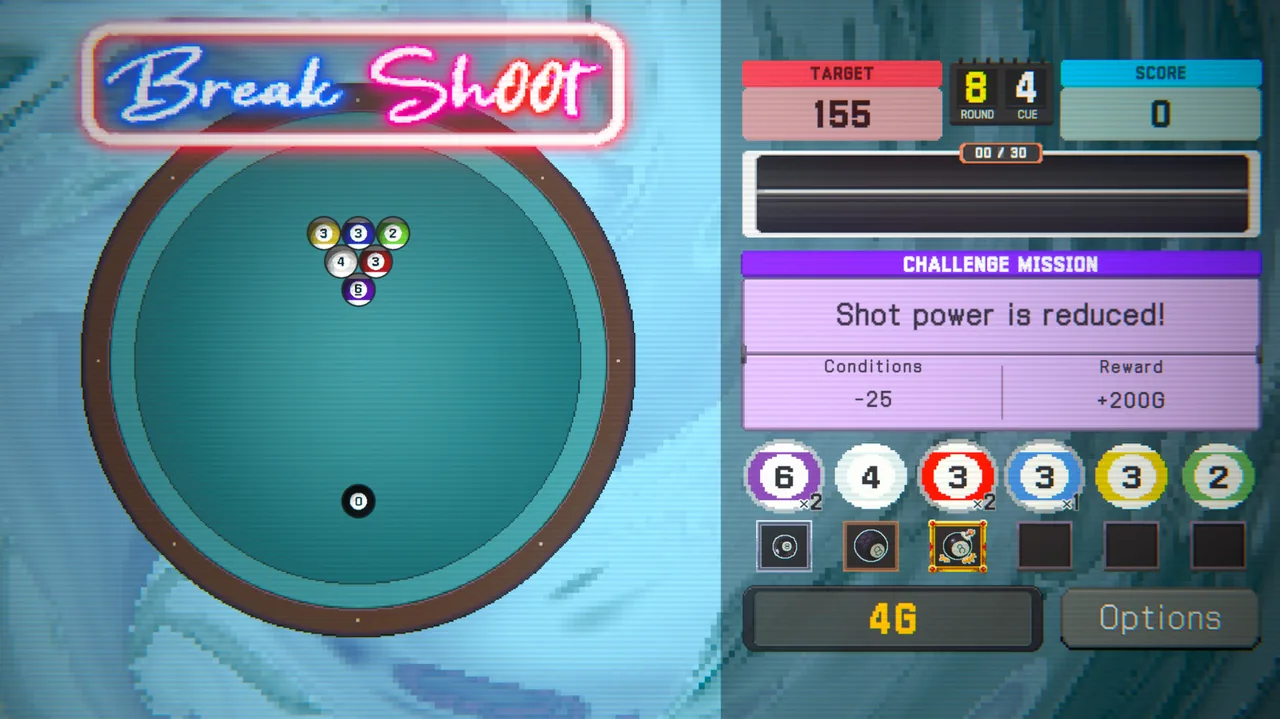
Break Shoot, released April 26, 2026 by solo Korean developer UPTRAND, takes the deckbuilding-roguelike structure that Balatro popularized and rebuilds it around a billiards table instead of a card table. Rather than pocketing balls, players trigger score by colliding balls off each other and the rails, stacking abilities and accessories onto individual balls between rounds to chain increasingly elaborate combos toward an escalating target score. It's a clear, openly-acknowledged homage, several reviewers call it "Billiard Balatro" outright, and it landed to a Very Positive reception on launch, 115 reviews and roughly 99% positive, with almost no negative English-language feedback in the sample.
A hook that works in short bursts
The core appeal lands quickly. Reviewers consistently describe the moment-to-moment loop, lining up a shot, watching a stacked ability chain trigger a cascade of collisions and score multipliers, as genuinely satisfying, aided by sound design several call out unprompted as one of the game's strongest elements. It's an easy game to recommend to players who bounced off Balatro's card-game trappings, since the billiards framing and simplified rules (no pockets, no traditional shot order) make it approachable without prior roguelike or cue-sports knowledge. Several reviewers specifically describe it as an ideal "turn the brain off" game for background play or listening to a podcast, which speaks to how well-tuned the core minute-to-minute feedback loop is, even for a small, first-time commercial release.
The abilities run out faster than the enthusiasm does
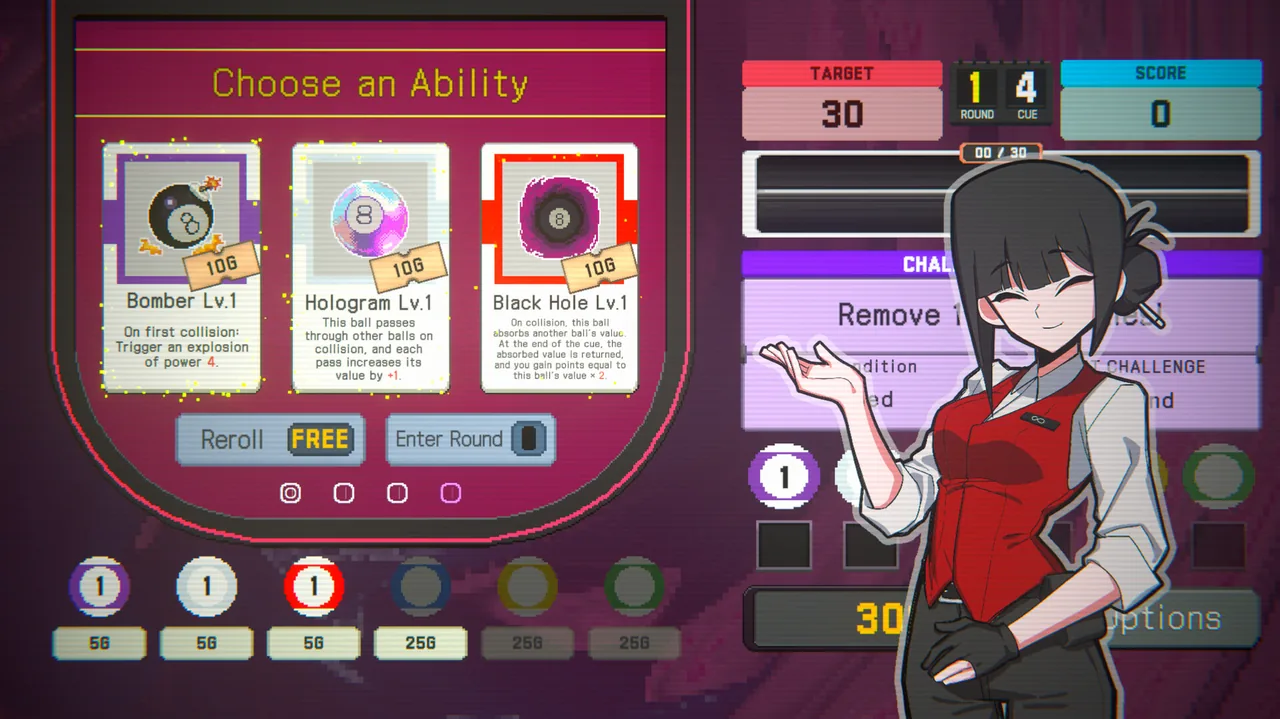
The most consistent critical thread, showing up in a majority of the more detailed reviews even among broadly positive ones, is that the pool of ball abilities and accessories is thin enough to become repetitive after five to ten successful runs. One detailed review sums up the arc bluntly: strong first impressions followed by a steep decline once the limited number of viable builds becomes apparent, since a handful of standout abilities (a black hole effect and a self-duplicating "clone" ball come up repeatedly as community favorites) end up dominating most winning strategies with little reason to deviate. Another reviewer, more skeptical of the game's "Overwhelmingly Positive"-adjacent score, argues plainly that the billiards hook itself becomes "set dressing" rather than a meaningful mechanical layer once ability stacking takes over, echoing a broader sentiment that the theme is thinner than the systems built on top of it.
Standing in a tall shadow
Because the resemblance to its inspiration is so direct, right down to UI layout and pacing conventions, several reviewers can't help but measure Break Shoot against Balatro specifically, and it's a comparison the smaller game doesn't fully survive. One Russian-language review puts it succinctly: the underlying loop is comparable, but where the genre's most popular entry supports fifty to a hundred hours of build variety, this one starts to feel same-y after five to ten runs without further content. That's not a fatal criticism for a $4.99 solo-developer debut, reviewers are broadly forgiving of the gap given the price, but it does mean the game reads more as a well-made, focused riff than a genre-defining new direction in its own right.
Presentation, localization, and a mascot with her own fan following
Visually, Break Shoot leans into a clean, card-game-adjacent UI with a recurring anime-style dealer character who's become something of an unofficial mascot in the review section, multiple reviewers specifically request more of her presence, additional voice lines, or unlockable outfit variants, and the developer has already added several cosmetic skins tied to achievement completion. On the technical side, a handful of reviewers report untranslated Korean text bleeding into other-language builds in parts of the points shop, along with a few reports of achievements not triggering reliably. None of these are described as game-breaking, but they're consistent enough across languages to suggest the launch build could use another localization and QA pass.
Is the price right?
At $4.99, reviewers are near-unanimous that Break Shoot delivers comfortably on value even accounting for its build-variety ceiling. Several describe it explicitly as worth more than its asking price for a first commercial release, and multiple reviewers who tried the pre-launch demo during Steam Next Fest note the full version added meaningful difficulty tiers and a dedicated "Massé Mode" that weren't present before launch. It's priced and scoped like exactly what it is: a tight, well-executed indie roguelike rather than a system built to be played for months.
What a future update could fix
Because the criticism levied at Break Shoot is so specific and so consistent, more abilities, more accessory variety, deeper late-game scaling, it also reads as unusually fixable for a launch-week roguelike. The core scoring math and collision-chain feedback are already well-tuned, which is normally the harder problem to solve in this genre; what's missing is breadth rather than a fundamental redesign. Several reviewers explicitly frame their critique in these terms, expressing hope that post-launch patches will expand the ability pool the way many successful indie roguelikes have grown well past their initial release scope. Patch history since launch has so far focused on stability rather than new content, so whether that expansion actually arrives remains an open question for anyone weighing a purchase against the promise of future updates rather than what's available today.
The verdict
Break Shoot understands what made its inspiration compelling and translates the feeling convincingly into a new setting, the collision-based scoring is genuinely fun to watch unfold, and the presentation has real personality for a solo debut. Its ability pool simply isn't deep enough yet to sustain the dozens of hours its genre peers can offer, making this a strong, addictive short-term pickup rather than a long-term obsession. Worth its asking price for a handful of enjoyable evenings; keep an eye on future content updates if the limited build variety is a dealbreaker.
Pros and cons
Pros
- A snappy, satisfying core loop of stacking ball abilities and accessories to chain collision-based combos
- Cool music and genuinely satisfying sound design that reviewers repeatedly call out as a highlight
- Approachable and easy to learn even for players with no billiards background or roguelike-deckbuilder experience
- A budget price that reviewers broadly agree matches the amount of content on offer for a short, replayable session
Cons
- A limited pool of ball abilities means builds start to repeat and runs feel similar after five to ten successful attempts
- The billiards theming functions more as set dressing than a meaningful mechanical layer once abilities take over scoring
- Visual and UI presentation leans heavily on Balatro's established look, which several reviewers feel undercuts the game's own identity
- Scattered localization bugs, including untranslated Korean text appearing in other language builds, and some achievement-unlock reports
Screenshots
-
Break ShootImage: UPTRAND via Steam -
Break ShootImage: UPTRAND via Steam -
Break ShootImage: UPTRAND via Steam -
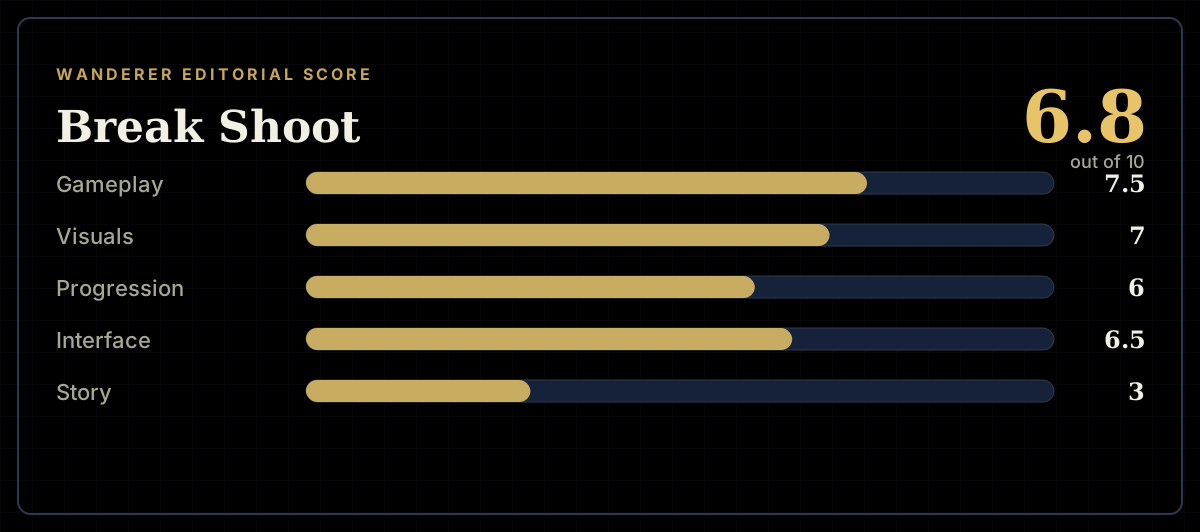
How the review scores each part of the gameWanderer Editorial -
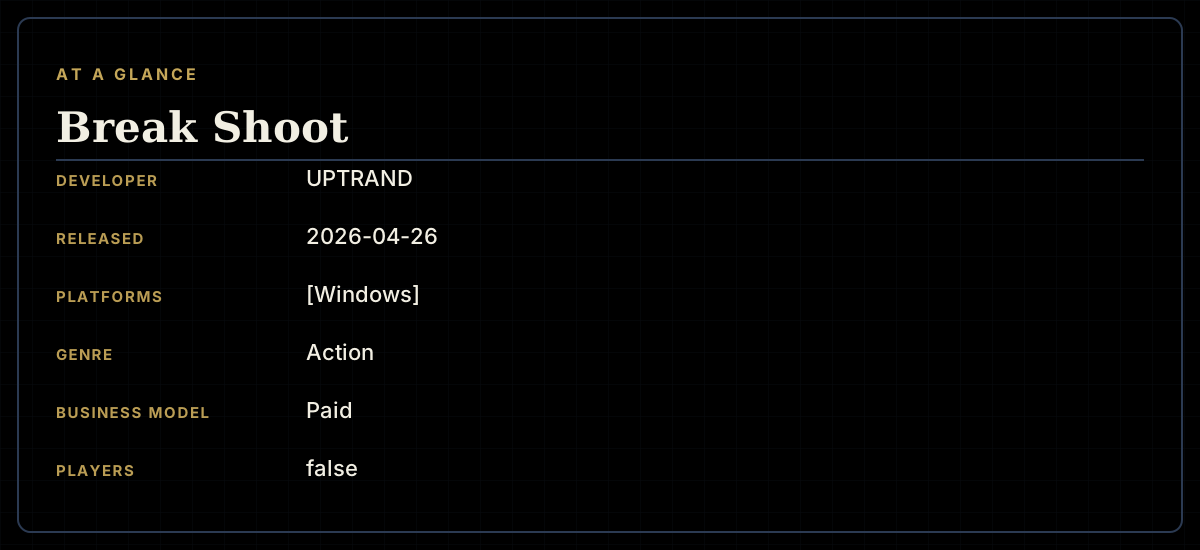
Key facts at a glanceWanderer Editorial -
The short versionWanderer Editorial