Game review
Beltex
6 / 10
- Developer
- Notional Games
- Publisher
- Notional Games
- Released
- 8 July 2022
- Platforms
- Windows
- Genre
- Puzzle
- Monetisation
- One-time premium purchase; no ads, in-game purchases or premium currency found
- Players
- Single-player only; no online, co-op or PvP modes
The short version
Beltex takes the belts-and-conveyors automation loop that Shapez made popular and swaps its shape-cutting for basic arithmetic: mine digits, add and multiply them into the specific numbers a central core demands, and route it all across a hex-gridded map with belts and bridges. Its own reviewers are unusually upfront about where the idea came from, and the game doesn't try to hide it either — what it offers instead is a cheaper, calmer, more approachable take on the same loop.
The trade-off is real depth. Only three operations exist for the entire game, copy-paste tooling that most automation puzzles treat as core stays locked away until well into a run, and there's no equivalent of the genre benchmark's proper end-game challenge. A genuinely dense first seven months of patches shows a developer paying attention, but support stopped in February 2023, and the same developer's next game — a direct, more fully-featured successor — makes a strong case for skipping straight past this one now that it exists.
Biggest strengths
- A clean, legible interface that multiple reviewers single out as easy to read and understand from the first few minutes
- The hex-grid layout gives routing puzzles a genuinely different visual and spatial feel from the square grids most factory-automation games use
- A real, dense patch cadence in its first seven months — fourteen updates between launch and February 2023 — including fixes and quality-of-life additions the community specifically asked for
Biggest weaknesses
- Explicitly and repeatedly described by its own reviewers as "Shapez but with numbers," with less content and no equivalent to that game's proper capstone challenge
- Only three mathematical operations exist for the entire game; once a player has built the basic patterns for each, later levels are largely repetition of the same techniques at larger scale
- Copy-paste tooling, essential to any automation game once bases get large, isn't unlocked until partway through the game — several reviewers say this alone kept them from recommending it until it was patched in, and even after the patch it stays locked out for the early hours
Who it's for: Automation-puzzle fans wanting a short, cheap, unintimidating entry point to the genre, or anyone who likes Shapez's loop but wants something calmer and less demanding. Not for players who already know the genre and want a deep, long-haul factory game.
Our recommendation: A fair budget pick on a discount for genre newcomers, but genre veterans should strongly consider the developer's own newer game, Beltmatic, instead.
6 / 10
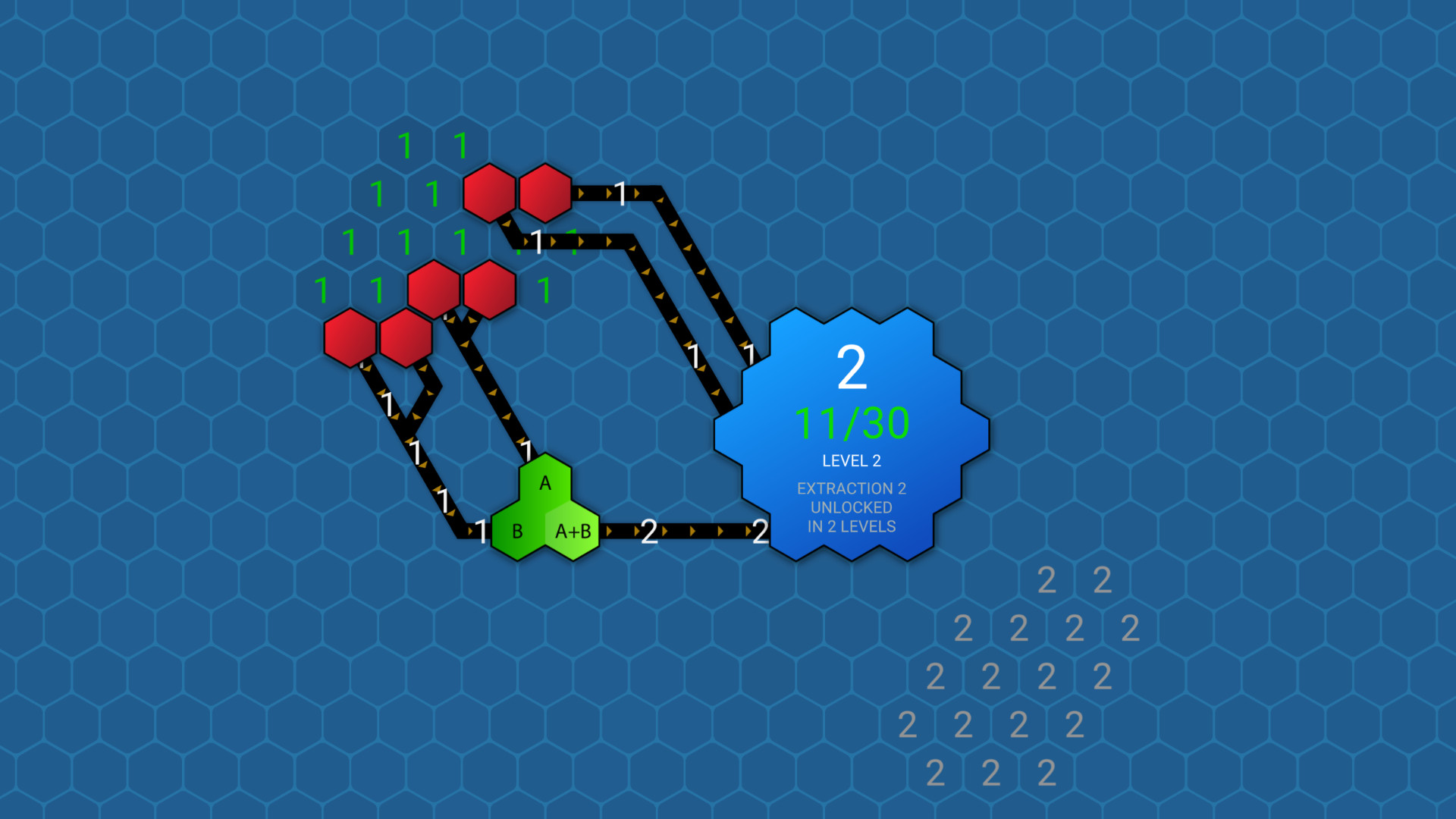
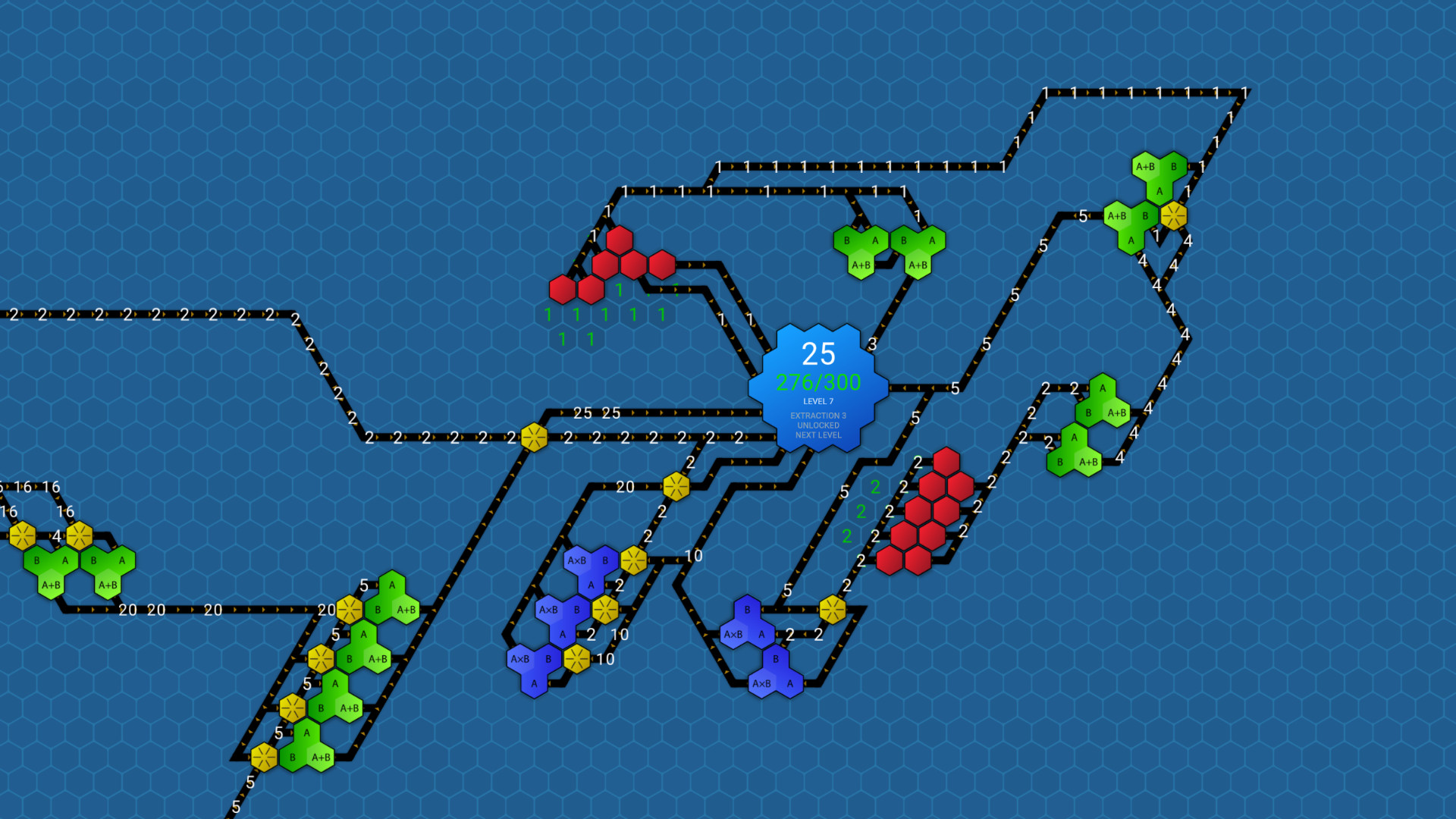
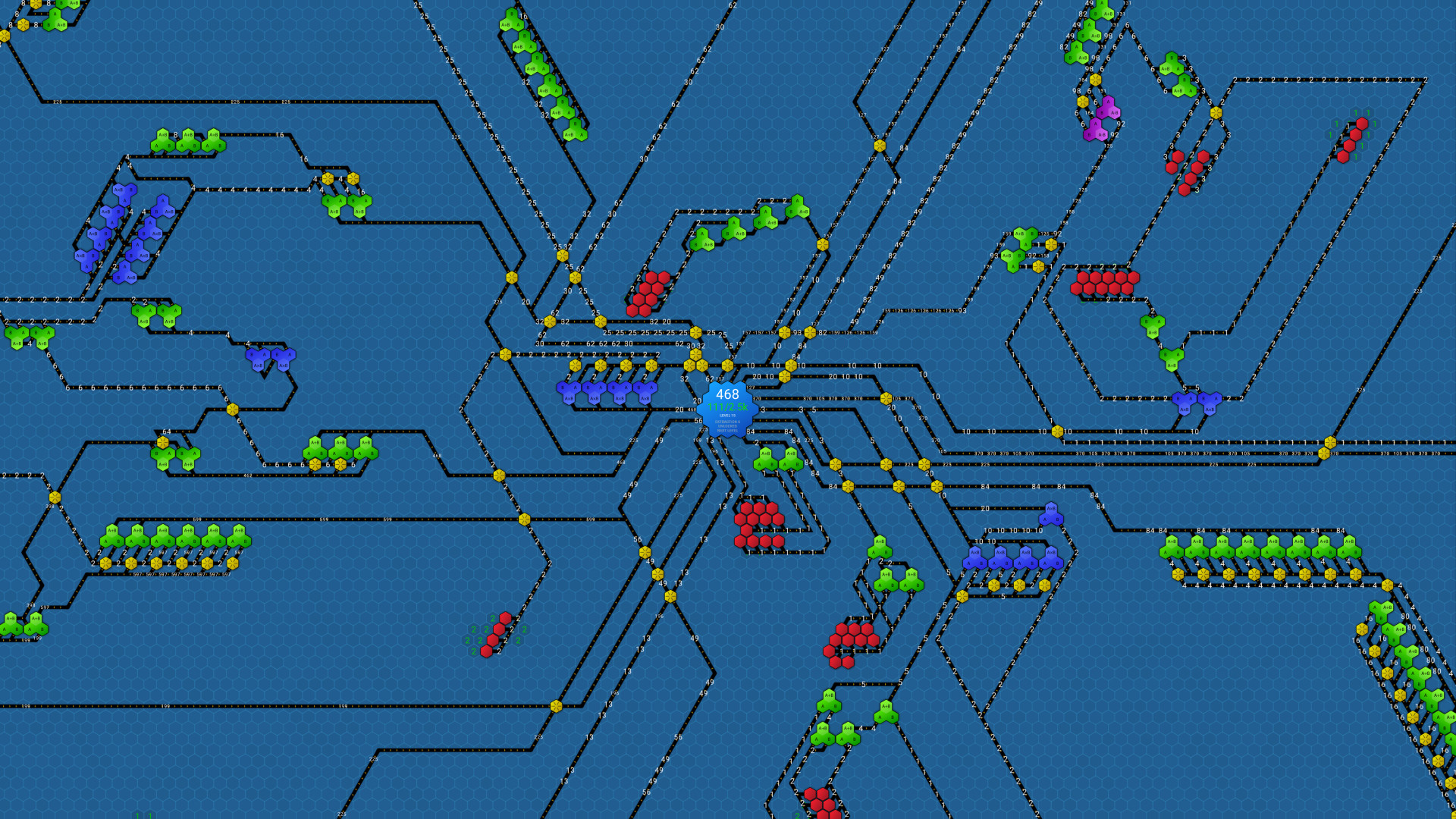
Beltex doesn't disguise its inspiration, and neither do the people who play it. It takes the belts- and-conveyors automation loop popularised by Shapez — mine a resource, process it through a chain of machines, route the result to where it's needed — and rebuilds it around basic arithmetic on a hex-gridded map instead of shape-cutting on a square one. You mine single digits, combine them with adders, subtractors and multipliers into the specific number a central core is demanding, and wire the whole thing together with belts, splitters and bridges. It's a genuinely clean idea, cheaply priced, and clearly built by a developer who understood the genre it was borrowing from. What keeps it from being more than a solid budget alternative is how much depth that borrowing leaves behind.
Approachable by design, thin by comparison
Reviewers who know the automation-puzzle genre are consistent and specific about where Beltex sits relative to its clearest reference point: simpler, calmer, and shorter, with less content and, crucially, no equivalent of Shapez's proper late-game capstone challenge. That's not necessarily a flaw on its own — a more approachable, lower-stakes entry point to the genre has real value, and several reviewers recommend it on exactly those terms, particularly praising the hex grid for giving routing puzzles a different rhythm than the square grids the rest of the genre defaults to. The clean, legible interface earns specific praise too. But the game only ever gives you three mathematical operations to work with, and once you've built a working pattern for each, the back half of its level progression is mostly the same techniques applied at larger scale rather than new ideas layered on top — a shape Steam's own achievement data backs up, with completion rates falling from 47% at an early level milestone to just 7.5% at the final one.
The hex grid itself is a genuine, if modest, design contribution rather than just a cosmetic swap. Reviewers note it changes how belts have to curve and merge compared to the right-angle routing every square-grid factory game defaults to, and several specifically call the resulting patterns more visually pleasing to build. It doesn't add new mechanical depth on its own — every routing problem the hex grid poses is still solved with the same handful of tools — but as a way of making a familiar loop feel a little fresh without adding complexity, it does what it sets out to do.
A late-arriving, half-locked essential tool
The single most repeated specific complaint is copy-paste. In any automation game, being able to duplicate a working section of factory rather than rebuild it by hand becomes essential the moment builds get larger, and several reviewers say its absence alone was enough to withhold a recommendation. The developer did respond — a patch just twelve days after launch added copy-paste support — but the feature stays locked until a specific mid-game level, meaning the early hours, where new players are least equipped to build efficiently by hand, are exactly when it's unavailable. It's a real fix that arrived fast, undercut by a gating decision reviewers still single out as a problem even after the fix shipped.
A genuinely dense support run, then a stop
Whatever else is true about its depth, Beltex's launch-era patch record is a real point in its favour: fourteen separate updates landed between its 8 July 2022 launch and 11 February 2023, most addressing specific community requests — the copy-paste system, automatic bridge placement, parallelogram-shaped selection tools, keyboard map panning. That's a genuinely attentive seven months for a small, cheap indie release. It also stopped there. There's been no further update since that February 2023 patch, and the developer's next release — Beltmatic, a mechanically related automation game launched in March 2024 — is described directly by players who've tried both as the more complete, better-realised version of the same underlying idea. That's a specific, checkable claim rather than vague praise for "the developer's other games": Beltmatic exists, carries the same developer credit, and its existence is the most concrete reason a reviewer today would point a new player toward it instead of here.
One achievement that punishes exactly the wrong thing
A smaller but telling issue: one of Beltex's twelve achievements requires reaching a high level without ever placing a bridge — a piece so easy to lay down by accident while routing belts around existing lines that at least one detailed review describes losing hours of unrelated progress after triggering it unintentionally, since there's no way to undo the requirement short of starting over. Steam's global completion data shows just 8.5% of players have ever earned it, the second-rarest achievement in the game behind only its final level. For a relaxed, low-stakes puzzle game, an achievement built around punishing a natural, easy-to-make mistake sits oddly against everything else Beltex is trying to be.
Where it lands
Beltex is a fair, honestly-priced way into the automation-puzzle genre for someone who hasn't played Shapez or wants something gentler than it, backed by real evidence the developer cared about the seven months it actively supported the game. It's not a game with much to offer players who already know this genre well, its toolset stays thin for its whole runtime, and its own developer has since made a better version of the same idea. A six reflects a solid, cheap, competently-built puzzle game that both its shallow depth and its own maker's follow-up work have since overtaken. Buy it, if at all, as an inexpensive first taste of the genre or a relaxed side game rather than a main event — and check the price against a sale first, since it rarely seems to sit at full price for long.
Pros and cons
Pros
- A clean, legible interface that multiple reviewers single out as easy to read and understand from the first few minutes
- The hex-grid layout gives routing puzzles a genuinely different visual and spatial feel from the square grids most factory-automation games use
- A real, dense patch cadence in its first seven months — fourteen updates between launch and February 2023 — including fixes and quality-of-life additions the community specifically asked for
- Cheap even at full price, and frequently available at a steep discount
Cons
- Explicitly and repeatedly described by its own reviewers as "Shapez but with numbers," with less content and no equivalent to that game's proper capstone challenge
- Only three mathematical operations exist for the entire game; once a player has built the basic patterns for each, later levels are largely repetition of the same techniques at larger scale
- Copy-paste tooling, essential to any automation game once bases get large, isn't unlocked until partway through the game — several reviewers say this alone kept them from recommending it until it was patched in, and even after the patch it stays locked out for the early hours
- One achievement requires reaching a high level without ever placing a bridge, an easy piece to place by accident that forces a full restart if triggered — reviewers call this a punishing, poorly considered goal for what's otherwise a relaxed game, and Steam's own completion data shows barely one in twelve players ever earns it
- Development stopped after a February 2023 patch, and the developer's 2024 follow-up game, Beltmatic, is described by players who've tried both as the more complete version of the same idea
Screenshots
-
BeltexImage: Notional Games via Steam -
BeltexImage: Notional Games via Steam -
BeltexImage: Notional Games via Steam -
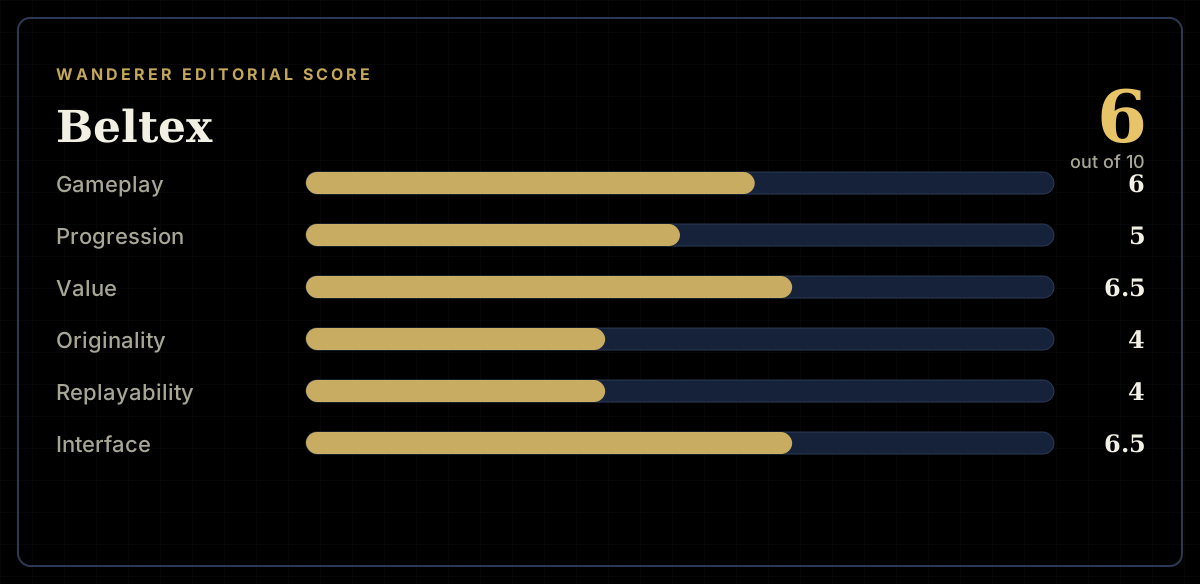
How the review scores each part of the gameWanderer Editorial -
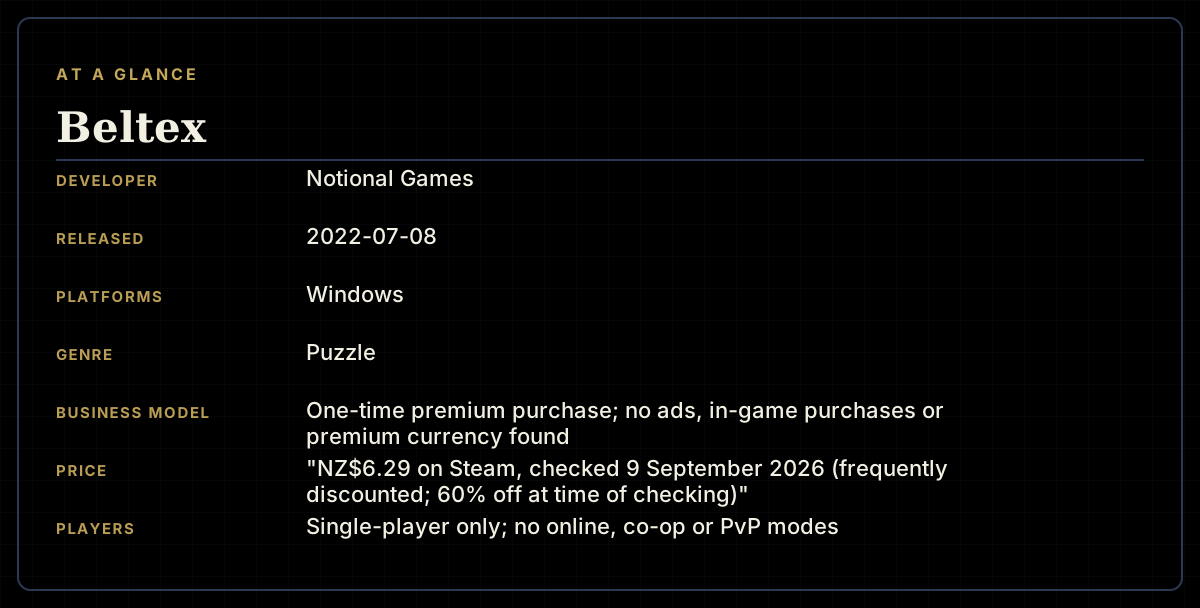
The specsWanderer Editorial -
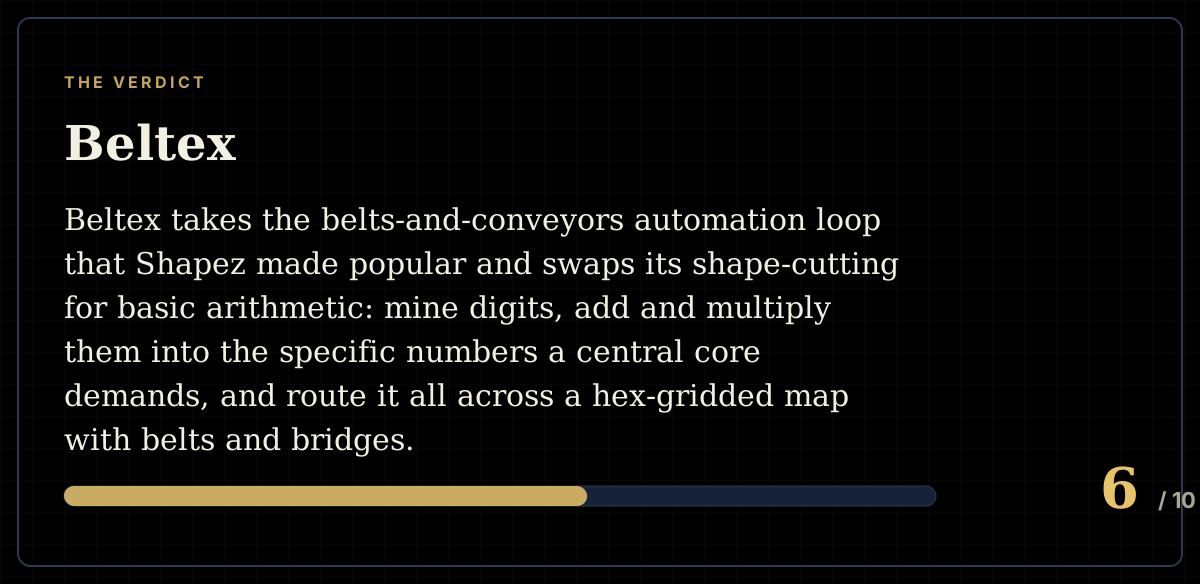
The short versionWanderer Editorial