
Game review
Beggar's Life
6 / 10
- Developer
- Perennial Hearts LLC
- Publisher
- Perennial Hearts LLC
- Released
- 14 June 2026
- Platforms
- Windows
- Genre
- Indie, RPG, Simulation, Strategy
- Monetisation
- paid
- Players
- false
The short version
Biggest strengths
- A genuinely unique, philosophically-themed premise built around a medieval beggar's search for meaning, with distinctive class paths like priest, thief, or pyromaniac
- Deep, intertwined systems of skills, resources, tasks, and locations that reward imagination and experimentation
- A minimalist, text-forward presentation that several reviewers said sparked genuine creative engagement rather than feeling barren
Biggest weaknesses
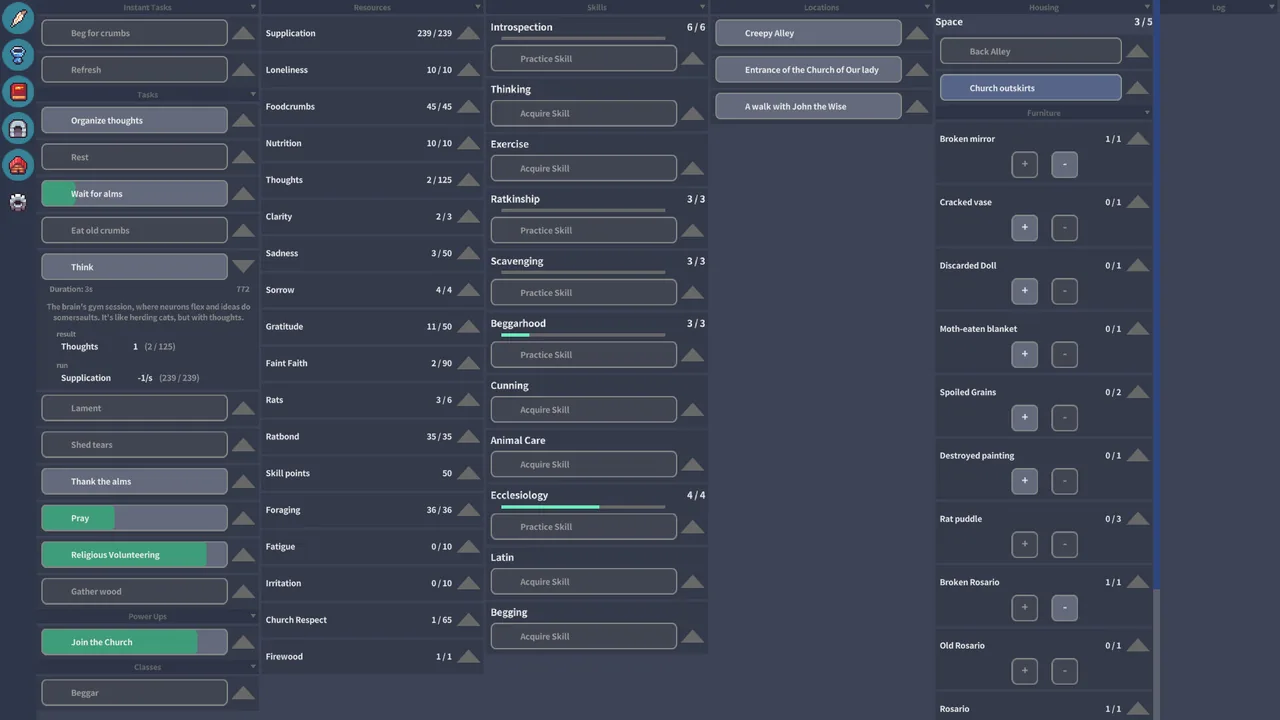
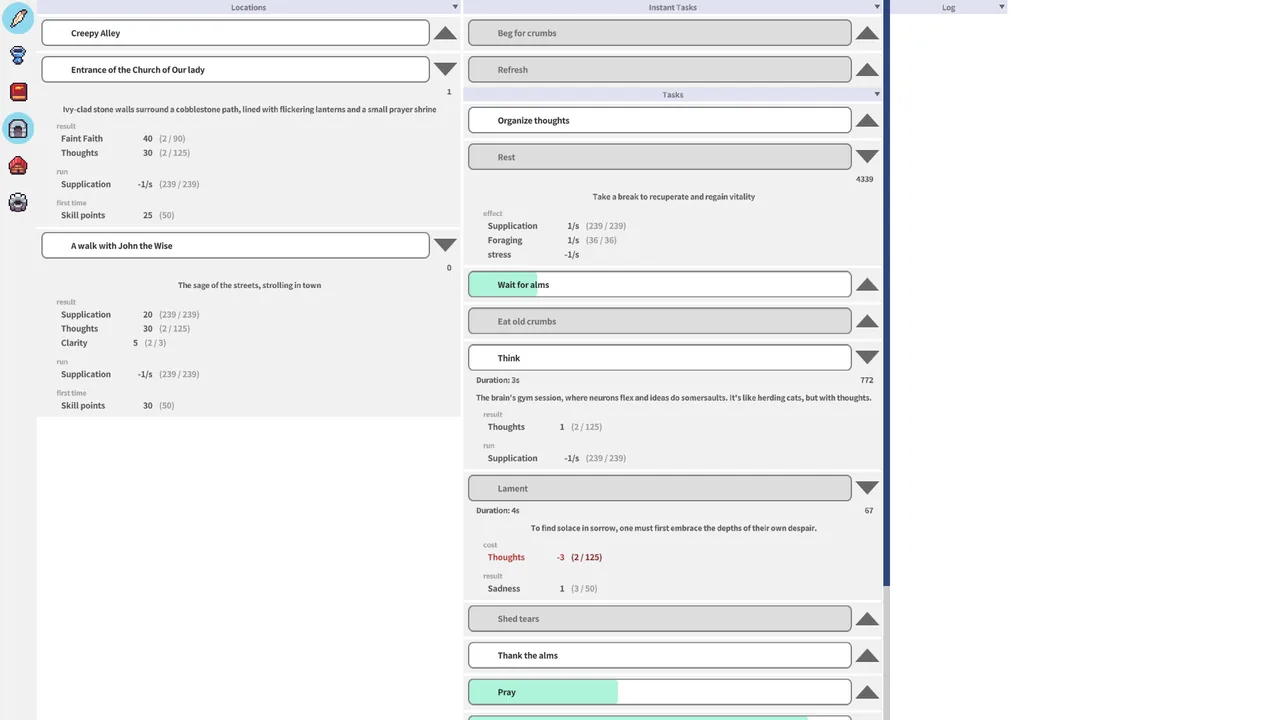
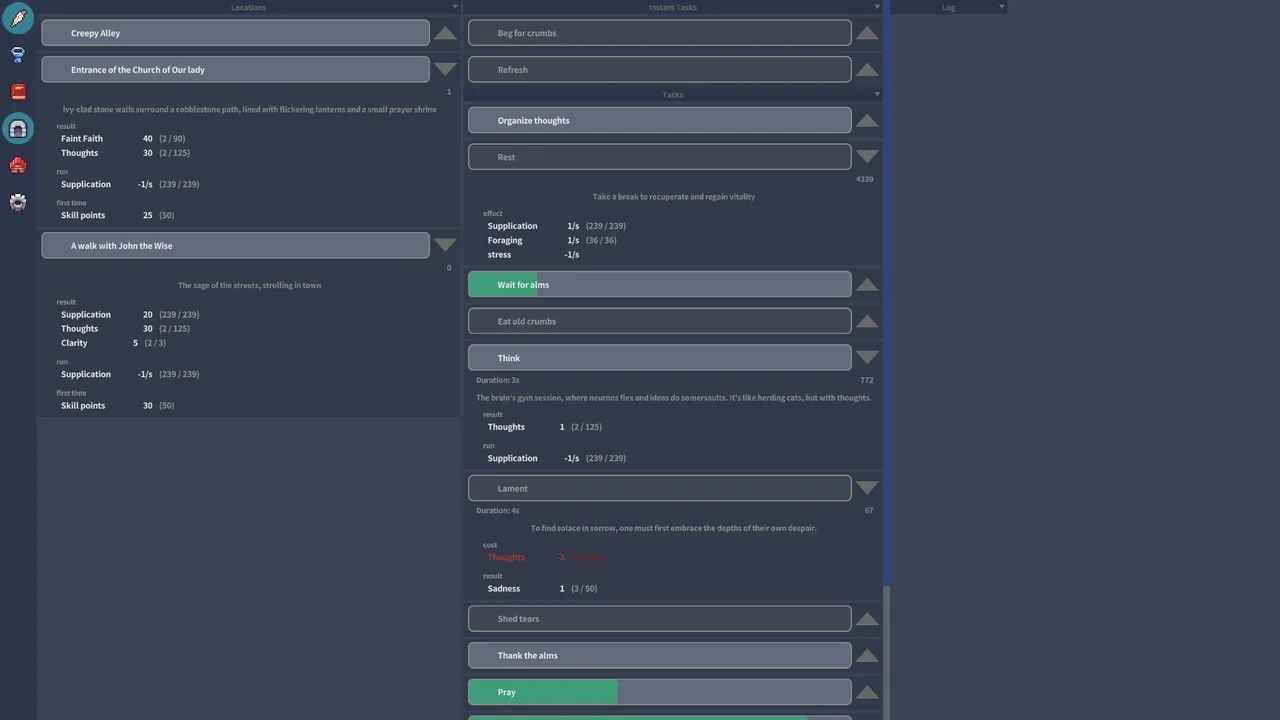
- A cluttered, unintuitive UI that a large share of reviewers described as genuinely exhausting, with hidden menus and poor use of screen space
- Minimal quality-of-life features, including no ability to queue tasks, hide completed items, or reliably see resource income and outcome
- Inconsistent pacing that some reviewers found either too slow to sustain interest or too demanding of active attention to feel like a true idle game
Who it's for: Fans of deep, text-heavy incremental games like Theory of Magic or Kittens Game who can tolerate a genuinely rough, cluttered interface for real thematic and mechanical depth
Our recommendation: recommended
6 / 10
Beggar's Life released on Steam on June 14, 2026, from developer Perennial Hearts LLC, a textual incremental game that casts players as a nobody begging for food in a medieval city, gradually growing into one of several distinct paths, priest, thief, rat lover, or sadistic pyromaniac, while navigating church politics and a dense web of intertwined skills and resources. Its 29-review English pool lands at Mixed (19 up, 10 down, 66%), and the split is unusually coherent: reviewers overwhelmingly agree on what the game does exceptionally well and what holds it back, they simply weigh those two things differently.
The game's thematic ambition draws some of the pool's most personal, striking praise. One reviewer wrote that the game's theme of "lost philosophy" resonated deeply, explaining that "growing stronger in this game always involves gaining clarity and becoming a reflective person," adding, "as an invisible nobody who struggles for clarity and longs for philosophy, I feel seen." Another reviewer summarized the game's arc more playfully, joking, "I begged so hard I became Socrates," while a longer review described the underlying question driving the whole experience: "you are looking for the meaning of life... is it happiness with cats, reality with rats, are you trying to find how to be good, or are you going to be a sadist that captures and burns people," concluding that the specific ending mattered less than "the route there," which the reviewer called "overwhelming with a lot of possibilities" that players have real freedom to sort through and define for themselves.
Reviewers consistently and independently compare the game to Theory of Magic (also known as Arcanum), a beloved deep incremental game, and the comparison is treated as both a compliment and a useful warning about what kind of experience to expect. One reviewer pushed back specifically on the developer's own marketing framing, writing "the dev made a big mistake advertising it as similar game to Theory of Magic," arguing that unlike that game's "overworked maze with dead end pathways" requiring a wiki to navigate, Beggar's Life "has a more single minded design and pathways, which makes the content much more fun and interesting to explore," concluding it's "much more playable than Theory of Magic." A different, more critical reviewer reached a more measured version of the same comparison after finally completing a full run, writing "I love Theory of Magic and there aren't very many games like it, if you like that style you will probably enjoy this game, but it is missing quite a bit of QoL," ultimately rating their own experience around "60% positive" despite genuinely wanting to like it more.
That quality-of-life gap is, by a wide margin, the pool's most consistent and detailed source of complaint, showing up in some form in nearly every critical review and even several positive ones. One reviewer described the interface bluntly: "the game plays like a bullet-point list on PC... there's a dropdown menu with literally every button," adding that "for an incremental game, this is a horrible weakness" because it fails to respect the player's time. Another wrote that "the more you unlock, the more cluttered it gets," describing headaches from "how many times I had to scroll just to press another skill." A separate reviewer catalogued specific missing features directly: "no ability to queue actions... UI popup elements get locked... if you don't realize that 'Locations' are hidden, you'll miss half the game," a detail they said cost them access to roughly half the content on their first attempt, though they were upvoting anyway "to help the developer" because "we need more idle games."
Several reviewers also pushed back specifically on the game's positioning as an idle or incremental title, arguing its actual pacing sits awkwardly between genres. One reviewer described it as sitting "at that annoying point of being too active to nicely idle but too idle to be truly active," specifically criticizing a buff mechanic that requires "holding down the 1 key indefinitely" rather than offering a simple toggle. Another was harsher still, writing, "TLDR: if you like idle games, this aint it chief," and detailing how too many resources can't be automated once a player progresses past their early stages, arguing the game would benefit from automatically queuing follow-up activities when a chosen task runs dry on a needed resource. A separate reviewer specifically called out the lack of offline progression as a fundamental mismatch with genre expectations, concluding the developer seemed to be blending inspirations, name-checking Hobo: Tough Life, "that's not working together, yet."
One reviewer raised a more pointed concern worth reporting carefully: after purchasing what was billed as the full release, they found it loaded a save from an earlier demo and displayed text directing players to Patreon "for most up to date version," and reported waiting five days without a reply after asking about it in the game's discussion board. That reviewer's review was later edited to note, "dev did answer, is the full game," resolving the concern, but the episode is worth flagging as a legitimate, developer-addressed instance of buyer confusion around what exactly shipped at release, rather than an ongoing unresolved issue.
Despite the rough edges, a meaningful share of the pool remained genuinely enthusiastic, framing the interface complaints as real but ultimately secondary to the game's originality. One reviewer wrote, "it's really sad that good games like this get mixed reviews on Steam. Sure it's a bit rough around the edges, but who cares? The world needs more non-idle incremental games like this," while another described a specific, nostalgic pull to the experience, comparing it to "one of those random browser games you stumble upon and then play for 12 hours straight despite the game first appearing fairly simple." That split, genuine enthusiasm for the underlying design paired with genuine frustration at how it's currently presented, is the clearest way to understand the game's mixed rating: this isn't a shallow or poorly conceived game struggling to find an audience, it's a genuinely deep and original one that hasn't yet built the interface its ambitions deserve.
Given its real thematic and mechanical depth, and reviewers' consistent agreement that the underlying design compares favourably to beloved genre touchstones like Theory of Magic, Beggar's Life is a reasonable recommendation for incremental-game fans willing to push through a genuinely rough, cluttered interface to find something distinctive underneath. Players who need a polished, well-signposted idle experience right now should wait for quality-of-life updates, but for the specific pleasure of building a strange, deeply personal medieval life out of scraps and ambition, there's real substance here worth the low asking price.
Pros and cons
Pros
- A genuinely unique, philosophically-themed premise built around a medieval beggar's search for meaning, with distinctive class paths like priest, thief, or pyromaniac
- Deep, intertwined systems of skills, resources, tasks, and locations that reward imagination and experimentation
- A minimalist, text-forward presentation that several reviewers said sparked genuine creative engagement rather than feeling barren
- A clear point of comparison to beloved incremental games like Theory of Magic, which many reviewers said it improves on in specific ways
Cons
- A cluttered, unintuitive UI that a large share of reviewers described as genuinely exhausting, with hidden menus and poor use of screen space
- Minimal quality-of-life features, including no ability to queue tasks, hide completed items, or reliably see resource income and outcome
- Inconsistent pacing that some reviewers found either too slow to sustain interest or too demanding of active attention to feel like a true idle game
- At least one reviewer raised concerns about whether the released version matched the most up-to-date build, a complaint the developer did respond to
Screenshots
-
Beggar's LifeImage: Perennial Hearts LLC via Steam -
Beggar's LifeImage: Perennial Hearts LLC via Steam -
Beggar's LifeImage: Perennial Hearts LLC via Steam