Game review
Areteion Review
7 / 10
- Developer
- juxtapositioned
- Publisher
- juxtapositioned
- Released
- 13 July 2026
- Platforms
- ["Windows", "Mac"]
- Genre
- Strategy
A 4X Card Game That Plays Like a Strategy Game First
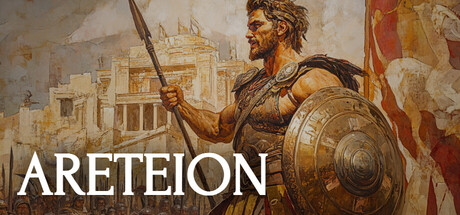
Areteion launched July 13, 2026, the solo-developed work of "juxtapositioned," and its pitch is unusually specific about what it isn't: a card game where you "throw units at your opponent's face." Instead, cards go onto a shared board where they farm, hunt, fish, build, explore, and only sometimes fight, with victory measured in accumulated Arete rather than a depleted health bar. One reviewer who logged over 45 hours framed the appeal precisely: "A Blend of Sorcery, Battletech, and Dune: Imperium... the core gameplay is you play lands and units, exactly like in Sorcery, to gain resources to play more, until inevitably you clash with your opponent." At review time it sat at 17 positive reviews against 1 negative, a small but nearly unanimous 94 percent "Positive" pool for a niche genre-blend that, by its own reviewers' account, doesn't have an obvious comparison point on Steam.
Twelve Gods, Twelve Ways to Play
The structural hook is that every deck is built around one or two of twelve Olympians, and each plays according to that god's domain rather than a shared set of card-game archetypes: Demeter builds farms, Artemis sends hunters chasing game across the map, Poseidon builds harbors and fishes, Ares just attacks. One reviewer who came in skeptical ended up sold specifically on that variety: "Each god plays totally different, a lot [of] archetypes to build... Three game modes, in one you construct your own deck between the cards you have unlocked, the other is a roguelike where you draft cards from your god, the last one is vs." Another reviewer, a 4X and RTS fan rather than a traditional card-game player, described the fit well: "Plays like a 4x, RTS, or Strategy game with the cards taking on the structures, units, and heroes," which is close to the exact hybrid the store page promises and, based on the review pool, mostly delivers.
The Board Fights Back, and the Gods Are Fickle
Beyond deckbuilding, Areteion layers in board-level unpredictability that reviewers describe as both its best and most divisive feature. Barbarians raid, monsters like the Lernaean Hydra squat on good land, and a Favor system rewards or punishes players based on how well they've appeased their chosen Olympians. "The game is dynamic, the field of battle can change drastically from turn to turn... every turn the Gods could potentially punish you, forcing you to alter your strategy, or granting you a boon highlighting an alternate strategy," one reviewer wrote, adding that at launch the game "had UI and quality of life issues that were resolved by the solo dev within a day." Not every reviewer loves the volatility, though: one negative review summed up the frustration directly, "you play good game but systematically random events crash all effort, ends up being just boring," a fair complaint against a design that deliberately refuses to let players lock in a single optimal line of play.
The Recurring Complaint: Grind and Randomness in the Unlock Path
The most consistent reservation among otherwise positive reviewers is how much of the game's depth stays gated behind a slow unlock curve, and how much randomness governs whether a run goes well. "Unlocking content is a bit on the grindier side. A lot of how a game pans out depends on randomness (not just card draw but events, locations, etc.), so if you are the type who wants to optimize in predictable environments rather than see it as an opportunity to adjust, then it may not be for you," one reviewer wrote, a fair-minded assessment that frames the randomness as a taste issue rather than a flaw outright. A separate reviewer flagged a related onboarding gap at launch: "It's good! Learning wish there was a tutorial but will still play and get it." That specific complaint didn't sit unaddressed for long, a "Tutorial & Offer to the Olympians" patch landed two weeks after launch, one of several examples of the developer visibly responding to exactly the friction reviewers were describing.
A Genre Mashup With Real Reference Points
What's notable across the review pool is how many players reach for the same handful of comparisons to explain what Areteion is doing, and how consistently those comparisons land as compliments rather than complaints. Beyond the Sorcery and Dune: Imperium references, one reviewer pointed to a more card-game-native touchstone: "If you played Duelyst or similar games to that, you should also check this out... The characters/decks are genuinely unique and they interact with different components of the game, which I think makes them pretty interesting." That same reviewer was candid about the tradeoff of a one-person project: "Note that it is a one-dev project, so expect it to be a bit rough." Several others echoed variations of "labor of love," a phrase that shows up more than once in the pool, generally attached to praise for how much thematic and mechanical depth exists across twelve distinct playstyles and 600-plus cards for a solo-developed release.
A Solo Developer Patching Multiple Times a Week
Areteion's update history backs up the "responsive solo dev" reputation the review pool has built for it. Steam's news feed shows a hotfix on launch day itself, followed by numbered patches nearly every few days through July and August: balance passes for individual gods, an AI overhaul, a board UI rework, a "Persistent Power" update that rebuilt the Hero's Journey roguelike mode, and a Favor-system rework in early September, the most recent patch landing September 9, 2026, less than two months after launch. That cadence, several updates per week sustained over two months by a single developer, is doing real work in the review pool: multiple reviewers specifically credit fast fixes to launch-week UI complaints as the reason they stuck with the game past a rough first session.
Verdict
Areteion is a genuinely uncommon idea executed with more thematic depth and mechanical ambition than its tiny review count would suggest, twelve Olympians who each demand a different strategic approach, a board that actively fights back against whatever plan you settle on, and a solo developer whose patch cadence rivals much larger studios. What holds it back from a wider audience is exactly what a handful of reviewers already flagged: a grindy unlock curve, randomness that can swing a promising run into a frustrating one, and rough edges that come with being a one-person passion project rather than a polished mainstream release. At $19.99, it's a strong pickup for strategy fans burned out on traditional CCGs and looking for something closer to a board game in card-game clothing, though players who want predictable, optimizable systems should wait for a few more balance passes first.
Screenshots
-
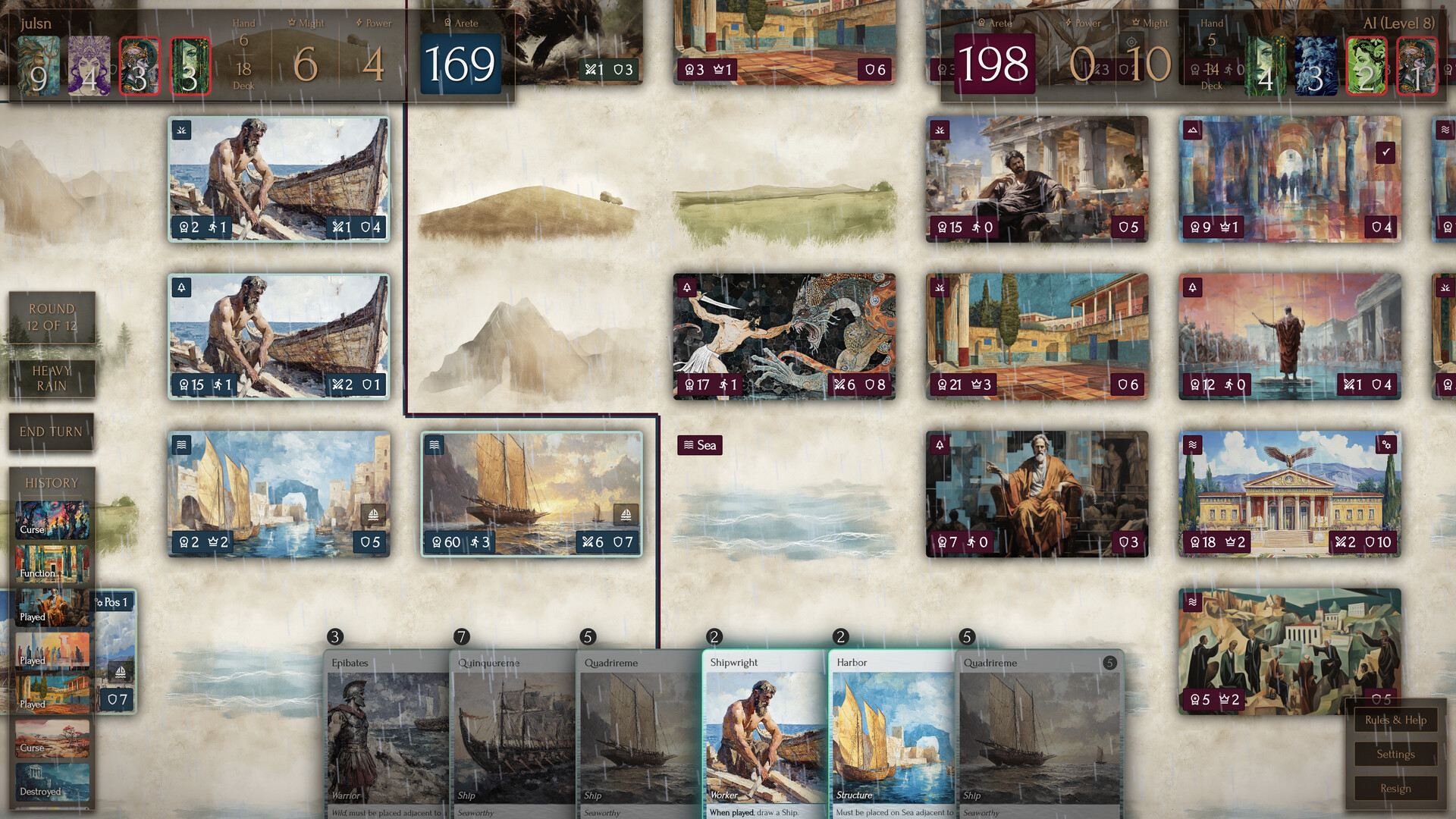
A Poseidon-leaning board mid-match, ships and harbors built out along a rain-soaked coastline.Image: juxtapositioned via Steam -
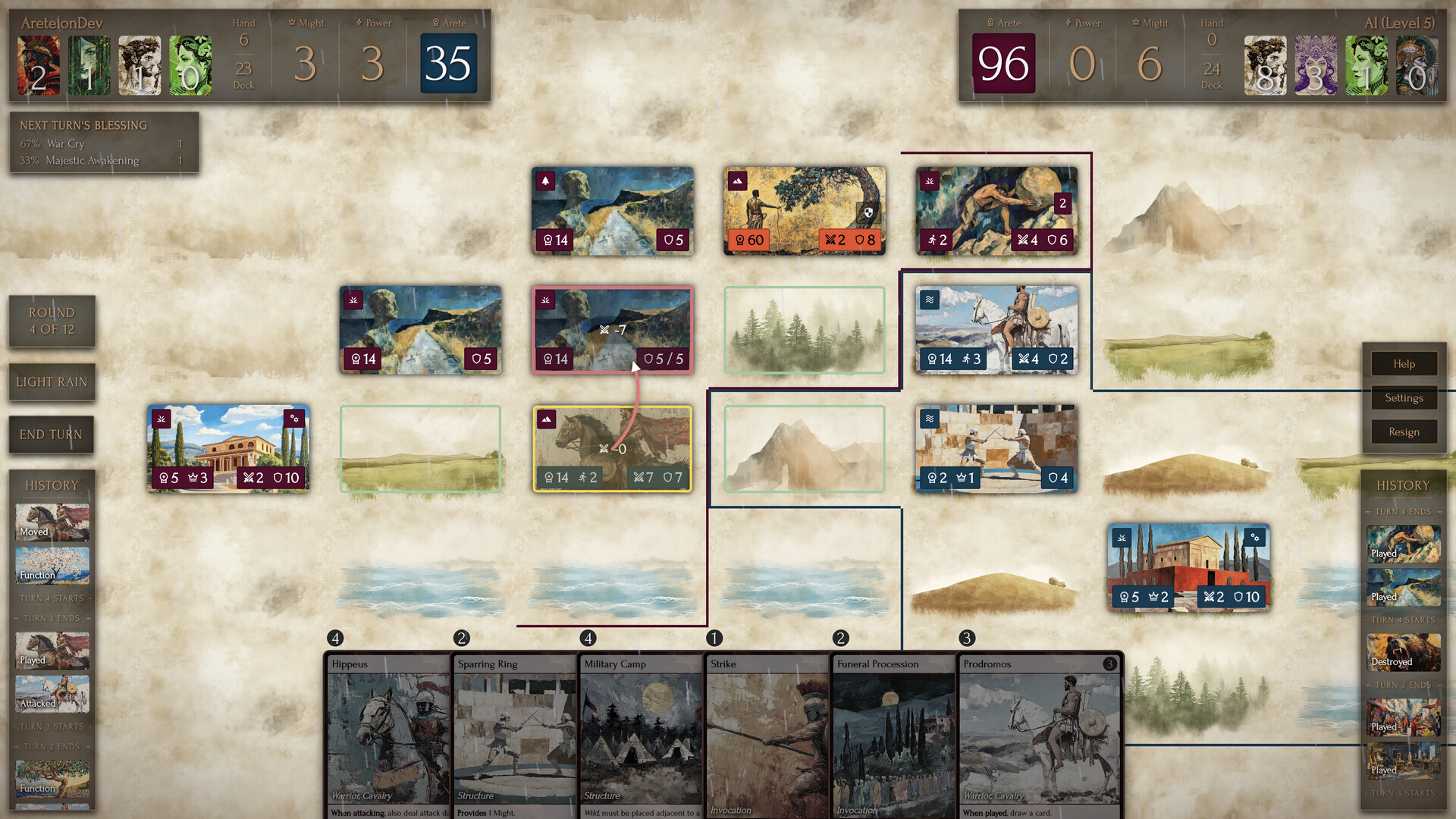
A wider board layout showing the terrain-driven movement paths and the Favor system's turn-ahead forecast.Image: juxtapositioned via Steam -
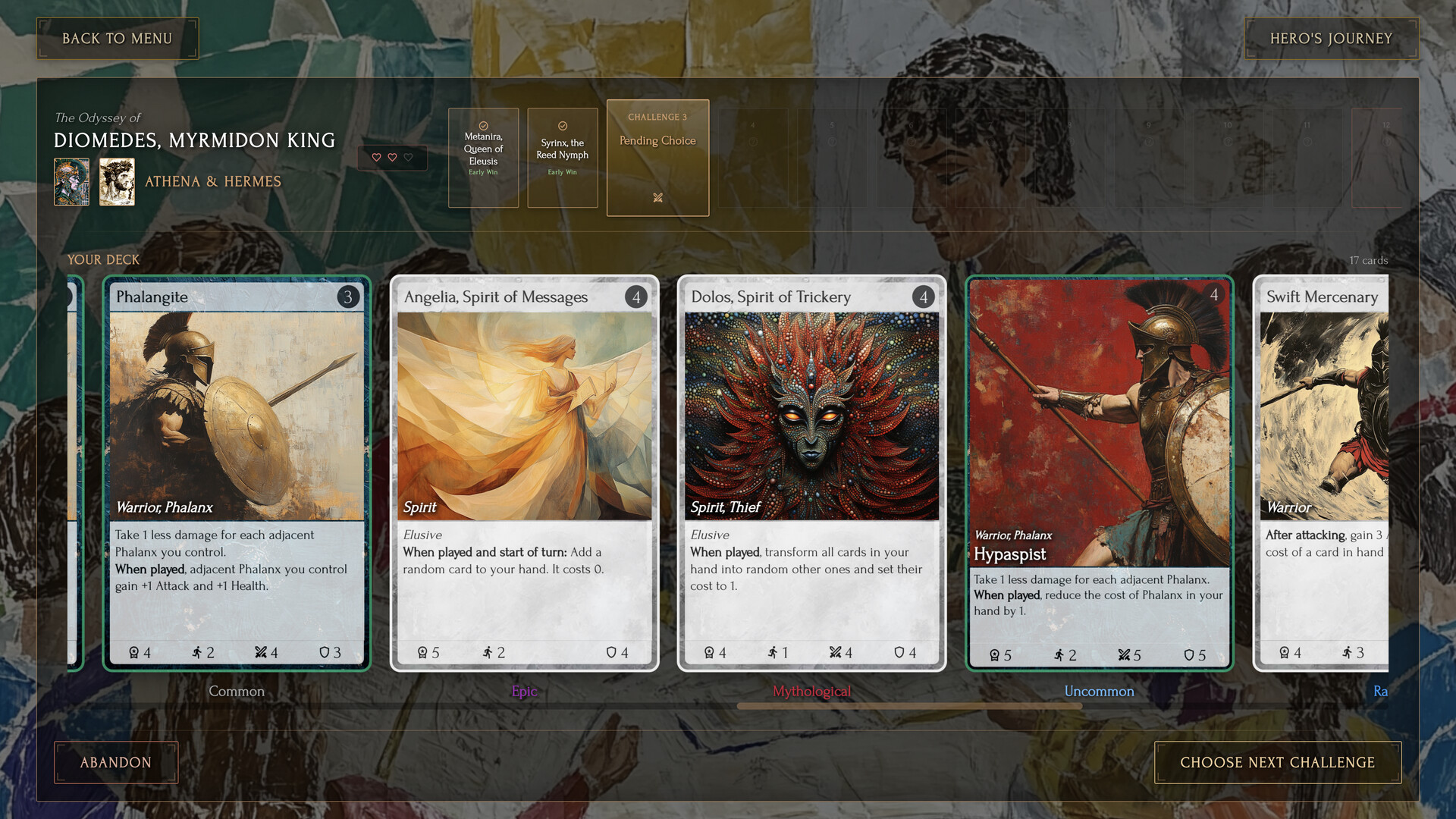
Drafting cards in the Hero's Journey roguelike mode, one of the game's three ways to play.Image: juxtapositioned via Steam