Game review
Ages of Conflict: World War Simulator
7 / 10
- Developer
- JoySpark Games
- Publisher
- JoySpark Games
- Released
- 17 February 2023
- Platforms
- Windows, macOS, Linux
- Genre
- Map painting and nation-conflict simulator
- Monetisation
- Premium, one-off purchase — no DLC, no in-app purchases, no ads. Steam Workshop is free, and 11 Steam Achievements plus Steam Cloud saves are included at no extra cost
- Players
- Single-player only; there is no online or local multiplayer mode, and no way to control a nation head-to-head against another player
The short version
Ages of Conflict hands you a blank map, a paintbrush for borders and terrain, and a roster of AI nations that will fight, ally, splinter and rebuild entirely on their own once you stop touching anything. The scenario editor and Steam Workshop are the real draw — hundreds of community-made worlds spanning real history, alternate history and pure invention, all free to drop into and let run. The trouble is the layer that actually decides who wins those wars: an abstracted "combat effectiveness" stat that fluctuates close to randomly, with only a loose connection to a nation's size, population or position. Watching history unfold is still compelling in short bursts; watching it unfold according to a stat that seems to ignore the map underneath it gets old once the novelty wears off.
Biggest strengths
- The map and scenario editor plus live "God Mode" tools let you reshape borders, terrain and nation stats mid-simulation without pausing the world, which makes building your own scenario almost as engaging as watching one
- Steam Workshop hosts hundreds of community scenarios covering real history, alternate history and invented fantasy worlds, multiplying the content on offer at no extra cost
- At under $7 with no DLC, ads or in-app purchases, the price is negligible next to the multi-hundred-hour playtimes its most devoted players routinely log
Biggest weaknesses
- Combat outcomes lean on a largely randomized "combat effectiveness" roll with only a loose tie to a nation's territory, population or resources, so a single-tile micro-state can repeatedly claw back ground from a continent-spanning empire for no legible reason
- There is still no way to actually play as one nation and be held accountable for its own survival — the closest the game gets is nudging AI-controlled borders from outside at any time
- Over three years into Early Access, well past the developer's own original roadmap estimate, updates have leaned toward polish and new toggles rather than the deeper systems — real population counts, casualties, diplomacy, logistics — that recur constantly in player feedback
Who it's for: Best suited to players who already like the "leave it running and see what happens" appeal of games like WorldBox — history buffs, map nerds, and anyone who finds satisfaction in building a scenario and then just watching it play out rather than directing every beat themselves. A poor fit for anyone expecting the territorial logic of a Paradox grand strategy game or wanting to play as a single nation and be held responsible for its survival.
Our recommendation: An easy purchase at under $7 if the pitch alone appeals to you — paint a map, spawn some nations, and watch centuries compress into an afternoon. Go in knowing the war resolution is closer to a randomized tug-of-war than a simulation of actual military or economic strength, and that the game has now spent over three years in Early Access adding content faster than it has added the deeper systems its own players keep asking for.
7 / 10
Leave a save of Ages of Conflict running long enough and it will hand you a story no writer planned: a landlocked micro-state outlasts three larger neighbours by inches, a puppet state declares independence the moment its master loses a border skirmish, and an empire that once painted half the map in its colour quietly dissolves into six squabbling successor states over the following century. None of it is scripted. All of it happens because you painted some borders, assigned some nations, and then did nothing at all. That's the entire pitch, and for a lot of players it's enough — the game has settled in as a genuine Steam Workshop phenomenon with players routinely logging hundreds, sometimes thousands, of hours letting worlds run in the background. The problem is what's actually deciding those outcomes underneath the spectacle, and once you notice it, it's hard to un-notice.
A map painter first, a war game second
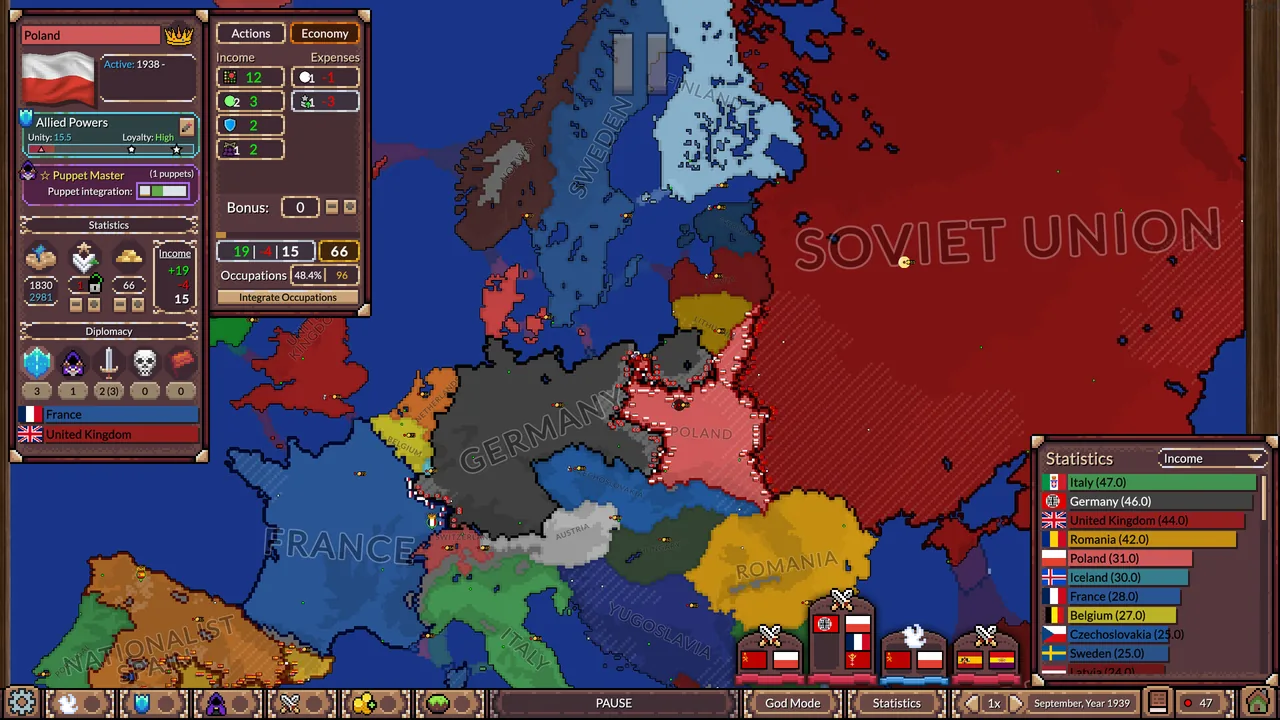
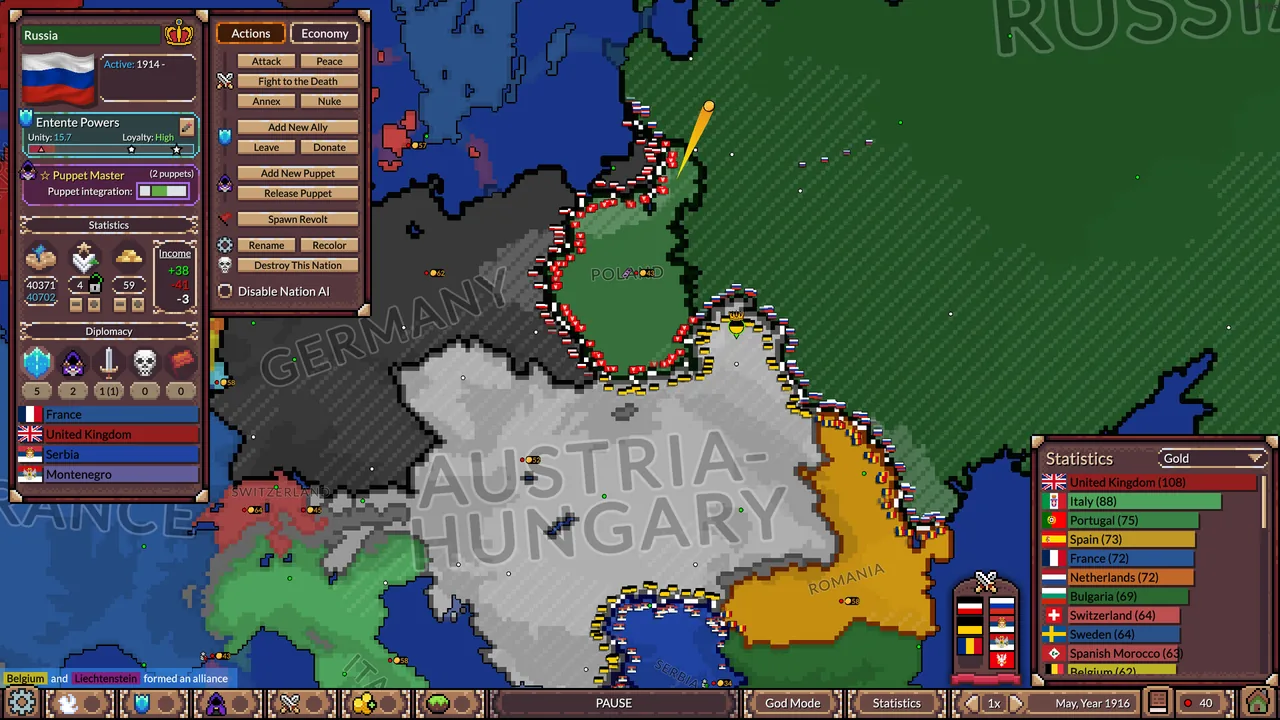
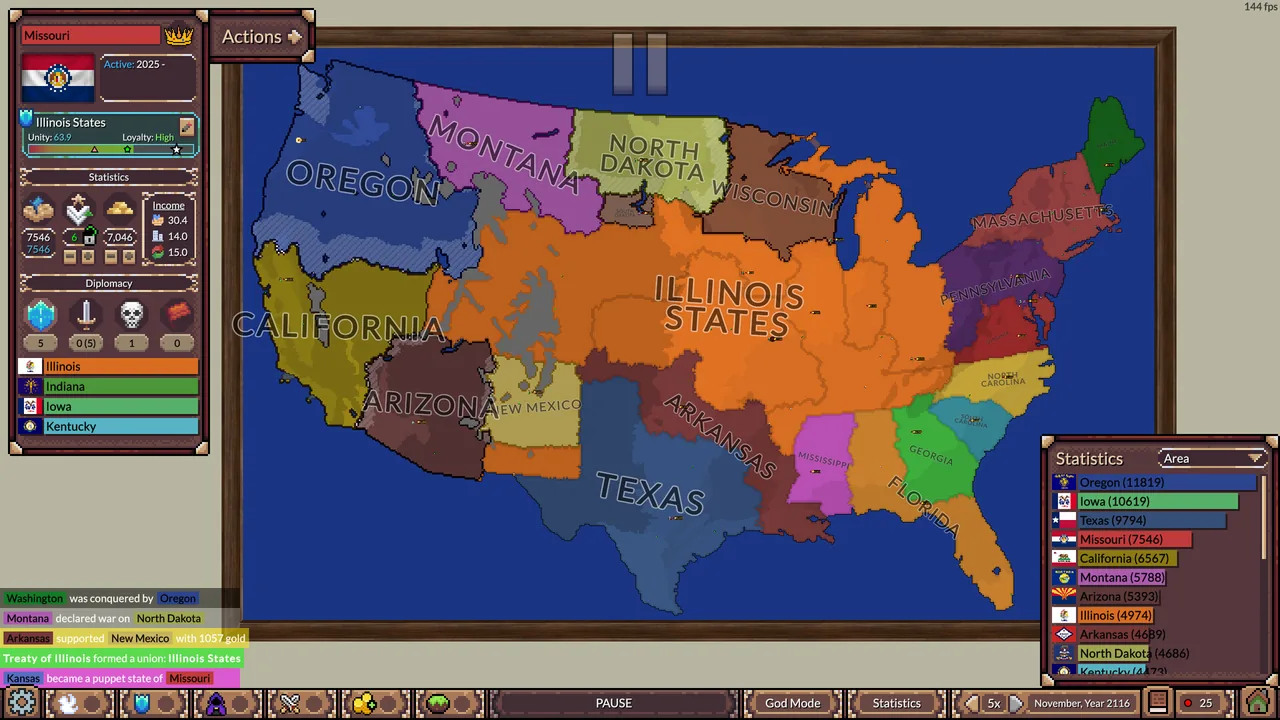
The core loop has almost nothing to do with traditional strategy gaming. You either load one of the built-in maps and scenarios or open the editor and draw your own — coastlines, terrain, and then a patchwork of nations assigned starting territory, colours, and a handful of stats. Press play, and the simulation takes it from there: nations expand into unclaimed land, form alliances, go to war with neighbours, and occasionally fracture into revolt or dissolve into puppet states of whoever conquered them. "God Mode" tools let you reach in at any point without pausing anything, nudging a nation's stats, redrawing a border, or propping up a collapsing state on a whim, which makes the editor almost as much of a toy as the simulation itself.
That framing — a map painter that happens to run a war sim underneath — is the right way to approach it. The developer's own store page is explicit that this "is not a Strategy Game," and taken on those terms the tools genuinely deliver. Building a scenario from scratch, populating it with a dozen custom nations and flags, and watching your own creation play out is a different kind of satisfaction than winning at Civilization or Hearts of Iron, and it's one the game is well built to provide.
The dice roll problem
Where it runs into trouble is the one system a "simulator" can't really avoid getting right: who wins a war. Every nation carries a "combat effectiveness" value that swings up and down more or less at random, and battles are resolved by comparing that number between the two sides rather than anything tied to territory size, population, terrain, or supply lines. The result, repeated across an enormous number of player reviews, is that a nation the size of a single province can hold off — or even claw back ground from — an empire that dwarfs it many times over, with no explanation beyond a favourable roll. One frequently-cited example has a country the size of Bermuda pushing back the borders of the United States; it's funny the first time and symptomatic of a real design gap the tenth.
This isn't a fringe complaint. It's the single most common thread running through the minority of negative reviews, and it shows up constantly inside otherwise-positive ones too, usually phrased as a wishlist item: give combat effectiveness some actual connection to the map, add population and casualties so wars carry real weight, let alliances matter beyond a name on a diplomacy screen. The developer has kept shipping updates since the February 2023 Early Access launch, and Workshop support plus achievement and Cloud-save infrastructure show a project that's being maintained rather than abandoned — but the fundamental war-resolution model that players have been asking to see deepened for years is still, largely, the same randomized tug-of-war it launched with.
Where the Workshop earns its keep
The single strongest thing keeping the base game feeling fresh well past its own systems is Steam Workshop support. Hundreds of community-built scenarios are available for free, ranging from faithful historical maps and specific conflict recreations to full alternate-history "what if" setups and entirely invented fantasy worlds. Because the map editor and the simulation are the same tool the developer used to build the included scenarios, there's no meaningful gap between what the community can produce and what ships in the box — which is rare, and it's the reason the game has a much longer tail than its comparatively thin core mechanics would suggest on their own. If the built-in scenarios feel like they've been fully explored, the Workshop is where the real replay value lives.
It's worth being upfront about the genre comparison that comes up constantly around this game: it gets called a WorldBox clone often enough that it's worth addressing directly. The resemblance is real but shallow — both are hands-off sandboxes where you spawn factions and let a simulation run without much direct control. WorldBox is the broader god-game, adding disasters, monsters, physics and outright chaos on top of its civilizations; Ages of Conflict narrows its entire focus to geopolitics specifically — borders, alliances, revolts, puppet states — and leans much harder into the map-painting and scenario-building side of that narrower premise. Judged as a dedicated nation-conflict sandbox rather than a WorldBox competitor, it's carved out a genuinely distinct niche.
Presentation, performance and the price of admission
Visually, this is about as unpretentious as sandbox simulation gets: flat-coloured territory blobs shifting across a stylized map, with pixel-art flourishes in the UI and flags. It won't win anyone over on looks, and a meaningful slice of its own fanbase treats that plainness as part of the charm — something closer to watching a living infographic than a game with art direction to admire. What it does buy is performance: minimum requirements sit comfortably below what most PCs built in the last decade offer, and there's little in the way of the frame-rate strain that heavier simulation sandboxes run into once a save gets old and crowded.
At $6.99 USD, the asking price undercuts almost every comparable sandbox-simulation game on the market, and the value case only strengthens once you factor in the achievements, Cloud saves, and a Workshop library that costs nothing beyond the base purchase. There are no ads, no premium currency, and nothing resembling a paywall between you and any feature in the box — a refreshingly clean monetisation model, especially set against the free, ad-supported mobile map-simulator games this genre tends to attract. The catch is entirely about content depth rather than price: several of the game's own long-time players describe hitting a ceiling after a few dozen hours, wishing for the war logistics or diplomatic depth to match the ambition of the premise, rather than wishing they'd paid less for what's there.
Players who enjoy systems that keep running and writing their own outcomes without constant supervision may also find something to like in Wanderer's own gathering and combat loops, which keep progressing a character even while you're away from the keyboard — a much more structured, personal version of the same "let it run" appeal.
Verdict
Ages of Conflict: World War Simulator is at its best in the hour or two after you've just built or loaded a new scenario, when watching your custom nations jockey for territory still feels unpredictable and alive. The map editor and God Mode tools are genuinely well made, the Steam Workshop gives it a content tail most $7 games could only dream of, and the presentation is light enough to run on almost anything. But the "simulator" in the name is doing more work than the game can back up — combat resolution that ignores the very borders and populations it's supposed to be simulating is a real structural weakness, not a nitpick, and it's the reason a majority of its history-loving fans still ask for the same handful of deeper systems update after update.
Recommend it to anyone who already knows they like this specific flavour of hands-off map-watching, especially at a price this low. Steer players who want their wars to make sense, or who want to actually play as a nation rather than just repaint its borders, toward something with more mechanical teeth. Three-plus years into Early Access, Ages of Conflict has proven it can hold an audience; it hasn't yet proven it can give that audience the war it keeps asking for.
Price, platform and reception details checked 1 August 2026.
Pros and cons
Pros
- The map and scenario editor plus live "God Mode" tools let you reshape borders, terrain and nation stats mid-simulation without pausing the world, which makes building your own scenario almost as engaging as watching one
- Steam Workshop hosts hundreds of community scenarios covering real history, alternate history and invented fantasy worlds, multiplying the content on offer at no extra cost
- At under $7 with no DLC, ads or in-app purchases, the price is negligible next to the multi-hundred-hour playtimes its most devoted players routinely log
- Watching an empire fracture into revolts and puppet states, then slowly reunify centuries later, delivers a genuinely hypnotic kind of passive storytelling that more manual strategy games can't replicate
Cons
- Combat outcomes lean on a largely randomized "combat effectiveness" roll with only a loose tie to a nation's territory, population or resources, so a single-tile micro-state can repeatedly claw back ground from a continent-spanning empire for no legible reason
- There is still no way to actually play as one nation and be held accountable for its own survival — the closest the game gets is nudging AI-controlled borders from outside at any time
- Over three years into Early Access, well past the developer's own original roadmap estimate, updates have leaned toward polish and new toggles rather than the deeper systems — real population counts, casualties, diplomacy, logistics — that recur constantly in player feedback
- Sessions built entirely around watching autonomous borders shuffle can wear thin within a few hours for anyone who wants more direct input than painting a map and pressing play
Screenshots
-
Ages of Conflict: World War SimulatorImage: JoySpark Games via Steam -
Ages of Conflict: World War SimulatorImage: JoySpark Games via Steam -
Ages of Conflict: World War SimulatorImage: JoySpark Games via Steam -
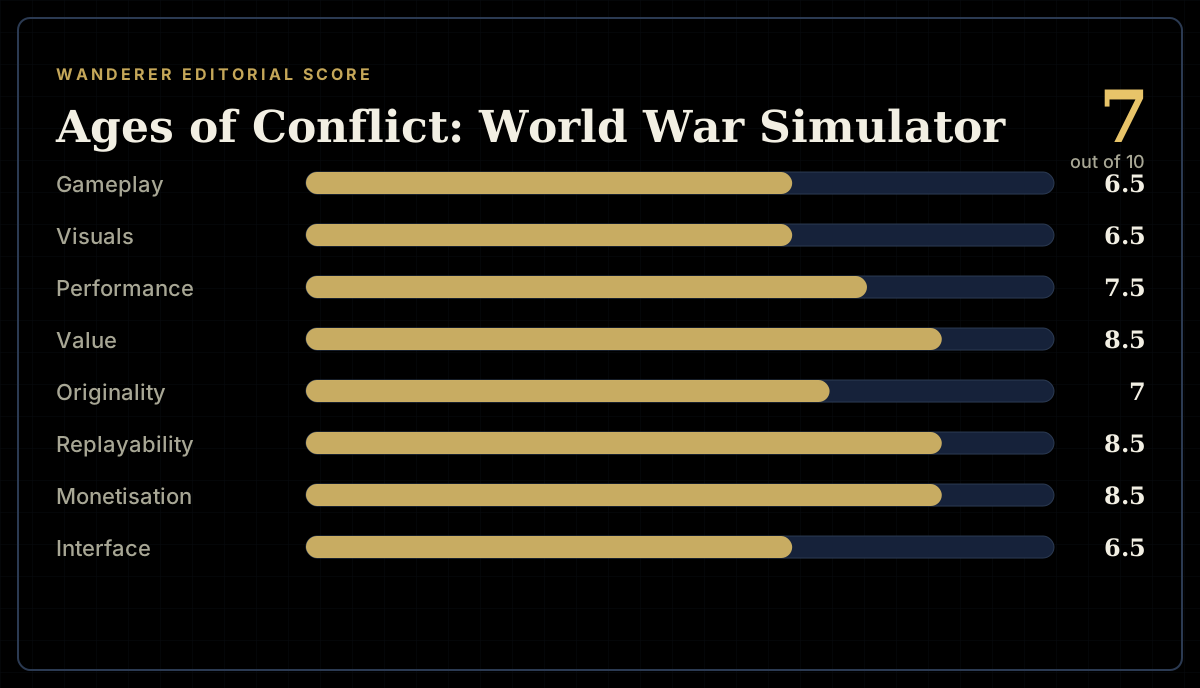
How the review scores each part of the gameWanderer Editorial -
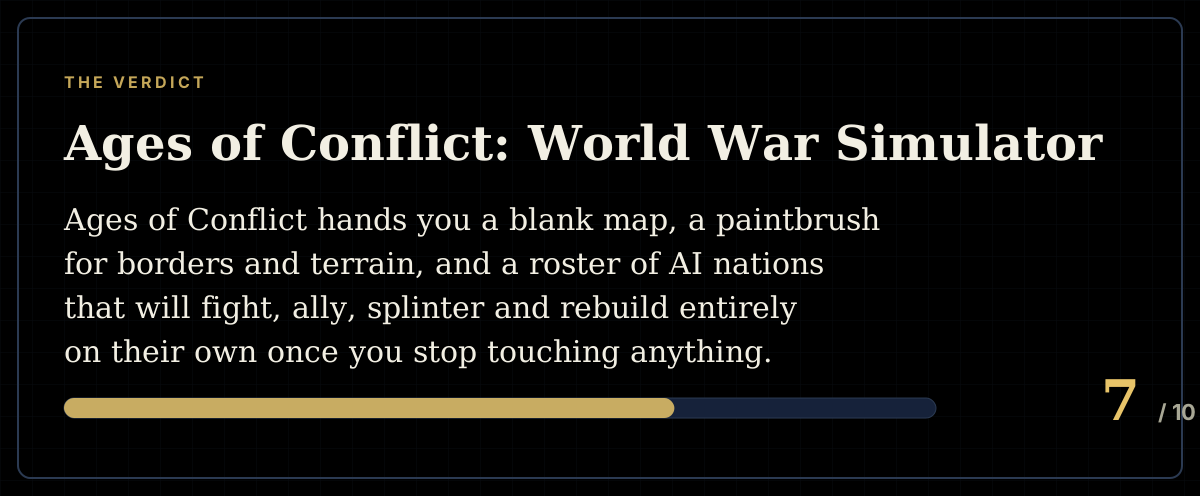
The short versionWanderer Editorial