
Game review
Yakiniku Simulator
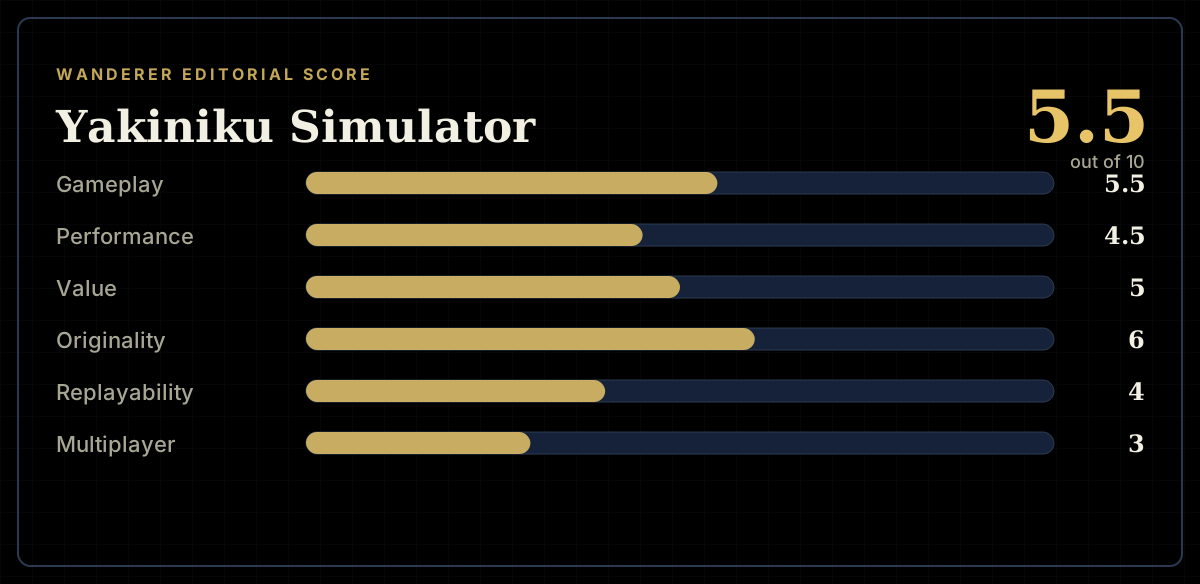
5.5 / 10
- Developer
- SECRET CHARACTER
- Publisher
- Flyhigh Works
- Released
- 3 June 2022
- Platforms
- Windows
- Genre
- Simulation
- Monetisation
- One-time premium purchase; no ads, in-game purchases or premium currency found
- Players
- Local free mode plus an online co-op grilling mode; several reviewers report the online mode dropping players mid-session or losing track of shared items
The short version
Yakiniku Simulator's whole pitch is grilling meat on a tabletop Japanese barbecue, timing when to flip each piece before it burns, and eating it for points. That's genuinely the entire game, and for a two-dollar launch price it delivered exactly that with real charm — the sizzle audio alone gets singled out by reviewers as unreasonably satisfying. What's remarkable is what happened next: rather than the usual joke-game silence, the developer kept patching it for over three years, added a real skill-based scoring and leaderboard layer on top of the relaxation-focused free mode, ported it to Switch, and eventually launched a direct spiritual sequel, Ramen Simulator, in 2026.
None of that changes what reviewers in several languages consistently say about the core game itself: it's thin, the meat variety stayed limited for a long time even as content updates arrived, and the one system explicitly built for playing with friends — online co-op — is reported broken by multiple reviewers, with items vanishing and players getting disconnected mid-grill. A charming, well-supported small idea with real structural gaps underneath it.
Biggest strengths
- A satisfying, tactile core loop built around genuinely well-designed sizzle and sear audio that multiple reviewers across several languages single out unprompted
- An unusually long, real support record for a two-dollar joke-premise game: patches continued into 2025, a Switch port shipped in 2023, and the developer's next game, Ramen Simulator, launched in 2026 as a direct, same-studio spiritual sequel
- A skill-based scoring mode with online leaderboards gives the simple grilling loop real depth for players chasing mastery, on top of a separate, more relaxed free mode for players who just want to zone out
Biggest weaknesses
- Online co-op grilling, the mode built specifically for playing with friends, is reported broken by multiple reviewers: items and meat disappearing mid-session, players getting disconnected or unable to join at all
- Several reviewers, particularly in the game's larger Chinese, Japanese and Korean-language review base, describe the meat and item variety as staying limited for a long stretch even as "new meats" updates were advertised, calling the ceiling on what the game actually offers shallow compared to its premise
- Physics and interaction bugs are reported repeatedly in non-English reviews: meat floating above the grill instead of resting on it, pieces getting stuck underneath others and becoming unflippable
Who it's for: Fans of low-stakes, sensory "chill" simulation games who want something to dip into for short sessions, especially achievement hunters drawn to its skill-based scoring layer. Not for anyone hoping to actually cook with friends online.
Our recommendation: A reasonable cheap pickup for the core solo loop and its surprisingly long support history, but go in expecting a shallow single-player minigame rather than the social co-op experience its multiplayer mode promises.
5.5 / 10
Yakiniku Simulator doesn't oversell itself. You sit at a tabletop Japanese barbecue grill, place cuts of meat on it, watch them change colour, flip them at the right moment before they burn, and eat them for points. That's the entire premise, delivered at a two-dollar launch price with no pretence of being anything more. What makes it worth a review three and a half years later isn't the premise — it's that the small Japanese studio behind it treated a joke-scale idea with a level of ongoing care that games several times its price rarely get, and that care sits alongside real, specific problems reviewers in the game's largest audiences keep raising.
A tiny idea that kept getting real support
Most two-dollar single-mechanic joke games either get one launch-week patch or none at all. Yakiniku Simulator's own event history runs to 25 entries across more than four years: a "Free Mode" update and a toggle to turn off the eating sound landed within days of the June 2022 launch, new meats and challenge modes followed through that summer, a full online competitive mode arrived in 2023 alongside a Switch port, controller support and further patches continued into 2025, and in 2026 the same developer and publisher released Ramen Simulator, an independently listed, same-studio spiritual sequel applying the identical premise to ramen instead of barbecue. That's a genuinely unusual commitment curve for something this small, and it's a large part of why the game has stayed Very Positive across 444 reviews rather than fading into the usual pile of abandoned two-dollar novelties.
The scoring layer built on top of that simple loop is more substantial than the premise suggests. Beyond the relaxed Free Mode, a separate scored mode tracks how efficiently you can grill and eat without burning pieces, feeding into online leaderboards and a set of escalating score-milestone achievements (1,000 points, 2,000, and upward). Steam's own global achievement data shows a steep drop-off matching a real skill ceiling — around a third of players reach the first 1,000-point milestone, but under 2% ever reach the game's hardest achievement, "Grill Master." A couple of the game's achievement names lean into dark comedy that a Japanese-language reviewer specifically flagged as an odd choice — one, tied to drinking beer while eating, references acute alcohol intoxication in its framing, which the reviewer found a strange thing to gate progress behind even as a joke. It's a small detail, but it's evidence the developer kept iterating on more than just bug fixes over the game's long patch run, for better and for stranger.
The sizzle sells it; the depth doesn't always follow
The audio design gets singled out constantly and specifically — reviewers across English, Japanese and Chinese-language reviews describe the actual grilling sound as unreasonably satisfying on its own, to the point that it's frequently cited as the single best reason to try the game. Where the praise runs out is content depth. A detailed Simplified Chinese review, one of the most-upvoted critical reviews on the game's page, argues the system is far shallower than its premise implies: limited meat variety even after advertised content updates, no meaningful table setup or side items (seasonings, drinks, plates for burnt pieces), and a wish that the developer open the game to Workshop-made content if it wasn't going to build that depth itself. Several other non-English reviews independently describe growing bored within ten to twenty minutes once the core loop's limits become clear, even while praising the sensory presentation that got them there. The one English-language negative review in this fleet's sample — "too simple and with too little to offer" — says the same thing in five words.
Physics and interaction bugs compound the content complaints rather than standing apart from them. Japanese and Korean-language reviewers describe meat pieces getting stuck floating above the grill grate instead of resting on it, becoming impossible to flip or remove cleanly, and one review specifically warns achievement hunters that these bugs can block progress toward specific milestones rather than just being cosmetic annoyances. None of this reads as game-breaking on its own, but stacked against a core loop several reviewers already call thin, unresolved interaction bugs make the ceiling feel lower than it needs to.
Online co-op doesn't reliably work
The most concrete, repeatedly-reported problem is the online mode built specifically so friends could grill together. Multiple reviewers across Chinese, Japanese and Korean-language reviews describe it failing in specific, consistent ways: meat and shared items disappearing mid-session, players being unable to join a friend's game at all, and sessions dropping players partway through with no clear cause. This isn't a vague "multiplayer feels laggy" complaint — it's several independent accounts describing the same category of failure closely enough to suggest a real, unresolved synchronisation problem rather than isolated bad luck. For a feature the store page specifically advertises as a way to grill with friends, a mode that doesn't reliably let friends finish a session together is a serious gap, not a minor rough edge.
Where it lands
Yakiniku Simulator earns real credit for outlasting almost every game in its price and premise bracket, backed by a genuinely rare four-year support record, a console port, and a same-studio sequel that proves the idea had staying power worth building on again. But the reviews that make up its large international audience are consistent about where it falls short: a core loop that stays thin longer than its content updates suggest, physics and interaction bugs that recur across languages, and an online mode that doesn't reliably do the one social thing it promises. A 5.5 reflects a likeable, well-supported small idea that never quite grew past being a small idea. It's an easy recommendation as a cheap solo curiosity and a much harder one as the shared, social experience its own store page and multiplayer mode promise.
Pros and cons
Pros
- A satisfying, tactile core loop built around genuinely well-designed sizzle and sear audio that multiple reviewers across several languages single out unprompted
- An unusually long, real support record for a two-dollar joke-premise game: patches continued into 2025, a Switch port shipped in 2023, and the developer's next game, Ramen Simulator, launched in 2026 as a direct, same-studio spiritual sequel
- A skill-based scoring mode with online leaderboards gives the simple grilling loop real depth for players chasing mastery, on top of a separate, more relaxed free mode for players who just want to zone out
- Cheap even at its current, increased price, and frequently available at a further discount
Cons
- Online co-op grilling, the mode built specifically for playing with friends, is reported broken by multiple reviewers: items and meat disappearing mid-session, players getting disconnected or unable to join at all
- Several reviewers, particularly in the game's larger Chinese, Japanese and Korean-language review base, describe the meat and item variety as staying limited for a long stretch even as "new meats" updates were advertised, calling the ceiling on what the game actually offers shallow compared to its premise
- Physics and interaction bugs are reported repeatedly in non-English reviews: meat floating above the grill instead of resting on it, pieces getting stuck underneath others and becoming unflippable
- The English-language review sample is thin (87 reviews) relative to the game's larger international audience, so an English-speaking buyer has comparatively little peer feedback to go on before purchasing
Screenshots
-

Yakiniku SimulatorImage: SECRET CHARACTER via Steam -

Yakiniku SimulatorImage: SECRET CHARACTER via Steam -

Yakiniku SimulatorImage: SECRET CHARACTER via Steam -
How the review scores each part of the gameWanderer Editorial -

The specsWanderer Editorial -
The short versionWanderer Editorial