
Game review
Waterpark Simulator
7.5 / 10
- Developer
- CayPlay
- Publisher
- CayPlay
- Released
- 22 August 2025
- Platforms
- Windows
- Genre
- Management Simulation
- Monetisation
- One-time purchase, no in-app purchases, no DLC. Listed at NZ$17.99 with a 20% launch discount bringing it to NZ$14.39 — checked 3 August 2026.
- Players
- Online co-op, added in the 1.0 update after being delayed through Early Access. Several players can build and decorate simultaneously rather than one player hosting while the others watch, which is the detail the co-op reviews keep singling out.
The short version
Waterpark Simulator is enormously likeable — build absurd slides, spray guests with water guns, watch the ragdoll physics do the rest, and now do all of it with friends who can build alongside you instead of watching you work. For fifteen dollars that's a lot of game and the reception says so. The reservations are structural rather than cosmetic: staff caps and instant decay mean you never graduate from doing the chores yourself, so the management sim never becomes a management sim, and performance remains rough enough that players with capable hardware report crashes and frame drops as their parks grow.
Biggest strengths
- Co-op is properly implemented — everyone can build and decorate at once rather than one host doing the work, which is rarer in this genre than it should be
- Slide and park construction is genuinely creative, with loops and spirals that let you build something ridiculous on purpose
- Physics comedy carries it; guests, friends and beach balls all behave badly in ways that generate their own stories
Biggest weaknesses
- Staff caps are the game's most-criticised system: players unlock worker types they can't afford to employ, so the park never delegates
- Everything breaks or dirties almost immediately, turning the mid-game into laps of manual repair rather than decisions
- Performance is the weak point — crashes, frame drops past a few dozen guests, and hardware heating reported by players running far heavier games comfortably
Who it's for: Groups of friends looking for a cheap co-op sandbox with slapstick physics, simulator fans who want building and mess-making over spreadsheets, and anyone who liked the idea of RollerCoaster Tycoon but wants to be inside the park. Poorly suited to players who want an economy that eventually runs itself, or who need a stable frame rate on a mid-range machine.
Our recommendation: Buy it for co-op — that's the version of this game with the fewest compromises, because the tedium that dominates the late solo game becomes a shared joke when there are four of you. Solo players should go in expecting a busy, hands-on cleaning-and-repair loop rather than a tycoon game, and anyone on modest hardware should check refund windows before committing to a large park.
7.5 / 10
Waterpark Simulator arrived at the top of Steam's new releases with 11,000 reviews and a 96% rating, which should be your first clue that something doesn't add up. No four-day-old game has eleven thousand reviews.
It isn't four days old. Waterpark Simulator has been in Early Access since 22 August 2025 — the date on its store page is the 1.0 release, a year later. Nearly all of those reviews were written about builds that no longer exist, and the negative ones cluster hard in September 2025, when the game was three weeks old and, by the accounts in them, held together with tape. Anyone reading that 96% as a verdict on the game released last week is reading a year of history instead.
The good news is that the current version is genuinely well liked too: the hundred most recent English reviews, all post-1.0, run 93% positive. So the number survives scrutiny. It just doesn't mean what the store page implies.
What 1.0 actually brought
The headline is co-op, and it's the right headline. Online multiplayer had been promised, then delayed out of an interim update and pushed to full release — a decision at least one player called out at the time as misleading roadmapping. It landed with 1.0, and the reviews since are disproportionately about it.
What makes it work is a small design decision with big consequences: everyone can build and decorate simultaneously. In a distressing number of co-op builders, one player has the tools and the rest stand around passing bricks. Here four people can be laying slides at once, which turns park construction into a shared project rather than a spectator sport. Add first-person physics — you can pick up your friends, throw things at them, and generally interfere — and you have a game that produces its own anecdotes. The reviews are full of them and they're all some variation on "I punched my friend into orbit."
The rest of the 1.0 package is substantial: a new city zone with its own backdrop and building space, night-time operation, security staff who eject unruly guests, mascots, multiple character slots, and loans from the mafia when your finances go sideways. That's a real update, not a version bump.
The management sim that won't delegate
Here's the structural criticism, and it's remarkably consistent across players with 10, 25 and 38 hours logged.
An economic simulator is supposed to trend toward automation. You start doing everything yourself, you hire people, and eventually you stand back and make decisions while the machine runs. Waterpark Simulator never lets you reach the standing-back part. Staff are capped, so players unlock worker types and then discover they can't employ them; the ones they do hire tire after a few in-game hours and move slowly. Meanwhile every attraction dirties and breaks almost immediately, so the demand for labour scales up while the supply is pinned.
The result is a game where a five-star park is more hands-on than a one-star park. Players describe running laps, holding a click on each broken thing, never getting to the design work the game is otherwise good at. One reviewer puts it precisely: it takes its play style from the cleaning genre — closer to a power-washing game than to a tycoon — and the park layout ends up mattering mostly for how efficiently you can run between chores.
That's a legitimate design choice for a first-person sim, and plenty of players clearly enjoy the constant busyness. But it's the opposite of what the word "simulator" promises in a management context, and it's why the late game turns into stress for a visible slice of the audience.
Performance is the real wart
The complaint I'd weigh most heavily before buying is technical. Crashes appear across the whole review history and haven't gone away — including a post-1.0 report from a player who runs Cyberpunk and Elden Ring at maximum settings and gets 40 to 60 fluctuating frames here at the lowest ones. Parks passing a few dozen guests bog down on mid-range laptops. A Steam Deck player describes the hardware getting alarmingly hot.
Some of this is the nature of a first-person sim with hundreds of physics-driven guests, and the game does scale down if you dig into settings. But "runs badly relative to its visual fidelity" is the single most repeated technical note in the corpus, and a year of Early Access hasn't resolved it.
There are 1.0-era gaps worth knowing about too: you can't build custom pools — the developers have said that isn't an immediate priority — and loose objects like beach balls and life rings can't be cleared away.
Verdict
For about fifteen dollars this is a lot of entertainment, and the co-op release is the moment it became the game it was pitched as. If you have two or three friends and an evening, the physics slapstick and the shared building make it an easy recommendation, and the 1.0 content genuinely expands what there is to do.
Go in with two adjustments. First, treat it as a busy, hands-on park-maintenance game rather than a tycoon — the fun is in the doing, not in the delegating, and the players who bounce are almost always the ones who expected an economy that eventually flies itself. Second, check it runs on your machine before you build anything you'd be sad to abandon.
And if you were about to buy it because it looked like the hot new release of the week: it's a year-old game that just finished. That's not a criticism — a studio shipping a real 1.0 after twelve months of updates is doing the thing more Early Access projects should — but it does mean the reviews you're skimming were written about a different game. Compare it with Corsair Cove, released the same day at three times the price and finished on arrival, and you get a neat illustration of the two routes a builder can take to market.
Players who want a park that keeps ticking over while they're away, instead of one that falls apart the moment they stop running, may also enjoy Wanderer.
Pros and cons
Pros
- Co-op is properly implemented — everyone can build and decorate at once rather than one host doing the work, which is rarer in this genre than it should be
- Slide and park construction is genuinely creative, with loops and spirals that let you build something ridiculous on purpose
- Physics comedy carries it; guests, friends and beach balls all behave badly in ways that generate their own stories
- Extremely generous for the price, and the 1.0 update added real content rather than a version number — a city zone, night operation, security, mascots and mafia loans
- The developer shipped through a year of Early Access to a 1.0 that most of its audience is happy with, at 93% positive across the most recent hundred English reviews
Cons
- Staff caps are the game's most-criticised system: players unlock worker types they can't afford to employ, so the park never delegates
- Everything breaks or dirties almost immediately, turning the mid-game into laps of manual repair rather than decisions
- Performance is the weak point — crashes, frame drops past a few dozen guests, and hardware heating reported by players running far heavier games comfortably
- Building is done by holding a click on each object individually, which is fine for one slide and wearing across a whole park
- Notable gaps for a 1.0: you can't build custom pools, and stray items like beach balls can't be cleared away
Screenshots
-
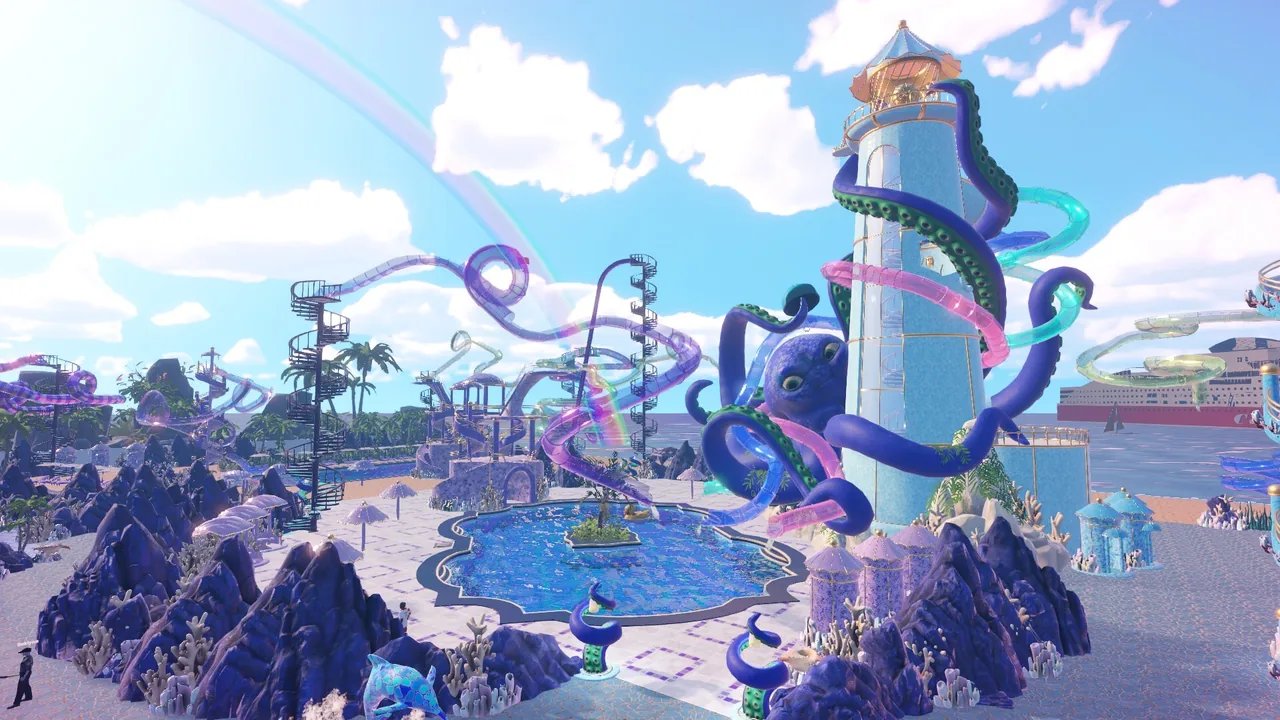
Waterpark SimulatorImage: CayPlay via Steam -

Waterpark SimulatorImage: CayPlay via Steam -
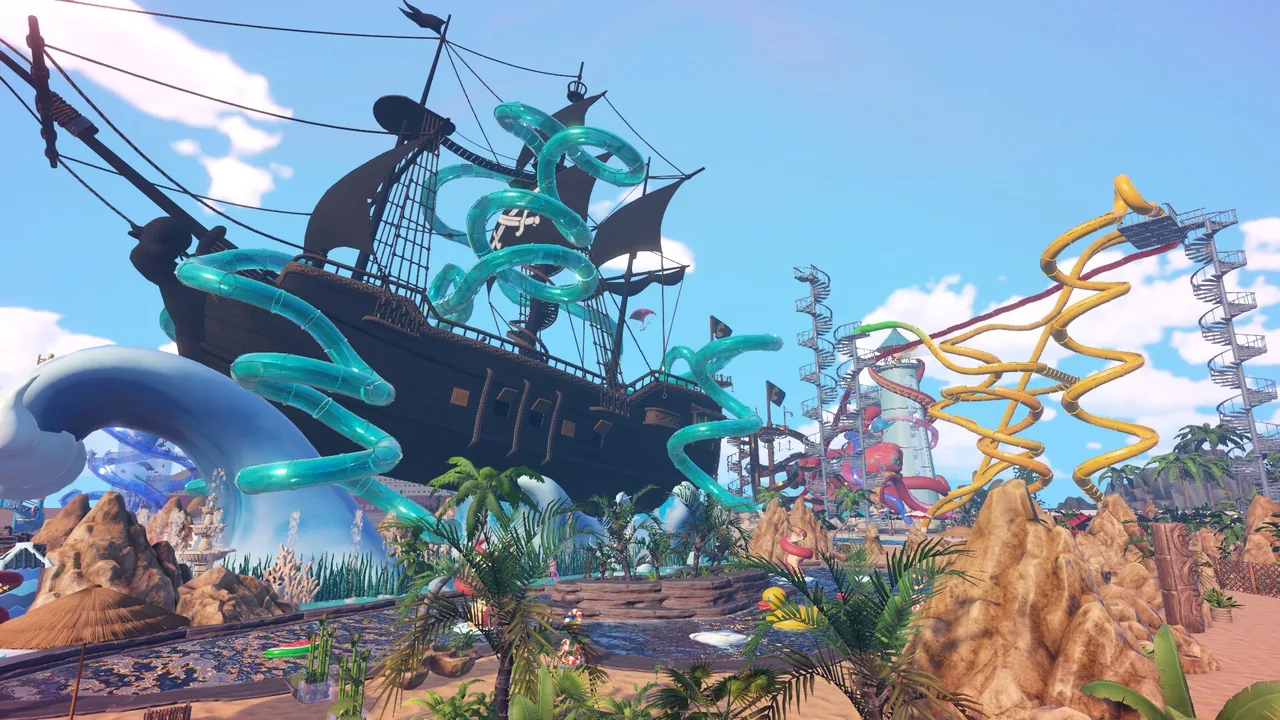
Waterpark SimulatorImage: CayPlay via Steam -
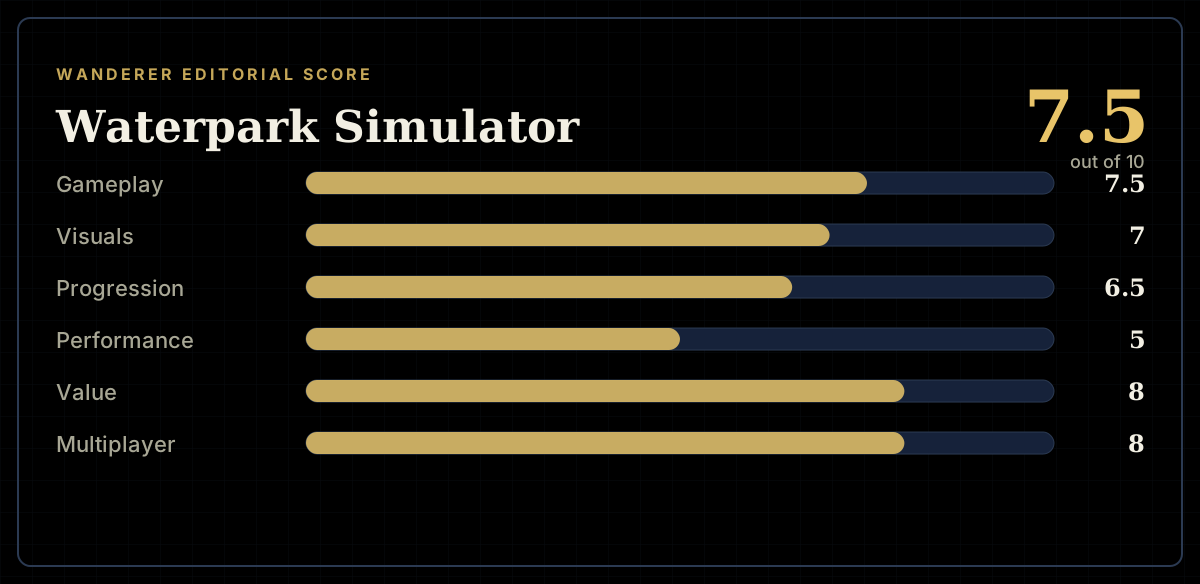
How the review scores each part of the gameWanderer Editorial -
The short versionWanderer Editorial