
Game review
Unicycle Together Review
7 / 10
- Developer
- Eneskp, Yusuf Demirhan
- Publisher
- Slugshot Games
- Released
- 5 August 2026
- Platforms
- ["Windows"]
- Genre
- Casual
Sausages, Unicycles, and a Ticking Bomb
Unicycle Together launched August 5, 2026 from the two-person team of Eneskp and Yusuf Demirhan, published under the Slugshot Games label. It's a 2-4 player physics-based party game built around one absurd, punishing premise: you're a sausage, you can only get around by unicycle, and your group has to carry a live bomb up a mountain before it detonates, dropping it, falling off, or letting the timer run out all end the round in an explosion. At review time the game sat at 196 all-language reviews (175 positive, "Very Positive") and an 86-review English subset (80 positive, 6 negative), a strong ratio for a $4.99 debut from a first-time two-person studio.
Don't Drop the Bomb
The core loop reviewers describe is almost universally the same: pass a bomb between wobbling, unicycle-riding sausages while navigating obstacles and terrain that actively want you to fall off, with the added tension that death is often shared, if the bomb goes off, everyone near it goes with it. "The balancing mechanic on the unicycle is pretty fun and satisfying," one reviewer wrote, and that push-and-pull between skill and chaos is the throughline across almost every positive review. Several reviewers specifically called out the moment-to-moment tension of holding the bomb versus handing it off, "the chaos that ensues while carrying the bomb is fantastic," while others focused on how quickly cooperative intent collapses into slapstick betrayal, "will you work as a team or will you drop the bomb in your friend's lap and run away?" as the store page itself frames it. One reviewer who finished the game's boss encounter singled out the ending's leaderboard-comparison stats as a genuinely satisfying capstone, joking about how their group's six-hour playthrough compared to speedrunners finishing in under an hour.
Self-Aware "Friendslop," and Proud of It
A specific, telling word shows up independently across multiple reviews: "friendslop," internet shorthand for games whose main draw is proximity to friends rather than deep systems. "Yes, this is another friendslop. No, friends don't come as a bundle with a purchase. But the gameplay is very fun for the price the game is asking," one reviewer wrote, essentially pre-empting the genre criticism before making it anyway. A second, more negative review used the same term as a direct complaint: "Took the slop in friend slop a little TOO far. Could feel the brain cells evaporating out of my head every second I spent on that stupid unicycle." Two independent uses of the same specific label, one embracing it, one rejecting it, sketch out exactly where the game sits: reviewers broadly agree it isn't reinventing anything mechanically, but at $4.99 for a night or two of screaming at friends over a passed bomb, most of the pool treats that as a fair trade rather than a flaw.
Performance Complaints: Frame Rate Tied to Physics
The most consistent and technically specific complaint in the review pool concerns performance, and it's corroborated across multiple, independent reviews rather than a single outlier. One reviewer, writing partly in Russian, complained specifically that the unicycle board's movement is tied to frame rate rather than server tick, reporting stable 70fps in other demanding titles but stuttering, sub-40fps performance here. A second review echoed the same underlying issue in plainer terms: "Game is good, optimalization is terrible on high-end PC, 45 fps and during final fight 20 fps." A third reviewer flagged a related resource problem, the game reportedly runs the GPU at or near maximum utilization even with all graphics settings lowered, on multiple different machines in their friend group. None of these complaints stopped the reviewers in question from ultimately recommending the game, but all three treated the optimization gap as a real, specific technical shortcoming rather than a vague gripe, worth flagging clearly for anyone planning to run it on older or weaker hardware.
The Other Recurring Ask: More Maps
The second most common thread, after performance, is a near-constant, good-natured request for more content, specifically more maps. At launch the game shipped with what multiple reviewers describe as a single map, and the phrase "please add more maps" or a close variant of it shows up repeatedly across otherwise glowing reviews: "beautiful game, but i need more maps," "Great game need more maps though," and "Love this game! Me and my friends can't find anything that compares, wish there was more of the game! Please add more maps!" It's a request rather than a complaint in most cases, the existing content is well liked enough that reviewers specifically want more of it rather than feeling shortchanged by what's there, but it does mean the game's replay value currently rests almost entirely on how much chaos a given friend group can wring out of one course, rather than on variety the developers have built in yet.
Verdict
Unicycle Together is a small, cheap, self-aware party game that delivers exactly what its premise promises: a genuinely funny, chaotic co-op physics challenge best experienced screaming at two or three friends over a voice call. It leans fully into "friendslop" territory and mostly earns forgiveness for that by being honest about it and pricing itself accordingly, but real, corroborated performance issues, frame-dependent physics and unusually high GPU load even at low settings, are a legitimate concern for anyone without a strong PC, and the single-map launch content means its lifespan depends heavily on how much your specific group enjoys repetition. At $4.99 for a two-person debut, it's an easy recommendation for a group looking for one good, ridiculous night together, less so as a game anyone should expect to return to solo or without a full lineup of willing friends.
Screenshots
-
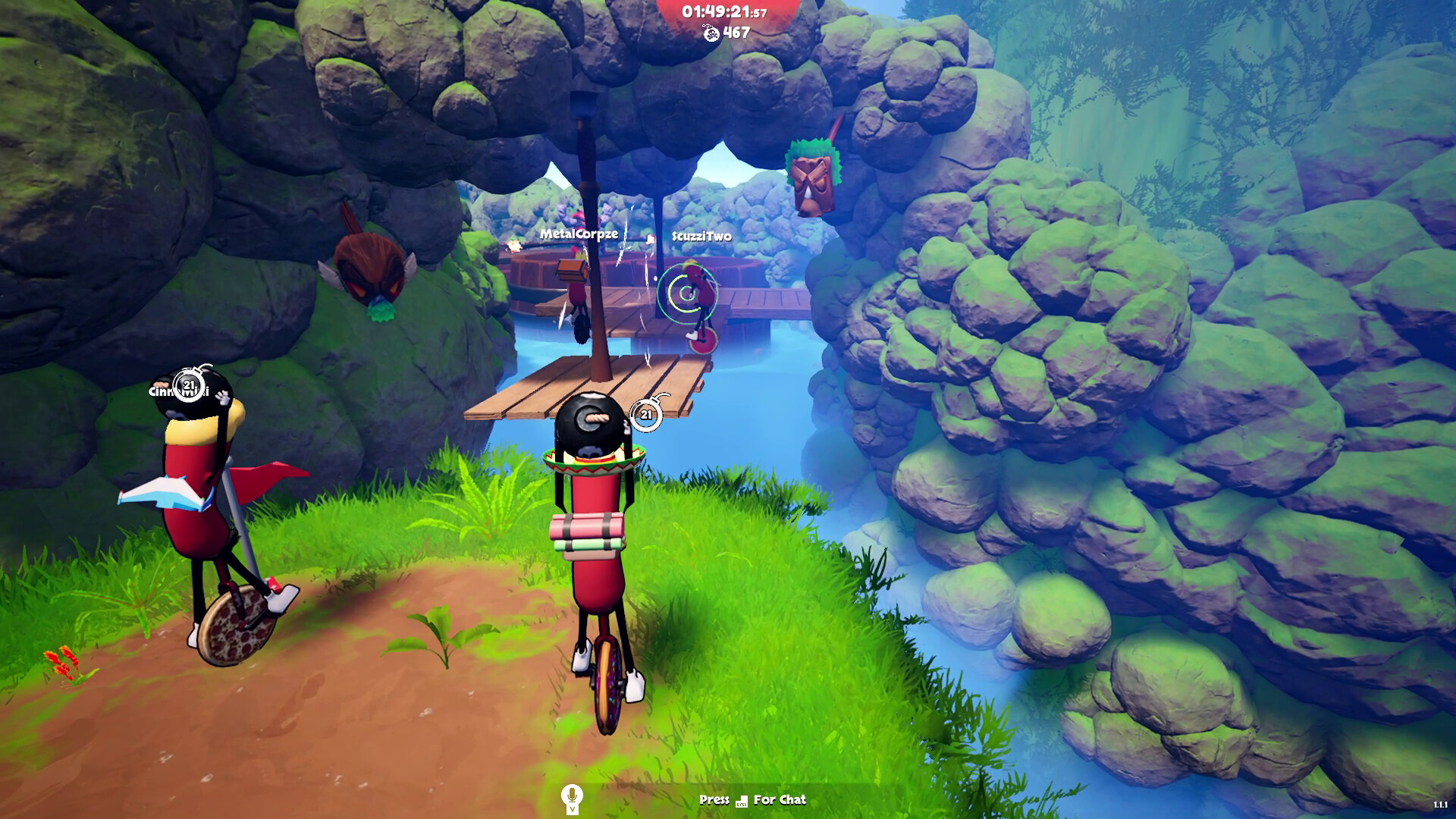
A typical bomb-passing chase through the jungle course, the moment-to-moment tension reviewers repeatedly singled out as the game's strongest hook.Image: Slugshot Games via Steam -
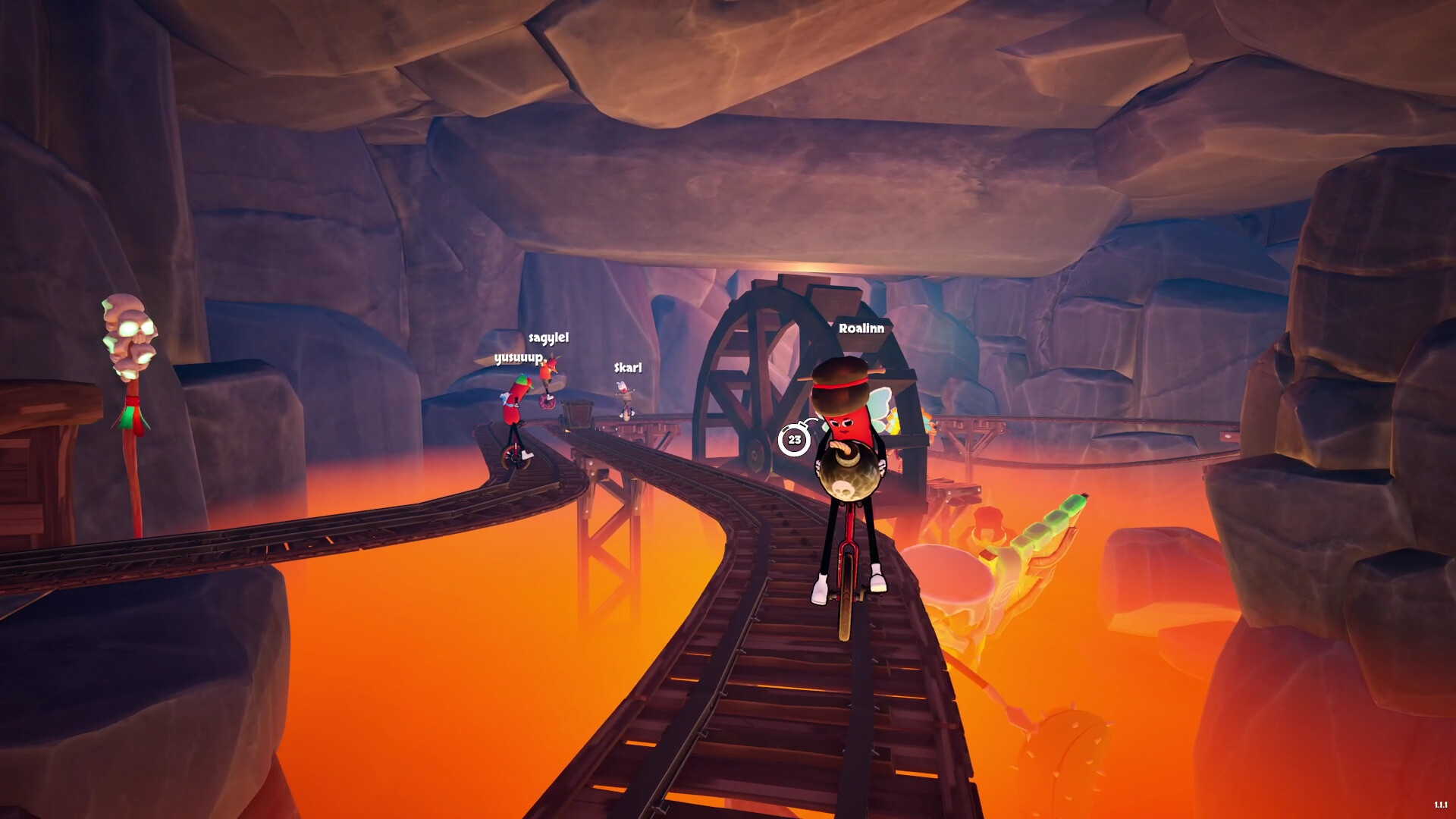
One of the game's more hazardous course sections, a precarious rail line suspended over lava, where a single fall can mean losing the bomb entirely.Image: Slugshot Games via Steam -
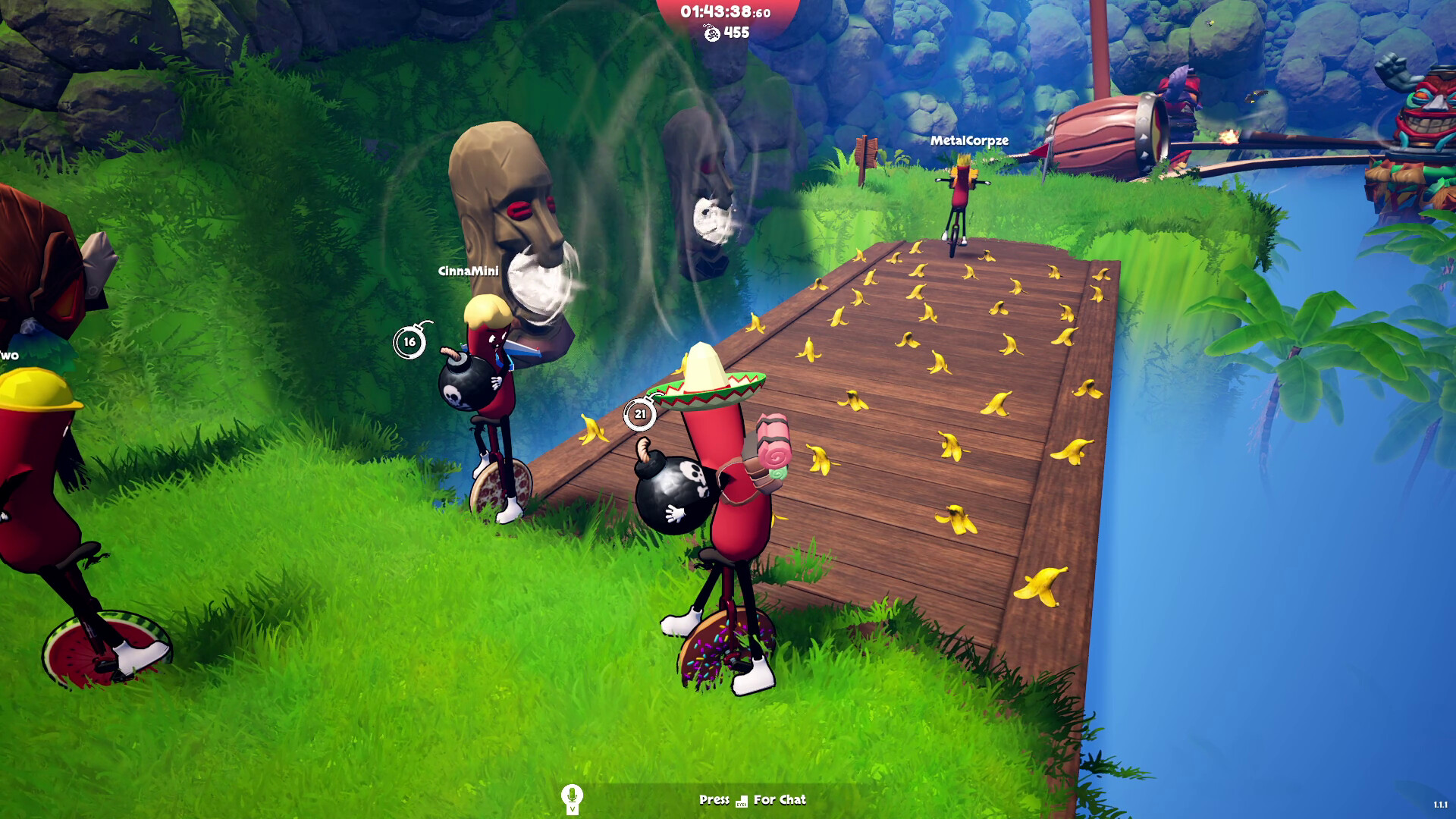
A banana-strewn dock hazard on the game's jungle course, the kind of slapstick obstacle reviewers say turns cooperation into chaos fast.Image: Slugshot Games via Steam