
Game review
Ultimate Theater Simulator
6.8 / 10
- Developer
- RAKTWO Games, steelbox Games
- Publisher
- steelbox Games, RAKTWO Games
- Released
- 29 October 2025
- Platforms
- [Windows, macOS]
- Genre
- Simulation
- Monetisation
- Paid
- Players
- Single-player only
The short version
Ultimate Theater Simulator earns its comparisons to job-simulator hits by giving the genre a genuine hook: threading film by hand, laying out concessions, and hiring staff to run a cinema that players can dial from cosy to chaotic with a settings menu full of customer misbehaviour toggles. It's an addictive, funny loop that a wide range of reviewers say hooked them for dozens of hours, but bugs around AI employees, an unfinished movie rental system, and post-launch patches that reviewers say broke the projector screen keep it feeling less finished than its official 1.0 status suggests.
Biggest strengths
- The manual projector mechanic — loading the bulb and threading film by hand rather than clicking a single button — gives the core loop a tactile hook most job-simulator games skip
- A deep settings menu lets players toggle individual customer misbehaviours (stealing, smoking, phone calls, fights) on or off, tuning the chaos level to taste
- Deep layout and staffing customisation, with clear level-gated unlocks for new products, employees, and customer interactions as the theater grows
Biggest weaknesses
- AI-controlled employees reportedly keep stocking and customers keep browsing furniture that players have already retired to storage, breaking game logic
- The movie rental system is described by multiple reviewers as confusing and unintuitive
- Some achievements reportedly fail to unlock, and some textures remain visibly unfinished
Who it's for: Fans of "job simulator" management games — Supermarket Simulator, PC Building Simulator, and similar — who want their sandbox chaos dialled up with fights, thefts, and phone-call arguments they get to punish personally.
Our recommendation: Recommended
6.8 / 10
Running a Cinema, One Threaded Reel at a Time
Ultimate Theater Simulator drops players into the job-simulator genre with a fittingly specific twist: rather than running a supermarket or a PC repair shop, the job here is keeping a movie theater alive, one screening at a time. The core loop is familiar to anyone who has played Supermarket Simulator or its many cousins — stock shelves, serve customers, expand the business, hire staff to take over the busywork — but reviewers repeatedly single out one mechanic as the game's real hook: manually loading the projector bulb and threading the film reel by hand instead of simply clicking a button and letting the show start. One reviewer calls it "the little twist that got me," describing how it sits alongside deep layout customisation — placing tables, equipment, and staff — to make the theater feel genuinely personal rather than a preset template with a different coat of paint.
That sense of ownership extends into the settings menu, which several reviewers highlight as unusually deep for the genre. Customer misbehaviours — stealing, smoking, phone calls during screenings, the occasional fistfight — can each be toggled independently, letting players dial the chaos up or down depending on the mood they're after. One widely-quoted review frames this well: "with those interactions cranked up, things get genuinely fun and interesting... all of it keeps you on your toes instead of just running the same loop over and over." Multiple reviewers describe kicking phone-using patrons out of screenings and, when those patrons object, settling things with a fistfight — a level of sandbox absurdity that shows up again and again as a highlight rather than a complaint, with one review summing the whole experience up as "This is giving Schedule 1 but in the movie theaters. I absolutely love it."
A Theater That Grows With You, Mostly on Its Own Terms
Progression is built around clear, level-gated unlocks: new products, higher stock quantities, more hireable employees, and fresh customer interactions all arrive as the theater's level climbs, giving players concrete goals rather than an open-ended, directionless sandbox. Several reviewers describe that structure as satisfying in the early hours, with the growing need to manage staff shifting the game from a solo job into something closer to a small business simulation. That said, more than one reviewer flags the opening stretch as unexpectedly punishing on the wallet: one review describes needing to take out a loan just to afford a soda and popcorn machine on day one, calling the early economy "fairly stressed" for a game otherwise pitched as a relaxed sandbox experience.
The other side of that progression curve is a familiar management-sim problem: once the unlock ladder is climbed, there isn't a great deal left to chase. One reviewer who collected every achievement in 20 hours put it plainly: "not much else to do now other than keep up on ordering product," while still recommending the game overall and expressing hope for future theater expansions. That's a reasonable trade-off for a sub-NZ$20 sandbox title, but it does mean the game's appeal leans more on the moment-to-moment chaos of running the theater than on any long tail of new systems to discover once the level cap is reached.
The Developers Are Visibly Present, and Reviewers Notice
A recurring thread across the sample is how directly engaged the development team appears to be with its community. One reviewer who describes personally knowing the developers says the pair have been in voice chat "5-10 hours basically everyday for the past 10ish months" polishing the game and adding content, while a separate, unrelated reviewer describes being commissioned to compose the game's boombox soundtrack after the developers reached out directly — a detail that lines up with the general tone of the sample, where reviewers repeatedly credit the team for actively fixing bugs and responding to feedback. One review specifically clarifies "It's not AI" when describing the game's art style, framing the in-house asset work as a point of pride distinct from cheaper, template-driven entries in the crowded job-simulator space.
That goodwill isn't universal, however. A more critical, more recent review pushes back hard on the idea that the game earned its 1.0 label, describing persistent AI-employee bugs, broken achievements, unfinished textures, and a movie rental system that remains confusing months after launch, concluding that "the game as a whole still feels like an Early Access title rather than a finished 1.0 release." That review isn't recommended, and it stands out for coming well after the initial launch wave, suggesting some of the rough edges reviewers noted at release hadn't been fully resolved months later.
Bugs That Undercut an Otherwise Confident Launch
The most specific, repeated complaint concerns AI employees and stock logic: when players retire old furniture or equipment to storage rather than deleting it, both staff and customers reportedly continue treating those items as active, with employees stocking shelves that no longer exist on the floor and customers wandering into the storage room to take products directly — a bug more than one reviewer describes as breaking both game logic and immersion. A separate, more recently reported issue describes the theater screen going blank during showings after a patch, forcing players to exit and restart the film from the beginning; one frustrated reviewer notes hearing that the developers are prioritising a console port over fixing this kind of PC-side regression, souring an otherwise positive impression of "one of the better simulator theater games out there." Taken together, these are the kind of bugs that read less like fundamental design flaws and more like a live-service-style rollout that hasn't fully caught up with its own feature set — annoying in the moment, but not (yet) disqualifying for most of the sample's overwhelmingly positive reviewers.
Verdict
Ultimate Theater Simulator earns its place in the crowded job-simulator genre by finding a genuinely fresh hook — hand-threaded film reels and a chaos-toggle settings menu that lets players decide exactly how badly their customers behave — wrapped around a familiar but well-executed stock-and-staff management loop. The team's visible, hands-on presence in its own community goes a long way toward explaining the game's overwhelmingly positive reception, but a cluster of persistent bugs around AI employees, achievements, and a post-launch screen-freezing regression mean it still plays, for some, like an Early Access title wearing a 1.0 label. For fans of the genre willing to tolerate some rough edges, it's a funny, addictive theater to run all the same.
Pros and cons
Pros
- The manual projector mechanic — loading the bulb and threading film by hand rather than clicking a single button — gives the core loop a tactile hook most job-simulator games skip
- A deep settings menu lets players toggle individual customer misbehaviours (stealing, smoking, phone calls, fights) on or off, tuning the chaos level to taste
- Deep layout and staffing customisation, with clear level-gated unlocks for new products, employees, and customer interactions as the theater grows
- Multiple reviewers highlight an unusually responsive, community-engaged development team, including crediting a player-made soundtrack track added post-launch
Cons
- AI-controlled employees reportedly keep stocking and customers keep browsing furniture that players have already retired to storage, breaking game logic
- The movie rental system is described by multiple reviewers as confusing and unintuitive
- Some achievements reportedly fail to unlock, and some textures remain visibly unfinished
- A recent update is reported to have introduced a bug where the theater screen goes blank during showings, forcing a restart of the film
- Early-game economy balance is reportedly punishing, with new players needing loans to afford basic equipment on day one
Screenshots
-
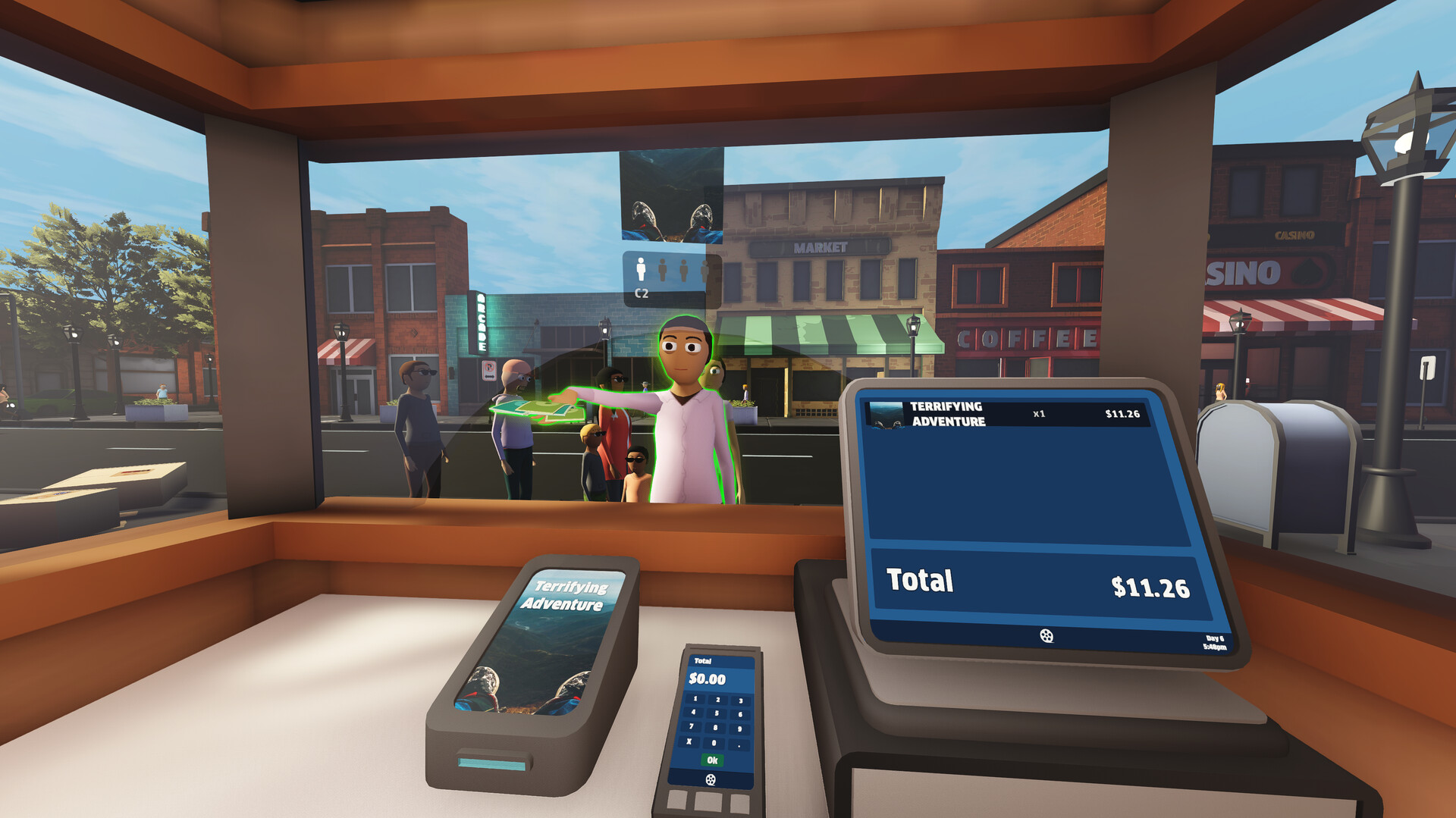
Selling tickets is only half the job — customers, staff, and stock all need managing at oncesteelbox Games -
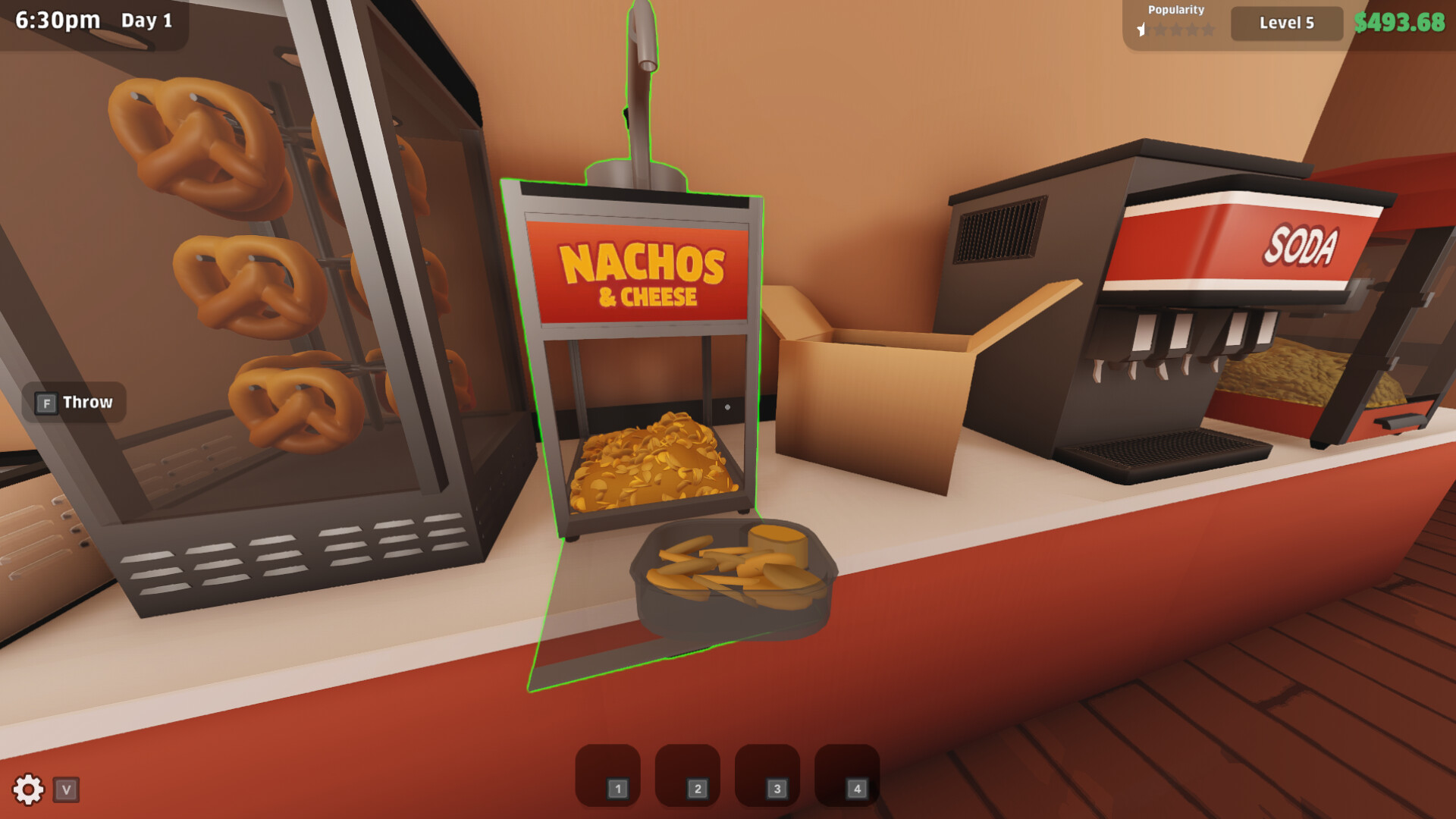
Restocking the concession stand is a core part of the moment-to-moment loopsteelbox Games -
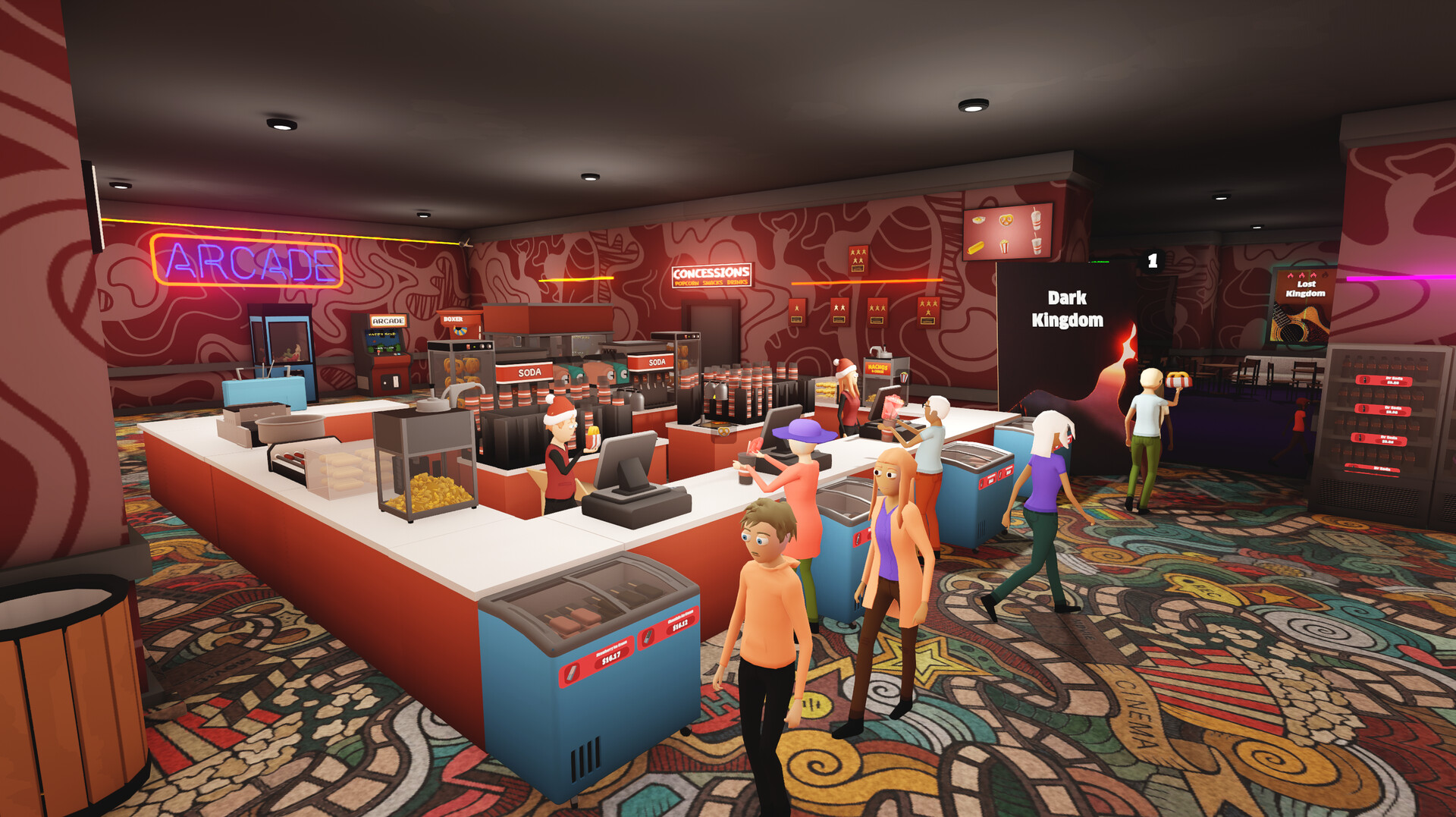
A theater in full swing, with staff working the counters while customers roam the lobbysteelbox Games -
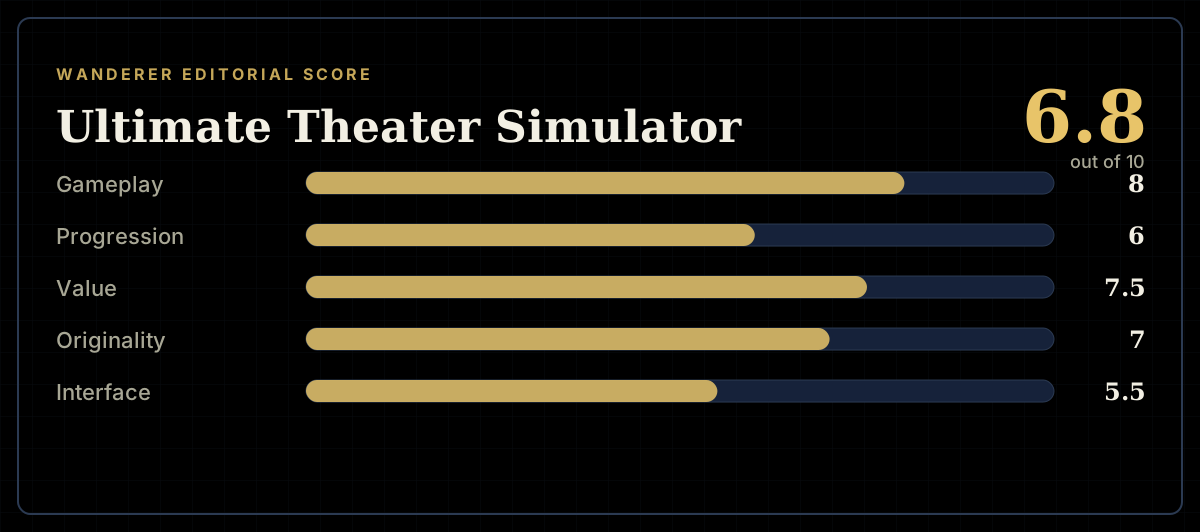
How the review scores each part of the gameWanderer Editorial -
The short versionWanderer Editorial