
Game review
TTV3
4.5 / 10
- Developer
- Walter Machado
- Publisher
- Walter Machado
- Released
- 18 July 2019
- Platforms
- Windows
- Genre
- Action
- Monetisation
- Paid, no in-app purchases found
- Players
- false
The short version
TTV3 asks one simple thing of the player: escape each screen before something on it kills you, then immediately do it again on a new, harder screen, over and over. At its ultra-low price that's a defensible, if minor, arcade curio for players who specifically enjoy fast, punishing reflex games and can find the flow state its fans describe. But it's the third entry in an already-established series doing almost exactly the same thing as the first two, and several reviewers argue it hasn't meaningfully evolved the formula, while one specific technical regression makes the controller experience worse than its predecessors.
Biggest strengths
- A genuinely fast, punishing difficulty curve that several reviewers describe reaching a real flow state ("The Zone") with, rewarding focus and reflexes over memorisation
- Distinctive, hardcore-leaning music that changes with each screen, which reviewers who enjoyed the game consistently single out as a highlight
- An extremely low asking price that several reviewers explicitly frame as fair value even for a very short experience
Biggest weaknesses
- Multiple reviewers argue the core formula is essentially identical to the previous two entries in the series, questioning whether a separate paid release was warranted for such a small iteration
- A specific technical regression: controller movement is limited to 8 directions rather than the full 360-degree movement supported in the first two games, a change at least one reviewer calls a dealbreaking bug
- Extremely low content volume by design — one reviewer reports fully completing the game, achievements included, in 19 minutes
Who it's for: Fans of fast, minimalist reflex/dodging arcade games who specifically want more of the exact Trip to Vinelands formula, ideally already familiar with the first two entries.
Our recommendation: A fair impulse buy at its asking price for genre fans, but not worth it for anyone hoping for meaningful evolution over the earlier games in the series.
4.5 / 10
What it is
TTV3 is the third entry in solo developer Walter Machado's Trip to Vinelands series, a minimalist arcade concept built around a single repeating challenge: guide a small character out of a constantly shifting screen before touching anything that kills it instantly, then immediately face a new, harder screen the moment the last one ends. There is no larger narrative, no meaningful RPG system, and — by design — very little to the game beyond that one loop repeated with rising intensity. It released on 18 July 2019 at NZD 1.49, an ultra-budget price that matches its ultra- minimal scope, with full achievements and controller support.
Its review corpus, 76 in English, sits at a strong Very Positive (62 to 14), but reading through it reveals a genuinely split reaction that has less to do with quality in the abstract and more to do with what a reviewer already thought of the first two games in the series before starting this one.
The case for it
Reviewers who enjoy this specific niche of arcade reflex game describe a real, distinct appeal. Several specifically use the language of flow state — "you enter The Zone easily," writes one, crediting the combination of instant death, tight controls and constantly changing screens for producing genuine, absorbing concentration rather than mere frustration. The music draws consistent specific praise: one reviewer calls TTV3 "maybe the best of the TTV games" specifically because of "dynamic music design that changes every time you switch screens," paired with a faster overall pace than its predecessors. Value gets a fair hearing too — one reviewer who "100%'d it in 19 minutes" still calls it "worth the 74 cents," a low bar cleared honestly rather than grudgingly, while adding they'd welcome a larger game built around the same core concept.
The case against it
The most detailed critical review makes a specific, structural argument rather than a vague dismissal: it calls the game "conceptually sound" but executed with "the laziest and most unintuitive execution imaginable," arguing the challenge relies on "brute-force muscle memory across a dozen or two randomly repeating, poorly designed levels" rather than fair, learnable difficulty. A separate reviewer who says they "enjoy this series" and finds it "very difficult" in a way they appreciate still concludes there's "little to no difference between the first, second, or third game," arguing they "all progress the same" and that the format "gets tedious" by the third iteration specifically because of that repetition.
A more concrete, specific complaint concerns a technical regression: one reviewer reports that, unlike the first two Trip to Vinelands games, "the controller movement is not 360, but only 8 directions," and states outright that they "cannot recommend this... until the controller bug gets fixed." That's a meaningfully worse input experience for a game whose entire challenge rests on precise, immediate movement — a regression from earlier entries rather than a novel limitation players might have accepted from the start.
A trilogy's diminishing returns
Reading the corpus for TTV3 alongside its own reviewers' comparisons to the earlier two games suggests the series' central tension: the format itself is a real, workable arcade idea, but a minimalist "escape the screen" loop has a limited amount of genuine surprise to offer across three paid releases in a row. Reviewers who came in fresh, without prior TTV fatigue, are more likely to find the difficulty and music genuinely compelling. Reviewers who've already played the first two are more likely to notice how little has changed, and to weigh that repetition against the asking price and the added friction of the controller regression. Neither reaction is wrong; they're measuring different things — the format on its own merits, versus the format's third consecutive outing with minimal evolution.
What the achievement data confirms about scope
TTV3 ships with only six tracked Steam achievements, and their completion curve is unusually gentle compared to almost every other game checked in this lane: 93.8% of owners have earned the first, tapering only to 27.5% for the sixth and hardest. That's a meaningfully shallower drop-off than the steep, long-tail curves this lane has found in games with real depth to explore — where even a generous early achievement might sit in the 60-70% range before falling toward single digits for end-game content. A curve this gentle, on a game with only six milestones total, is itself a data point confirming what the reviewer who "100%'d it in 19 minutes" already reported directly: there simply isn't much game here to progress through, and most people who buy it see most of what it has to offer in a single short sitting.
That's not automatically a criticism — plenty of legitimate, well-regarded games are short by design, and a $1.49 arcade toy isn't being held to the same content-volume standard as a full-price release. But it does mean any positive recommendation here has to be understood in scale: this is a brief distraction, not a game with hidden depth waiting to be discovered on a second or third playthrough.
A solo developer's third consecutive release in a narrow format
It's worth noting what TTV3 represents for its developer specifically: a third consecutive paid release built on the same core mechanic, by the same solo creator, within what appears to be a fairly short span of time. That pattern of iterative, low-risk releases is a legitimate and common strategy for solo developers working in a tight format, and it isn't inherently a red flag — but it does mean the reviewer complaints about insufficient evolution between entries carry real weight rather than reading as unfair nitpicking. A player who already owns TTV and TTV2 is, by the corpus's own account, buying a script they've largely already run twice before, with a new difficulty curve and soundtrack layered on top rather than a structurally new experience underneath.
Verdict
TTV3 is exactly what it presents itself as: a tiny, cheap, difficult arcade toy that some players will find a genuinely satisfying reflex challenge and others will find an unnecessary third helping of an idea already fully explored twice before. Its content volume and ambition are both intentionally minimal, which makes it a fair deal at its asking price on its own terms, but not one that offers much beyond what its own predecessors already delivered — and the controller regression is a real, avoidable step backward for anyone coming from the earlier games.
Pros and cons
Pros
- A genuinely fast, punishing difficulty curve that several reviewers describe reaching a real flow state ("The Zone") with, rewarding focus and reflexes over memorisation
- Distinctive, hardcore-leaning music that changes with each screen, which reviewers who enjoyed the game consistently single out as a highlight
- An extremely low asking price that several reviewers explicitly frame as fair value even for a very short experience
- The most visually vibrant and highest-energy entry in its own trilogy, according to reviewers who've played all three
Cons
- Multiple reviewers argue the core formula is essentially identical to the previous two entries in the series, questioning whether a separate paid release was warranted for such a small iteration
- A specific technical regression: controller movement is limited to 8 directions rather than the full 360-degree movement supported in the first two games, a change at least one reviewer calls a dealbreaking bug
- Extremely low content volume by design — one reviewer reports fully completing the game, achievements included, in 19 minutes
- Level design is criticised by at least one detailed reviewer as relying on "brute-force muscle memory" across "poorly designed" repeating layouts rather than fair, learnable challenge
- No meaningful replay value beyond chasing a personal best, according to multiple reviewers, once the game's full content has been seen
Screenshots
-

TTV3Image: Walter Machado via Steam -

TTV3Image: Walter Machado via Steam -

TTV3Image: Walter Machado via Steam -
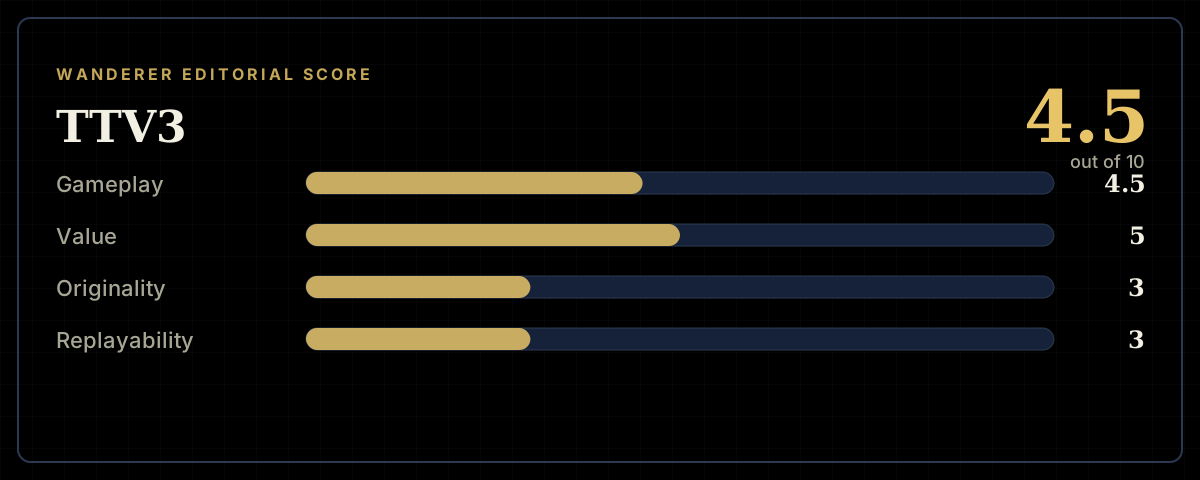
How the review scores each part of the gameWanderer Editorial -
The short versionWanderer Editorial