
Game review
KILL KNIGHT
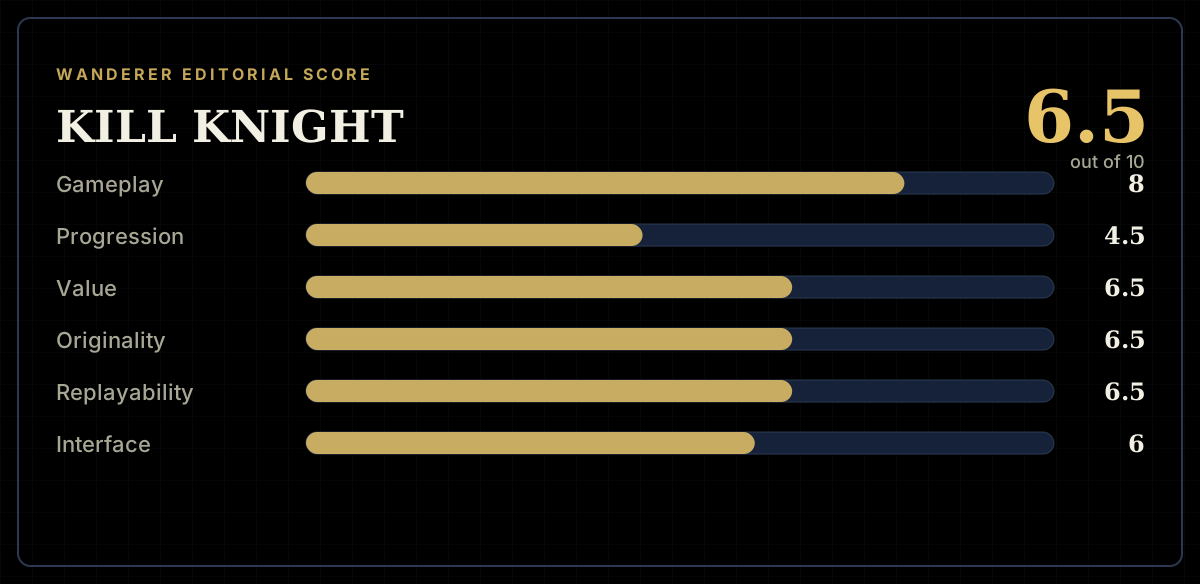
6.5 / 10
- Developer
- PlaySide
- Publisher
- PlaySide
- Released
- 2 October 2024
- Platforms
- Windows
- Genre
- Arcade twin-stick shooter
- Monetisation
- One-time purchase, no in-game store or additional currency purchases
- Players
- Single-player only
The short version
KILL KNIGHT casts you as a betrayed knight reanimated in the Abyss with one purpose — kill the last angel — descending through five eldritch layers armed with parries, active reloads, and precise dodges in a fast, unforgiving twin-stick shooter clearly indebted to games like Devil Daggers and Hyper Demon. This review's sample is close to unanimous that the core combat feel is genuinely excellent, with veteran genre fans and casual players alike describing real flow-state intensity once the mechanics click. What tempers that praise, repeated with striking consistency across the negative sample, is a specific structural complaint about progression: rather than earning weapons and upgrades through natural play, unlocks are gated behind obscure, often poorly-explained challenge conditions that many reviewers describe as an artificial, frustrating wall standing between them and the game's own advertised depth.
Biggest strengths
- The core combat feel — movement, parries, active reloading, and dodges — draws near-universal, specific praise for its precision and responsiveness, with veteran genre fans repeatedly calling it best-in-class
- Multiple long-playtime reviewers describe genuine flow-state immersion, with one reviewer with over 17,000 minutes logged describing an unusually powerful emotional connection to the game's rhythm and structure
- The art direction and eldritch aesthetic draw consistent, appreciative mentions, with reviewers describing the presentation as tightly and deliberately crafted rather than excessive
Biggest weaknesses
- A specific, widely repeated complaint dominates the negative sample: equipment and weapon unlocks are gated behind obscure, often arbitrary challenge conditions that several reviewers say don't teach players how to complete them, turning early progression into frustrating trial and error rather than a natural reward for skillful play
- Multiple reviewers describe a resulting grind wall, with several reporting many hours invested for comparatively little unlocked content, and at least one reviewer reporting they'd beaten only two levels after six hours of play
- Several reviewers report crashes or launch failures, including at least one describing the game hard-locking their PC on a significant percentage of launch attempts, and another reporting persistent stuttering on modern hardware that went unaddressed after multiple reports
Who it's for: Fans of precise, high-intensity arcade shooters in the tradition of Devil Daggers, Hyper Demon, and Ruiner who value combat feel and score-chasing over story, and players with genuine patience for demanding, obscure unlock requirements standing between them and the full toolkit.
Our recommendation: A genuinely excellent arcade shooter at its mechanical core, worth it for genre veterans who can push through a real, well-documented early-game progression wall — casual players drawn purely by the aesthetic should know that wall is a real and widely-reported obstacle before buying.
6.5 / 10
KILL KNIGHT strips its premise down to a single sentence: a betrayed knight, reanimated in the Abyss, exists for one purpose — kill the last angel. What follows is five layers of isometric, twin-stick arcade combat built around parries, active reloads, and razor-precise dodging, clearly speaking the same language as Devil Daggers and Hyper Demon. This review's sample agrees almost completely about the quality of that combat. Where it splits, sharply and specifically, is on what stands between a new player and actually experiencing the game at its best.
Combat that earns genre veterans' respect
The praise for how KILL KNIGHT actually plays is remarkably consistent and comes from people who clearly know the genre well. "This is the quintessence of a modern arcade game. There are no unnecessary elements here. Everything fits together and was made with devilish precision," one reviewer with over 7,000 minutes logged writes. Another, deeply versed in the space, gives a detailed technical assessment: "Fast paced twin-stick shooter mixing shooting with melee and heavy resource management. Seemingly inspired by Devil Daggers & Hyper Demon it leans more into endurance-based challenges rather than bite-sized levels with large enemy or boss fight variety. On top of a high level of" mechanical polish that keeps every encounter demanding real skill. A third reviewer describes an almost meditative connection to the game's rhythm: "This game gets me right into flow state. It requires full attention and focus and it is SO. MUCH. FUN. I can't play it for long, I'm so spent after a good run that I can't make 2 good runs in a row."
The wall nearly every critical reviewer hits
Set against that praise, the negative sample converges with unusual precision on a single structural complaint: how the game gates access to its own advertised depth. "I hate this progression system, can I just play the game instead of playing some [obscure] gimmicks?" one frustrated reviewer writes, quoting an unlock condition verbatim to illustrate how opaque the requirements can feel. Another lays out the mechanism directly: "Kill Knight locks ALL of its upgrades through arbitrary, obscure challenges that do not even teach you how to play the game, but effectively makes you play the [game blind, guessing at hidden conditions]." A third, an experienced genre veteran who clearly wanted to love the game, sums up the disconnect precisely: "Good Idea, Poor Execution... Kill Knight lacks enough content or variety to be truly wor[th recommending, specifically because so much of its content sits locked behind this system]." This is a genuinely different kind of complaint than the usual "it's too hard" grumbling — it's a specific, repeatable criticism about how the game teaches and rewards its players, made independently by reviewers who otherwise respect the underlying mechanics.
A concrete accessibility concern
Beyond the progression complaint, at least one reviewer raises a specific, physical concern worth flagging directly: "Fun game, however the over use of the color red gives me a headache. It may also be the addition of other visual distortions on top of it. What ever it was i got a seriously bad migraine after playing this game." That's a concrete, actionable warning for players sensitive to intense color and visual-distortion effects, distinct from the broader difficulty and progression debates.
Real, reported technical instability
A handful of reviewers report genuine stability problems rather than subjective complaints. "Only game that hard locks my PC on launch 40% of the time I try and play," one reviewer writes. Another reports the issue going unresolved despite direct outreach: "Can't run it on my [modern high-end GPU] due to extreme lag and stuttering, even after raising the issue multiple times the team hasn't fixed it or responded." These are a minority within the broader sample, but specific and severe enough to flag directly for buyers on less common hardware configurations.
What the achievement data confirms about the difficulty curve
Steam's own completion figures line up cleanly with the reviewer-described split between an accessible core and a genuinely brutal endgame. An early combat milestone sits at a healthy 83.2%, and several mid-tier equipment-unlock achievements remain in a reasonable 45-70% range, suggesting most players do make real progress through the early game despite the friction reviewers describe. But full-badge, all-layer completion achievements collapse to 0.5-1.4%, a genuinely extreme drop that confirms the game's true endgame content is reserved for an extremely small, dedicated fraction of its playerbase — corroborating both the "genuinely deep for those who push through" praise and the "obscure wall before you get there" complaint simultaneously.
An outstanding record of ongoing support
Whatever friction exists in the unlock system, this review found no evidence the game was left to languish. KILL KNIGHT's partner-events feed documents an active, sustained post-launch history: several hotfixes in the weeks after release, a substantial "Krystalized" content update roughly two months post-launch, Steam Deck optimization, a genre-award nomination, and a well-marked one-year anniversary sale. That's a genuinely healthy, ongoing commitment from the developer.
Final verdict
KILL KNIGHT delivers some of the tightest, most precisely tuned arcade combat this review series has covered, and this review's sample is remarkably unified in confirming that. Its specific, widely documented progression-gating problem is a real and fair criticism worth taking seriously before buying — genre veterans with patience for obscure unlock conditions will likely find the wait worthwhile, but players hoping for the full toolkit to open up naturally through play should know that isn't how this game is built.
Pros and cons
Pros
- The core combat feel — movement, parries, active reloading, and dodges — draws near-universal, specific praise for its precision and responsiveness, with veteran genre fans repeatedly calling it best-in-class
- Multiple long-playtime reviewers describe genuine flow-state immersion, with one reviewer with over 17,000 minutes logged describing an unusually powerful emotional connection to the game's rhythm and structure
- The art direction and eldritch aesthetic draw consistent, appreciative mentions, with reviewers describing the presentation as tightly and deliberately crafted rather than excessive
- The score-attack and rank-chasing systems give the game genuine replayability for players focused on mastery and competitive improvement rather than narrative content
- Steam's own partner-events feed documents exceptionally sustained post-launch support, including a major "Krystalized" content update, multiple patches, and a genre-award nomination, confirming strong ongoing developer investment
Cons
- A specific, widely repeated complaint dominates the negative sample: equipment and weapon unlocks are gated behind obscure, often arbitrary challenge conditions that several reviewers say don't teach players how to complete them, turning early progression into frustrating trial and error rather than a natural reward for skillful play
- Multiple reviewers describe a resulting grind wall, with several reporting many hours invested for comparatively little unlocked content, and at least one reviewer reporting they'd beaten only two levels after six hours of play
- Several reviewers report crashes or launch failures, including at least one describing the game hard-locking their PC on a significant percentage of launch attempts, and another reporting persistent stuttering on modern hardware that went unaddressed after multiple reports
- At least one reviewer describes a specific, concrete accessibility concern: the game's heavy use of red visual effects and screen distortion triggered migraines during play
- Several reviewers report that default and early-unlocked gear feels notably weaker than late-unlocked equipment, limiting meaningful build variety until deep into the progression grind that the complaint above already identifies as frustrating
Screenshots
-

KILL KNIGHTImage: PlaySide via Steam -

KILL KNIGHTImage: PlaySide via Steam -

KILL KNIGHTImage: PlaySide via Steam -
How the review scores each part of the gameWanderer Editorial -
The short versionWanderer Editorial