Game review
Toffee Cats
7 / 10
- Developer
- traint
- Publisher
- traint
- Released
- 14 May 2025
- Platforms
- Windows
- Genre
- Puzzle
- Monetisation
- One-time purchase; no ads, in-app purchases, energy systems or premium currency anywhere in the game
- Players
- Single-player, no online features
The short version
Toffee Cats carries the Idler tag on the storefronts that aggregate Steam data, and it is not an idle game in any sense — there is no automation, no away-from-keyboard progress and nothing that runs without your input. It is a Flow-style connect-the-dots puzzle game, reskinned with cats: draw a line from each cat's head to its matching tail without crossing another line, and fill the whole grid to clear the level. Seven difficulty packs of 150 levels each give it real, legible structure, the art is genuinely charming, and there isn't a single ad, timer or currency anywhere in it for NZ$2.99.
The trade-off is that the puzzle itself is a well-worn one borrowed wholesale from decades of Numberlink and Flow Free clones, with the cat theme doing all of the differentiating work. The review sample is tiny and unanimously positive, which is worth reporting honestly rather than padding into a bigger verdict than the evidence supports.
Biggest strengths
- Genuinely misclassified as an Idler by aggregators; it is a real, played-by-hand puzzle game with over a thousand individual levels across seven difficulty tiers
- A single NZ$2.99 purchase with no ads, in-app purchases, energy systems or currencies of any kind, confirmed by both the store listing and the storefront screenshots
- The difficulty curve is gentle enough that a fifth of owners have cleared every level on record, an unusually healthy completion rate for a 1,000-plus-level puzzle game
Biggest weaknesses
- The core mechanic — connect matching pairs with non-crossing lines that fill the whole grid — is a long-established genre (Numberlink, Flow Free) that Toffee Cats doesn't meaningfully reinvent, just reskins
- The Steam review sample is very small (65 lifetime, 20 in English) for a game that's been out over a year, so "unanimously positive" is a thin signal rather than a settled verdict
- Fewer than half of owners have logged even two hours with it, according to Steam's own achievement data, suggesting many buyers bounce off early even at this price
Who it's for: Puzzle players who want a short, undemanding connect-the-dots game to work through in small sessions, and cat-themed-game collectors looking for something that's actually a game rather than a desktop toy.
Our recommendation: A safe buy at NZ$2.99 for what it honestly is — a competent, generous, ad-free puzzle game. Don't buy it expecting an idle or incremental game; that tag is wrong.
7 / 10
Steam's tag aggregators list Toffee Cats as an Idler. It isn't one, and it's worth saying that plainly before anything else, because a shopper who buys this expecting away-from-keyboard progress or automation is going to be confused within the first thirty seconds. Toffee Cats is a hand-played connect-the-dots puzzle game — pull up the vote-weighted community tags on its own store page, buried in the page's tag-modal data rather than the developer-ordered pills near the top, and Idler sits dead last of twenty tags with 28 votes, well behind Puzzle (89), Cats (85) and even Match 3 (32). The honest signal was there the whole time; it just wasn't the one the aggregator surfaced.
What it actually is: a Flow-style puzzle, the genre also known as Numberlink, where every level is a grid scattered with cat halves — a head here, a matching tail somewhere else — and the job is to draw an unbroken line connecting each pair without letting any two lines cross, while covering every dot on the board. Player reviews describe it more precisely than the store page does; more than one calls it out directly as "a numberlink game with a cat theme" or compares it to the Flow Free lineage. The storefront's own screenshots confirm it down to the interface: a level counter, a completion percentage, an undo button and a settings gear, nothing else. No currency counter, no energy meter, no timer.
A generous amount of a familiar puzzle
Seven difficulty packs — Beginner, Easy Peasy, Not So Bad, Challenging, Pretty Hard, Very Difficult and Impossible — each run 150 levels, which lands close enough to the store page's claimed "900+ levels" that the number checks out. That's a real amount of content for NZ$2.99, and the difficulty curve is legible in a way a lot of cheap puzzle games aren't: Steam's global achievement data shows 77.6% of owners clearing the Beginner pack, tapering gradually rather than falling off a cliff, down to 20.8% who have cleared every single level across all seven tiers. That's an unusually strong full-completion rate for a puzzle game this size — most libraries this section has reviewed see completionist achievements sitting in the single digits — and it says the difficulty ramp genuinely holds together from first level to last rather than spiking somewhere in the middle and losing everyone.
It doesn't hold everyone's attention for long, though. The same achievement data shows only 43.9% of owners have logged even two hours with the game, and the lifetime playtime figures in the review sample back that up: a hands-on median of about 5.6 hours across every reviewer who mentioned it, with the shortest a five-minute bounce and the longest just over 31 hours. Read generously, that's exactly what a NZ$2.99 pick-up-and-put-down puzzle game should look like — short sessions, no obligation to finish it. Read less generously, it means a sizeable share of buyers try a handful of levels and never come back, and there's no way from the outside to tell which reading is closer to true for any given player.
The cat theme is doing real work
Numberlink puzzles are usually presented as bare grids and abstract lines, which is exactly why the theming here matters more than it might in a heavier game. traint — a two-person team credited in the store description as "Andrew and Sergio" — gave every connection its own small cat with a distinct face, outfit or prop: a cat in a cardboard box, one wearing glasses, one with a bow tie, one drinking from a bowl. Completed lines render as the cat's own body bending around the grid instead of a plain coloured pipe, which turns an abstract logic puzzle into something with a bit of warmth to it. Reviewers keep landing on the same joke independently — more than one calls the tail-half of each cat a "cat butt" and finds it funnier than it has any right to be — which is a decent sign the theme is actually landing rather than just decorating a spreadsheet of levels.
The game supports light and dark colour themes, alternating between packs in the storefront screenshots, and at least one reviewer singles out the dark option by name as a welcome inclusion for a game meant to be played in short, relaxed bursts.
What the review sample can and can't tell you
Pulled directly from Steam rather than any secondhand count, Toffee Cats sits at 65 lifetime reviews across all languages — 65 positive, zero negative — with 20 of those in English, also 100% positive. There is no negative review to weigh against the positive ones, and no meaningful split by playtime to draw, because there's only one side of the ledger to work with. That's worth stating outright rather than dressing up as more decisive than it is: a hundred-percent-positive score on a sample this size, over fifteen months after release, describes a small, quiet, well-liked game more than it describes a broadly tested one. Simplified Chinese is actually the largest single-language group in the sample at 25 of 65, ahead of English's 20, and its reviews track the same "Positive" rating as the English ones rather than pulling in a different direction — for what it's worth given how few reviews either group represents.
The developers haven't posted a single news update to the game's Steam page since launch. For a finished, non-live-service puzzle game with no ongoing systems to patch, that's a fair reading of "nothing needed fixing" rather than a red flag — but it also means anyone hoping for expansion packs or a content drip after the initial 900-plus levels run out should expect none.
Final verdict
Toffee Cats is a competent example of a genre it doesn't try to reinvent: connect matching pairs, fill the grid, no crossing lines, dressed up in cat art that's specific enough to be genuinely charming rather than generic. It's honestly priced at NZ$2.99 with zero monetisation tricks, its difficulty curve is unusually well-tuned for how many players see it through to the end, and nothing in the storefront's own screenshots or the small review sample contradicts any of that. It settles at 7.0 rather than higher because the puzzle mechanic itself is borrowed wholesale from Numberlink and Flow Free, there's no reason to return once a difficulty pack is cleared, and the evidence base — a hundred percent positive, but out of only 65 reviews after fifteen months — is thin enough that "well-liked by the few who found it" is the fairest way to put it. This library also covers cozier, more ambient small-purchase games like Chillquarium and Cornerpond — both idle collection games proper, which Toffee Cats is not, despite sharing a shelf with them on price and audience. If you specifically want an idle game, look there instead. If you want a short, well-made puzzle to solve by hand in a cat costume, Toffee Cats delivers exactly what it says, and nothing it doesn't.
Price and review data checked 7 August 2026.
If you'd rather your progress kept moving on its own instead of waiting on you to draw the next line, Wanderer is built around exactly that.
Pros and cons
Pros
- Genuinely misclassified as an Idler by aggregators; it is a real, played-by-hand puzzle game with over a thousand individual levels across seven difficulty tiers
- A single NZ$2.99 purchase with no ads, in-app purchases, energy systems or currencies of any kind, confirmed by both the store listing and the storefront screenshots
- The difficulty curve is gentle enough that a fifth of owners have cleared every level on record, an unusually healthy completion rate for a 1,000-plus-level puzzle game
- Cat art is specific and charming rather than generic stock cuteness — mischievous cats, sleepy cats, cats in cardboard boxes, each with its own head-and-tail pairing to solve
- An undo button and a level-progress percentage keep the interface out of the way of the puzzle itself
Cons
- The core mechanic — connect matching pairs with non-crossing lines that fill the whole grid — is a long-established genre (Numberlink, Flow Free) that Toffee Cats doesn't meaningfully reinvent, just reskins
- The Steam review sample is very small (65 lifetime, 20 in English) for a game that's been out over a year, so "unanimously positive" is a thin signal rather than a settled verdict
- Fewer than half of owners have logged even two hours with it, according to Steam's own achievement data, suggesting many buyers bounce off early even at this price
- Windows only, with no Mac, Linux or controller support listed, and the developers haven't posted a single news update since launch
- Once a difficulty pack is cleared there's no daily challenge, seed-based mode or other reason to come back — when the levels are done, the game is done
Screenshots
-
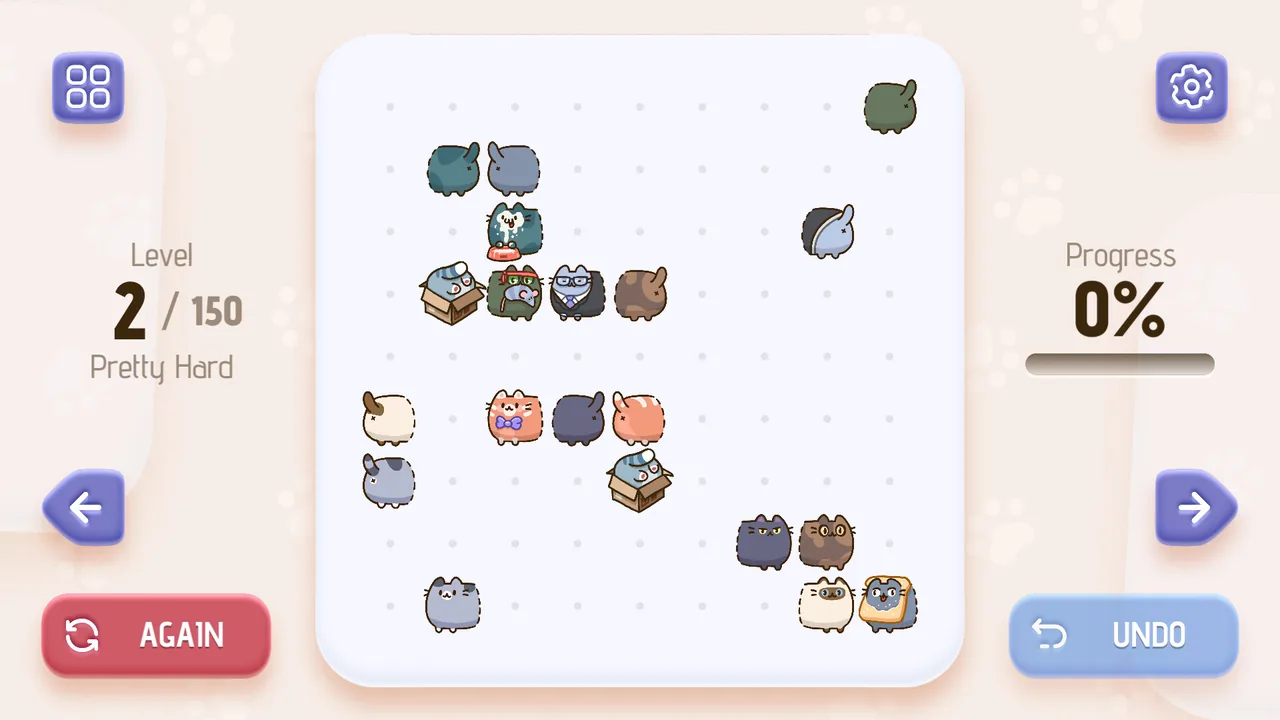
Each cat is split into a head and a tail that must be joined with an unbroken lineImage: traint via Steam -
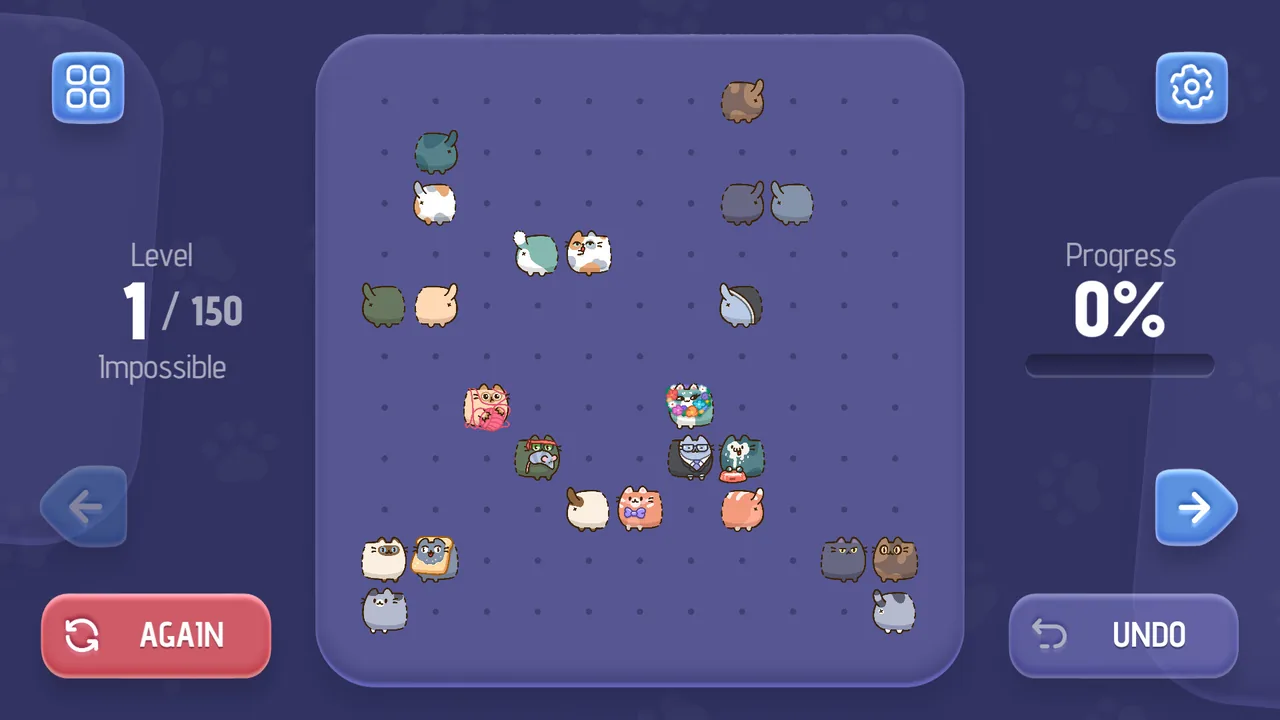
The Impossible pack is one of seven difficulty tiers, each running 150 levels deepImage: traint via Steam -
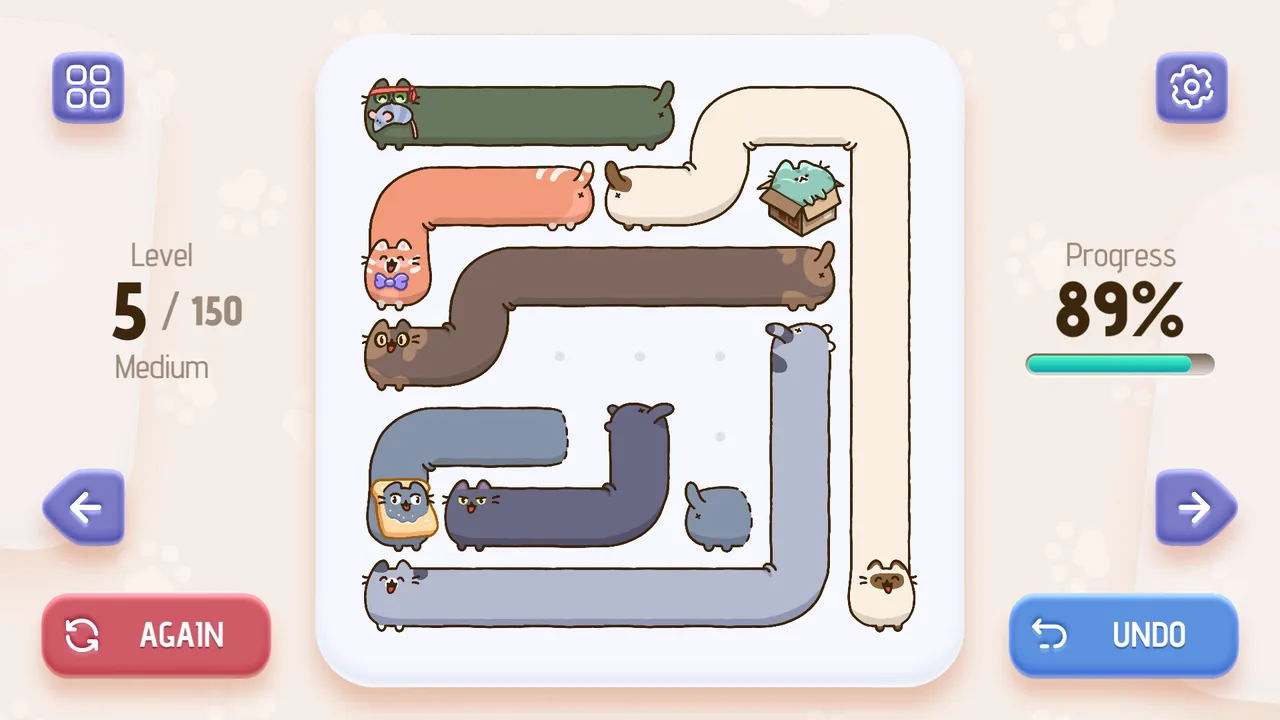
Completed connections render as the cat's own body bending around the gridImage: traint via Steam -
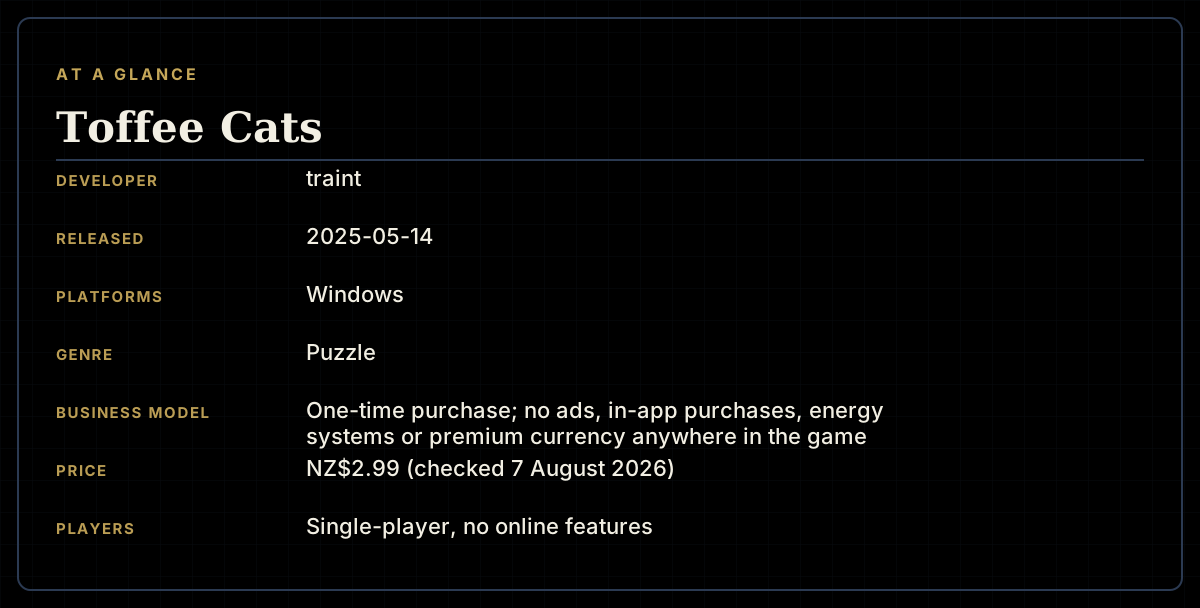
Toffee Cats at a glanceWanderer Editorial -
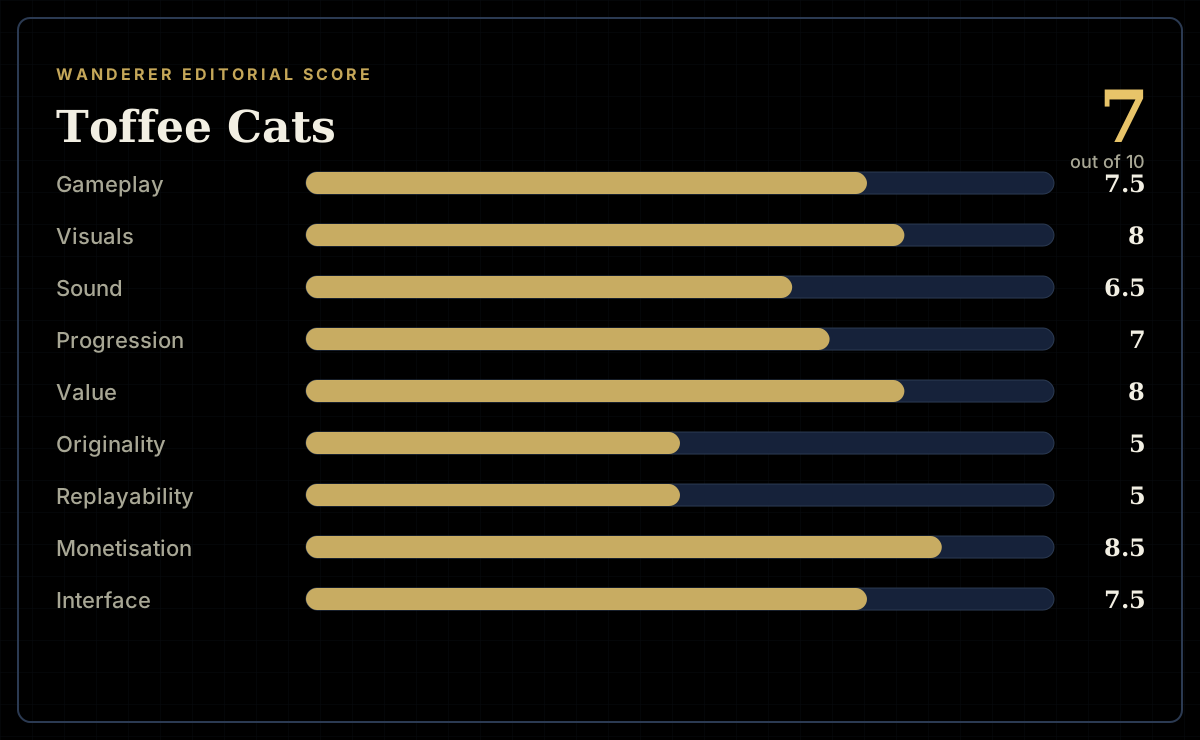
How the review scores each part of the gameWanderer Editorial -
The short versionWanderer Editorial