Game review
Titanic Escape Simulator Review
3.5 / 10
- Developer
- magicprostudio, Vintage Digital Revival
- Publisher
- magicprostudio
- Released
- 24 August 2026
- Platforms
- ["Windows"]
- Genre
- Simulation
A Beautiful Ship Wrapped Around a Deeply Troubled Release
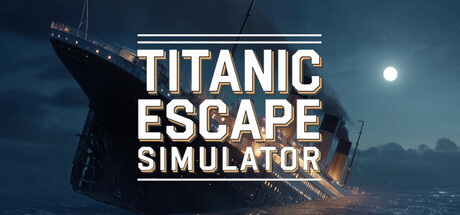
Titanic Escape Simulator launched August 24, 2026 from magicprostudio and Vintage Digital Revival, promising a private-investigator mystery aboard the RMS Titanic that turns into a desperate escape once the iceberg hits. It's an appealing pitch, and a good number of reviewers admit the ship itself is genuinely striking to walk through. But this is also one of the more contested releases this lane has covered: alongside a "Mixed" 52 percent all-language score (382 reviews) and a nearly identical 55 percent English-language score (200 reviews, 110 positive/90 negative), the review pool contains a cluster of serious, repeated, and specific accusations, about AI-generated content, about astroturfed positive reviews, and about the ship model itself being lifted from another studio's free release, that go well beyond ordinary launch-week jankiness and deserve to be reported plainly.
The Pitch: Investigate, Then Survive
The structure is straightforward: play a detective aboard the Titanic's final voyage, question passengers, search cabins, and follow a trail of clues through the ship's public rooms and restricted service corridors, before the iceberg strikes and the game shifts into a race through flooding corridors, tilting decks, and failing lights. Several positive reviewers describe exactly this experience working as intended. "Exploring the ship before and during the disaster is atmospheric and tense," one wrote, while another called it "an atmospheric blend of adventure, investigation, and survival." One reviewer flagged the balance directly, though: "This 'Escape Simulator' spends 90% of the game solving an insane mystery that is completely bonkers, then 10 minutes escaping the ship," a fair description of a title whose marketing and its actual pacing don't quite match.
The Central Controversy: Borrowed Assets and an Unproven Studio
The most serious recurring complaint in the negative pool isn't about bugs, it's about where the ship itself came from. Multiple independent reviewers state that the explorable Titanic interior is drawn from the free tech-demo assets of the long-running fan project Titanic: Honor and Glory, without that project's involvement or permission. "I don't understand how they could use the complete interiors from the Titanic: Honor & Glory demo. I'm pretty sure the THaG team never gave permission for their work to be used like this," one wrote. Another was blunter: "you can explore parts of the Titanic through a old model of the ship that was released by 'Titanic Honour & Glory' ... Whoever made this game, took that model, slapped a poorly 100%-made-by-AI ridiculous story and characters on it, and they're selling it as a game." A third reviewer recommended downloading the free Honor & Glory demo directly instead, calling this release "the exact same model with none of the AI jank." This is a serious, specific, and repeated claim, not a single aside, and it's the backbone of why so many negative reviews describe the game as feeling assembled rather than made.
The Recurring Complaint: AI-Generated Voice Acting and Suspected Astroturfing
Layered on top of the asset dispute is a second, equally corroborated thread: reviewers independently describing the character voice acting and dialogue as AI-generated. "The NPCs have the worst voice overs ever. I genuinely laughed when one says 'ahh, my eyes!' in a robot voice," one wrote. Another: "Isidor Straus calls his wife Isidor, probably because the voice acting seems to be handled by AI." A third called it plainly "ai slop of the highest order." One reviewer noted a partial disclosure that undersold the extent of it: "The game gives fact it made AI but feels what they disclose was made with AI is not fully true." Several reviewers went further still, questioning the legitimacy of the game's own positive reviews. "There's no way I can believe that positive reviews for this game are not people involved with the development," one wrote, while another headlined their review "MOST OF THE POSITIVE REVIEWS ARE AI AND/OR PAID." This review can't verify that specific claim, but it's worth reporting as a repeated, player-raised concern rather than a single outlier's suspicion.
Technical State: Bugs, Missing Faces, and an Unfinished Feel
Beyond the content disputes, the technical execution draws consistent complaints even from some positive reviewers. "Characters are buggy and they phase through their outfits," one wrote in an otherwise favorable review, while a harsher account listed "textures that don't load, voice acting by AI, people floating on chairs, lighting issues." One self-described Titanic historian described "NPC faces [that] didn't load, the lighting was terrible, surfaces didn't render, scenes were just a black screen," and two NPCs whose voices played from the wrong character models mid-conversation. Multiple reviewers reported falling through the map, getting stuck, missing inventory items, and being blocked from finishing the escape sequence entirely. Playtime across the negative pool clusters low, several reviewers refunded within 45 to 90 minutes, which for a $19.99 asking price is a hard number to defend regardless of where any individual bug ranks in severity.
What Still Works: The Ship Itself
It would be unfair to say nothing lands. Even many negative reviews single out the explorable ship model as the one unambiguous success, "the ship is nice to walk around on, that's it, that's the only positive I can find here," as one put it, and the game did add a dedicated Free Roam mode in a post-launch patch specifically so players could explore without the story getting in the way. For a narrow slice of Titanic enthusiasts who just want to wander the halls, that mode plus the ship's visual detail is a genuine, if thin, reason to look twice. It's a fraction of what a $19.99 "escape simulator" implies, though, and it doesn't address the asset-origin and AI-content questions raised by so many of the game's own reviewers.
Verdict
Titanic Escape Simulator arrives with a genuinely attractive ship to walk through and not much else that reviewers agree is finished, original, or reliable. The volume and specificity of the complaints here, an explorable ship reportedly lifted from another studio's free fan project, AI-generated voice acting that multiple players independently mocked, and suspicion (repeated, though unproven) that some of the positive reviews aren't genuine, put this well outside ordinary launch-week roughness. Layer on the crashes, missing faces, and a story that most reviewers found thin or unfinished, and the $19.99 price tag looks hard to justify next to the free tech demo several reviewers say the ship model actually came from. Wait for a steep discount, or better yet, wait to see whether a more transparent, more polished successor ever arrives.
Screenshots
-
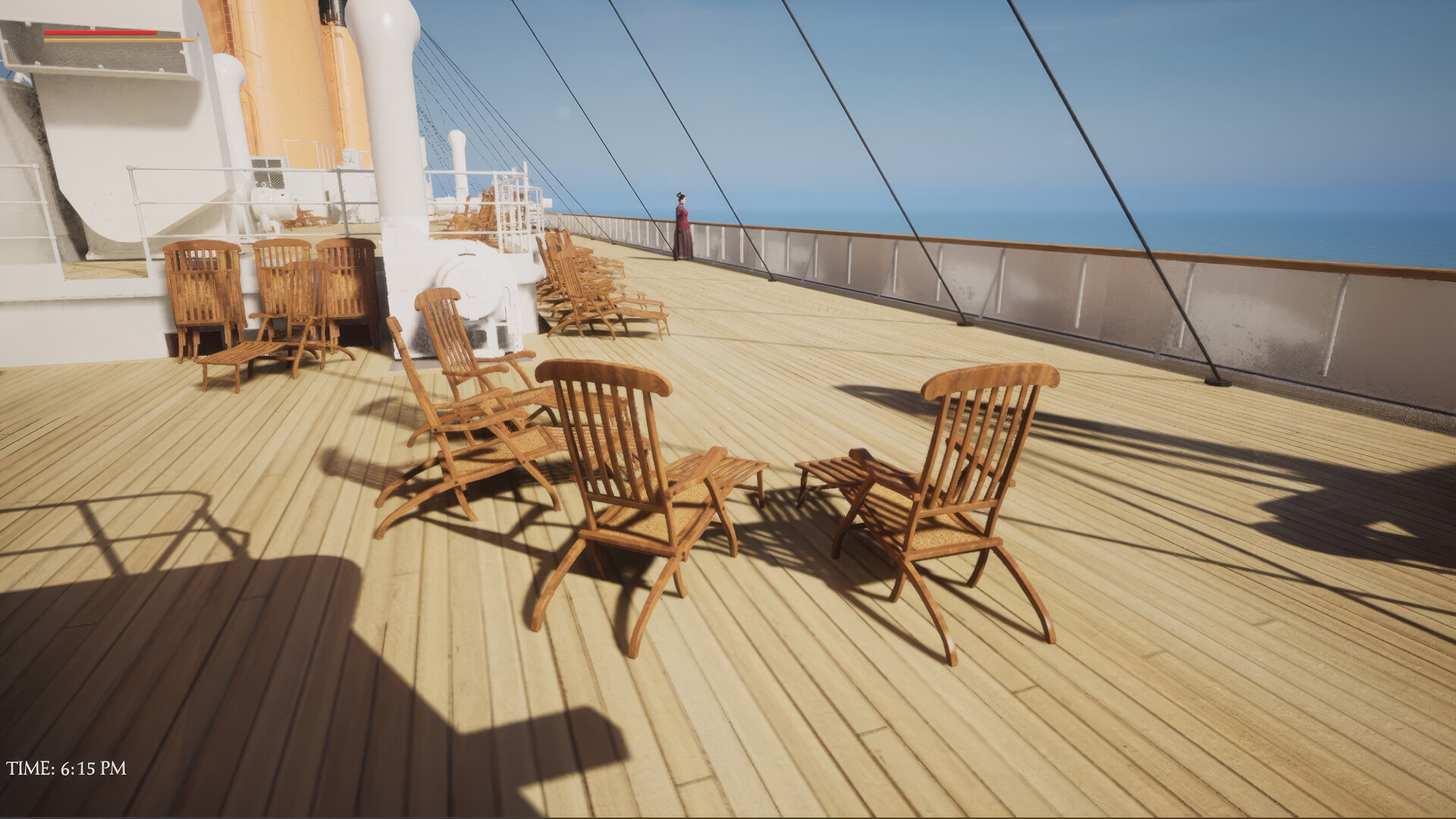
Walking the Titanic's promenade deck at 6:15 PM, one of the ship's quieter, more atmospheric moments.Image: magicprostudio via Steam -
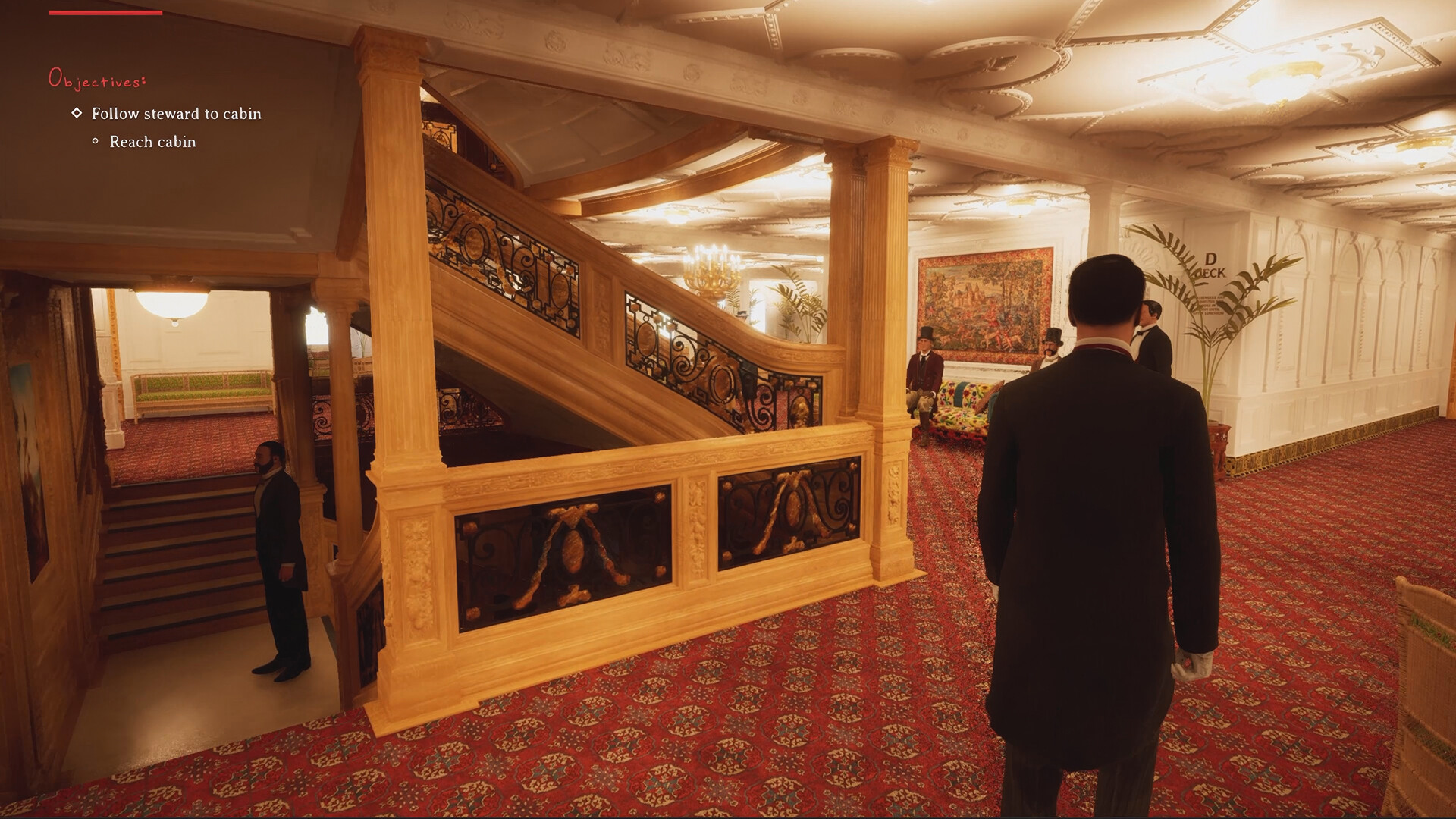
The Grand Staircase, rendered in detail, with an objective marker guiding the player toward the next story beat.Image: magicprostudio via Steam -
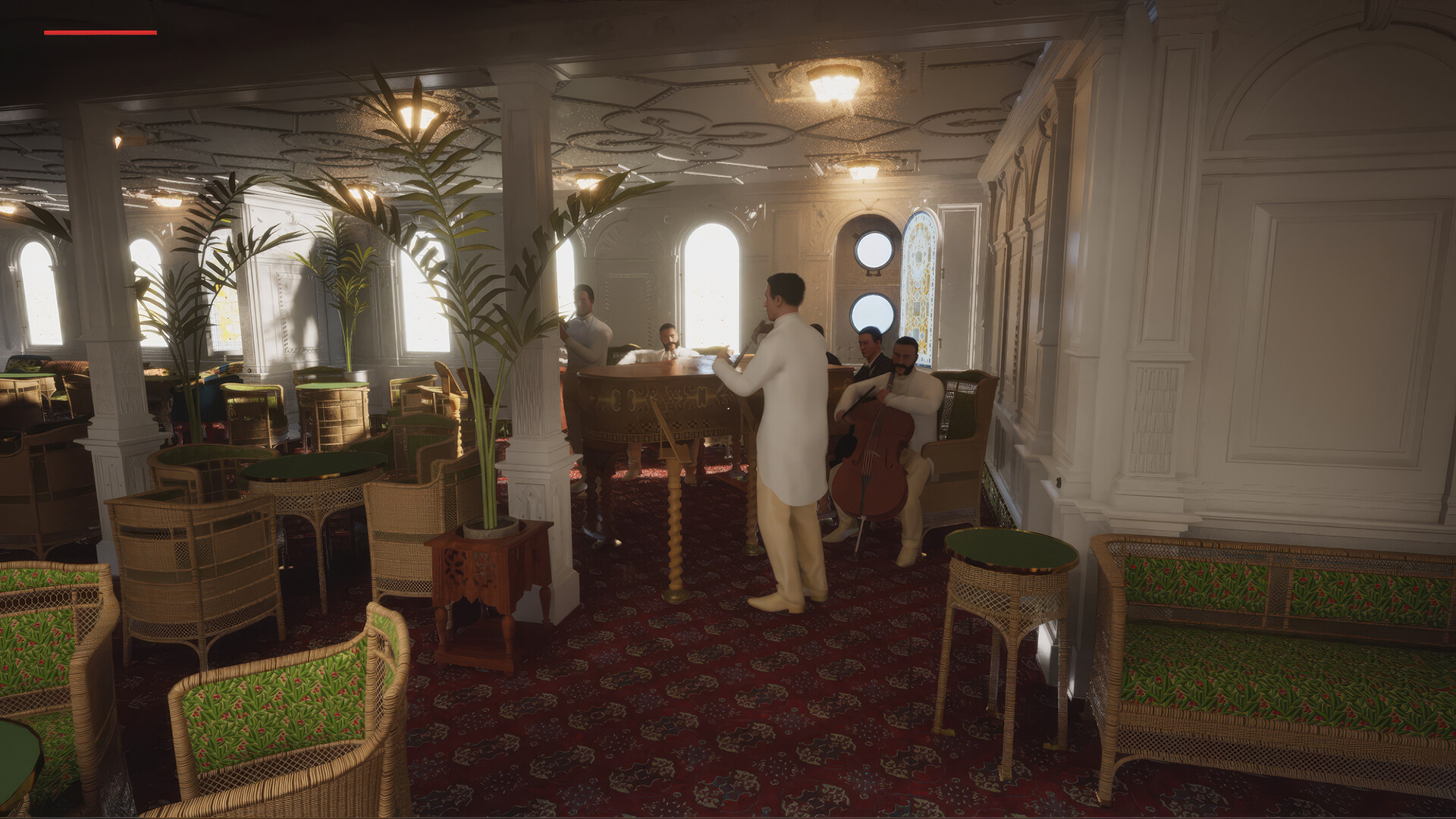
One of the ship's first-class social spaces, complete with a period-dressed house band.Image: magicprostudio via Steam