
Game review
The Greenening
7 / 10
- Developer
- Erkberg Games
- Publisher
- Erkberg Games
- Released
- 7 May 2026
- Platforms
- Windows
- Genre
- Incremental / Casual Simulation
- Monetisation
- Premium one-off purchase; no in-app purchases, ads, energy systems or DLC found
- Players
- Single-player only
The short version
The Greenening hands you a rain-cloud, a dead planet caked in ash, and a skill tree, and asks for about three hours of your evening in return for five dollars. The core loop — wash away grey to reveal green, spend what you find on a chunky tree of cloud upgrades — is genuinely satisfying in a way a lot of cozy incrementals only claim to be, and the currency-into-upgrades pacing rarely asks you to grind for it.
It's also a game that peaks early and knows it. The skill tree stops handing out meaningfully new verbs well before the credits, the one section that tries to introduce actual puzzle-solving arrives in the final act and barely gets to breathe, and the whole experience is built to end right as a player might start wanting more from it.
Biggest strengths
- Washing ash off the world to reveal color underneath is a strong, immediately readable core action that never stops feeling good, even on the fiftieth patch of ground
- The upgrade tree ties every new cloud ability to a visible change in how fast you can clear the map, so progression never feels abstract or purely numerical
- Full controller support and a genuinely relaxed pace make this comfortable to play one-handed on a couch, which most incrementals in this price band don't bother with
Biggest weaknesses
- The skill tree's most interesting choices cluster near the start; later upgrades mostly scale numbers you've already unlocked rather than introducing new ways to interact with the world
- A late-game puzzle system built around lakes and power generators is the closest the game comes to asking for actual strategic thinking, and it shows up with barely enough runtime left to matter before the credits roll
- At roughly three hours with little reason to replay, the value case rests entirely on the low asking price rather than on content depth
Who it's for: Players who want a short, controller-friendly wind-down game with a real progression system attached — not players looking for a skill tree deep enough to justify a second playthrough.
Our recommendation: An easy purchase at $4.99 for what it is, provided you go in wanting a three-hour mood rather than a long-term incremental to sink a weekend into.
7 / 10
Washing the grey off the world
The Greenening's opening minutes tell you almost everything about what kind of game this is going to be. You control a small rain-cloud drifting over a planet buried under a thick layer of ash — the aftermath, the game implies without spelling out, of an industrial civilization that burned through its own world. Drop water on the ash and it washes away, revealing grass, flowers, streams and the odd piece of rusted machinery underneath. That's the entire verb set at the start: hover, rain, watch grey become green. It sounds thin written out like that, and for the first few minutes it is. It stops being thin the moment the currency starts flowing.
Clearing ash yields resources — separate currencies for flora, fauna and reclaimed technology, based on what your rain uncovers — which feed a skill tree governing your cloud's rain power, penetration and range. Early upgrades are the difference between timidly dabbing at patches of ash and sweeping whole sections of a level clean in a single pass, and because the effect of every purchase is something you can immediately go outside and use, the tree never feels like it's spending your time on invisible percentage increases. That's a real strength for the genre. A lot of short incrementals treat their upgrade screen as a separate game bolted onto the exploration, something you check between sessions of the "actual" gameplay. Here the upgrade screen and the exploration are the same system wearing two faces, and the game is better for it.
A skill tree with a fast opening and a slow finish
Ten areas make up the full journey, each introducing a new environmental wrinkle or a new helper — butterflies and wolves are mentioned among the creatures that start clearing obstacles for you once you've earned their trust — and each feeding back into the same currency-and-upgrade loop. The problem is one of pacing rather than design: the tree's most interesting decisions are front-loaded. New verbs — new things your cloud can actually do — arrive quickly in the opening stretch and then taper off, leaving the back half of the tree mostly occupied with upgrades that make existing abilities bigger or faster rather than qualitatively different. For a three-hour game that's not a fatal problem, but it does mean the back half of the run feels more like coasting on momentum built earlier than like a game still introducing itself.
The one attempt to break that pattern shows up in the final area, which folds in a light puzzle layer built around lakes and power generators — the closest thing to genuine problem-solving anywhere in the package, requiring you to think about sequencing rather than just pointing your cloud at the next patch of grey. It's a good instinct arriving at the wrong time. With so little runtime left once it appears, the mechanic barely gets a chance to develop before the credits roll, and the overall impression is of a game ending just as it works up the nerve to ask something harder of the player. A dedicated review of the release flagged the same issue directly: promising mechanics introduced far too late to pay off.
A cozy space garden that's more mood than system
Between areas, currency also feeds a decorative garden-building layer on what appears to be a spaceship — arranging reclaimed biomes into your own small green space. It's a nice capstone to the ash-washing loop, giving the resources you're gathering a visible, personal destination beyond "bigger number on the upgrade screen," but it's decoration rather than a system with its own decisions to make. Players hoping for genuine base- building depth to go with the exploration will find a mood board rather than a management game, and that's fine as long as expectations are set correctly going in — this is closer to a reward screen than a second gameplay pillar.
Presentation, controls and the price of admission
The visual style — soft, rounded, almost squishy character and object design — matches the wholesome pitch well, and the lofi soundtrack does the quiet work of making repeated ash-clearing feel meditative rather than repetitive. Full controller support is a genuine plus in a genre that frequently assumes mouse-and-keyboard by default; this is a comfortable couch game, not just a comfortable desk game, and the pacing never punishes a relaxed, one-handed play style. Thirty-four Steam achievements give completionists a reason to poke into every corner of a short map rather than beelining the credits.
At $4.99, there's essentially no monetisation conversation to have — no ads, no energy system, no premium currency running alongside the one you actually earn, no expansion pass waiting on the storefront page. What you see at checkout is what you get, and for a three-hour game that's exactly how the transaction should work. The Steam player base has responded accordingly, with reviews running heavily positive and few complaints beyond the brevity and the underused late puzzle system that show up here too.
Verdict
The Greenening is a well-made short incremental that understands its own best idea — tying visible, immediate feedback to every upgrade — better than most games twice its length manage. It doesn't overstay its welcome, it doesn't nickel-and-dime the purchase, and it's genuinely pleasant to sit with for an evening. Where it falls short is ambition after the opening hour: a skill tree that stops introducing new ideas well before the credits, and a puzzle mechanic that arrives with almost no room left to prove itself. Neither issue makes the three hours you do get any less enjoyable; they just cap how much game there is to enjoy.
Buy it for what it is — a low-cost, low-friction wind-down session with a genuinely satisfying core action — and not for what the final area briefly hints it could have been. Players who want that same kind of steady, visible progression but with a lot more runtime attached to it, including systems that keep advancing whether or not they're at the keyboard, may also want to look at Wanderer.
Pros and cons
Pros
- Washing ash off the world to reveal color underneath is a strong, immediately readable core action that never stops feeling good, even on the fiftieth patch of ground
- The upgrade tree ties every new cloud ability to a visible change in how fast you can clear the map, so progression never feels abstract or purely numerical
- Full controller support and a genuinely relaxed pace make this comfortable to play one-handed on a couch, which most incrementals in this price band don't bother with
- A completely clean purchase — no ads, no energy timers, no premium currency sitting next to the real one, nothing to opt out of
- Thirty-four Steam achievements and a lofi soundtrack give the short runtime a bit more shape than a single straight-through sitting would suggest
Cons
- The skill tree's most interesting choices cluster near the start; later upgrades mostly scale numbers you've already unlocked rather than introducing new ways to interact with the world
- A late-game puzzle system built around lakes and power generators is the closest the game comes to asking for actual strategic thinking, and it shows up with barely enough runtime left to matter before the credits roll
- At roughly three hours with little reason to replay, the value case rests entirely on the low asking price rather than on content depth
- Windows-only, with no Mac or Linux build, despite a presentation style that would sit comfortably on Steam Deck or a laptop
Screenshots
-
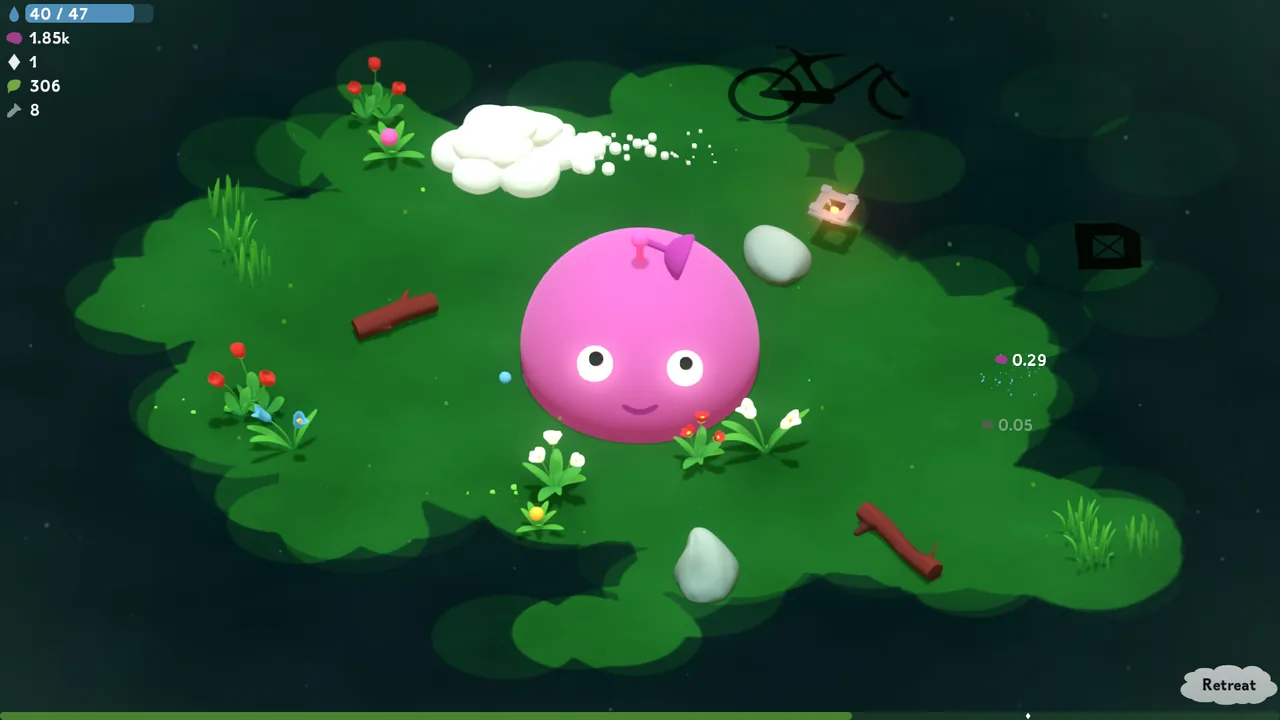
The GreeneningImage: Erkberg Games via Steam -
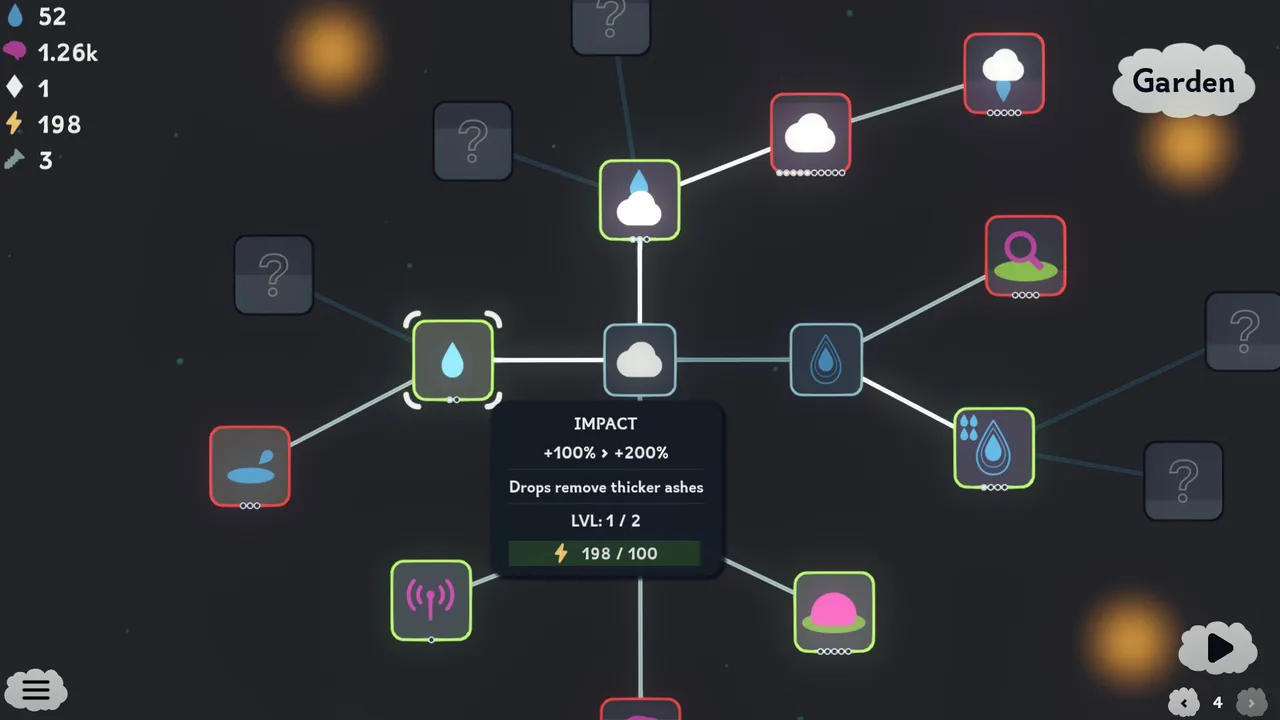
The GreeneningImage: Erkberg Games via Steam -
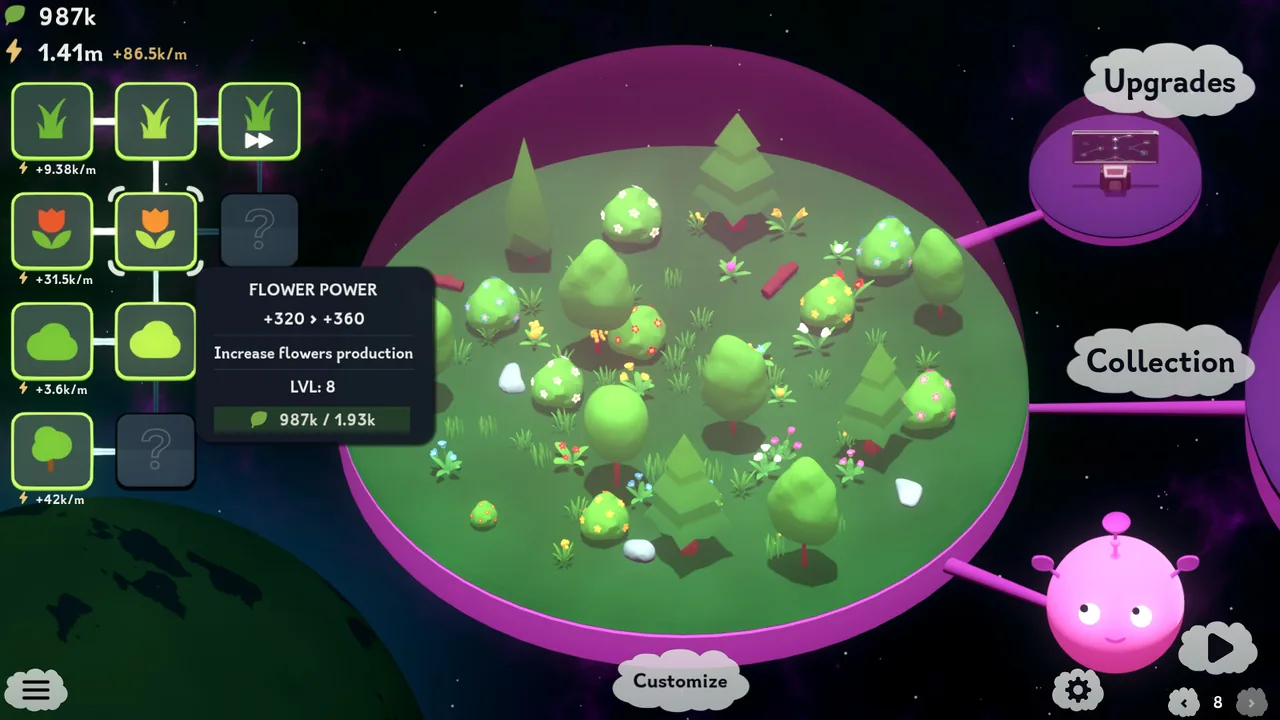
The GreeneningImage: Erkberg Games via Steam -
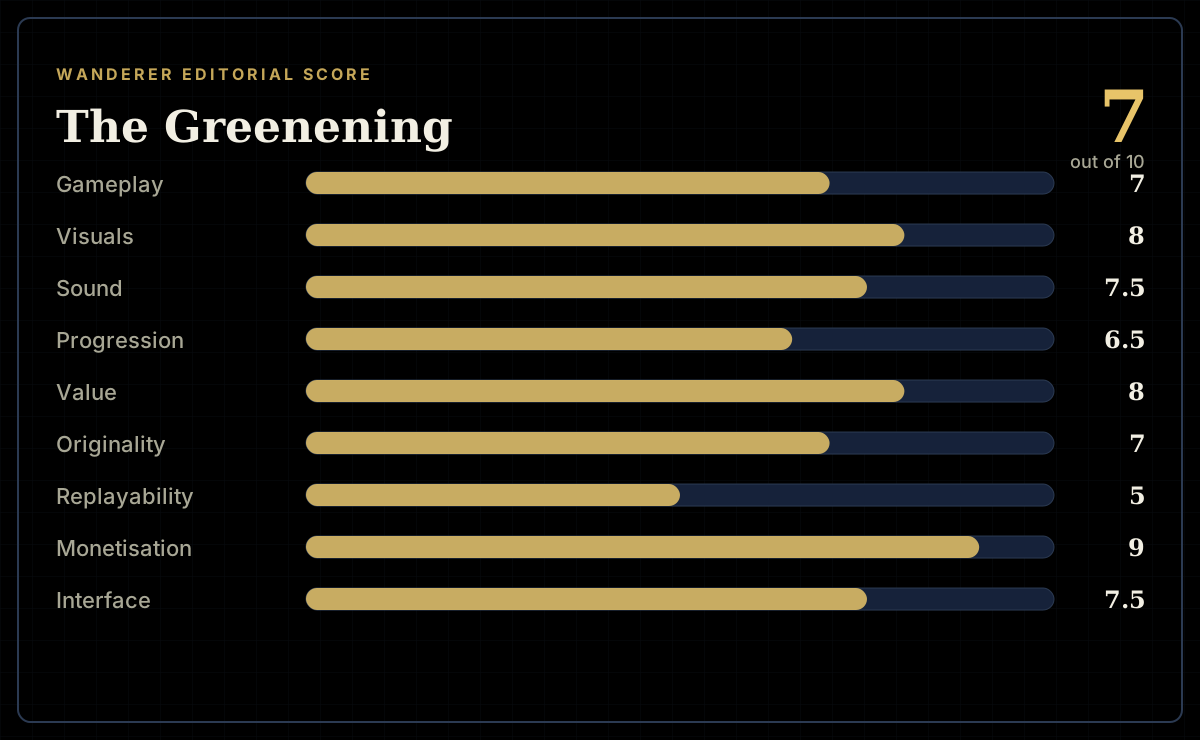
How the review scores each part of the gameWanderer Editorial -
The short versionWanderer Editorial