
Game review
Tempopo
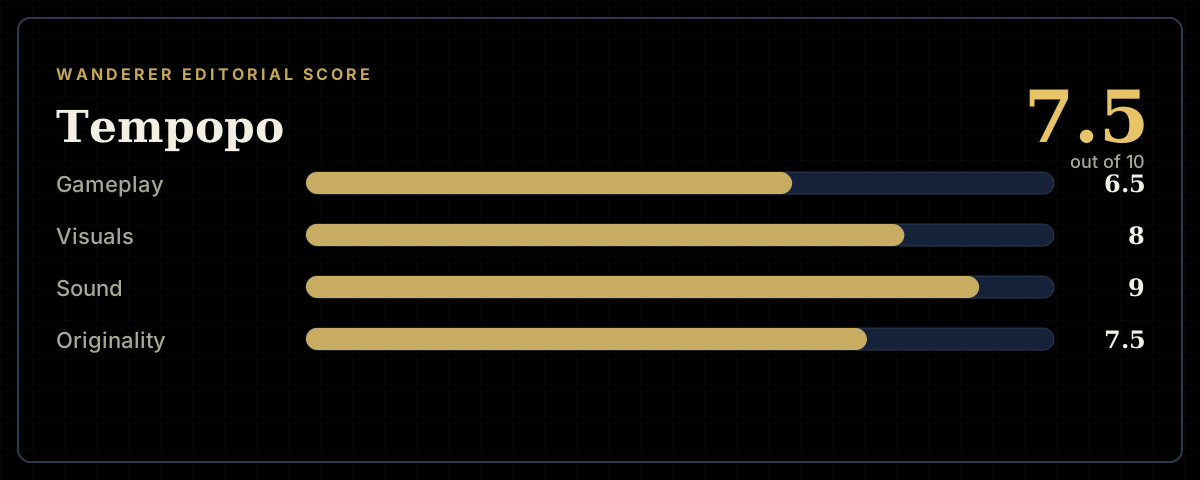
7.5 / 10
- Developer
- Witch Beam
- Publisher
- CULT Games
- Released
- 17 April 2025
- Platforms
- Windows
- Genre
- Puzzle, Music
- Monetisation
- One-time purchase, no DLC or in-game currency
- Players
- Single-player
The short version
Tempopo asks you to conduct a chaotic flock of creatures called Tempopo through island puzzles spanning all four seasons, having them smash, block, lift and push one another to rescue musical flowers and rebuild a melodic garden. It's the latest from Witch Beam, the small Australian studio behind the beloved bullet-hell Assault Android Cactus and the acclaimed Unpacking, with a soundtrack from BAFTA award-winning composer and audio director Jeff van Dyck that draws exceptionally strong, specific praise across nearly the entire review corpus. Reviewers who already loved the studio's prior work describe an immediate, earned trust extending to this release, and most find the puzzling genuinely satisfying to unpack. One detailed dissenting review, though, raises a specific and well-argued mechanical concern: that progress often comes down to placing commands almost at random and observing the chaotic result, rather than reasoning through a solution the way comparable conducting-puzzle games like HUMANITY are built to reward.
Biggest strengths
- The soundtrack, composed by BAFTA award-winning Jeff van Dyck, draws exceptionally strong and specific praise across nearly the entire review corpus, with multiple reviewers describing it among the best game music they've encountered and crediting it for elevating even straightforward puzzle-solving into something joyful
- Witch Beam's established reputation from Assault Android Cactus and Unpacking carries real weight with reviewers, several of whom describe trusting the studio unconditionally and finding that trust rewarded again here
- The puzzle structure — conducting multiple creatures to smash, block, lift and push each other through increasingly complex island layouts — is described by multiple reviewers as satisfying to plan and genuinely rewarding when a solution comes together, particularly once the back half introduces tougher challenges
Biggest weaknesses
- A detailed, well-reasoned negative review argues the puzzle logic relies too heavily on trial-and-error rather than deducible planning, describing creature movement as unpredictable enough that solutions often come down to placing commands almost at random and observing the chaotic result rather than reasoning toward an answer
- That same reviewer makes a specific, informed genre comparison, arguing the similarly-structured conducting-puzzle game HUMANITY does a better job of setting up clear, logically-solvable obstacles where success feels earned rather than lucky
- The kid-friendly cartoon aesthetic and protagonist, while acknowledged upfront in the game's own trailers, are specifically flagged by at least one reviewer as running somewhat counter to the developer's own "a game for all ages" framing on the discussion forum, suggesting the marketing undersells how strongly the presentation skews young
Who it's for: Puzzle fans who enjoy planning-and-execution "watch your plan unfold" mechanics in the vein of Lemmings, and who specifically value outstanding music and presentation as part of the puzzle- solving experience. Its bright, cartoon aesthetic is explicitly kid-friendly, which several reviewers say adults should know going in even though many still find real challenge and joy in it.
Our recommendation: A confident recommendation for puzzle fans specifically drawn to Witch Beam's track record and to outstanding game music — just be aware of one detailed, credible critique that the puzzle logic can feel closer to trial-and-error chaos than deliberate reasoning, especially in denser levels.
7.5 / 10
Conducting chaos into music
Tempopo's premise is charming and immediately legible: Hana's garden of musical flowers has been scattered across a sky full of islands, and she enlists the help of the Tempopo — small, chaotic, uncoordinated creatures — to get them back. Each island is a puzzle of planning and execution, instructing your Tempopo to smash, block, lift and push one another through obstacles spanning all four seasons, with every rescued flower joining a growing, synthesizable melodic garden back home. It's the latest release from Witch Beam, the small Australian studio whose earlier games — the frenetic bullet-hell Assault Android Cactus and the quietly acclaimed Unpacking — have built exactly the kind of developer trust that carries real weight in how this new release is being received. Multiple reviewers describe that trust directly, saying Witch Beam "does not miss" and that they'd play anything the studio makes sight unseen.
A score worth building a review around
If there's one element of Tempopo that draws essentially unanimous praise, it's the music. Composed by Jeff van Dyck, a BAFTA award-winning composer and audio director, the soundtrack earns some of the strongest, most specific praise in this review's entire survey — reviewers describe "bouncing in their seat" through levels, call it among the best game music they've heard, and credit it with elevating what might otherwise be a straightforward puzzle loop into something genuinely joyful to sit inside. That's a rare, high bar of praise, and it recurs consistently enough across the sample that even the game's one detailed critic opens by conceding the soundtrack is "amazing."
When planning gives way to chaos
That one detailed dissent deserves real attention precisely because it's argued so carefully. The reviewer credits Tempopo's presentation and music fully, then raises a specific, mechanical concern: progress in denser levels often comes down to placing commands almost at random and observing how much farther the chaotic result gets you, rather than reasoning through a deducible solution the way a strong planning puzzler should reward. They note creature movement can feel unpredictable — "why did they turn right and not left?" — undermining the sense that a cleared level was earned through skill rather than luck. Most tellingly, they draw a specific, informed comparison to HUMANITY, a similarly-structured conducting-puzzle game, arguing it does a better job establishing clear, logically-solvable obstacles. That's exactly the kind of detailed, comparison-backed critique worth weighing seriously rather than dismissing as one player's frustration, even though it represents a minority view in this small sample.
Built with kids in mind, enjoyed by more than kids
A separate, more descriptive observation concerns tone. The same reviewer notes that while Witch Beam states on its own discussion forum that Tempopo is "a game for all ages," the actual presentation — a cartoon protagonist, cutesy dancing companions — reads as clearly aimed at a younger audience, a detail visible in the trailers but worth stating plainly for adult buyers calibrating expectations. That's borne out by other reviews too, several of which specifically recommend the game for children, nieces or nephews — but just as many adult reviewers report genuine enjoyment and real challenge in the puzzle-solving regardless of the game's visual target audience, suggesting the "for all ages" framing holds up better as an actual play experience than as marketing copy alone.
What the achievement data suggests
Steam's global achievement percentages offer an independently-checkable window into how the difficulty curve actually plays out across the full population of owners, separate from what any individual reviewer chooses to report. The earliest, most basic achievements sit in the 40-48% range — already a meaningful drop-off from the ownership base, typical for any puzzle game where a chunk of buyers never progress far past the opening islands. What's more telling is how steep the fall gets toward the back half: the deepest, most demanding achievements sit at just 2.1-2.3% completion, a gap of roughly twenty-fold between the easiest and hardest unlocks. That's consistent with the recurring reviewer description of a first half that's straightforward and a back half that "throws in some more challenges and a few noodle scratchers" — and it's also consistent with the dissenting review's core complaint, since a puzzle structure that leans on chaotic, hard-to-predict outcomes would plausibly produce exactly this kind of sharp late-game completion cliff, as players who can brute-force early trial-and-error solutions hit a wall once density and unpredictability compound.
The melodic garden's quieter appeal
Beyond the moment-to-moment puzzle-solving, Tempopo's meta-progression deserves its own mention. Every rescued flower joins a growing garden back at Hana's home, and each flower type contributes its own distinct musical tune, with the option to synthesize different combinations together into unique performances. It's a smaller, gentler layer than the core conducting puzzles, but it gives the soundtrack — already the game's standout element — a second life as something players actively curate rather than simply listen to in the background of a level. For a game already earning this much specific praise for its music, building an entire secondary system around letting players arrange that music themselves is a thoughtful way to extend the appeal beyond the length of the campaign itself, and it rewards full completion in a way that's musical rather than merely numerical.
The verdict
Tempopo delivers an exceptional musical experience wrapped around a puzzle structure that most reviewers find satisfying, if occasionally chaotic. Witch Beam's reputation for polish and creative risk-taking carries through clearly, and the near-unanimous praise for Jeff van Dyck's score alone is worth taking seriously as a reason to try it. The one detailed dissent — that the puzzle logic sometimes rewards trial-and-error over genuine reasoning — is specific and well-argued enough to flag clearly for players who specifically value logical, deducible puzzle design above all else. For everyone else, this is a bright, joyful, confidently-made game from a studio with a real track record of earning that description.
Pros and cons
Pros
- The soundtrack, composed by BAFTA award-winning Jeff van Dyck, draws exceptionally strong and specific praise across nearly the entire review corpus, with multiple reviewers describing it among the best game music they've encountered and crediting it for elevating even straightforward puzzle-solving into something joyful
- Witch Beam's established reputation from Assault Android Cactus and Unpacking carries real weight with reviewers, several of whom describe trusting the studio unconditionally and finding that trust rewarded again here
- The puzzle structure — conducting multiple creatures to smash, block, lift and push each other through increasingly complex island layouts — is described by multiple reviewers as satisfying to plan and genuinely rewarding when a solution comes together, particularly once the back half introduces tougher challenges
- Limited voice acting, confined mercifully to the intro cinematic according to one reviewer, keeps the presentation from feeling padded with dialogue that would otherwise slow down the puzzle-focused pacing
- The melodic garden meta-progression, where rescued flowers each contribute their own tune to a synthesizable performance, gives completionist players a genuine, musically satisfying reason to clear every level rather than just the required ones
Cons
- A detailed, well-reasoned negative review argues the puzzle logic relies too heavily on trial-and-error rather than deducible planning, describing creature movement as unpredictable enough that solutions often come down to placing commands almost at random and observing the chaotic result rather than reasoning toward an answer
- That same reviewer makes a specific, informed genre comparison, arguing the similarly-structured conducting-puzzle game HUMANITY does a better job of setting up clear, logically-solvable obstacles where success feels earned rather than lucky
- The kid-friendly cartoon aesthetic and protagonist, while acknowledged upfront in the game's own trailers, are specifically flagged by at least one reviewer as running somewhat counter to the developer's own "a game for all ages" framing on the discussion forum, suggesting the marketing undersells how strongly the presentation skews young
- The early levels are described by more than one reviewer as fairly easy and straightforward, meaning players hoping for consistent challenge from the outset may need patience before the back half's tougher puzzles arrive
- The review sample is small — 51 total reviews at time of writing — so while the near-unanimous praise (49 of 51 positive) is a strong signal, it hasn't yet been tested against a large-scale audience the way bigger releases in this survey have been
Screenshots
-

TempopoImage: CULT Games via Steam -

TempopoImage: CULT Games via Steam -

TempopoImage: CULT Games via Steam -
How the review scores each part of the gameWanderer Editorial -
The short versionWanderer Editorial