
Game review
Tellyport
8 / 10
- Developer
- Tellyport
- Publisher
- ISART DIGITAL
- Released
- 8 June 2026
- Platforms
- Windows
- Genre
- Action, Indie, Free To Play
- Monetisation
- free-to-play
- Players
- false
The short version
Biggest strengths
- A genuinely fresh twist on the Portal formula, using television-screen portals that alter the traveler's size or gravity rather than just relocating them
- Outstanding production quality for a free release, with reviewers repeatedly praising the 70s-lab art direction, voice acting, and music
- Clever, well-paced puzzles that reward observation and experimentation without becoming frustrating
Biggest weaknesses
- A very short runtime, roughly 30 minutes for a first playthrough, that the overwhelming majority of reviewers wished were longer
- At least one reviewer reported the game is effectively unplayable on a laptop trackpad, since the throw action is bound to right-click with no rebind option
- A gravity-switching rule that isn't always clearly explained, leaving at least one reviewer confused about when it did or didn't apply to objects passing through a portal
Who it's for: Fans of Portal-style first-person puzzle games who want a short, gorgeous, free experience with a genuinely fresh spin on the teleport-and-manipulate formula, and who won't mind the runtime ending right as it hits its stride
Our recommendation: recommended
8 / 10
Portal's idea, rewired through an old television set
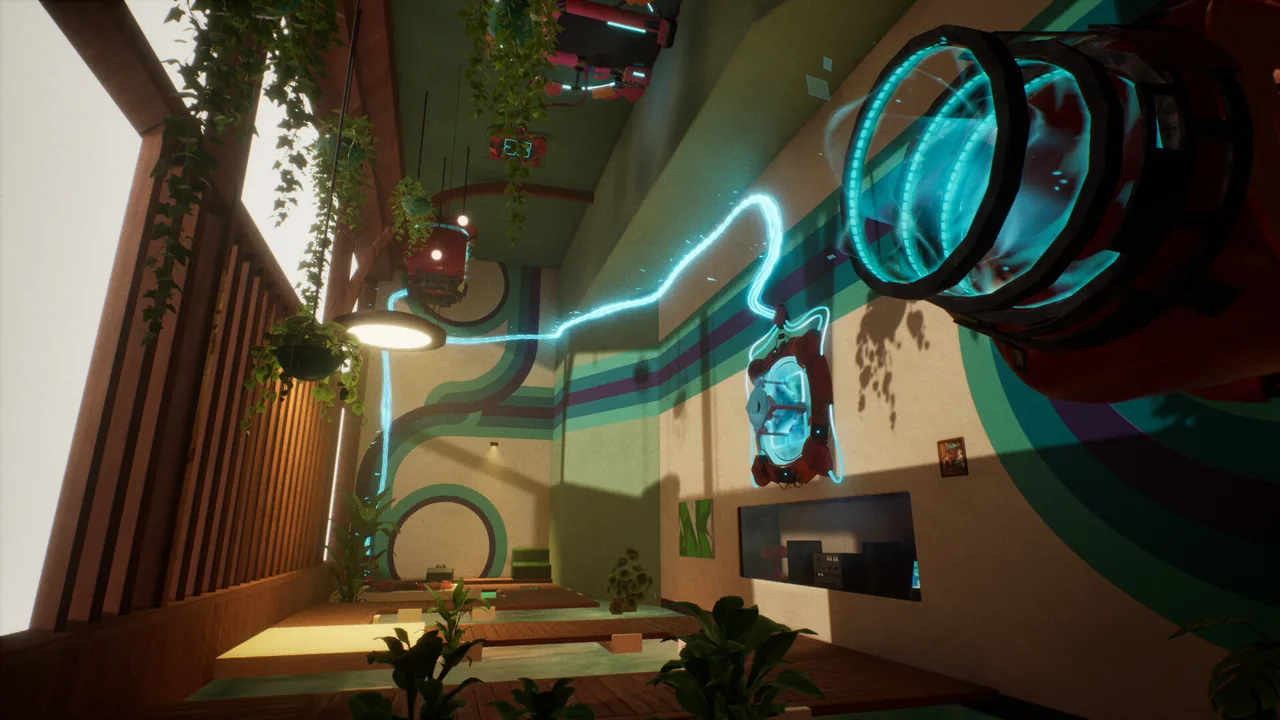
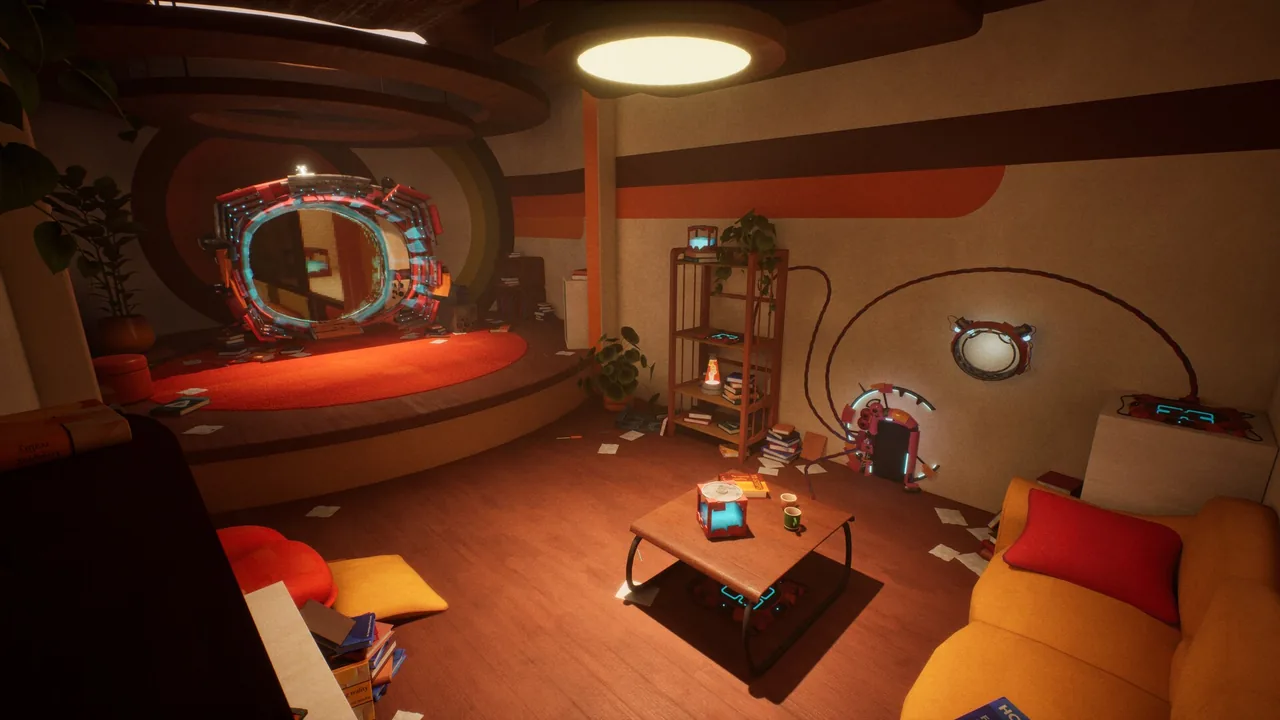
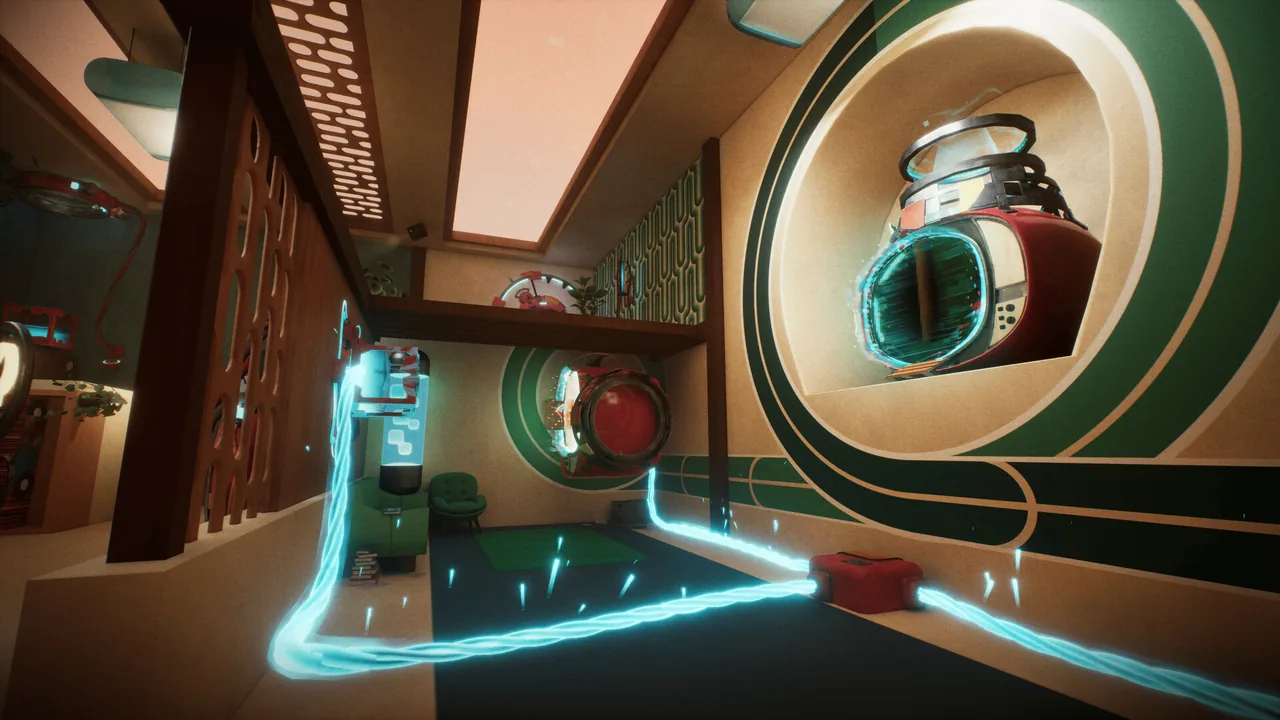
Tellyport's pitch is easy to describe and hard to pull off well: you play as Sally, visiting her eccentric inventor grandmother's cluttered 70s-style lab, and solve puzzles by stepping through pairs of connected television screens. One reviewer nailed the comparison precisely: "Portal, but you get bigger, smaller or be upside down." Another reviewer who initially dismissed it as derivative changed their mind quickly: "At first, this seemed just like a Portal clone with some cozy retro-futuristic decorations... But when you start playing, you realise this game does its own thing with the portals. Not only they allow you to teleport, but also to change your size or your gravity, and you have to use those mechanics to solve some puzzles." That's the core hook, and reviewers consistently credit it with feeling genuinely distinct rather than derivative, even while openly acknowledging its obvious lineage.
Production values well above its price tag
Given that Tellyport costs nothing, the review pool's praise for its presentation is striking in how little it hedges. One reviewer called it simply "a lovelly little heir of Portal series," while another wrote, "I cannot believe this is a FREE game! the puzzles make you really think and it truly feels rewarding when you figure it out! the 70s easthetic and the adorable voice acting make this a surprisingly cozy game." A third went further still: "Honestly would have paid a few dollars for this, despite it being so short. Game is well put together and gorgeous to look at, and the puzzles are unique and interesting!" That sentiment, that this looks and plays like a paid product despite costing nothing, recurs across nearly every longer review in the pool.
Puzzles that reward curiosity without punishing failure
Reviewers with prior experience in the genre found the puzzle design approachable without feeling shallow. One wrote that the puzzles "are really easy, but the little story and the rooms (along with their decorations) are interesting enough to keep you entertained," framing the difficulty curve as intentionally gentle rather than a shortcoming. Another, who came in fresh to the size- and gravity-manipulation mechanics, admitted, "Had I not had experience with Superliminal and Portal, these puzzles probably would've taken me wayy longer to figure out," suggesting the learning curve is friendlier to genre veterans than newcomers, though still approachable either way.
The one complaint nearly everyone shares
If there's a single dominant note of dissatisfaction in this review pool, it's not about quality, it's about quantity. One reviewer captured the consensus bluntly: "A brilliant game, intriguing puzzles, but far too short... I hope there's a sequel or, better yet, a full game." Another, more forgiving about the scope, offered useful context: "An extremely short relatively simple puzzle game that you can easily clear in under 30 minutes but has outstanding production quality. I kinda wish it were longer with more playtime but seeing as it's a student project I can understand why the scope was kept so small." That framing, treating Tellyport as a polished student showcase rather than a full commercial release, seems to be exactly how most of its audience has come to terms with the brevity: as a limitation of scope rather than of ambition or craft.
Real, if minor, friction points
A handful of reviewers ran into specific, concrete problems worth flagging. One reported the game is effectively unplayable without a mouse: "if you're on a laptop, you can't play. you need right click to throw, and you can't change the key bind. good game if you have a mouse. 6/10," a genuine accessibility gap for anyone without a full mouse setup. Another found the gravity-switching rules inconsistently telegraphed: "would have apricated it being explained why sometimes cubes changed gravity when going through a portal and sometimes dont." A couple of reviewers also mentioned minor technical hiccups, including a physics-object frame drop during one stage and a startup glitch that needed a settings-menu fix to resolve, though both described the issues as brief and non-blocking rather than persistent.
A calling card, not a full meal
Several reviewers explicitly framed Tellyport as evidence of a promising future rather than a complete standalone experience, hoping to see the concept expanded. One wrote, "We need a sequel!" after praising how well the two core mechanics, size-scaling and gravity-shifting, combined to create fresh puzzle possibilities. Another asked for "a way to make your own levels" to extend the game's life beyond its handful of built-in puzzles and achievement hunt. That kind of reception, genuine enthusiasm paired with a wish for more rather than disappointment with what's there, is a strong signal for a free release with this level of polish.
Verdict
Tellyport punches well above its price tag: a clever, well-executed twist on the Portal formula built around size- and gravity-altering television portals, wrapped in art direction, voice acting, and music that reviewers consistently say feels like a paid product rather than a free student showcase. Its problems are minor and specific rather than systemic, a missing keybind option that locks out trackpad-only laptop users, an occasionally unclear gravity rule, and a couple of small technical hiccups, but its single real shortcoming is a runtime so short that nearly everyone who loved it wished there were simply more of it. Easy to recommend to any Portal-style puzzle fan looking for a free, gorgeous half-hour, just go in expecting a tasting menu rather than a full course.
Pros and cons
Pros
- A genuinely fresh twist on the Portal formula, using television-screen portals that alter the traveler's size or gravity rather than just relocating them
- Outstanding production quality for a free release, with reviewers repeatedly praising the 70s-lab art direction, voice acting, and music
- Clever, well-paced puzzles that reward observation and experimentation without becoming frustrating
- Completely free with no monetisation, which reviewers say makes its polish feel like an unexpected gift rather than a limited demo
Cons
- A very short runtime, roughly 30 minutes for a first playthrough, that the overwhelming majority of reviewers wished were longer
- At least one reviewer reported the game is effectively unplayable on a laptop trackpad, since the throw action is bound to right-click with no rebind option
- A gravity-switching rule that isn't always clearly explained, leaving at least one reviewer confused about when it did or didn't apply to objects passing through a portal
- Minor technical hiccups reported by a couple of reviewers, including a physics-object frame drop and a startup glitch that required a settings fix
Screenshots
-
TellyportImage: ISART DIGITAL via Steam -
TellyportImage: ISART DIGITAL via Steam -
TellyportImage: ISART DIGITAL via Steam