Game review
TEEFS Review: A Goblin Idle Clicker With Real Teeth
6.9 / 10
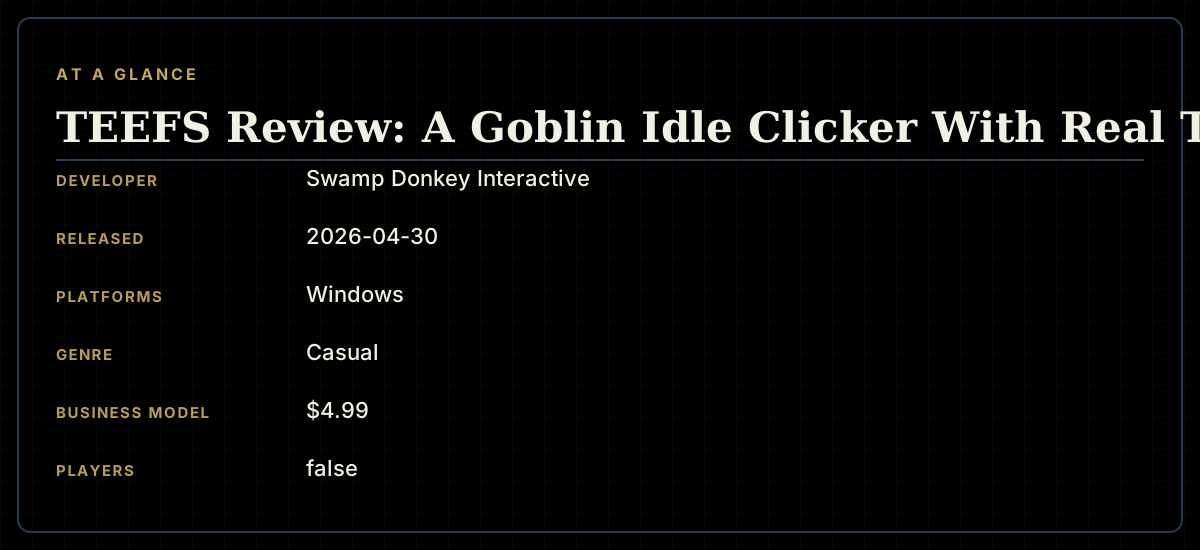
- Developer
- Swamp Donkey Interactive
- Publisher
- Swamp Donkey Interactive LLC
- Released
- 30 April 2026
- Platforms
- Windows
- Genre
- Casual
- Monetisation
- $4.99
- Players
- false
The short version
TEEFS takes the well-worn cookie-clicker template and reskins it with a genuinely funny goblin-and-ork economy built entirely on collected teeth, and its Positive review sample keeps calling out its lore, humor, and minigames as standout for the genre, even as a specific minority reports bugged unlock progression, background performance issues that undercut the point of an idle game, and UI text some found barely readable.
Biggest strengths
- Comedically strong ork and goblin writing and lore that multiple reviewers specifically credit for elevating the game above a generic numbers-go-up clicker
- A faster pace than genre touchstones like Cookie Clicker, with engaging minigames that several reviewers say keep the loop from growing stale
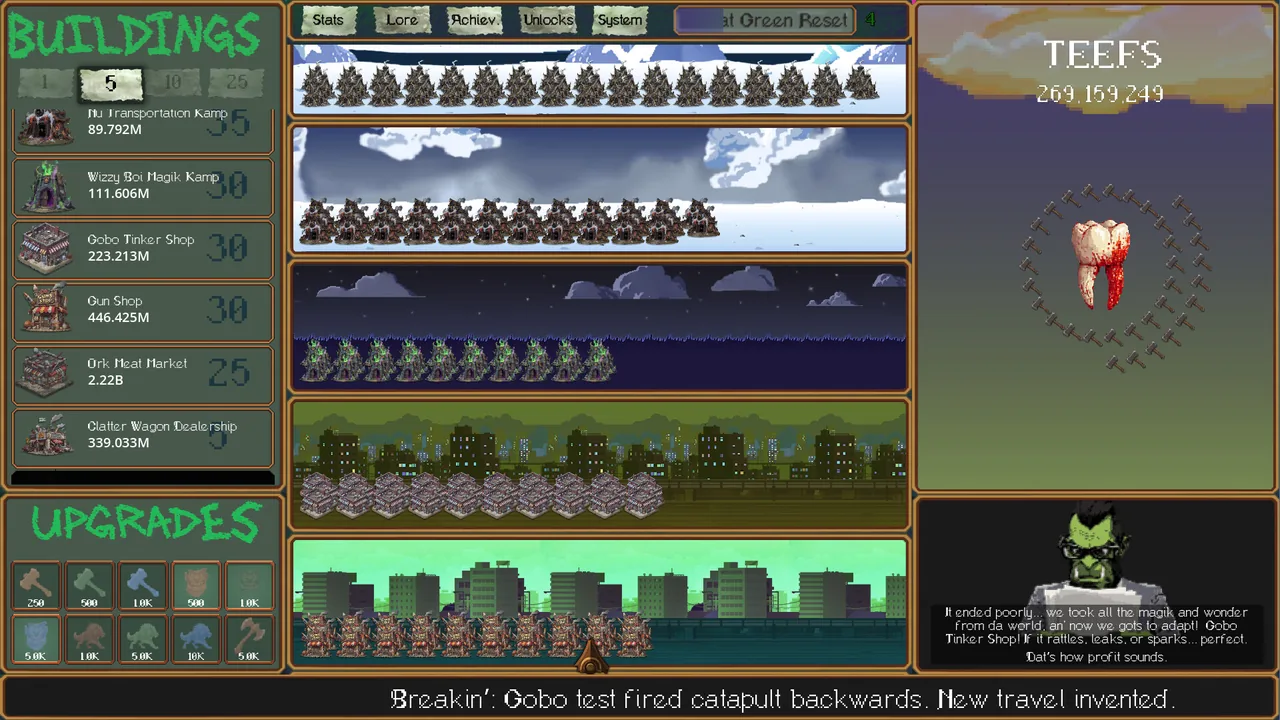
- A distinctive, well-received art style that reviewers say helps the game stand out visually in a crowded clicker/idler market
Biggest weaknesses
- A specific progression bug reported by one reviewer, where an unlock requiring 1,000 clicks stayed locked even after reaching the 5,000-click achievement threshold, serious enough that they returned the game over it
- Multiple negative reviewers report the game slows their computer down too much to comfortably leave running in the background, which cuts against the core appeal of an idle, second-monitor game
- One detailed negative review criticizes barely-readable font sizing, calls the minigames comparable to 'the worst NES games,' and says they don't meaningfully aid progression since there's no difficulty scaling
Who it's for: Best for idle and incremental game fans who want a faster-paced, more narratively engaged take on the Cookie Clicker formula, especially those drawn to comedic ork/goblin writing; a poor fit for players who need a game to genuinely idle untouched in the background without slowing their machine, or who are sensitive to progression-blocking bugs.
Our recommendation: Buy it
6.9 / 10
An idle clicker with an unusually funny premise
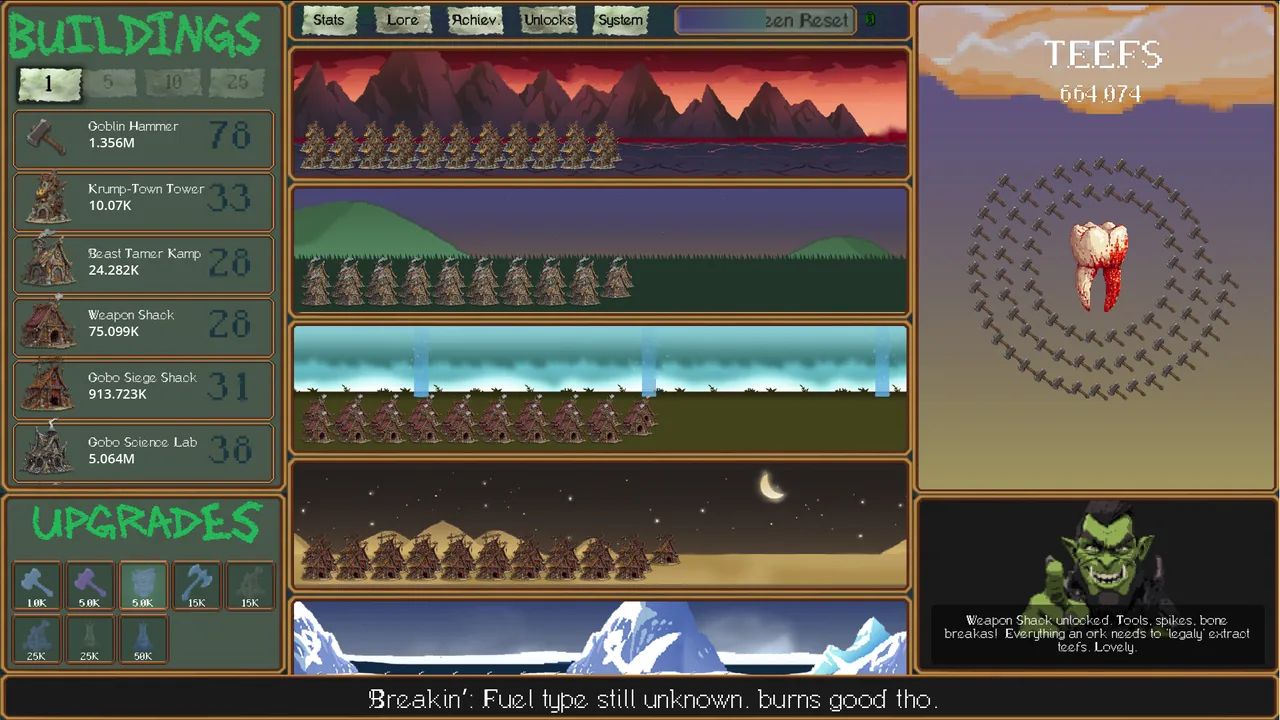
TEEFS is developer and publisher Swamp Donkey Interactive's entry into the idle-clicker genre, and its pitch is unapologetically silly: build "a wildly unethical TEEFS based economy" as a goblin wielding a hammer, turning collected teeth into an ever-expanding empire under the stated goal of making "da valley green," "da sky green," and "da water green." At $4.99, it's a cheap, low-commitment purchase, and the Positive review sample that's built up since launch treats the game less as a mechanical breakthrough and more as a well-executed, confidently written spin on a genre that lives or dies on its personality.
The ork and goblin writing is the game's biggest draw
Nearly every positive review in this sample singles out TEEFS's writing and lore as the reason it stands out from the crowded clicker field. One reviewer said simply that they "always appreciate getting some writing about orks," while another called the humor "very Ork" and said it "produces a few giggles" throughout a long play session. A third reviewer went further, saying they "have not seen a clicker game that looked more unique" and specifically credited the writing and presentation for making it memorable. Even reviewers who are otherwise lukewarm on the genre as a whole, one opening their review by noting "if you're into idlers, this isn't particularly groundbreaking," still land on a recommendation specifically because of how well the ork theme and comedic tone are executed.
Faster pacing and engaging minigames set it apart from Cookie Clicker
A recurring comparison point across the sample is Cookie Clicker, and reviewers generally agree TEEFS improves on the formula's pacing. One reviewer described the game as "quicker than Cookie clicker," with minigames that "keep things engaging" rather than existing purely as filler, while another called it "a good idler" after finishing it at 100 hours and 100% completion, singling out how much content had been added by the time they wrapped up. A reviewer who described themselves as not normally a clicker-game player admitted their "wrist hurts from all the clicks" but found the ork theme and comically written text "surprisingly addictive" regardless.
An actively patching developer earns real goodwill
Several reviewers specifically credit Swamp Donkey Interactive for responsive post-launch support. The reviewer who completed the game at 100 hours wrote that "devs were always receptive to feedback at early launch, and the new update fixed just about every minor issue I had with the game," adding they were "genuinely very impressed with what is here." Another reviewer confirmed that "all bugs I encountered on initial release have already been fixed," and a third noted the devs "have been actively updating the game rather quickly." One player who'd flagged a broken achievement system later edited their review to confirm it had since been fixed, which is a small but concrete example of the pattern reviewers describe more broadly.
A specific, serious progression bug drove at least one return
Not every technical report in the sample was so forgiving. The most detailed negative review describes a concrete, reproducible progression bug: an unlock that required 1,000 clicks remained locked even after the reviewer had already earned the in-game achievement for reaching 5,000 clicks, a clear desync between the achievement system and the actual unlock condition. That reviewer, who also criticized the game's minigames as comparable to "the worst NES games" and its font as "barely readable," ultimately returned the game over the combination of issues rather than waiting for a fix.
Background performance undercuts the core "idle" pitch for some
Because TEEFS is explicitly pitched and played as a second-monitor, run-in-the-background idler, performance complaints hit differently here than in a typical action game. One negative reviewer wrote plainly that the game "slows my computer down too much to leave in the background," calling it "very frustrating to actually 'play,' as it's constantly grinding," which directly undercuts the exact use case most positive reviewers praise the game for. This wasn't a universal complaint, most reviewers who mentioned leaving it running on a second screen reported no such issue, but it's a real enough pattern across the small negative-review sample that players on lower-spec machines should be aware of it before assuming smooth background play.
A window-resize request and other small quality-of-life gaps
Beyond the bigger bugs, a handful of reviewers flagged smaller polish requests that point to a game still rounding off its edges shortly after launch. One player who otherwise enjoyed the achievements system once it was fixed still asked, almost as an aside, "would love to be able to resize game window," a modest but meaningful gap for a game explicitly designed to sit in the corner of a second monitor alongside other windows. Another reviewer, more dismissive overall, took issue with the core tooth-collecting premise itself, writing they "honestly find the tooth thing to be pretty gross," a reminder that the game's central joke, no matter how well-written, is a hard sell for players who don't click with body-horror-adjacent humor from the outset.
A community that keeps returning to the lore
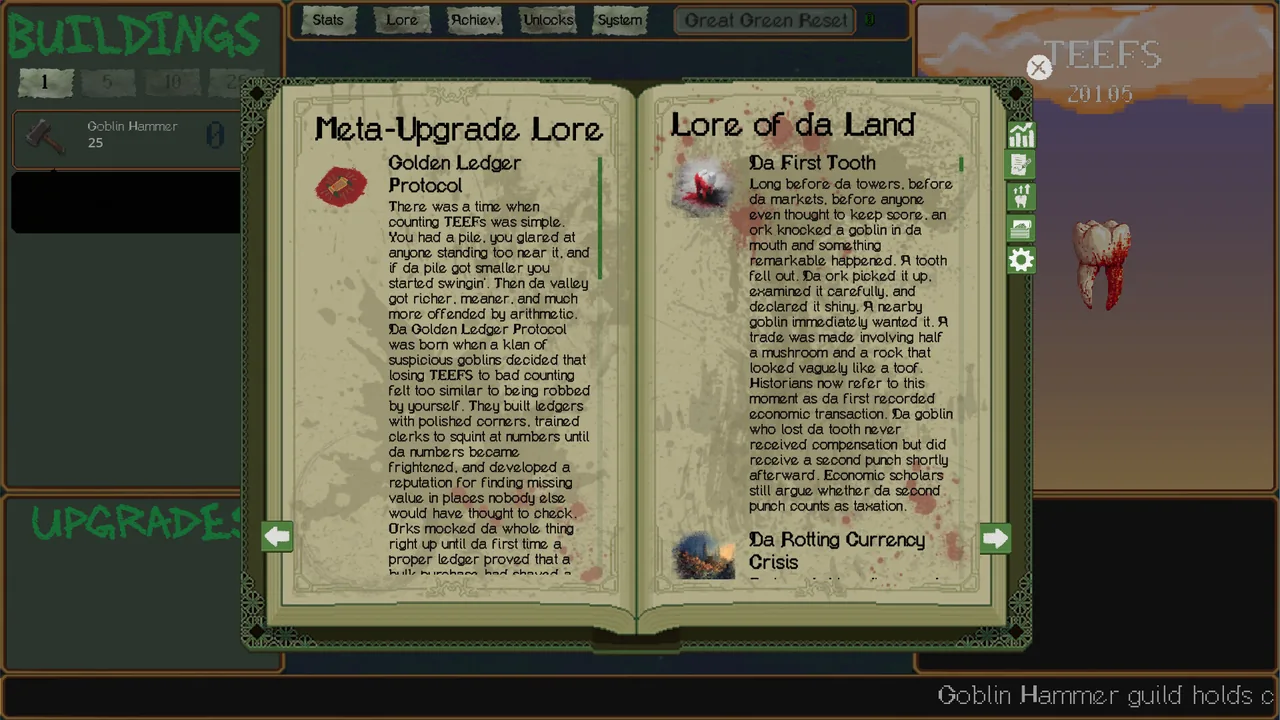
Despite its short, punchy reviews overall, several players specifically call out wanting to read more of the game's writing rather than treating the story as disposable flavor text around the clicking. One reviewer said they were "looking forward to" reaching the game's "great reset" mechanic specifically because of how much they'd enjoyed the lore leading up to it, while another wrote they hadn't played "a clicker i liked in a long time" before finding TEEFS, crediting the writing directly for breaking that streak. That kind of specific, repeated engagement with a clicker game's narrative content, rather than just its number-scaling systems, is a stronger signal of the writing's quality than any single glowing quote, and it lines up with how consistently reviewers across the sample return to the humor and lore as their primary reason to recommend it.
Worth it for the writing, with a few caveats
TEEFS earns its Positive score largely on the strength of its writing, art style, and unusually well-paced minigames, elements that reviewers across nearly every review, positive or negative, single out as the game's clearest achievement. The specific progression bug and background performance complaints from a handful of reviewers are worth taking seriously, especially since one directly led to a refund, but the broader pattern in the sample, including from players who finished the game at full completion, points to a developer patching quickly enough that most early issues get resolved. For $4.99, fans of the genre who want a faster, funnier alternative to the usual cookie-clicker formula should find plenty here, provided their setup can comfortably run it in the background as intended.
Pros and cons
Pros
- Comedically strong ork and goblin writing and lore that multiple reviewers specifically credit for elevating the game above a generic numbers-go-up clicker
- A faster pace than genre touchstones like Cookie Clicker, with engaging minigames that several reviewers say keep the loop from growing stale
- A distinctive, well-received art style that reviewers say helps the game stand out visually in a crowded clicker/idler market
- A developer actively and quickly patching post-launch issues, with at least one reviewer who played 100 hours to full completion specifically praising how responsive the devs were to early feedback
Cons
- A specific progression bug reported by one reviewer, where an unlock requiring 1,000 clicks stayed locked even after reaching the 5,000-click achievement threshold, serious enough that they returned the game over it
- Multiple negative reviewers report the game slows their computer down too much to comfortably leave running in the background, which cuts against the core appeal of an idle, second-monitor game
- One detailed negative review criticizes barely-readable font sizing, calls the minigames comparable to 'the worst NES games,' and says they don't meaningfully aid progression since there's no difficulty scaling
- A minority of reviewers found the early game too slow and felt upgrades didn't meaningfully change how runs feel, a complaint at odds with the majority who praised the game's faster-than-average pacing
Screenshots
-
TEEFSImage: Swamp Donkey Interactive LLC via Steam -
TEEFSImage: Swamp Donkey Interactive LLC via Steam -
TEEFSImage: Swamp Donkey Interactive LLC via Steam -
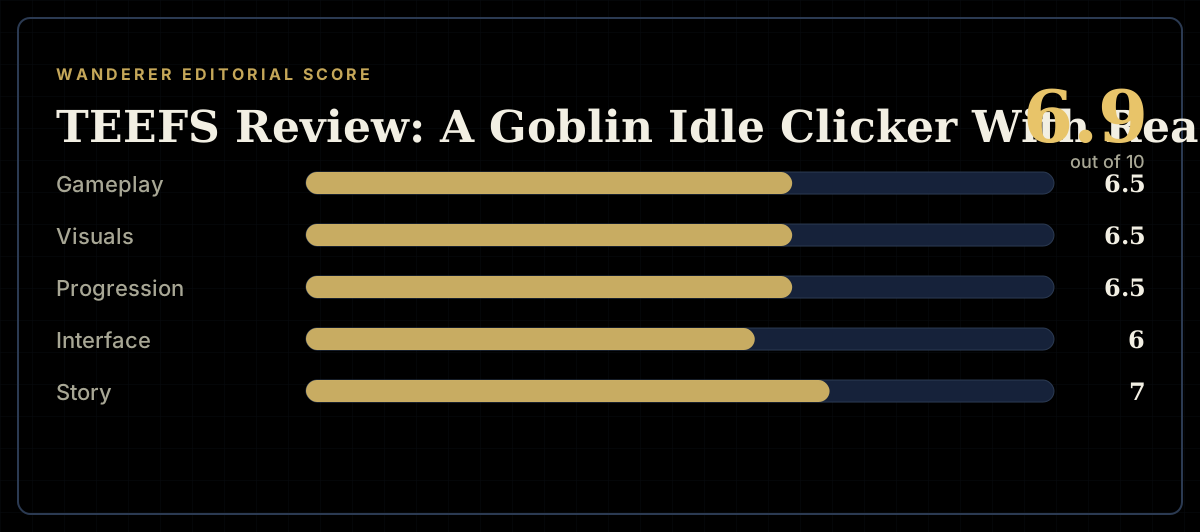
How the review scores each part of the gameWanderer Editorial -
Wanderer Editorial -
The short versionWanderer Editorial