Game review
Sword and Shield Idle
4 / 10
- Developer
- Meirad
- Publisher
- Meirad
- Released
- 13 September 2024
- Platforms
- Windows, macOS, Linux
- Genre
- Idle Incremental
- Monetisation
- One-time purchase at NZ$4.49. No in-app purchases.
- Players
- Single-player only
The short version
Sword and Shield Idle is a solo-developed idle dungeon-crawler for NZ$4.49: descend through boss-gated "deeps", free imprisoned allies who passively forge swords and shields for you, and reset for a permanent currency once progress stalls. It sits at Mostly Negative on Steam, 27% of 22 reviews positive, and the available English sample -- 18 of the 22 -- is unusually coherent for such a small pool. Even reviewers who like the core loop describe the same three problems: a prestige system that raises numbers without adding anything new to do, bugs including a shield-tab unlock that can break permanently and crashes that have cost players a full prestige run's progress, and no meaningful updates since launch. One reviewer at 66 hours simply calls it "dead game." Meirad has not published a second Steam title since.
Biggest strengths
- The dungeon-and-prisoners framing gives an otherwise generic idle-combat loop a bit of identity that a couple of reviewers specifically praised
- Genuinely cheap at NZ$4.49 with no in-app purchases, battle pass or premium currency layered on top
- The first half hour or so is described as satisfying by multiple reviewers, with a "deep in strategy" pitch that briefly delivers
Biggest weaknesses
- The prestige/reset system increases numbers without unlocking new mechanics, so returning players hit a wall of "more of the same" rather than fresh content
- A shield-tab unlock bug can permanently lock a core mechanic after resetting, and at least one reviewer lost a full prestige run to a crash with no auto-save to fall back on
- No apparent updates since launch nearly two years ago, despite reviewers reporting bugs the developer would need to patch to keep the loop functional
Who it's for: Idle-genre completionists curious about a very cheap dungeon-themed prestige loop, and only with expectations set low. Not for anyone who wants a few dozen hours out of an idle game, or who is not prepared to lose progress to a bug.
Our recommendation: Skip it, or treat the asking price as a one-hour curiosity rather than an idle game with legs. The opening loop is pleasant enough to see why some reviewers gave it a fair shot, but the shallow endgame and save-breaking bugs make it hard to recommend even at NZ$4.49.
4 / 10
A dungeon-themed idle loop, briefly
Sword and Shield Idle is the only Steam release from Meirad, a solo or very small developer, and it wears its scope openly: NZ$4.49, no achievements, no multiplayer, no in-app purchases, and a short store page that describes the whole pitch in two sentences. You descend through procedurally numbered "deeps," clear a boss room, and free a captive ally at each milestone. Those allies don't fight -- they idle-produce resources in the background: Sword Masters forge weapons that raise your attack, Skill Masters make shields that raise your defence, and Trade Masters hand out passive buffs. It's a familiar idle skeleton -- automated production feeding a single combat number that climbs against a wall of enemy health -- dressed in a dungeon-crawler coat of paint instead of the usual clicker trappings.
That framing is doing real work in the early reviews. More than one player singles out the dungeon-and-prisoners hook as the thing that made the opening stretch land: "the mechanics are deep without being overwhelming, and the dungeon progression keeps me engaged," reads one positive review, and another calls the framework "pretty good" and "very satisfying" after roughly twelve hours. For a $3 game with one developer, a first hour that a handful of players genuinely enjoyed is not nothing.
Where the prestige loop runs out of ideas
The trouble starts exactly where prestige loops are supposed to get more interesting: after the first reset. Idle and incremental design generally treats prestige as the moment new systems unlock -- new currencies, new automation tiers, new strategic choices about what to specialise in. Reviewers here describe the opposite. "Once you prestige a couple of times there's nothing else to do apart from prestige and numbers go up, very limited mechanics, functions and upgrades so far," says the most detailed available review, and a 99-hour player who bought in specifically for the "ascension system" reports the same thing at much greater length: resetting hands out a currency for raising the same handful of stats, then drops you back into the same content loop with nothing new to discover. "There are free games that have 10 times more content in this category," notes another. For a genre whose entire appeal is built on prestige mechanics constantly opening new doors, a prestige layer that only makes the existing door bigger is a serious structural problem, not a balance nitpick.
Bugs that cost you your run
The more damaging pattern in the review sample is technical rather than structural. Multiple players independently report a bug where the Shield tab -- one of the game's three core production systems -- can fail to unlock again after a reset, sometimes only fixed by restarting the entire game. One reviewer reports something worse: a crash during a prestige action that wiped an entire personal-best run's worth of accumulated currency, with no auto-save to recover it. For a genre built entirely around trusting the game to preserve incremental progress while you're not looking at it, a bug that can erase a run on the exact action prestige loops are designed around is close to disqualifying on its own.
Layered on top of the bugs is an apparent lack of aftercare for this specific game, though not necessarily the studio itself. "Seems the game has been launched and then abandoned by the author as hasn't been seen since the initial launch," reads one review; another, logged two months after release, reports the game "hasnt been touched" since launch. Steam's own news hub for the game (store.steampowered.com/news/app/2882710) lists no update posts, which is consistent with those reports. It's worth being precise about scope, though: Meirad's Steam developer page (store.steampowered.com/developer/Meirad) shows the studio has since put out a demo for a second title, Rogue Texter, with a full release listed as coming soon -- so "abandoned" describes this game specifically, not a developer who vanished from Steam entirely. One reviewer at 66 hours -- someone who clearly gave the loop a real chance -- summarises the current state of Sword and Shield Idle itself in two words: "dead game."
One further, narrower claim is worth recording rather than amplifying: a single English review describes the game as "AI generated" with "plenty of bugs." That is one player's characterisation rather than a pattern across the sample, and there is no way to independently verify which specific assets or systems it refers to from the evidence available here. It is noted as exactly what it is -- one reviewer's claim -- not treated as an established fact about the game's production.
Presentation and what NZ$4.49 actually buys
Visually, the game does enough with little: a top-down stone dungeon room, a handful of cartoon skeleton enemy sprites, and a legible damage-number readout as floating swords and shields swing themselves at whatever's on screen. The Sword Master upgrade panel is a useful illustration of where the budget went -- a single levelled weapon slot sits in the corner of a much larger empty grid clearly built to hold more upgrades than the game currently offers, visual proof of the "limited mechanics" complaint rather than just a subjective read of it.
At NZ$4.49 the price itself isn't the problem reviewers raise -- nobody in the sample calls the game overpriced for what it charges up front, and the absence of any in-app purchase, battle pass or premium currency is a genuinely rare thing to be able to say about a modern idle game. The complaint is closer to "even this was too much for what's here": a handful of hours of content wrapped in a genre that exists specifically to reward players who commit dozens or hundreds of hours, undercut by the very real chance that a crash erases the run before it gets there. A cheap price offsets thin content far more easily than it offsets losing your save.
Verdict
Sword and Shield Idle has a real, if small, kernel of a good idea: a dungeon-crawl framing on top of a standard idle-production loop, cheap enough that a handful of players walked away genuinely charmed by the first hour. But the prestige system that is supposed to be the entire point of an idle game adds numbers rather than substance, a shield-unlock bug and a save-destroying crash directly attack the genre's core promise of safe, trustworthy progress, and nearly two years without a fix or an update suggest nobody is coming to address any of it. At NZ$4.49 it's a low bar to clear and it still falls short of clearing it for most of the people who tried it.
Pros and cons
Pros
- The dungeon-and-prisoners framing gives an otherwise generic idle-combat loop a bit of identity that a couple of reviewers specifically praised
- Genuinely cheap at NZ$4.49 with no in-app purchases, battle pass or premium currency layered on top
- The first half hour or so is described as satisfying by multiple reviewers, with a "deep in strategy" pitch that briefly delivers
- Reasonably active in its first days, including a playable demo before the full release
Cons
- The prestige/reset system increases numbers without unlocking new mechanics, so returning players hit a wall of "more of the same" rather than fresh content
- A shield-tab unlock bug can permanently lock a core mechanic after resetting, and at least one reviewer lost a full prestige run to a crash with no auto-save to fall back on
- No apparent updates since launch nearly two years ago, despite reviewers reporting bugs the developer would need to patch to keep the loop functional
- Very little content beyond the first boss room by multiple accounts -- "in the first 30 seconds you will see everything this game may offer"
Screenshots
-
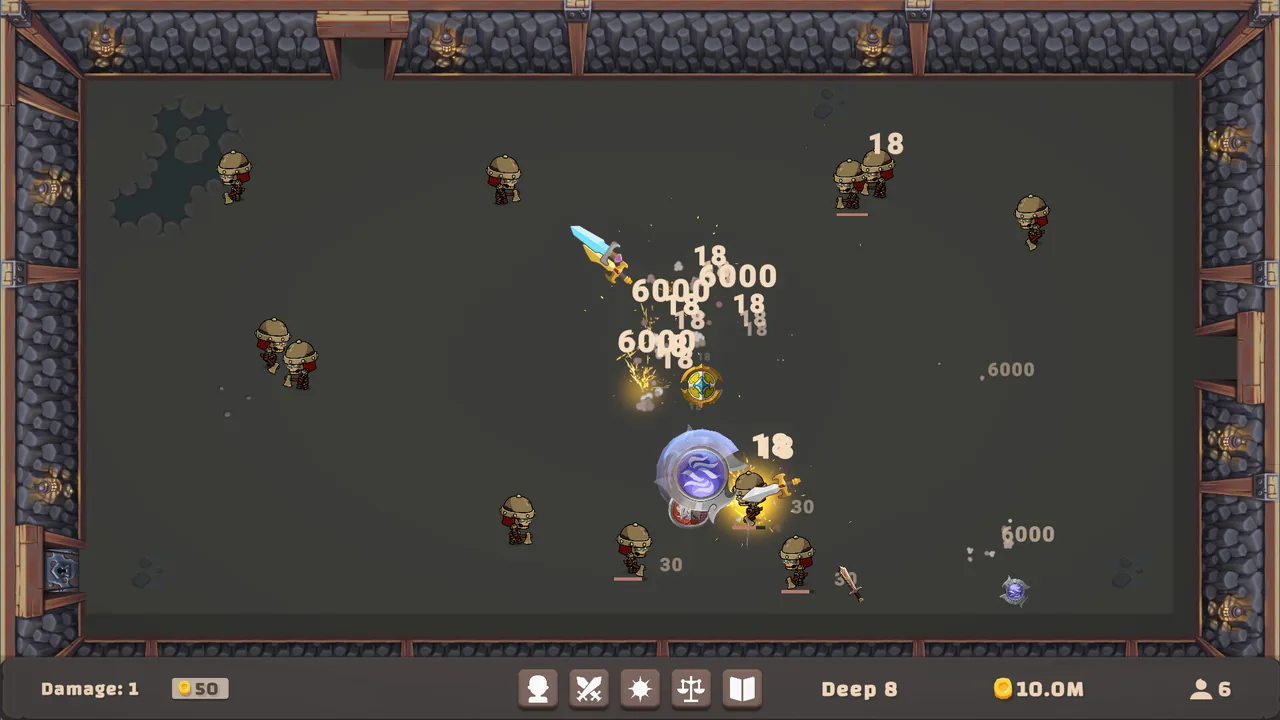
Auto-attacking swords and shields do the fighting once a "master" is freed and put to workImage: Meirad via Steam -
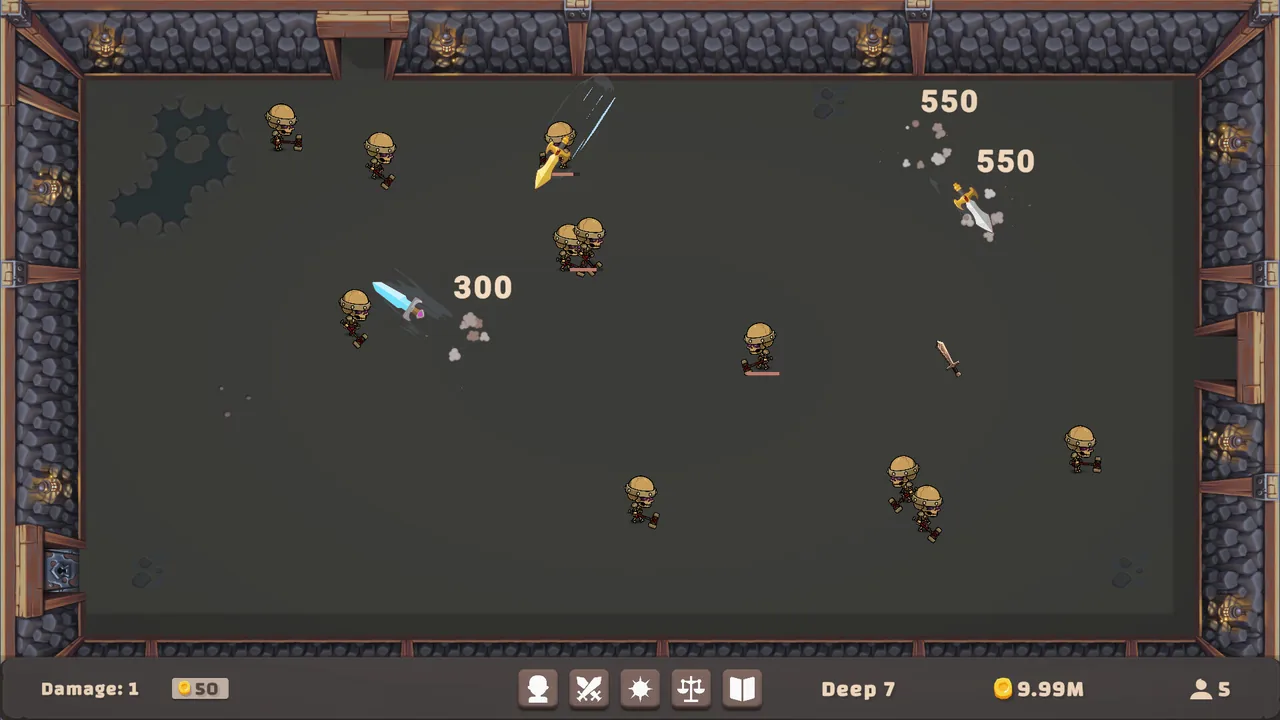
The same core loop repeats from Deep 1 through the later floors reviewers describe as offering little newImage: Meirad via Steam -
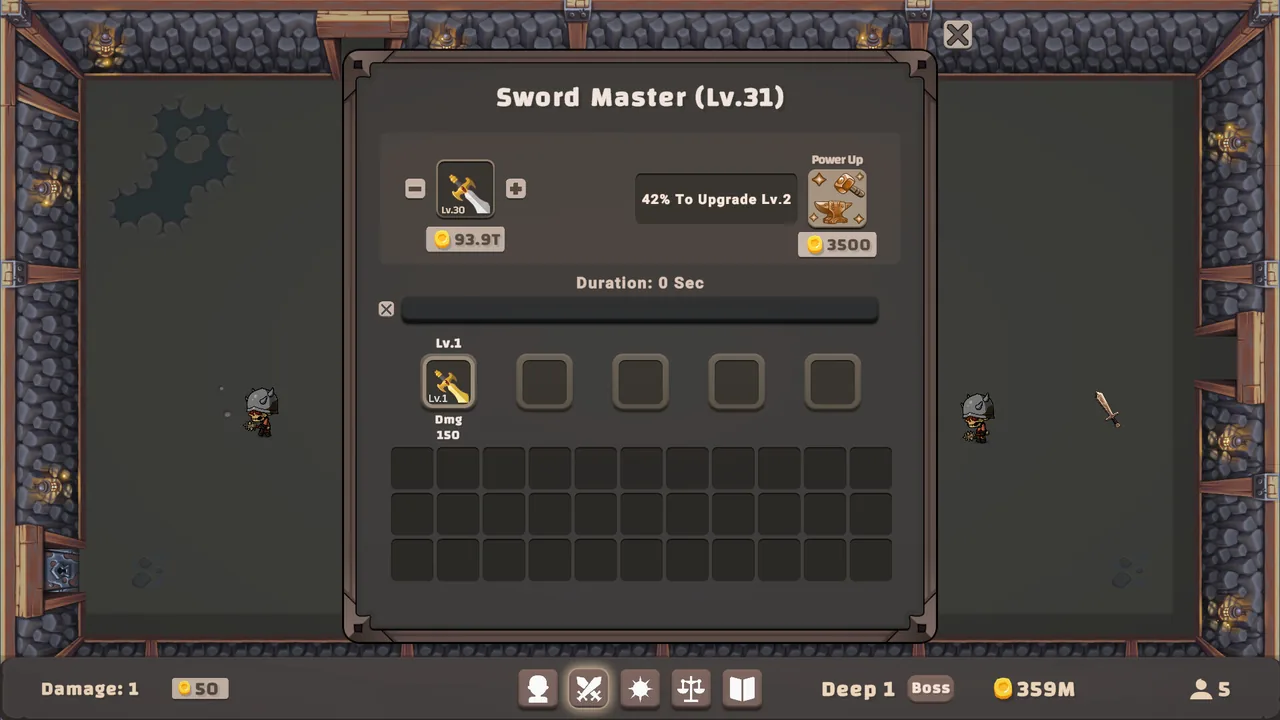
The Sword Master panel at Deep 1 -- most of the upgrade grid reviewers call "shallow" sits emptyImage: Meirad via Steam -
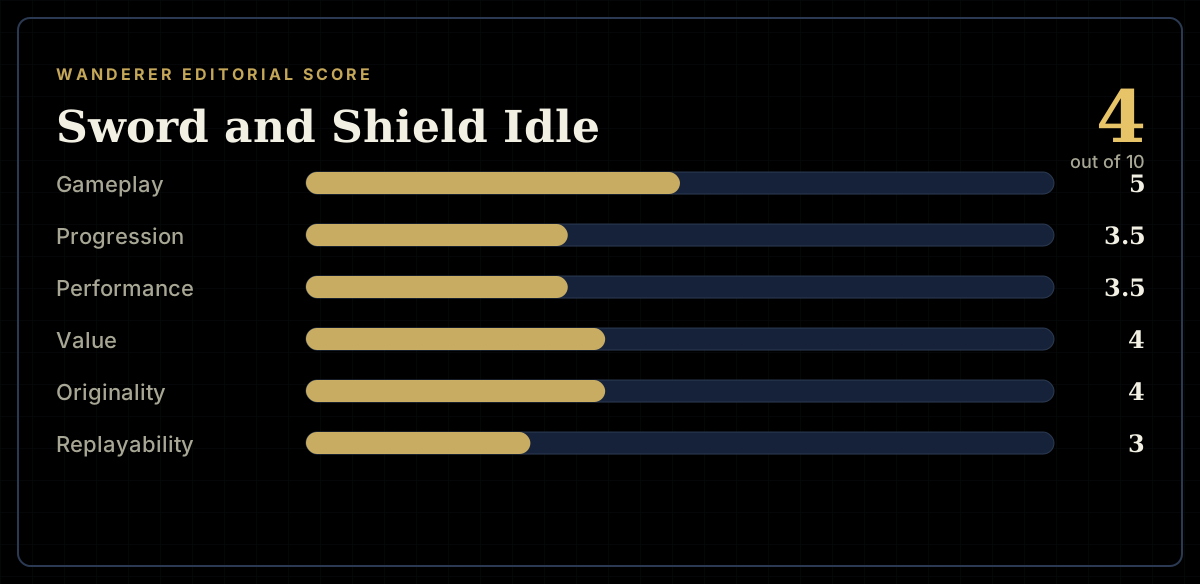
How the review scores each part of the gameWanderer Editorial -
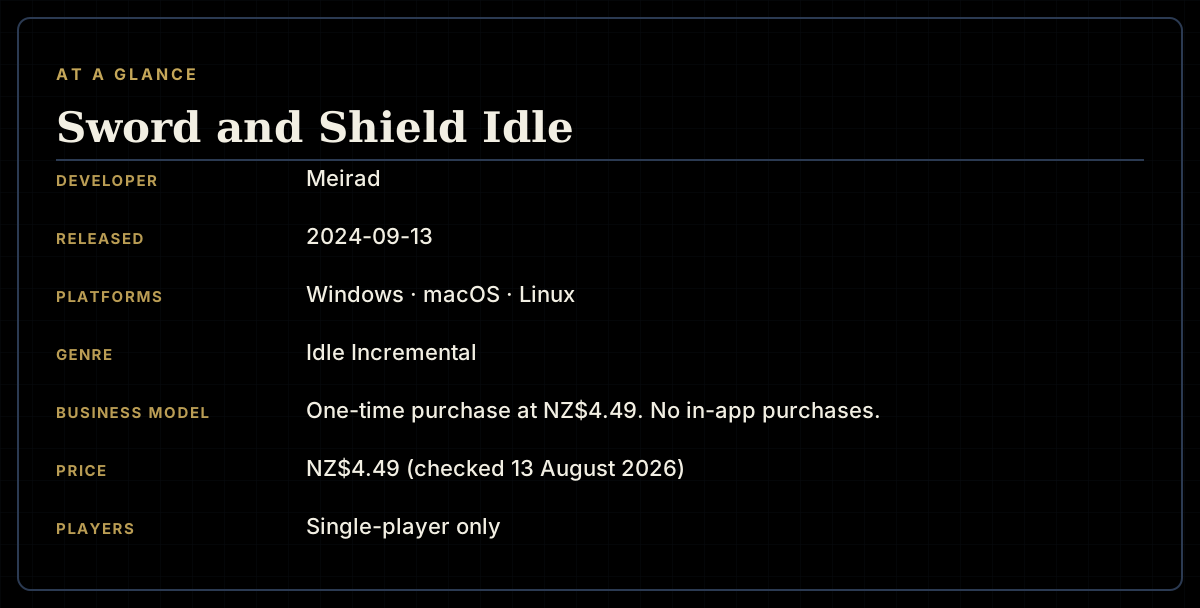
The game at a glanceWanderer Editorial -
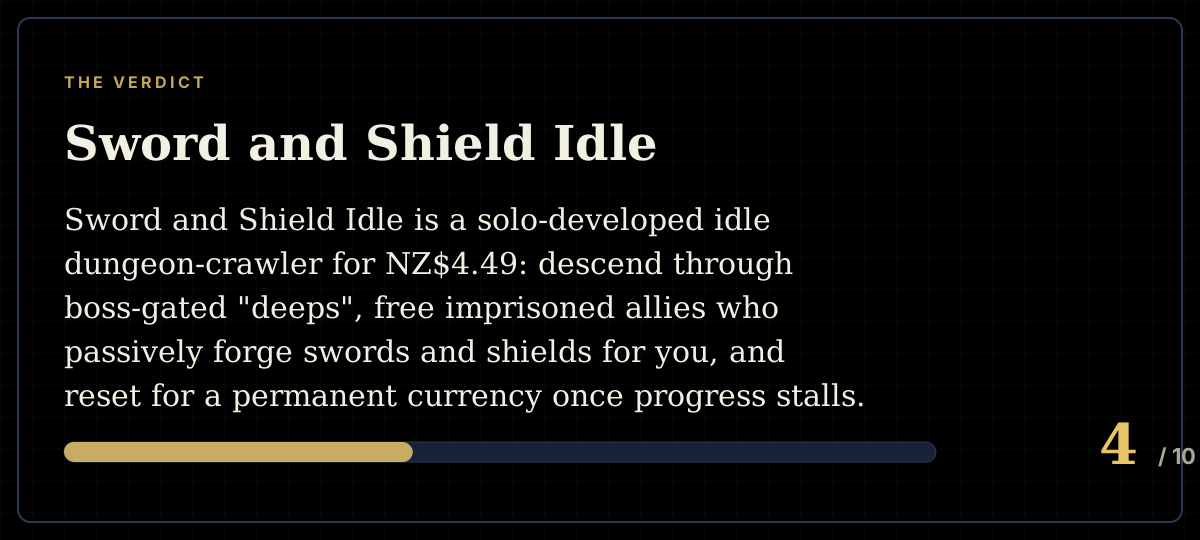
The short versionWanderer Editorial