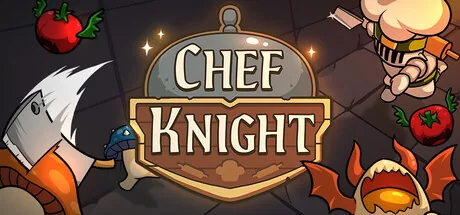
Game review
Chef Knight
7 / 10
- Developer
- Clover Bite
- Publisher
- Clover Bite
- Released
- 1 June 2026
- Platforms
- Windows
- Genre
- Action Incremental
- Monetisation
- One-time purchase, no in-game store, no IAP, no ads
- Players
- None; fully single-player
The short version
Chef Knight's premise is simple and it commits to it fully: fight through top-down dungeons where the monsters are walking ingredients, haul what you kill back to a kitchen, cook it into dishes, sell those dishes to fund a skill tree, and dive back in stronger. It's charming, well-illustrated, and the food-as-monster-design idea earns every bit of the goodwill it's gotten from players.
What it doesn't do is last. Global achievement data shows the overwhelming majority of buyers reach the game's final biome, and player reports consistently put a full, 100%-completed playthrough at two to three hours. For a cozy fantasy incremental at a price just under ten dollars, that's the whole conversation: it's a genuinely good couple of hours, not a genuinely good incremental grind, and going in expecting the latter is where the disappointment comes from.
Biggest strengths
- The core idea — fight food-monsters, cook what you kill, sell it to afford getting stronger — is genuinely distinctive and well realised in the art and enemy design
- Combat stays simple but functional: aiming, dodging traps and reading enemy tells all matter without ever getting fussy
- A real, if compact, skill tree gives meaningful choices between combat, cooking speed and selling efficiency across a run
Biggest weaknesses
- Global achievement data shows over four in five buyers reach the final biome, and many reviewers report finishing and 100%-completing the game in two to three hours
- Several players describe upgrade costs scaling faster than the power they buy, so late-run stats work to maintain your current pace rather than genuinely escalate it
- Only four biomes and nine total achievements make for a slim structure once the novelty of the premise wears off
Who it's for: Players who want a short, well-made fantasy incremental to finish in an evening rather than sink weeks into, and who find "monsters you can also eat" as funny an idea as the developer clearly does.
Our recommendation: A strong pick at a discount, and still a reasonable one at full price if you treat it like a short, polished indie rather than a long-haul incremental. Don't buy it expecting the dozens of hours the genre usually promises.
7 / 10
There's a small, specific joke sitting at the centre of Chef Knight, and it's a good one: the monsters you fight aren't just obstacles, they're dinner. A chili-pepper enemy with a health bar in the thousands isn't a reskinned slime, it's a chili pepper, and killing it drops the actual ingredient you'll cook with an hour later. That single idea — that the dungeon-crawling half of the game and the cooking-shop half are feeding directly off the same monster designs — is doing more work than most short indie incrementals manage, and it's the reason Chef Knight has earned an Overwhelmingly Positive standing on its most recent reviews. The catch, and it's a significant one, is how quickly that idea runs its course.
Fight, cook, sell, repeat
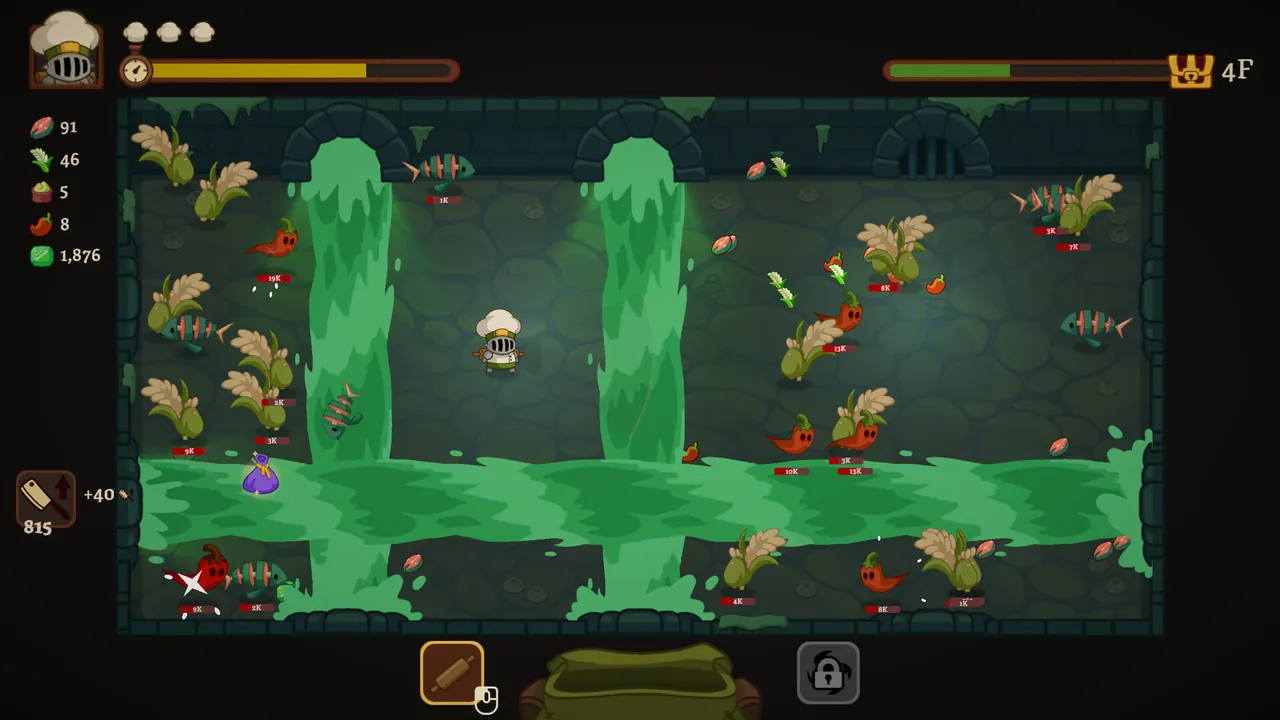
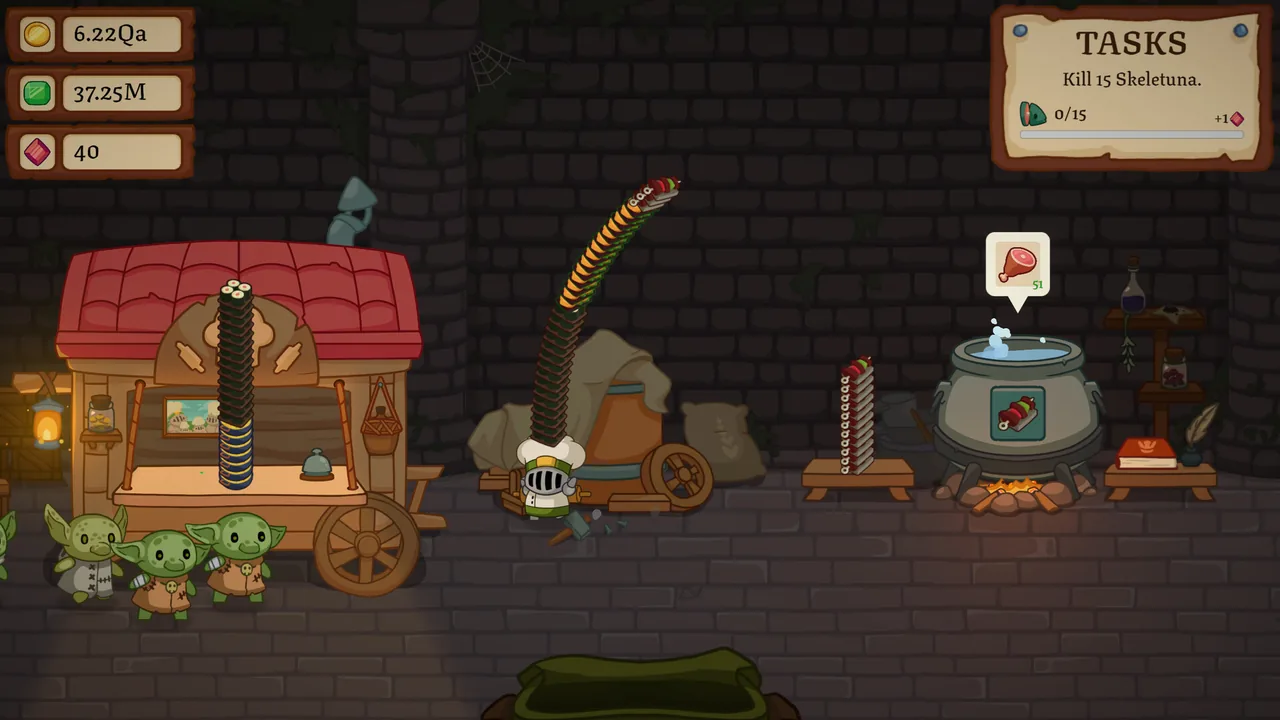
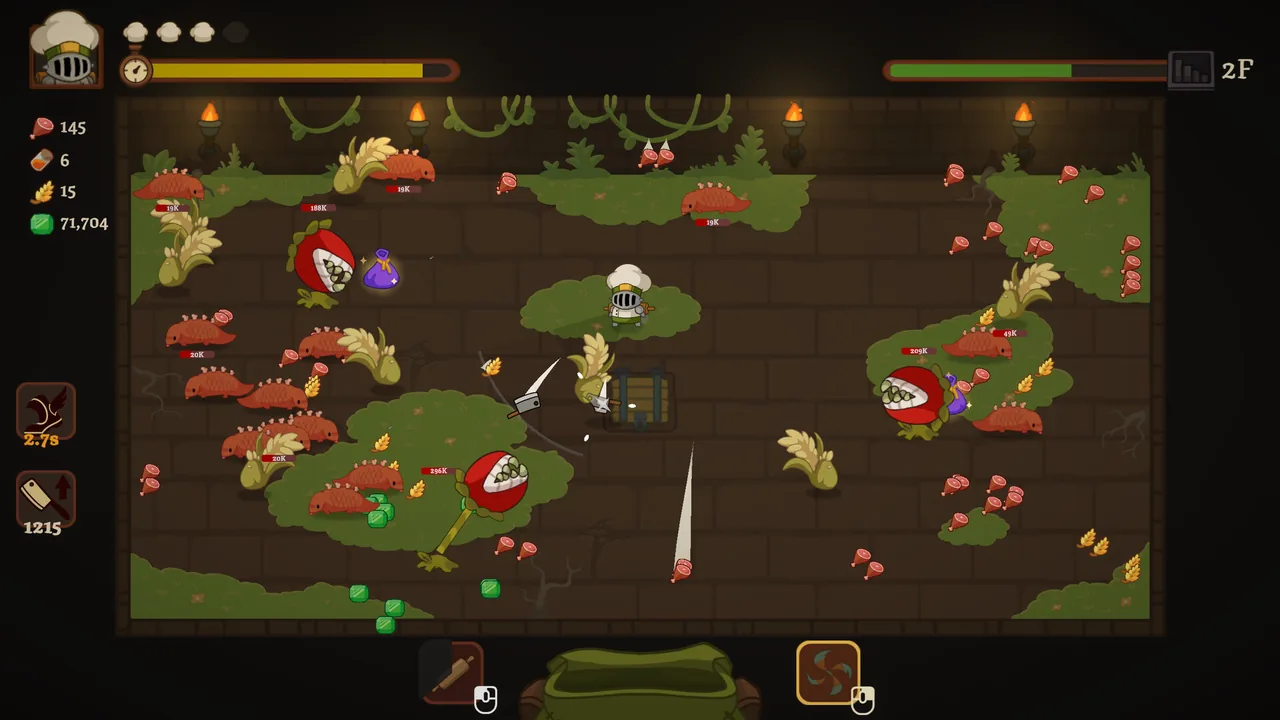
The loop is straightforward and doesn't pretend otherwise. Dive into a top-down dungeon floor, aim and dodge your way through waves of monster-ingredients, and haul back whatever drops. Ingredient management sits directly in the HUD as you fight, with running counts for meat, vegetables, sauces and chilis alongside a gem currency, so the game never lets you forget that combat and cooking are the same resource loop wearing two hats. Back at the kitchen, those ingredients become dishes, and dishes sell to fund a skill tree spread across combat power, cooking speed and selling efficiency. It's a clean structure, and Clover Bite has clearly put real thought into the visual identity around it — food-themed enemies with genuine character, readable telegraphs on their attacks, and a kitchen that feels like a reward to return to rather than a chore screen bolted onto a dungeon crawler.
Combat itself stays intentionally light. You aim, you dodge traps and enemy attacks, and you learn which food-monsters hit hardest well before the numbers on their health bars get intimidating. Reviewers consistently describe it as "fun" and "chill" rather than demanding, and that's clearly the intent — this isn't trying to be a tight action game, it's trying to be a relaxing one with just enough tension to keep runs interesting.
The treadmill underneath the charm
The most substantive criticism showing up in Chef Knight's own negative reviews isn't about the combat or the presentation — it's about what the skill tree actually does. More than one player describes upgrade costs scaling to outrun the power those upgrades provide, so a chunk of late-run spending goes toward maintaining your current damage, cooking speed and selling rate rather than meaningfully improving them. That's a real, structural complaint rather than a stylistic gripe: it means the second half of a run can feel like treading water even as the numbers keep climbing, which is close to the worst outcome for a genre built entirely around the satisfaction of getting stronger.
It's worth being fair to the other side of that argument, too — for players who finish the game in the two-to-three-hour window most reviews describe, this scaling issue may barely register before the credits roll. It becomes a real problem specifically for anyone hoping for a longer incremental grind, which the store page's own "incremental" framing invites but the actual content doesn't fully deliver.
What the achievement data actually shows
Chef Knight ships with only nine Steam achievements, and their global completion rates tell an unusually clean story: BIOME_1 sits at 90.2%, BIOME_2 at 88.1%, BIOME_3 at 85.3%, and BIOME_4 — almost certainly the final area — at 82.5%. For context, most games see completion rates fall off a cliff well before the end; here, over four in five people who bought Chef Knight reached its last biome. BUY_ALL_SKILLS, the closest thing to a full-completion achievement, still sits at 65.2%. That's an extraordinarily flat curve, and it corroborates the review pattern directly: this is a short, finishable game that most of its audience actually finishes, rather than a long tail that thins out as players lose interest. Whether that's a strength or a weakness depends entirely on what you paid for it expecting.
Support since launch
Clover Bite hasn't abandoned Chef Knight since its June 2026 release. A 40,000-player milestone post in mid-June came bundled with a real bug-fix pass, a dedicated patch addressed broken Russian localisation in the skill tree within the first few weeks, and a further update landed in July. None of that changes the game's length or its late-run scaling issue, but it does mean the technical experience has been actively maintained rather than left to rot after launch week — a detail worth knowing given at least one reported case of the game failing to start even when run as administrator, which reads as an isolated configuration issue rather than a widespread pattern in the wider review sample.
Final verdict
Judge Chef Knight as a short, beautifully themed dungeon-and-cooking hybrid and it's an easy recommendation — the monster-as-ingredient hook is genuinely funny and well executed, the art carries real personality, and the combat and kitchen loops feed into each other cleanly enough that neither half feels like filler. Judge it as the "incremental" the store page and its own tags promise, with the escalating, hours-deep grind that label usually implies, and it falls short: nine achievements, four biomes, and a skill tree that spends a good portion of its late game just keeping pace with its own rising costs.
At a discount this is close to an obvious buy. At full price, it's still a good couple of hours — just go in knowing that's what you're paying for, rather than the longer incremental climb the genre label suggests.
Players chasing a longer-haul version of "kill things, get stronger, come back for more" with progression that keeps building over weeks rather than hours may also want to look at Wanderer.
Pros and cons
Pros
- The core idea — fight food-monsters, cook what you kill, sell it to afford getting stronger — is genuinely distinctive and well realised in the art and enemy design
- Combat stays simple but functional: aiming, dodging traps and reading enemy tells all matter without ever getting fussy
- A real, if compact, skill tree gives meaningful choices between combat, cooking speed and selling efficiency across a run
- Post-launch support has been real rather than token, including a full bug-fix pass and a localisation fix within six weeks of release
- Overwhelmingly Positive review standing (94-96% across both lifetime and recent samples) reflects a game that mostly delivers exactly what its store page promises
Cons
- Global achievement data shows over four in five buyers reach the final biome, and many reviewers report finishing and 100%-completing the game in two to three hours
- Several players describe upgrade costs scaling faster than the power they buy, so late-run stats work to maintain your current pace rather than genuinely escalate it
- Only four biomes and nine total achievements make for a slim structure once the novelty of the premise wears off
- With no meta-progression seed variance called out and a short campaign, there's little pull to start a second run once the first is finished
- At least one reported case of the game failing to launch even when run as administrator, though this doesn't appear to be a widespread pattern in the review sample
Screenshots
-
Chef KnightImage: Clover Bite via Steam -
Chef KnightImage: Clover Bite via Steam -
Chef KnightImage: Clover Bite via Steam -
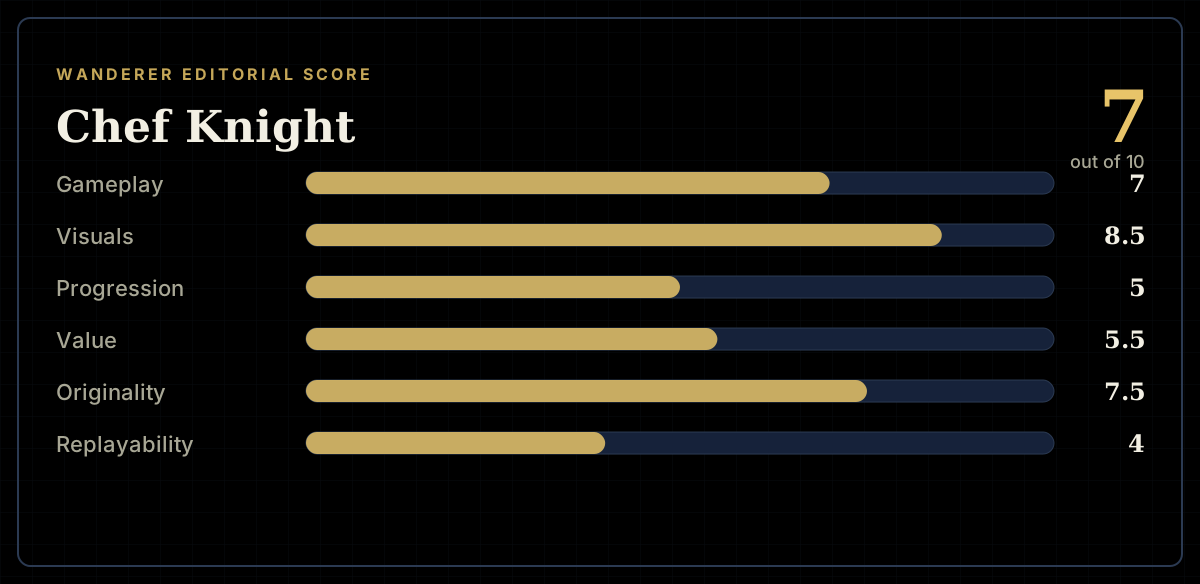
How the review scores each part of the gameWanderer Editorial -
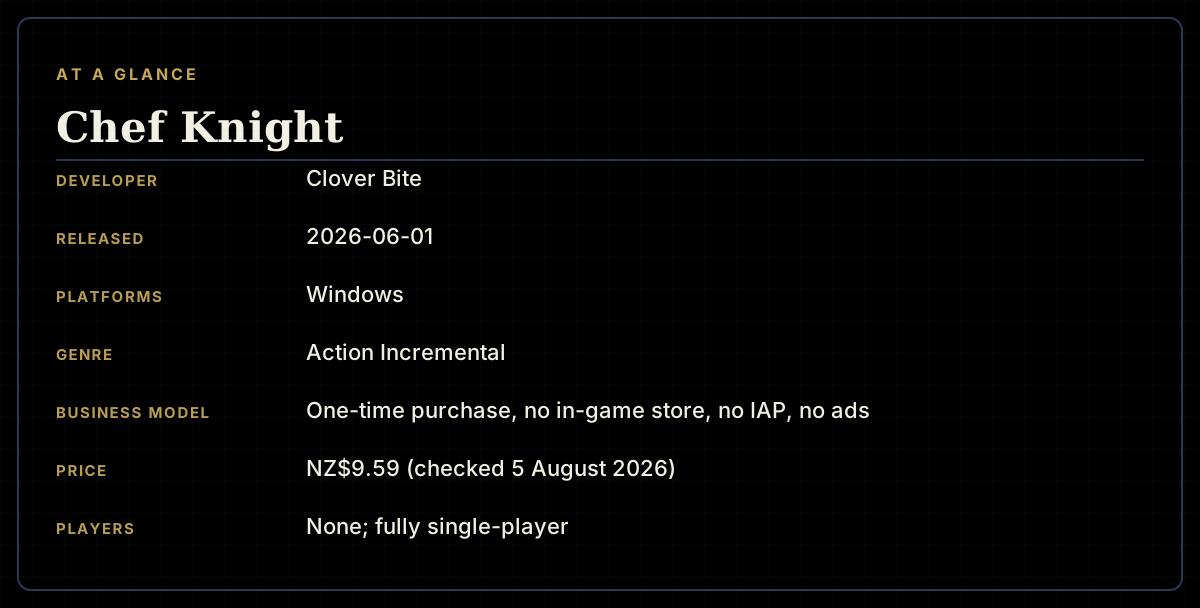
The game at a glanceWanderer Editorial -
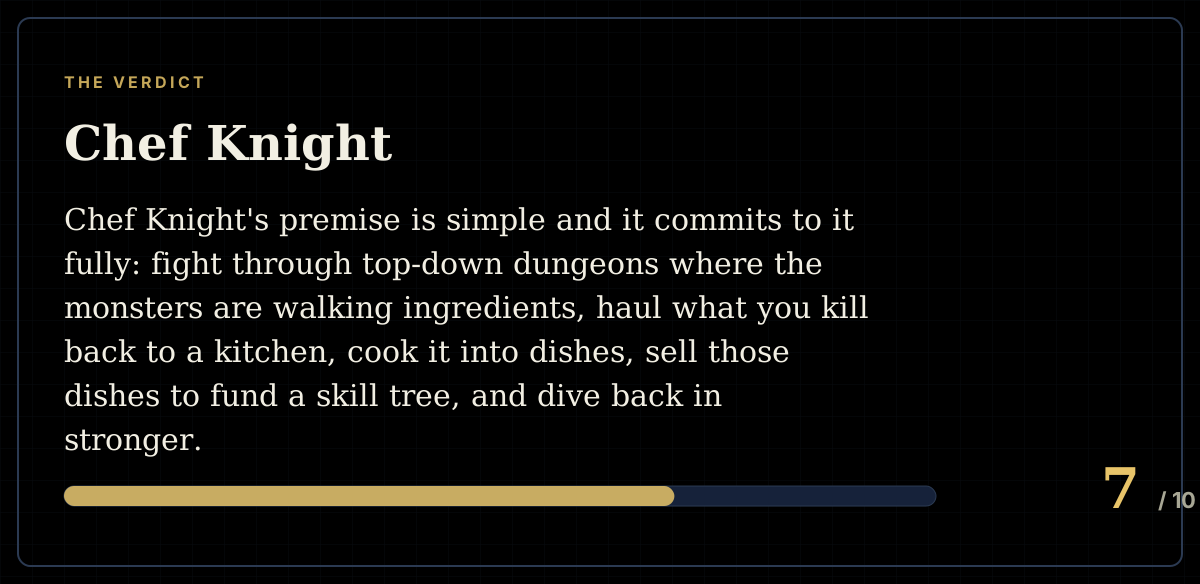
The short versionWanderer Editorial