Game review
SUPERBOLT Review
6.6 / 10
- Developer
- Skollheim
- Publisher
- Skollheim
- Released
- 2 September 2026
- Platforms
- ["Windows"]
- Genre
- Incremental
One Gesture, Seven Scales of Escalation
Most incremental games ask you to watch numbers climb while you're away. SUPERBOLT asks you to stay and do something: charge the bolt, release it, watch things break. That single gesture is the entire input vocabulary of the game, and Skollheim — a small studio whose $4.99 release marks its debut on Steam — builds seven distinct worlds on top of it, each one a jump in scale from the last. You begin at a workbench, charging a spark a few centimetres wide. By the final world you're triggering a gamma-ray burst measured in megaparsecs. The pitch line on the store page — "you start as a spark a few centimetres wide, you end erasing galaxies" — is a genuinely accurate summary of the run structure, not just marketing copy.
What makes that escalation interesting mechanically rather than just cosmetic is that the crossing between worlds isn't a menu selection or a prestige-style reset screen — you ride it, in real time, as the scale of your bolt visibly grows. It's a rare idle-genre design choice that keeps the "incremental" framing honest: the numbers get bigger because the thing you're actually doing gets bigger, not because a multiplier ticked up somewhere off-screen.
A New Rule Every World
SUPERBOLT's most distinctive design decision is refusing to let any single mechanic carry the whole seven-world arc. Each world introduces a genuinely new rule that changes how the core charge-and-release gesture plays out: The Rupture has you striking cracked nodes by hand to burst them; The Chains lets the bolt jump between nodes; The Leech forces you to prioritize a target that's actively stealing 22% of your charge while it stands; The Resonance asks you to strike on the beat and hold a rhythm; The Alignment has you tracking a sweeping beam and striking whatever it illuminates; The Saturation whitens the screen as a world nears its climax; and The Storm rewards six full-bar strikes with a field-wide burst. A final layer, The Scar, has every bolt leave a lasting mark on the ground that damages nodes crossing it later — a small touch of persistence within a single world that rewards paying attention to where you've already struck.
It's an unusually structured approach for a genre that often coasts on a single upgrade-the-number loop, and it gives SUPERBOLT a sense of forward momentum that keeps each new world feeling like a genuine rule change rather than a reskinned version of the last one. The one reviewer in the pool who left more than a one-line comment sums up the appeal plainly: "Every thunder is a fantasy, I can feel every strike in my body, SUPERBOLT is not for the weak."
Meta-Progression Built for Completionists
Beneath the seven-world ladder sits a conventional but well-built prestige structure. When a run has nothing left to give, you collapse it, converting the run into Ions that fund permanent Stars across three branches — Lightning, Memory, and Storm — so every subsequent run starts faster and pushes further than the last. Skollheim backs that loop with a genuinely substantial completionist layer for a $4.99 release: 47 achievements, five named challenge runs (SILENCE, GLASS, GREED, MONOCHORD, NIGHT) each with its own permanent reward, a journal that tracks every perk the player has ever held across runs, and a dedicated speedrun feat for players chasing time rather than scale. The store page's own framing — "made to be 100%ed" — is a fair description of how much structure is actually built around long-term completionist goals rather than just an open-ended number-go-up loop.
That said, the review pool itself doesn't yet offer much insight into how that meta-progression holds up across dozens of hours. Two reviewers logged well over 100 hours of playtime, both leaving simple one-line endorsements ("good," and a lengthy but joke-format checklist rating graphics as "Decent" and gameplay as "It's just gameplay") rather than detailed accounts of late-game pacing. It's a promising design on paper, backed by real playtime evidence that people are sticking with it, but the pool hasn't yet produced the kind of detailed long-session review that would confirm the meta-progression stays engaging rather than just busy.
A Small, Fast-Moving Launch
SUPERBOLT launched September 2 with no ads, no microtransactions, and no waiting walls — a straightforward one-time-purchase promise the game appears to keep. It also ships with a genuinely considered accessibility feature for a small studio's debut release: a Reduced Flashes mode that caps flash frequency and intensity, removes hitstop, and softens the whiteout effect that caps off each world, alongside an in-game photosensitivity warning shown at first launch. That's a level of care around a legitimately intense, flash-heavy visual style that's easy for a small team to skip and isn't.
Skollheim also shipped a progression-focused patch just three days after launch, explicitly responding to early feedback: "This update revisits the opening minutes of SUPERBOLT and the transition from one world to the next... Moving to another world no longer raises the price of upgrades" outright, among other changes aimed at making the early hours feel less like a grind before the seven-world structure gets a chance to show off its ideas. It's a small but telling sign of a developer paying attention during the critical first days after launch, even with a review pool this size.
Verdict
SUPERBOLT takes a genre that too often runs on autopilot and insists you stay hands-on for all of it, layering seven distinct rule sets onto one simple charge-and-release gesture and backing the whole thing with a genuinely substantial completionist structure for a $4.99 release. The review pool so far is small and mostly low-effort — more one-liners and jokes than detailed accounts — which makes it hard to say with confidence how the late-game holds up across dozens of hours. But what's here is inventive, actively supported post-launch, and thoughtfully built around accessibility from day one. For fans of incremental games looking for something that asks more of them than watching numbers climb, SUPERBOLT is worth the five dollars.
Screenshots
-
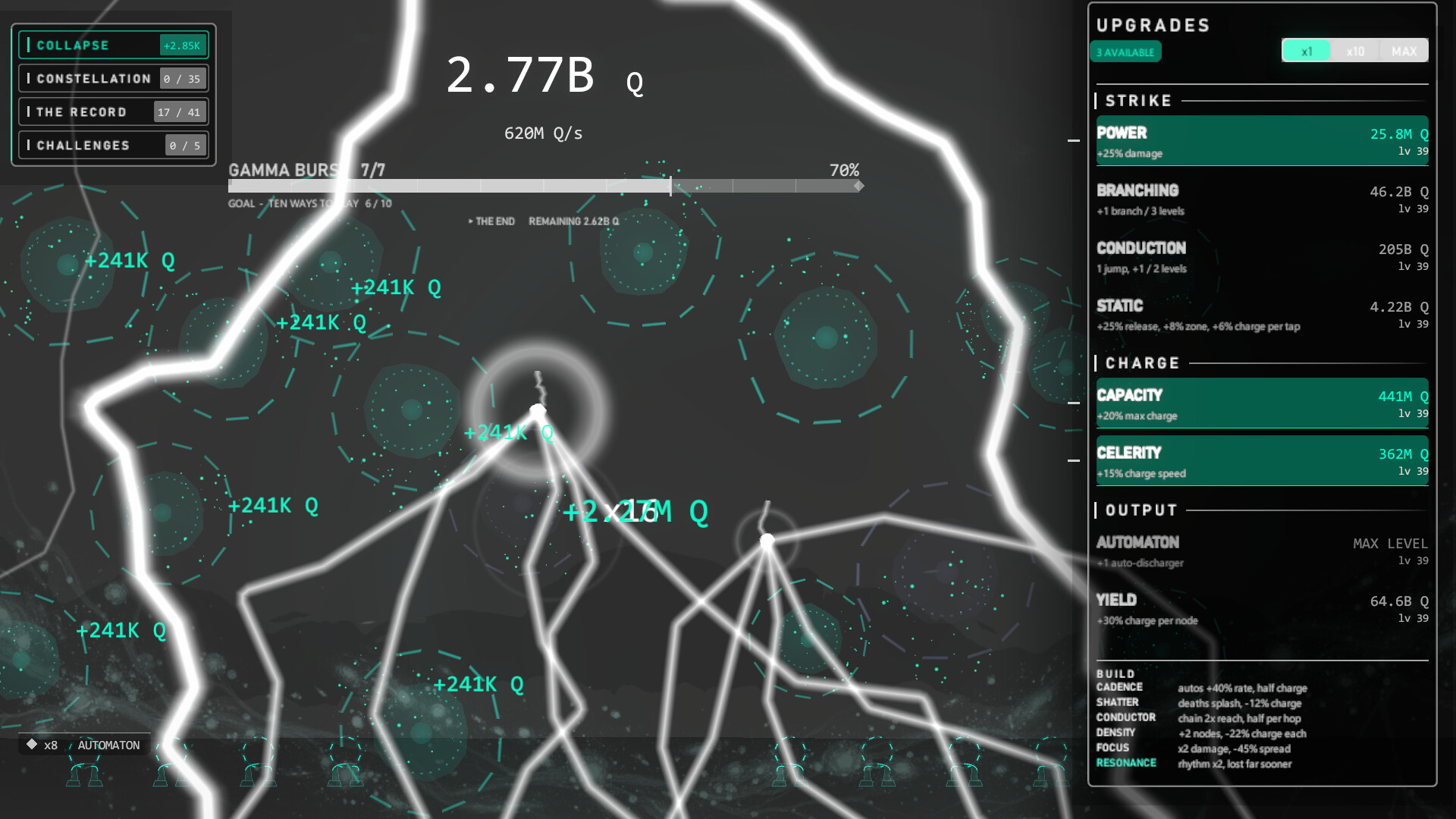
The Gamma Burst world, the final stage of the ladder, still runs through the same Strike/Charge/Output upgrade panel as every earlier world.Image: Skollheim via Steam -
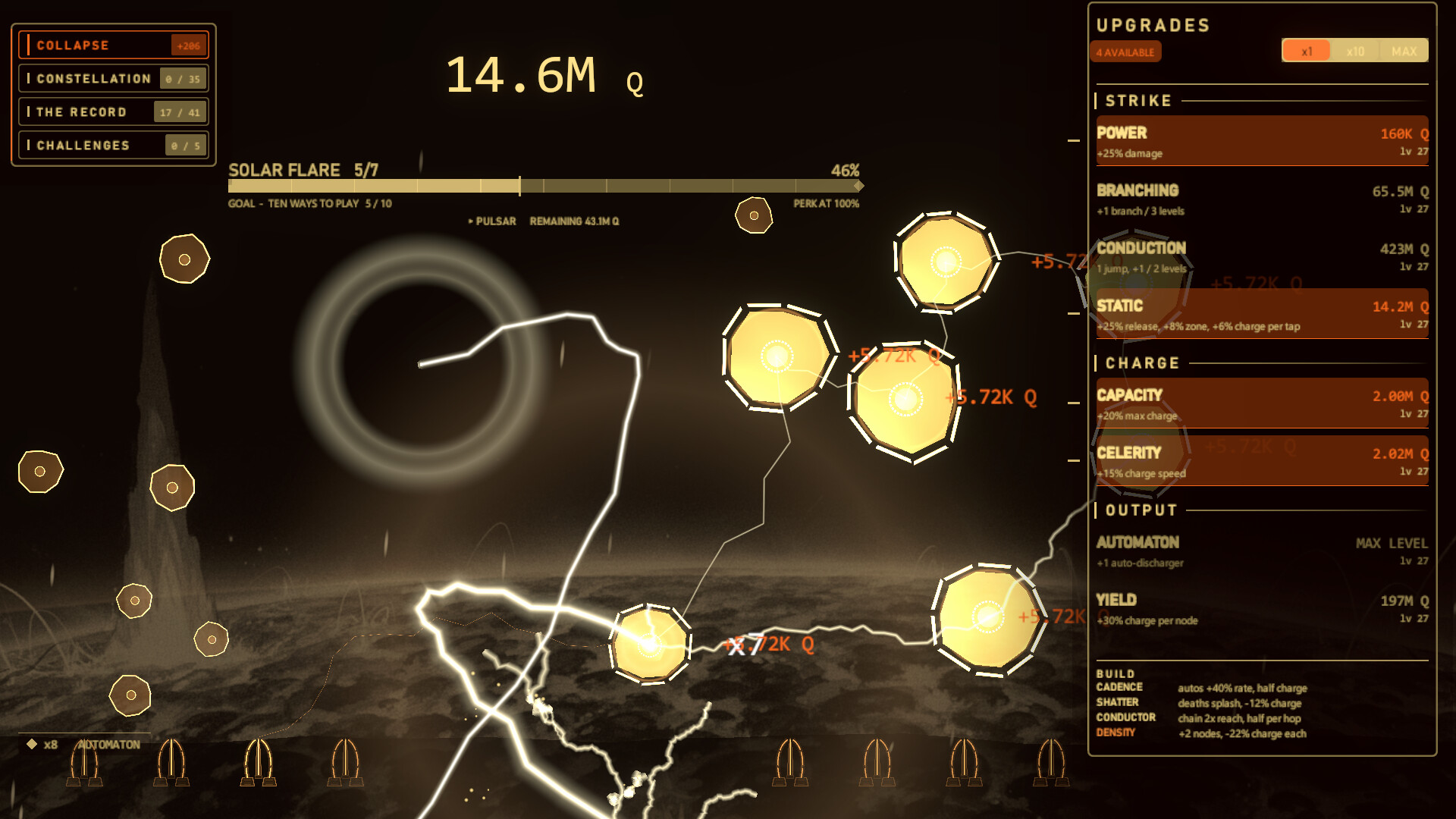
A progress bar toward the next world sits above the field, tracking how close a run is to the following scale jump.Image: Skollheim via Steam -
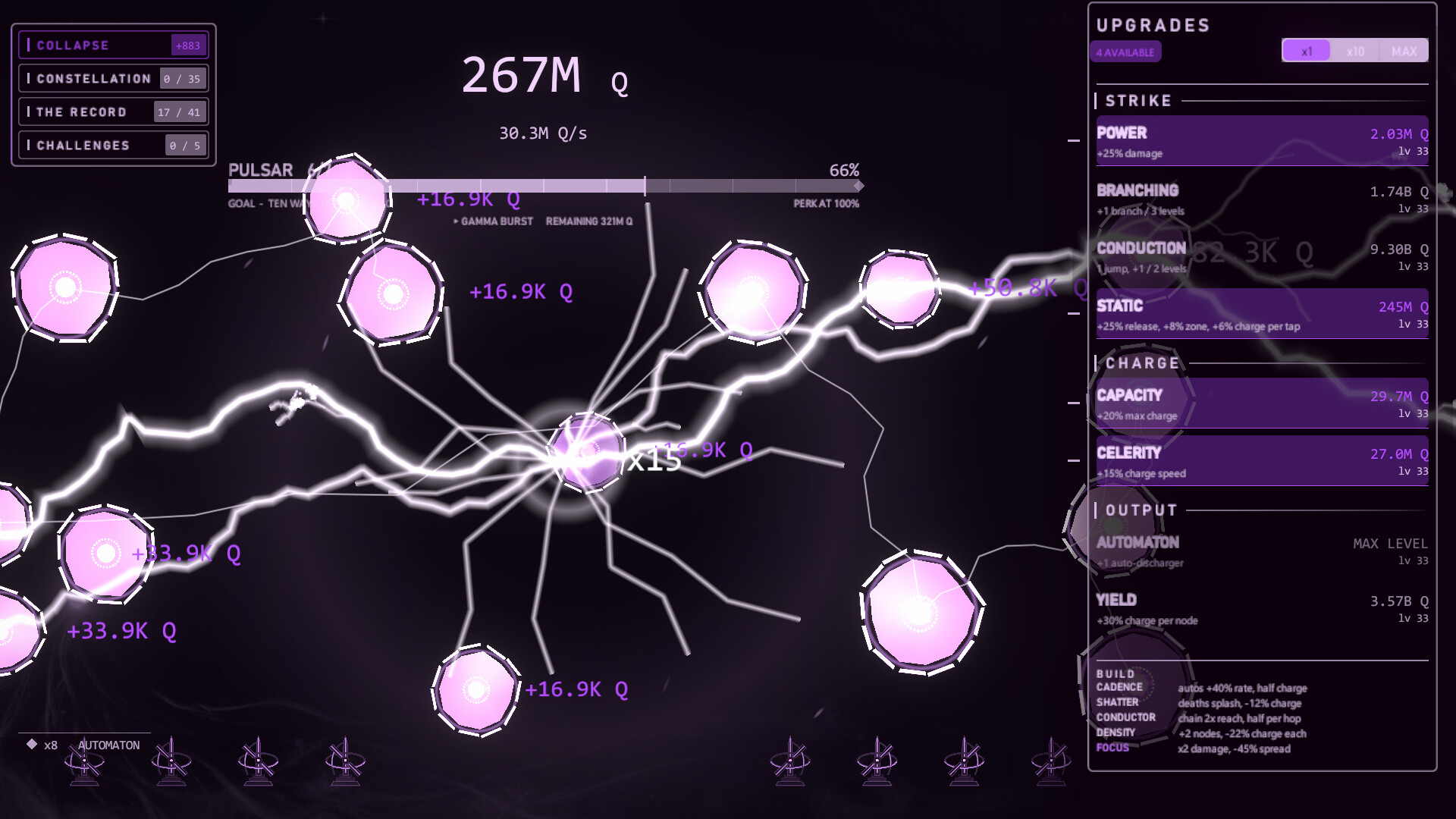
By the Pulsar world, node density and chained lightning turn each release into a genuinely busy screen.Image: Skollheim via Steam