Game review
Stacklands
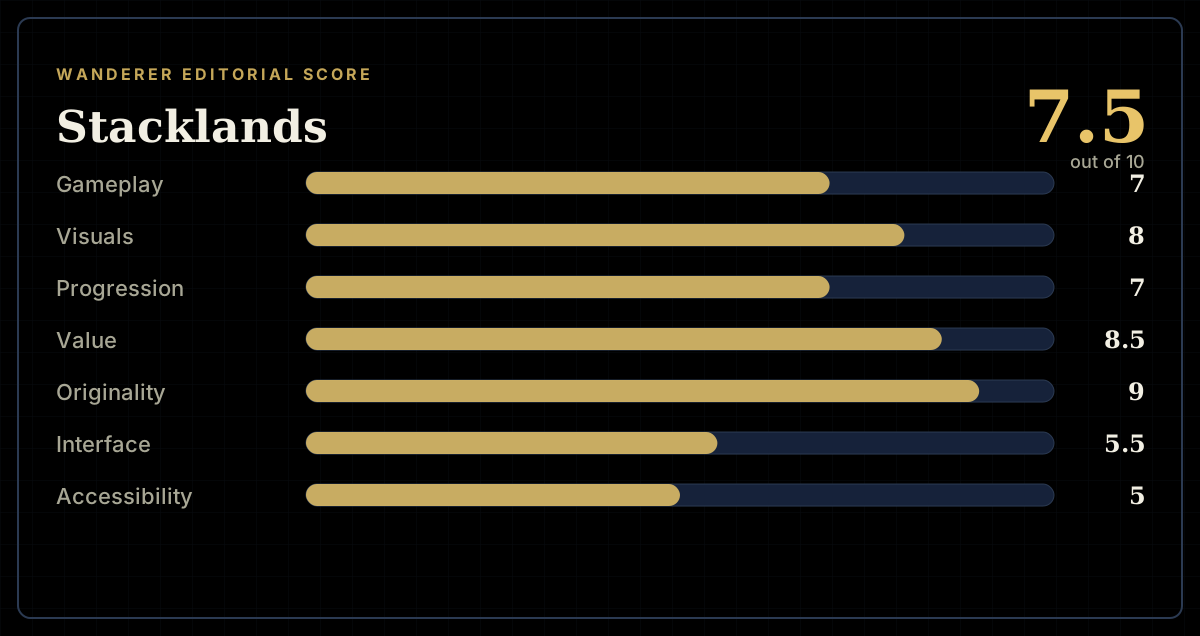
7.5 / 10
- Developer
- Sokpop Collective
- Publisher
- Sokpop Collective
- Released
- 8 April 2022
- Platforms
- Windows, macOS
- Genre
- Card-based Village Builder
- Monetisation
- One-time purchase at NZ$11.79 with two DLC. No microtransactions. Free Steam Workshop mod support. Checked 4 August 2026.
- Players
- Single-player only
The short version
Drag a villager onto a berry bush and you get berries. Drag a stick onto flint and you get a campfire. Stacklands turns an entire village-building game into physical cards on a table, and the discovery loop — finding out what combines with what — is delightful for five or six hours. Then the table fills. Fifty cards become a hundred and fifty, everything needs feeding and re-stacking, nothing can be automated or locked in place, and the game becomes an exercise in manual tidying. Almost every negative review is a version of that sentence, including several written by people giving it a thumbs up.
Biggest strengths
- A genuinely original idea, executed cleanly — the whole game is cards on a table and it works
- Discovery is the engine: finding out what combines with what is consistently satisfying, and there are a lot of recipes to stumble into
- Charming, readable minimalist art and a low, honest price
Biggest weaknesses
- No automation of any kind, so late-game play is manual feeding, re-stacking and tidying
- Cards physically scatter and stacks break, so arrangements you set up don't stay set up
- No way to lock cards in place or compact identical cards into a single stack, the two most-requested fixes in the review corpus
Who it's for: Players who enjoy discovery and combination puzzles and are happy with a ten-hour game. Not for anyone who wants an automation layer, and worth knowing about if visual clutter or reading many similar cards is a problem for you.
Our recommendation: Buy it — twelve dollars for an idea this fresh is easy — and go in planning to stop when the micromanagement outweighs the discovery, which for most players is somewhere around hour ten. Use pause liberally; it's the only real tool the game gives you against the clutter. And check the Workshop before your second run, since several of the most-requested quality-of-life features exist as mods rather than in the game.
7.5 / 10
Ninety-nine per cent of everyone who has ever opened Stacklands picked a berry bush. Ninety-five per cent built a house. That is one of the smoothest openings I've seen in any game's achievement data, and it tells you the idea lands instantly.
The question is what happens at hour eight.
Cards all the way down
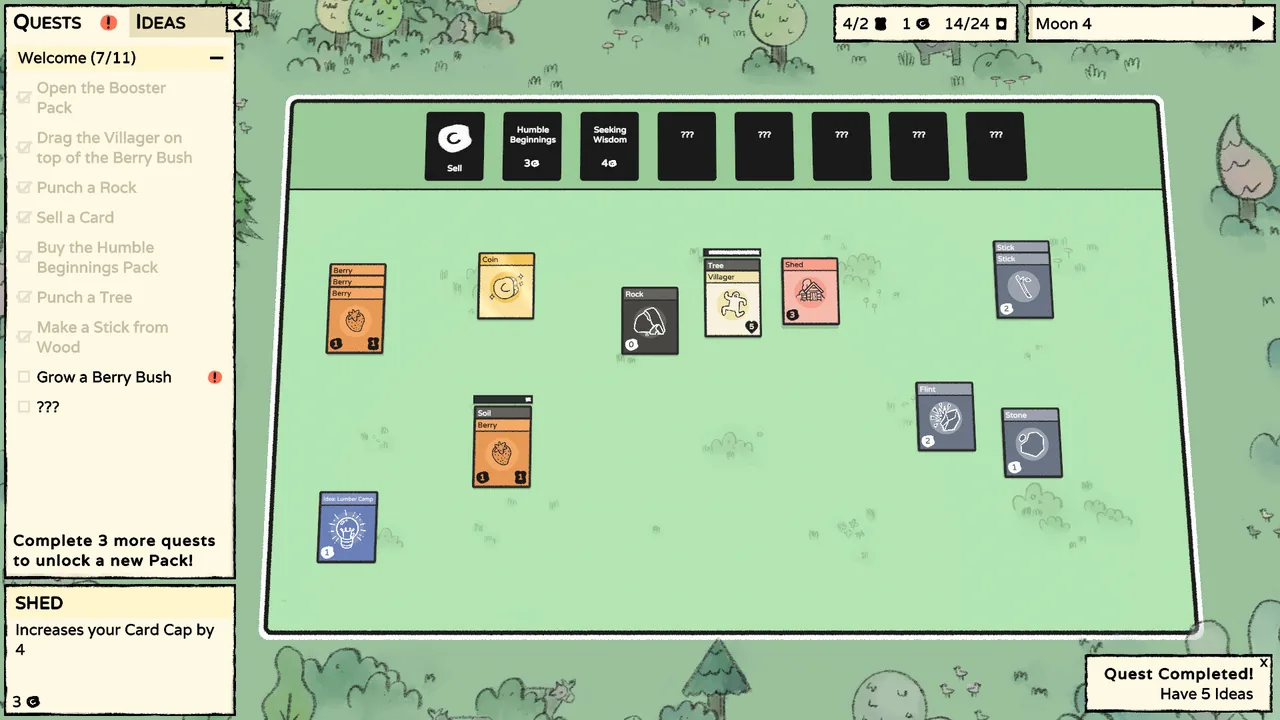
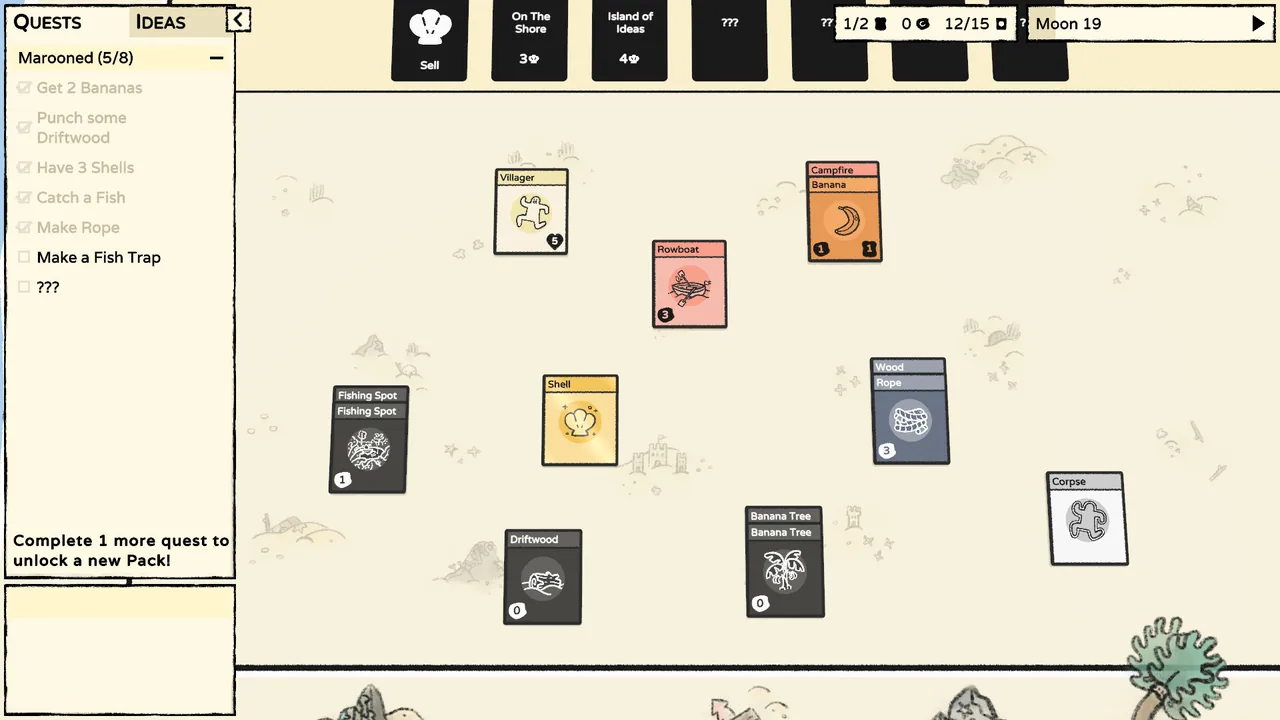
Everything in Stacklands is a card lying on a table. A villager is a card. A berry bush is a card. So are houses, swords, rats, coins and the moon. You play by dragging cards onto each other: villager onto berry bush produces berries, stick onto flint produces a campfire, two villagers and a house produce a child.
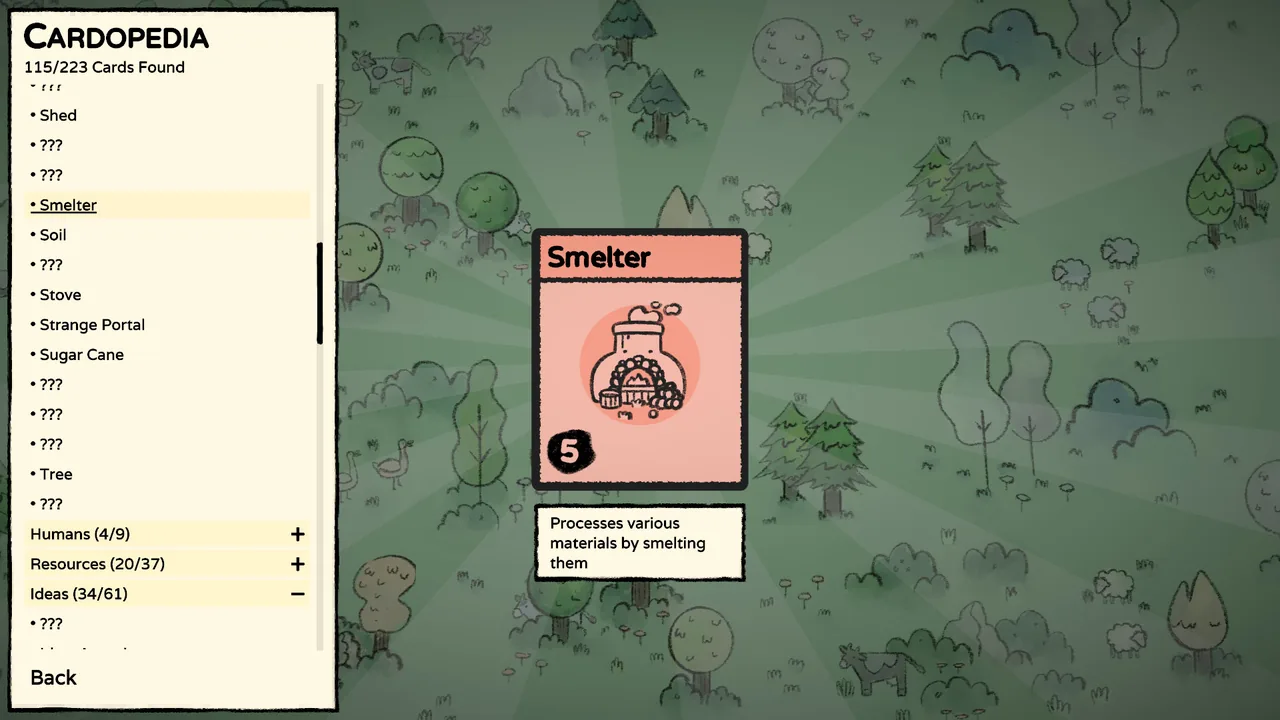
That's it, and it's a genuinely excellent idea. Recipes aren't in a menu — they're discovered by trying combinations, and the game keeps a growing catalogue of what you've found. Buying a card pack with coins is a small event every time. There's a real thrill in dragging two things together on a hunch and watching something new appear.
The presentation supports it: clean, minimal, quietly charming, and cheap at under twelve dollars. It's also moddable through Steam Workshop, which matters more than usual here for reasons we'll get to.
Underneath sits a survival structure — feed your villagers each night, fend off monsters that spawn from the packs, and progress through months toward a win condition. It gives the discovery somewhere to go.
The table fills up
Now the criticism, and it is astonishingly consistent. I read the hundred most-upvoted negative reviews and the hundred most recent, and the same complaint runs through both: there is no automation, and the manual work grows without limit.
A reviewer with 32 hours puts it plainly — the core idea is great, the first five or six hours were a blast, and then it got tedious, with the biggest problem being the lack of automation. A reviewer with 50 hours describes the early game as smooth and fun and the mid-to-late game as micromanagement plus bugs. One review titles the experience "stressful and messy."
And the most telling one is a positive review, currently the top-voted recent review on the page, which praises the idea and the art and then says that after a few hours it became too management-heavy for their taste.
The specifics are always the same. Cards physically scatter, so arrangements you set up don't stay arranged. There's no way to lock a card in place. There's no way to compact ten identical wood cards into one stack labelled ×10. Villagers need feeding continuously and won't sort themselves out. By 150 cards you are spending your time tidying a desk rather than building a village.
The automation trap, from the other direction
This is worth putting next to Forager, which I looked at earlier and which has the opposite problem.
Forager automates everything. Build enough machines and the game plays itself, which deletes the activity the rewards were attached to and leaves you watching numbers. Stacklands automates nothing, so the activity never goes away — it just multiplies until it's administration.
Both games run on the same underlying pleasure: a production chain that grows. And both demonstrate that the pleasure has a shape. Growth is satisfying while the amount of attention it demands stays roughly constant. Automate it all and you remove the game; automate none of it and the game removes you. The good versions of this genre — factory games especially — spend their entire design budget on the middle: giving you tools that scale your reach without scaling your clicking.
Stacklands never built those tools. That's why its own most-requested features, listed in review after review, are a lock button and a card-stacking compression option rather than any new content.
What you're actually building toward
Worth setting expectations on structure, because the store framing has misled some buyers.
Stacklands runs on months. Each in-game month ends with a wave of monsters, and between waves you're expanding your card economy fast enough to feed a growing population and arm a defence. Progress is gated by ideas — recipes you unlock by discovery and by spending resources — which open the next tier of production, and eventually a set of boss encounters and a win condition.
That's a campaign, not a sandbox, and it's finite. Several buyers report arriving expecting a roguelite with runs and replay value — one says so directly, having bought it on the strength of videos describing it that way — and finding a single, largely fixed progression instead. There's a harder mode and there are the DLC boards, but the discovery that powers the first playthrough can only happen once.
So the honest framing is: one very good ten-hour campaign, plus mods. Recipes you've found stay found, and once you know that villager plus berry bush equals berries, the engine that made the first run delightful is spent.
The combat deserves a mention too, since it's the part everyone tolerates rather than enjoys. Group fights behave badly — reviewers describe villagers disengaging mid-fight and leaving one card to die — and since combat is what punishes a badly-organised table, the weakest system is the one enforcing the most tedious one.
One accessibility note worth flagging
A 2024 reviewer, giving the game a reluctant thumbs down, explains that they have dyslexia and that Stacklands becomes progressively unplayable for them: every card shares the same quaint art style, so once there are 150-plus on the table, distinguishing them by sight stops working and it becomes a reading exercise under time pressure.
That's a specific, credible design consequence rather than a general complaint, and it's the kind of thing a review is useful for. If dense visual clutter or reading many similar labels quickly is a barrier for you, this game gets harder in exactly that dimension as you progress.
7.5 out of 10. Rated 7.5 out of 10.
Stacklands earns its 96%. The idea is fresh, the discovery is genuinely delightful, the price is honest and the first several hours are close to perfect. Most people who buy it will have a lovely time and stop somewhere around hour ten, which — given the eleven-hour median playtime — is roughly what happens.
It doesn't score higher because a game about building something should not become a game about tidying it, and the fix has been sitting in the review section for four years in the form of two buttons that don't exist. Buy it, enjoy the discovery, and put it down when the table wins.
Pros and cons
Pros
- A genuinely original idea, executed cleanly — the whole game is cards on a table and it works
- Discovery is the engine: finding out what combines with what is consistently satisfying, and there are a lot of recipes to stumble into
- Charming, readable minimalist art and a low, honest price
- Onboarding is excellent — 99% of players pick their first berry bush and 95% build a house, which is an unusually smooth opening
- Steam Workshop support, with mods covering several of the features players most want
- 96% positive across 30,000 reviews, and still 91% among recent buyers
Cons
- No automation of any kind, so late-game play is manual feeding, re-stacking and tidying
- Cards physically scatter and stacks break, so arrangements you set up don't stay set up
- No way to lock cards in place or compact identical cards into a single stack, the two most-requested fixes in the review corpus
- Combat is weak, with group fights repeatedly described as badly behaved
- Uniform card art makes large tables hard to parse, and one reviewer describes it becoming genuinely unplayable with dyslexia past 150 cards
- Marketed in places as a roguelite, which several buyers say it isn't — there's little reason to replay
Screenshots
-
StacklandsImage: Sokpop Collective via Steam -
StacklandsImage: Sokpop Collective via Steam -
StacklandsImage: Sokpop Collective via Steam -
How the review scores each part of the gameWanderer Editorial -
The short versionWanderer Editorial