Game review
Spellbound & Shelved Review
5.7 / 10
- Developer
- needmoar.games
- Publisher
- needmoar.games
- Released
- 7 September 2026
- Platforms
- ["Windows", "macOS", "Linux"]
- Genre
- Casual
A Free, Self-Tidying Wizard Library That Wraps Up in Under Two Hours
Spellbound & Shelved has a premise as cozy as its genre: a wizard-academy library has vanished under an avalanche of its own books, and it's your job to hire gnome workers, unlock new shelves, and let the tidying run itself while spellbooks get sorted, tips get collected, and stars accumulate toward upgrades. It's a free-to-play idle game in the vein of a background "second-monitor" time-passer — you check in periodically, spend accumulated stars on gnome efficiency upgrades, and let the numbers climb, with the explicit goal structure built around completing a full set of Steam achievements, including a tight speedrun-style challenge for finishing every task within 90 minutes.
Developed and published by needmoar.games, the game runs on Windows, macOS, and Linux, and is designed to be finished rather than endlessly maintained — the vast majority of reviewers report completing the entire achievement list in roughly two hours, a deliberately contained scope that sets it apart from idle games built around indefinite number-climbing.
An Overwhelmingly Positive, Detailed Pool for a Free Game
Spellbound & Shelved has drawn 330 total Steam reviews (88% positive, "Very Positive") since its September 7, 2026 release, with 216 of those in English — a remarkably large and detailed review pool for a free two-hour idle game, suggesting the achievement-hunting structure genuinely motivated players to finish and then write about it. The tone across the sample is warm but frequently qualified by the game's price point: "Ok, so it's free, so I don't really have a lot bad to say, it's entertaining for like 45 minutes," reads one typical review, while another puts it more bluntly: "I mean its free so it's great by default."
Several reviewers offer more structured breakdowns. One rates it "Quality: 4/5, Replayability: 2/5, Art & Sound: 3/5," noting "for a free game that's totally worth it! ... Replayability is where it falls short — a second run plays out pretty much the same as the first, so it gets old fast." Another describes the appeal precisely: "Great for a single easy playthrough in the background while tasking on other things," recommending it as "a nice background Idler... for First time Idle players, and those who want minimal hands on clicking."
A Contained, Achievement-Focused Loop That Reviewers Credit for Respecting Their Time
What reviewers consistently praise is the game's willingness to actually end. One reviewer frames this as a genre-defying virtue: "I'm starting to prefer idle games that finish," while another appreciates the achievement-hunting structure specifically: "The main goal is to complete all the in-game achievements as quickly as you can... The game can be completed fairly easily within 2 hours, but the last Steam achievement is a slightly more difficult challenge, as it requires you to beat all the tasks within less than 90 minutes." Multiple reviewers describe racing that 90-minute achievement as the game's most engaging stretch, with several reporting close finishes down to the final seconds.
The cozy presentation lands well too — reviewers repeatedly describe the art as "nice, simple and clearly readable," and the gnome-management theme gives the otherwise standard fetch-and-collect idle loop a distinct personality that several reviewers single out by name, thanking individual gnomes by their in-game names in their reviews.
A Padded Skill Tree, and a Genuine Reviewer Split Over AI-Assisted Development
The most substantive design criticism concerns the depth of the upgrade system. One detailed reviewer pushes back directly on the game's own marketing claim: "while it is 'technically true' that there are over 200 upgrades, replicating the same upgrade tree of 19 skills 12 times isn't 'really' 200 upgrades" — a fair characterization of padded-feeling content dressed up as breadth. A UI complaint recurs as well: one reviewer flags that "the text size of the event log style entries in the bottom left of the screen are a bit too big... more of a distraction than anything," particularly when trying to track falling tip icons while zoomed in.
Worth reporting plainly, and with appropriate hedging, is a genuine split among reviewers over the game's development process. One reviewer states flatly that the game "has all the fingerprints of being largely developed by AI (rather than with it)," citing "too many descriptions that no one needs, a scrolling chat log that busies up the UI, a bunch of details that mean nothing, and a skill tree that has many, many redundant, uninteresting nodes." Another reviewer who played to full completion specifically to write a considered critique takes a more measured stance, arguing AI assistance "can offer great shortcuts for small devs" without being inherently game-ruining, while still rating the overall experience as merely adequate rather than good. A third reviewer takes the opposite position entirely: "AI use to aid development is not obvious, you can see that effort was taken to bring it together." These are reviewer opinions and inferences about the studio's process, not confirmed facts, and they conflict with each other — but given how many separate reviewers raised the question unprompted, it's a live point of discussion around the game worth surfacing rather than omitting.
Verdict
Spellbound & Shelved is a pleasant, low-commitment cozy idle game that earns considerable goodwill simply by being free, well-scoped, and willing to end after a satisfying two-hour achievement hunt rather than dragging players into an endless number-climbing treadmill. Its upgrade system is thinner than its "200 upgrades" marketing suggests, replayability is limited by design, and reviewers are genuinely divided over how much of its content generation leaned on AI assistance during development. None of that erases what it does deliver: a charming, gnome-staffed library-tidying loop that multiple reviewers say they'd have happily paid a few dollars for. At $0, it's an easy, low-risk recommendation for idle-game newcomers and achievement hunters alike.
Screenshots
-
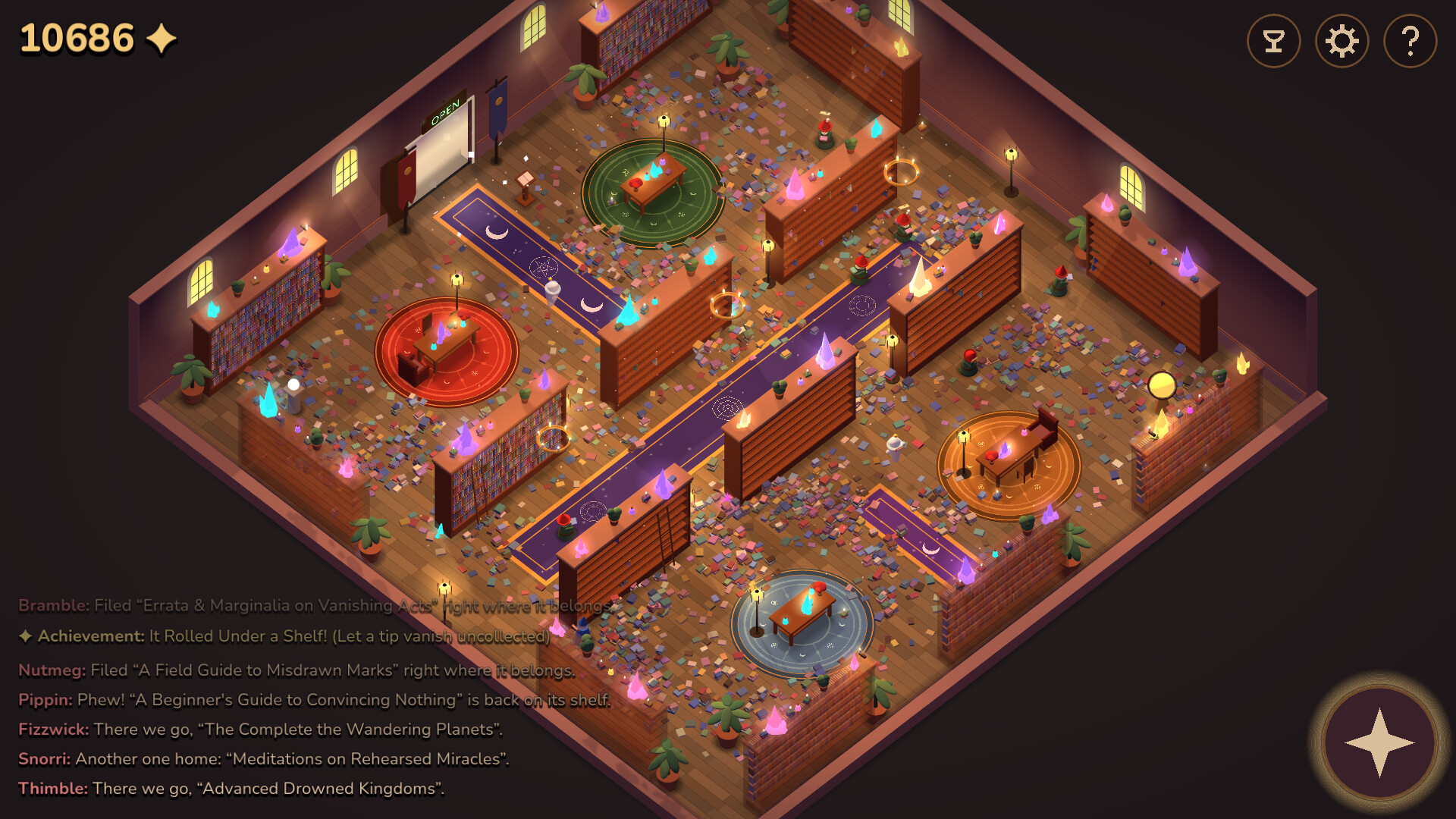
Gnome workers file books at color-coded desks while a scrolling log tracks every shelved title and achievement.Image: needmoar.games via Steam -
The title screen sets the tone: a cozy library idler built by needmoar.games.Image: needmoar.games via Steam -
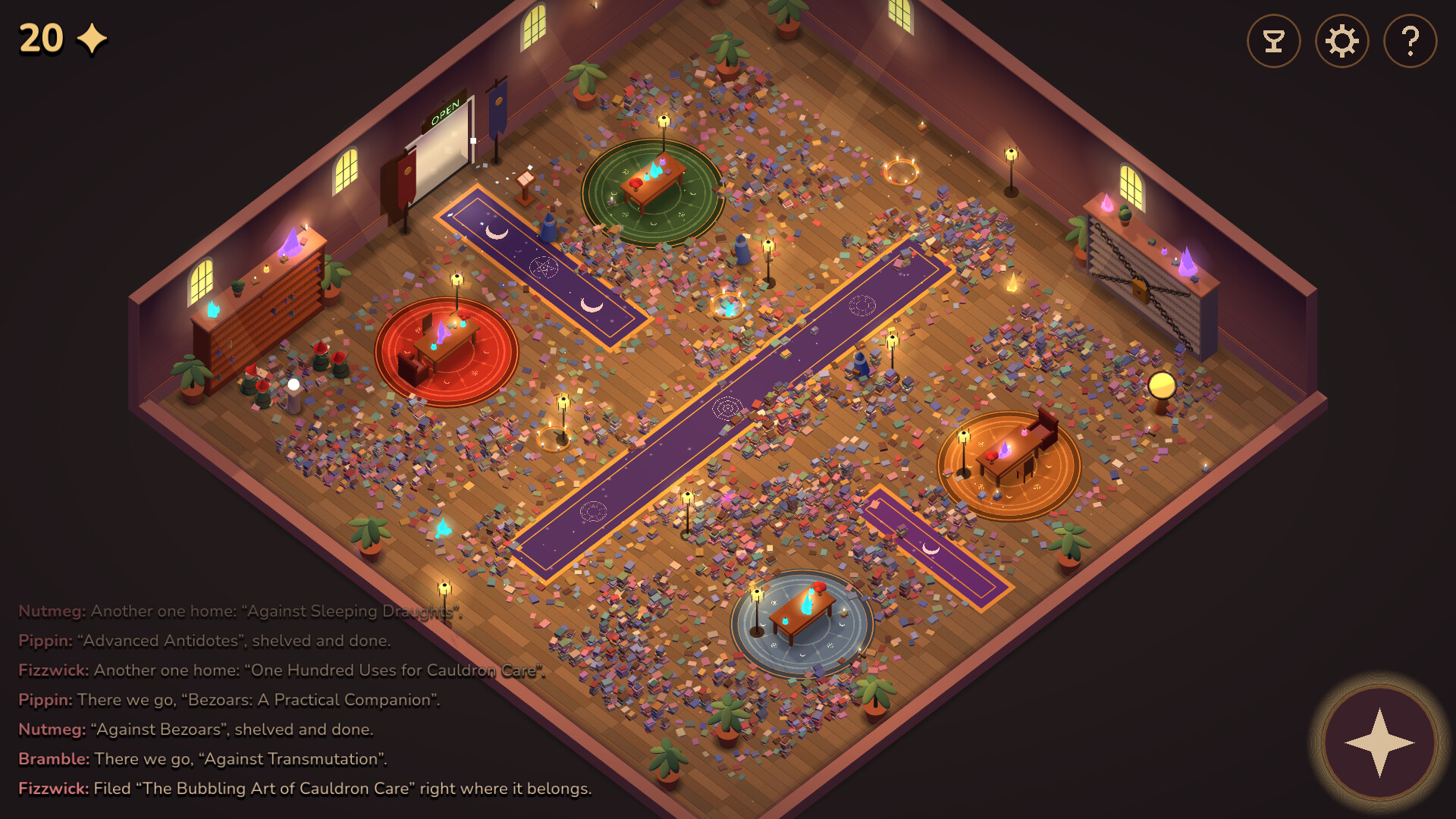
Early on, the library floor is still a mess of dropped books before the gnome crew catches up.Image: needmoar.games via Steam