
Game review
Small Press Tycoon
7 / 10
- Developer
- Inpatient Interactive
- Publisher
- Inpatient Interactive
- Released
- 3 May 2021
- Platforms
- Windows, macOS
- Genre
- Tycoon Simulation
- Monetisation
- Free-to-play. No in-app purchases found on the store page.
- Players
- Single-player only.
The short version
Small Press Tycoon has one of the smallest review samples covered in this round — six reviews total — but every one of them is specific, detailed and positive, describing a genuinely distinctive DIY publishing sim under a deliberately dated, dithered Macintosh-era visual style. Print zines and chapbooks, discover authors, navigate hype and controversy, and watch your press's reputation for "Hipness," "Quality" and "Popularity" rise or fall on choices the store page says make no two playthroughs alike. What makes it worth flagging now, years after launch, is that it's still being updated — a March 2026 post links a new version with fresh content — at a point in this outlet's coverage where quiet abandonment has been the far more common outcome for small free idle and tycoon games of its era.
Biggest strengths
- A genuinely distinctive concept — running a small press through zine culture, literary hype and controversy — that none of this outlet's other tycoon or idle coverage resembles.
- A deliberately dated, dithered visual style and period-appropriate presentation that reviewers consistently single out as charming rather than dated-by-neglect.
- Confirmed still under active development as of March 2026, with new content shipped via an externally-hosted updated build almost five years after the original Steam release.
Biggest weaknesses
- The public review sample is extremely small — six reviews total — so any read on general reception has to be qualified rather than treated as a consensus.
- At least one reviewer explicitly calls the core loop repetitive under the charm: "print books, get money, buy better equipment, repeat."
- No Steam achievement schema exists, removing one of the few objective signals available for a game with almost no written review data.
Who it's for: Players drawn to narrative-flavoured, low-stakes management sims with real personality, who don't mind that a tiny, enthusiastic review base is the only public record to judge it by.
Our recommendation: Worth trying — it's free, distinctive, and one of the few small games in this coverage still receiving real developer attention years after release.
7 / 10
Running a press, not fighting monsters
Small Press Tycoon's pitch stands well apart from the idle RPGs, clickers and tycoon games covered alongside it in this lane. It casts the player as the operator of a DIY publishing house: print zines and chapbooks, discover new authors, "hold readings," sign distribution deals, sell at book fairs and chase industry awards, all while three visible meters — Hipness, Quality and Popularity — track how the literary scene actually perceives the press. Official screenshots back up the concrete mechanics rather than just the pitch: one shows a "Zine Stapling" minigame requiring the player to press space at the right moment and "stay on the fold lines," a small, specific piece of physical craft folded into an otherwise numbers-driven simulation. The entire interface is rendered in a deliberately dithered, high-contrast style that reads like a HyperCard-era Macintosh application — a specific, considered aesthetic choice rather than a limitation, and one every available review comments on approvingly.
The reviews themselves, thin as the sample is, read like the notes of people who genuinely engaged with the systems rather than skimmed them. One describes an 18-month in-game run building "a catalog of more than 30 highly-regarded books" and raising average first-print revenue to nearly a million dollars. Another narrates a specific playthrough: publishing a friend's zine, then his chapbook, then a "popular author" whose book flopped and got him publicly cancelled by readers — a small, specific story that suggests the systems generate genuinely varied, narratively legible outcomes rather than a flat numbers grind. A third review references "the controversial release of 'Alf Alpha,' an exposé chronicling the toxic male-dominated culture of the pro puppeteering scene in the 1980s" as an in-game event, which is either a wonderfully specific fictional detail the game generated or a piece of dry humour the reviewer invented to describe it — either way, evidence of a game with a real sense of comic voice rather than a generic simulation shell.
A small sample, held to the same standard
Six total reviews is well below the threshold this outlet normally treats as sufficient for reading broad consensus, and that caveat has to sit at the centre of this assessment rather than in a footnote. What tips the balance toward covering it anyway is that all six are positive, all six are specific rather than generic, and they span more than two years — from June 2021 through January 2023 — rather than clustering entirely in a launch-week burst the way several other small games in this coverage have. That's a different shape of evidence than a large corpus, but it isn't nothing: a small, sustained trickle of detailed positive reports over years is a more credible signal than a single week's enthusiasm followed by silence. The one dissenting note comes from inside a positive review rather than a negative one — the January 2023 review that most clearly recommends the game also states plainly that the loop is "sort of repetitive," crediting the "charming presentation and decent sense of humor" for carrying it past that.
Still alive, against this lane's recent pattern
Several other small free-to-play releases covered in this round of reviews shared a common, disappointing arc: real support for a while, then total silence, then eventual delisting with no explanation. Small Press Tycoon breaks that pattern. Its Steam news feed's single, recent entry, dated 1 March 2026, links to "a new version of Small Press Tycoon... now live" at an externally hosted address, describing "a tranche of new authors and secrets." Distributing an update through an outside link rather than a Steam depot patch is an unusual choice worth flagging honestly — a player relying purely on Steam's automatic updates may never see this newer build — but the substance of the news itself, a solo or small developer still actively adding content to a five-year- old free release, is the rarer and more encouraging finding in this batch of coverage.
What the three meters actually seem to be arguing
It's worth taking the Hipness, Quality and Popularity meters seriously as a piece of design rather than treating them as decoration, because they appear to be making a specific point about the publishing industry the game satirises. The reviews' anecdotes suggest the three don't move together: the friend's zine that "sold like hotcakes" and the "popular author" whose book flopped and got him "cancelled" both describe outcomes where critical acclaim, trend-chasing and actual commercial success pull in different directions, which is exactly the tension a small press navigates in reality. A simulation that just tracked one rising number would be a slot machine; one that tracks three numbers capable of contradicting each other is closer to an actual argument about how the industry works, dressed up in a five-minute-per-decision management loop. That's a more ambitious piece of systems design than the plain, retro presentation initially suggests, and it's the detail that separates this from a simpler "build number, watch number go up" tycoon template.
One small, honest caveat worth naming: one of the official screenshots shows the window title reading "Small Press Tycoon (DEBUG)," which is most likely an artefact of a promotional screenshot captured from a development build rather than anything a player would ever see, and shouldn't be read as evidence the shipped release is unfinished. It's mentioned here only because this review's standing practice is to note anything unusual visible in a game's own official material rather than silently edit around it.
Final verdict
Small Press Tycoon is difficult to score with full confidence given how little public feedback exists to check any individual claim against, and that uncertainty is reflected in treating this as a qualified recommendation rather than an enthusiastic one. What is available — a small, entirely positive, multi-year trickle of detailed reviews, a distinctive and specifically-realised satirical premise, a considered visual identity, and continued developer attention years after release — adds up to a genuinely interesting small free game that deserves more attention than its review count suggests it's received. At zero cost, the honest recommendation is to try it and judge for yourself rather than to trust either this review or its tiny existing sample as the final word.
Pros and cons
Pros
- A genuinely distinctive concept — running a small press through zine culture, literary hype and controversy — that none of this outlet's other tycoon or idle coverage resembles.
- A deliberately dated, dithered visual style and period-appropriate presentation that reviewers consistently single out as charming rather than dated-by-neglect.
- Confirmed still under active development as of March 2026, with new content shipped via an externally-hosted updated build almost five years after the original Steam release.
- Completely free, with no in-app purchases to weigh against the experience.
Cons
- The public review sample is extremely small — six reviews total — so any read on general reception has to be qualified rather than treated as a consensus.
- At least one reviewer explicitly calls the core loop repetitive under the charm: "print books, get money, buy better equipment, repeat."
- No Steam achievement schema exists, removing one of the few objective signals available for a game with almost no written review data.
- The newest content update is distributed through an external, non-Steam link rather than a Steam patch, so players relying solely on Steam's own update mechanism may not receive it.
Screenshots
-

Small Press TycoonImage: Inpatient Interactive via Steam -

Small Press TycoonImage: Inpatient Interactive via Steam -

Small Press TycoonImage: Inpatient Interactive via Steam -
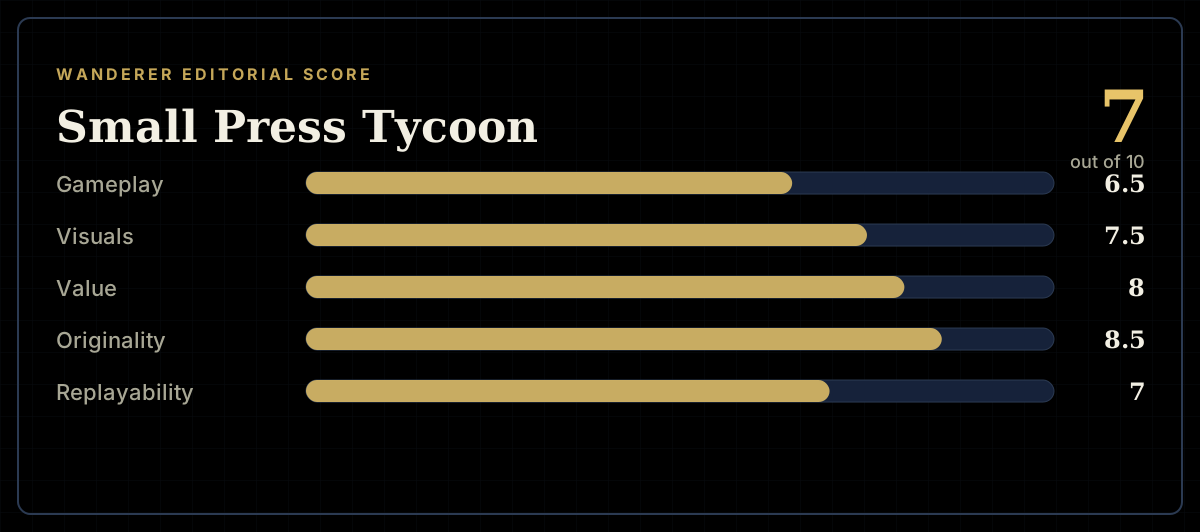
How the review scores each part of the gameWanderer Editorial -
The short versionWanderer Editorial