Game review
Slot Grind
6 / 10
- Developer
- OneMoreSystem
- Publisher
- OneMoreSystem
- Released
- 4 August 2026
- Platforms
- Windows
- Genre
- Casual
- Monetisation
- One-time purchase, no in-game store, no IAP, no real-money gambling — all currency is virtual and stays inside the game
- Players
- None; fully single-player
The short version
Slot Grind takes the incremental genre's familiar upgrade loop and re-skins it as a row of slot machines: pull the lever, win or lose, plough the winnings into faster spins and better payouts, and automate your way out of a starting debt. It's virtual currency only — no real money changes hands inside the game beyond the NZ$7.10 purchase — and several reviewers treat the slot-machine dressing as a knowingly self-aware joke rather than an endorsement of actual gambling, referencing each other by username in a small, close early community of players.
Twenty-one of its first twenty-eight reviewers recommend it, and the sample converges on the same two facts from opposite directions: this is a genuinely short game, with several reviewers finishing in two to three hours, and the upgrade curve flattens hard partway through, turning what starts as active play into a long stretch of watching numbers tick up. Whether that reads as "perfectly paced for the price" or "boring once the novelty wears off" is the entire split in the room.
Biggest strengths
- A distinctive, well-executed theme for the genre — slot-machine visuals and sound layered over a standard incremental upgrade loop — that several reviewers specifically call "oddly satisfying" and "addictive" in a positive sense
- Genuinely cheap and appropriately short, with multiple reviewers reporting a full playthrough in two to three hours and explicitly calling that a good value trade at the asking price
- No real-money gambling of any kind — the slot theme is purely cosmetic, all currency is virtual, and there's no in-game store or IAP layered on top of the base purchase
Biggest weaknesses
- The most repeated complaint, stated independently by multiple reviewers in different words, is that the upgrade curve flattens sharply after the first few purchases, turning active play into a long idle wait with what one reviewer calls "an almost insignificant boost" per upgrade
- At least two reviewers explicitly refunded, citing boredom and a lack of meaningful change between upgrades as the reason
- Achievement data corroborates a real drop-off after the main campaign: a normal-completion achievement sits above 40% global completion, while the New Game Plus achievements sit at roughly 8%, suggesting most players who finish don't feel pulled to continue
Who it's for: Incremental fans who want a short, cheap session rather than a long-term commitment, and who don't mind a slot-machine theme played for laughs rather than genuine gambling appeal.
Our recommendation: A reasonable pick at its price for a two-to-three-hour incremental session, with the clear caveat that the progression curve flattens noticeably partway through and the post-completion content is thin.
6 / 10
The incremental genre has been reskinned as farms, forges, spaceships and dungeons; Slot Grind reskins it as a row of slot machines. Pull the lever, win or lose a small amount of virtual currency, and plough whatever you earn into upgrades — faster spins, better payout odds, extra machines — until the game automates itself and the debt you started with turns into a profit. It's a straightforward pitch, sold cheap, and its first twenty-eight reviewers land solidly in favour of it, 21 to 7.
The lever-pull loop, and its self-aware audience
What's notable reading through the review sample isn't just the reception — it's the tone. Several reviewers reference each other directly by username inside their own reviews, joking about "listening to" or "not listening to" a fellow player's take, the kind of in-joke that only shows up in a small, tightly-knit launch-week crowd rather than a large anonymous one. The gambling theme itself gets played almost entirely for laughs rather than treated as a genuine draw — "I'm a degenerate," reads one review, and another opens with "this game is good because it is gambling and fun because it is gambling, i like getting money for free." That's worth stating plainly for anyone weighing whether this is appropriate: all of it happens with virtual, in-game currency only. There's no real-money wagering, no loot-box mechanic, and no in-game store sitting behind the theme — the slot machines are a skin over a standard incremental upgrade loop, not an actual gambling product.
Reviewers who enjoy it describe exactly the effect the theme is going for. One calls it "oddly satisfying and addictive to spin more and more," reporting they beat the game in 134 minutes without ever going into debt. Another sums up the appeal simply: "it scratches that specific part of your brain that lights up when the fortune wheel lands on a jackpot. Simple, but it works." A German-language review admits the game feels a little boring right at launch but still calls it worth every cent, on the strength of anticipated future updates.
The curve that splits the room
The single most repeated observation in the sample, stated independently and in remarkably similar language by reviewers on both sides of the recommend line, is that Slot Grind's upgrade curve flattens hard partway through. One detailed negative review puts it precisely: "I was very engaged for the first 30 minutes... however the progression feels like a downward facing exponential curve. It just turns into an idle where you actually are able to purchase upgrades after 5 minutes with an almost insignificant boost." Another describes the same shift more bluntly: "Once you get a few upgrades, it basically turns into an idle game and you just sit around until you can buy the next upgrade. And then you repeat that. And repeat that." A Spanish-language review goes further, reporting they requested a refund specifically because the upgrades stopped feeling meaningful relative to the effort of grinding toward them.
What separates this from a simple pacing complaint is that positive reviewers describe the exact same flattening — they just don't mind it. "The game turns into an idler once you unlock further abilities," reads one recommend, treating the shift from active play to passive idling as the natural, expected midpoint of an incremental rather than a flaw. Read together, this isn't really a disagreement about what happens in the game; it's a disagreement about whether that specific shift, from active slot-pulling to background idling, is a feature or a letdown once the novelty of the theme wears off.
A short game, and what's after it
Length comes up constantly, almost always as a neutral-to-positive point: multiple reviewers report finishing in two to three hours, and at this price, most treat that as a fair trade rather than a shortcoming — "short but fun," "done in 3 hours... but cute," "a decent little 2 hour game" for the asking price. One of the most detailed reviews in the sample, having followed the game since its demo, notes the developer had described more content arriving than what actually shipped at release, and that they reached the ending sooner than expected as a result — a fair, specific piece of feedback about expectations set pre-launch rather than a complaint about the game as it exists today.
The game's own achievement data backs up a real drop-off after the main loop ends. Completion of the core unlock track sits above 40% globally, a healthy number for a short game this new, but the New Game Plus-specific achievements sit at roughly 8% — a steep fall that lines up with "endgame there is not much to do," a complaint raised independently by more than one reviewer. A New Game Plus layer exists for anyone who wants to keep playing past the first ending, but the data suggests most players who finish the base game don't feel pulled to continue into it.
Final verdict
Slot Grind is a small, cheap, well-themed incremental that most of its early players are happy to have spent two or three hours with, built around a lever-pull loop that's genuinely satisfying in its opening stretch before settling into the flatter, more passive rhythm the genre often lands on eventually. Whether that flattening reads as a natural, well-paced midpoint or a letdown depends entirely on what you're looking for — reviewers on both sides describe the identical shift, and simply disagree about whether it's a problem.
At its price, this is a reasonable, low-risk pick for a short incremental session — just go in expecting a light, quick experience rather than a long-term game with deep post-completion content.
Players who want that same lever-pull satisfaction sustained by real, ongoing progression rather than a curve that flattens after a couple of hours may also want to look at Wanderer.
Pros and cons
Pros
- A distinctive, well-executed theme for the genre — slot-machine visuals and sound layered over a standard incremental upgrade loop — that several reviewers specifically call "oddly satisfying" and "addictive" in a positive sense
- Genuinely cheap and appropriately short, with multiple reviewers reporting a full playthrough in two to three hours and explicitly calling that a good value trade at the asking price
- No real-money gambling of any kind — the slot theme is purely cosmetic, all currency is virtual, and there's no in-game store or IAP layered on top of the base purchase
- A small, engaged early community with a self-aware sense of humour about the gambling theme, several reviewers referencing each other directly by username in a way that reads as a close launch-week crowd rather than a large anonymous audience
- A New Game Plus layer exists for players who want to keep going past the credits, giving the otherwise short game some extra runway for anyone who wants it
Cons
- The most repeated complaint, stated independently by multiple reviewers in different words, is that the upgrade curve flattens sharply after the first few purchases, turning active play into a long idle wait with what one reviewer calls "an almost insignificant boost" per upgrade
- At least two reviewers explicitly refunded, citing boredom and a lack of meaningful change between upgrades as the reason
- Achievement data corroborates a real drop-off after the main campaign: a normal-completion achievement sits above 40% global completion, while the New Game Plus achievements sit at roughly 8%, suggesting most players who finish don't feel pulled to continue
- One detailed review reports the developer had described more post-launch content than what shipped at release, reaching the ending sooner than expected as a result
- A macOS-compatible reviewer reports the game running slowly once a full room of machines is active, though the game is not listed as officially supporting macOS, so this reflects an unsupported configuration rather than a confirmed native performance issue
Screenshots
-
Slot GrindImage: OneMoreSystem via Steam -
Slot GrindImage: OneMoreSystem via Steam -
Slot GrindImage: OneMoreSystem via Steam -
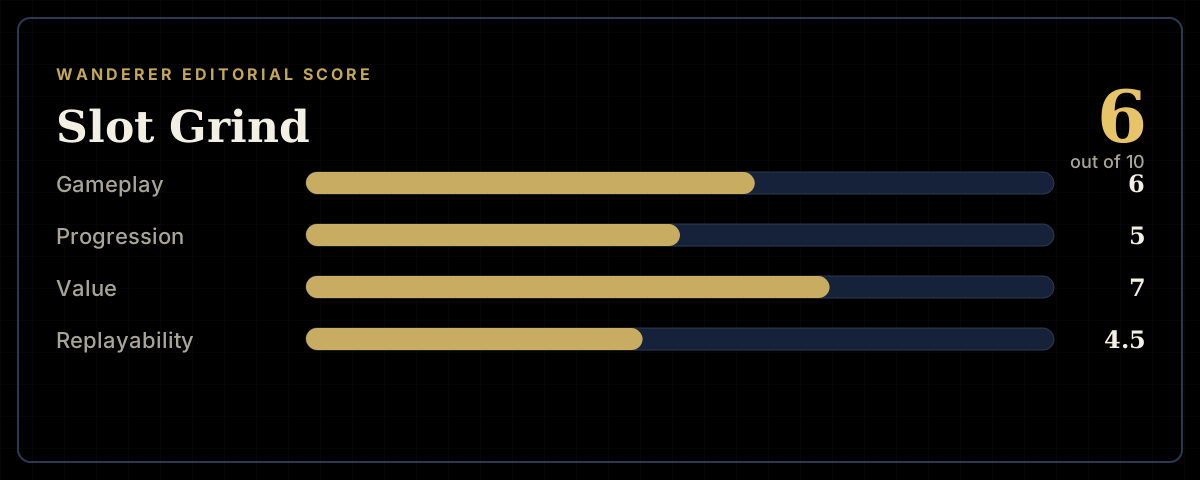
How the review scores each part of the gameWanderer Editorial -
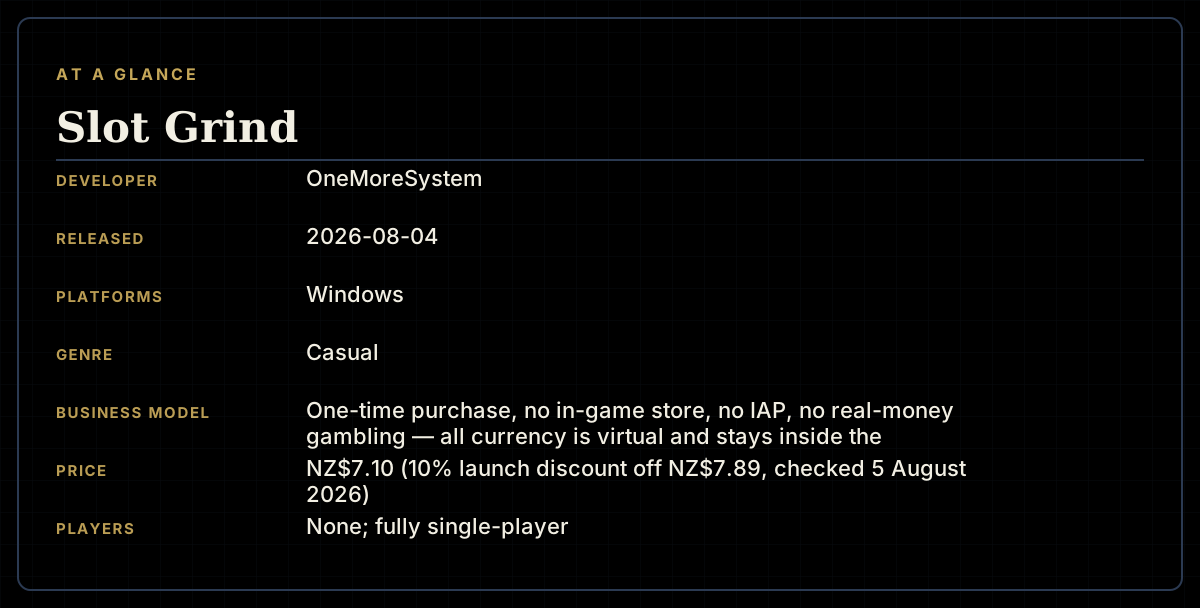
The game at a glanceWanderer Editorial -
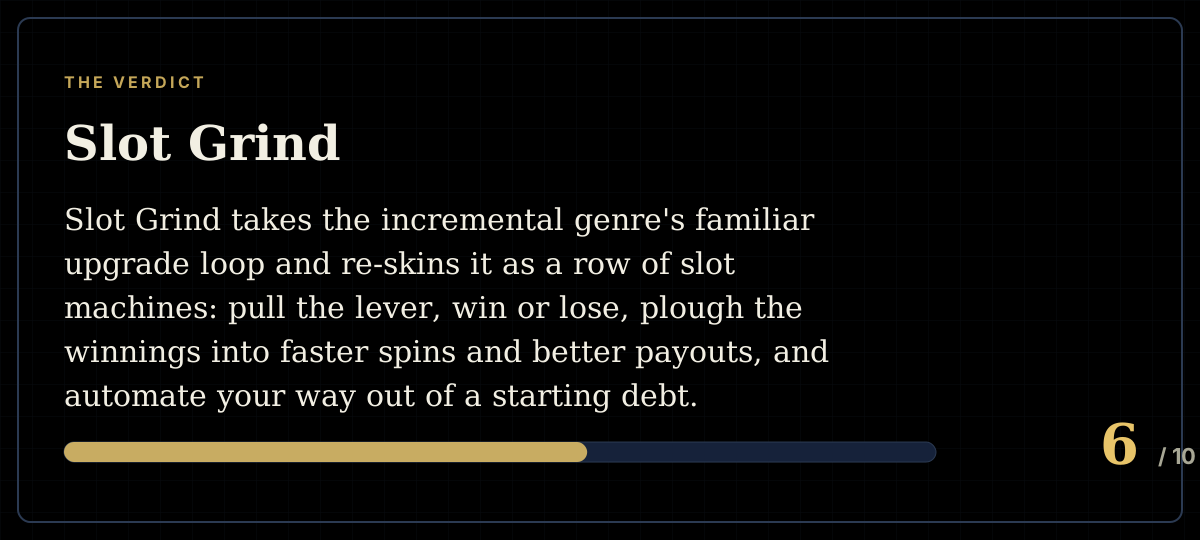
The short versionWanderer Editorial