Game review
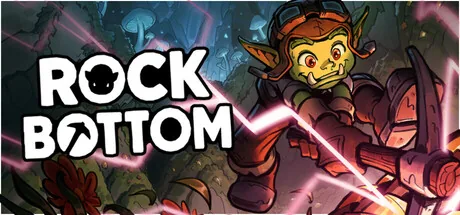
Rock Bottom
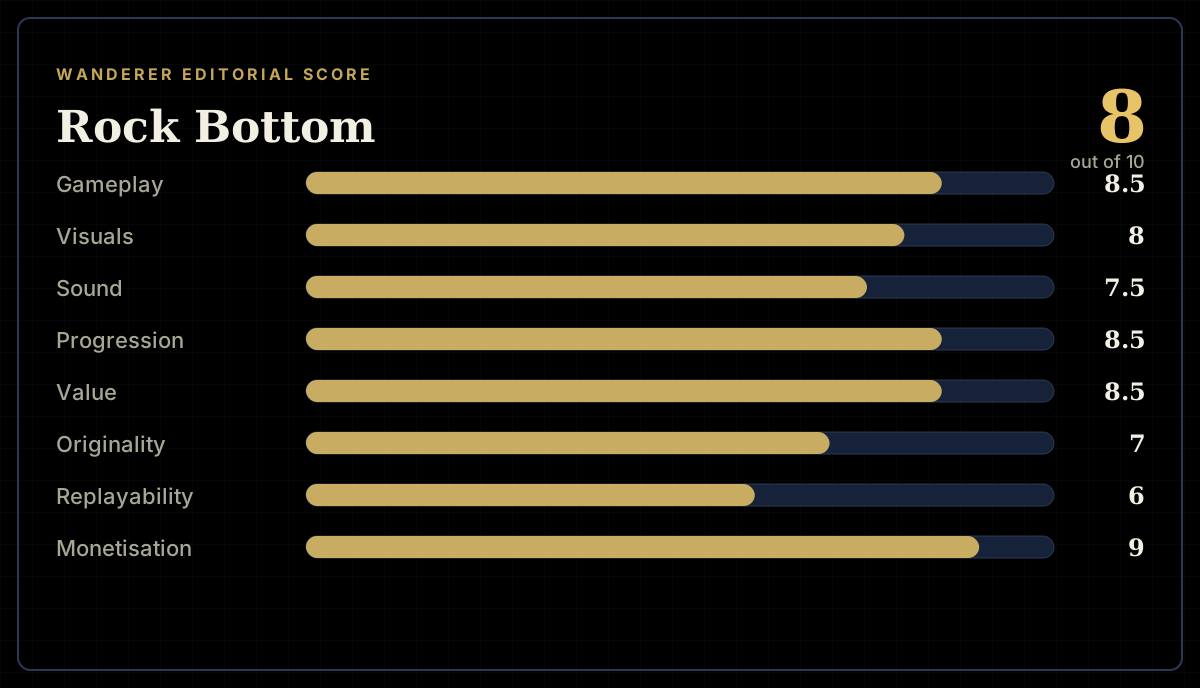
8 / 10
- Developer
- Logan Games
- Publisher
- Logan Games
- Released
- 14 July 2026
- Platforms
- Windows
- Genre
- Incremental
- Monetisation
- Premium, one-time purchase
- Players
- Single-player
The short version
Rock Bottom takes the oldest incremental fantasy there is — number goes up, digger digs faster — and builds a genuinely well-paced single-player game around it, with permanent upgrades that matter and a runtime that respects the fact that the loop can't run forever. It's short and its endgame thins out, but at eight dollars it doesn't need to apologise for either.
Biggest strengths
- Every bar spent on the skill tree produces a swing-speed or yield change you can feel within a minute, not a percentage buried in a tooltip
- Descending each of the eight layers is gated by a specific chunk-mining objective rather than simply grinding until a number is big enough, which keeps early hours from feeling like a waiting room
- A flat one-time price with no premium currency, energy timer or live-service layer of any kind
Biggest weaknesses
- A 3-5 hour completion time means the back half of the skill tree gets far less room to breathe than the front half
- The token economy that gates key unlocks like the gold pickaxe is deliberately scarce, which occasionally turns "what do I do next" into "which shop do I check"
- Once the final layer is cleared there's little pulling players back in, since the skill tree is a straight line rather than a build space with real alternate paths
Who it's for: Anyone who likes their idle mechanics wrapped around an actual game rather than a spreadsheet, and players who want a incremental with a real ending instead of an infinite number treadmill.
Our recommendation: Easy recommendation at its asking price, especially for players who want a complete, bounded incremental rather than one designed to run forever.
8 / 10
A pickaxe game that understood its own runtime
Most incremental games are built to never stop. Rock Bottom is built to end, and that single decision shapes almost everything good about it. Logan Games' debut takes the most familiar incremental premise on the market — swing something, watch a number climb, spend that number on upgrades that make the swinging faster — and instead of stretching it across a hundred prestige loops, compresses it into eight distinct underground layers with a beginning, a middle and an actual final screen. That's a much harder game to design than it looks. An incremental with no ceiling can paper over weak individual systems by simply giving them more time to matter; a four-hour incremental has to make every one of its hours count, and Rock Bottom mostly does.
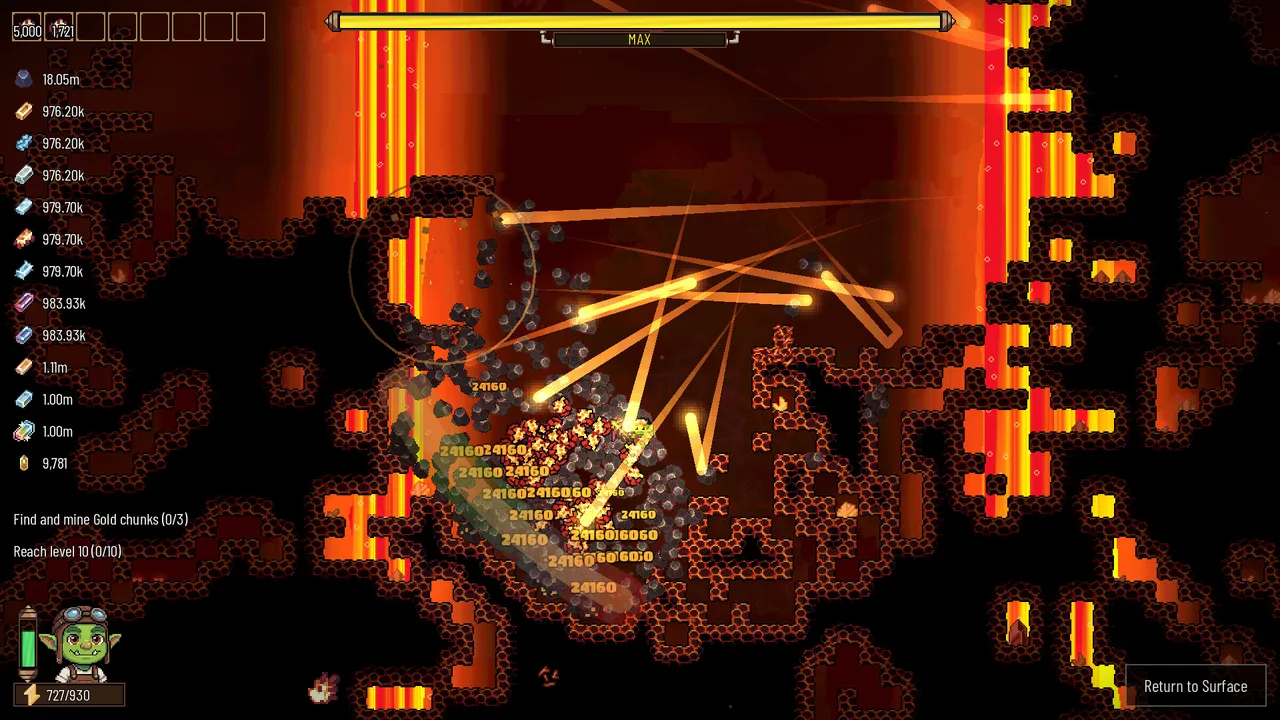
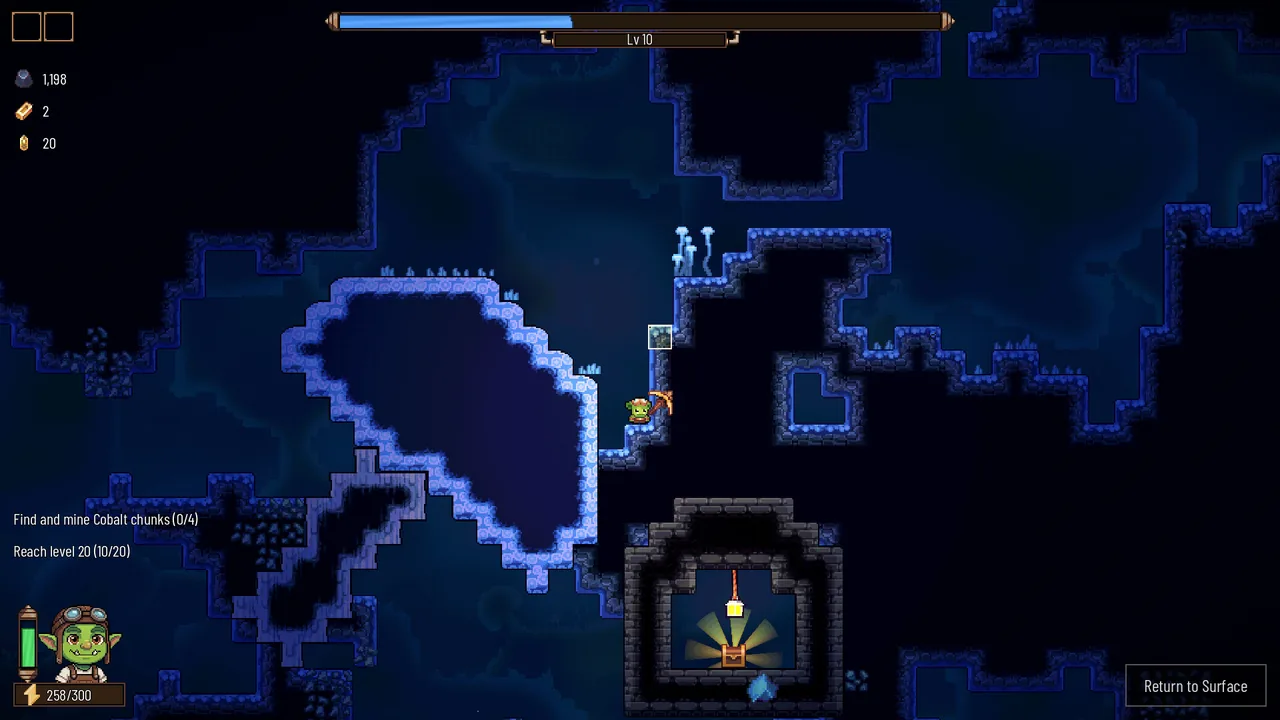
The premise is exactly as described on the tin: mine, smelt, upgrade, repeat. You swing a pickaxe through procedurally generated cave chunks, hauling out raw ore that gets smelted into bars at a furnace, and those bars fund a permanent skill tree that makes the next swing hit harder, reach further or trigger something new entirely. Descend far enough and an elevator takes you to the next layer, each one visually and mechanically distinct from the last — the flooded Wispy Waters plays nothing like the fire-lit Molten Core, and the spore-choked caverns further down gate themselves behind a gold pickaxe you have to earn first. The name of the game is also its destination: there's a specific, authored place called Rock Bottom, and reaching it is the point.
The loop, and why the gating works
What separates this from a browser clicker is the chunk-quest structure. Progression isn't "grind until the number is big enough to survive the next area" — it's "find and clear a specific set of marked chunks," which turns each layer into a small, legible objective instead of an open-ended resource sink. That single design choice does a lot of work. It means early hours have a visible finish line rather than a vague sense that you should keep clicking, and it means backtracking to an earlier, easier layer to farm a missed chunk or a hidden collectible never feels like a punishment — the game is happy to have you there.
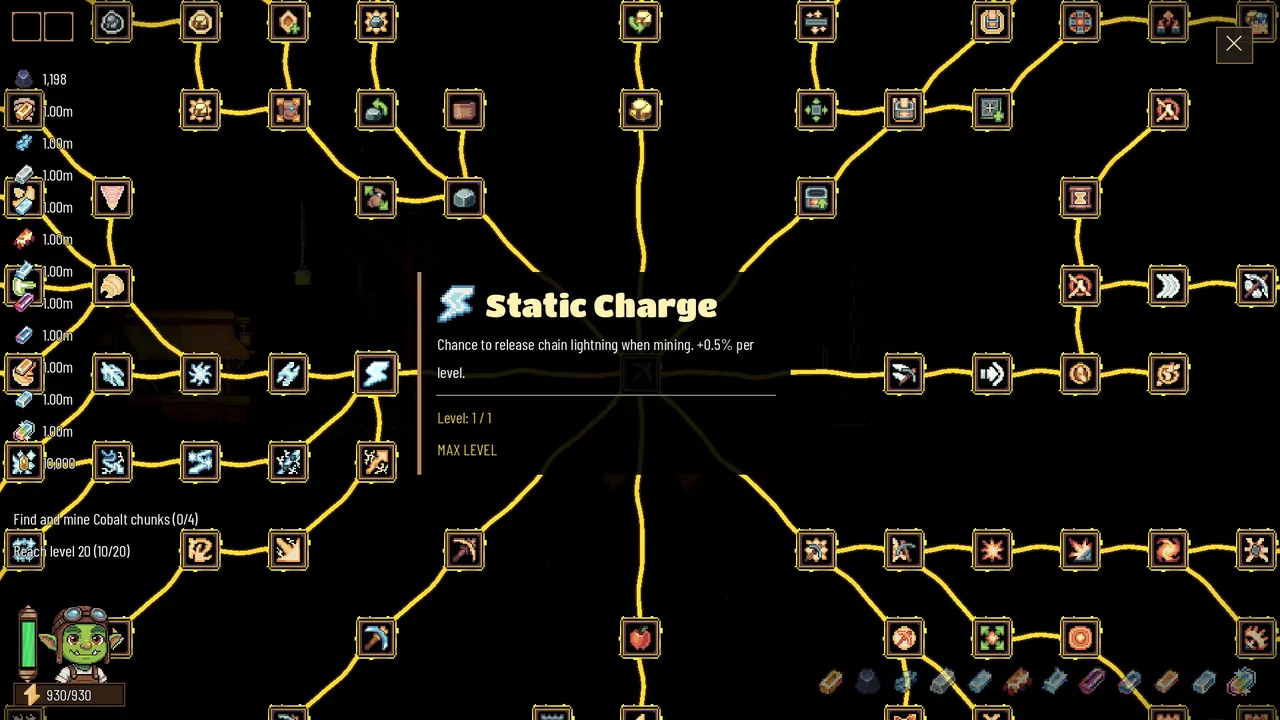
The skill tree backing all of this reportedly runs past 150 individual upgrades, and the ones that matter are the ones you notice without opening a menu: faster swings, wider mining radius, chunks that yield more ore per hit, new traversal options like a dash that a surprising number of players apparently miss for their first hour before realizing it's sitting on the Shift key. None of that is revolutionary as game design, but the execution is unusually clean — bars feel earned rather than handed out, and nothing in the tree is a dead node that exists purely to look impressive on a progress bar.
Sitting alongside the bar economy is a second, deliberately scarce currency — tokens, spent at a separate altar rather than the main upgrade tree. Tokens gate the things that actually reshape how you play, like the gold pickaxe required to enter one of the later layers, and the game wants you thinking carefully about each one rather than stockpiling. It's a smart way to create decision points in a genre that usually only offers "spend now versus spend later," though it does mean the early game occasionally turns into figuring out which of two shops your limited tokens should go toward rather than which layer to mine next. That's a minor friction point, not a structural one.
Presentation and pacing
The pixel art carries more of the load here than it would in a longer game, because with only eight biomes to work with, each one needs to read instantly and stay visually interesting for the hour or so you'll spend in it. It mostly clears that bar — the palette shifts hard enough between layers that screenshots alone tell you which one you're looking at, and the underground environments avoid the muddy sameness that sinks a lot of mining-themed pixel art. The soundtrack stays out of the way in the way good incremental-game music should: unobtrusive during long sessions, present enough that the silence would be noticeable if it dropped out.
Length is the one place where the "bounded runtime" design philosophy has a real cost. Most players are clearing the full eight-layer descent in three to five hours, and while that's an honest, appropriately-priced amount of content for eight dollars, it also means the second half of the skill tree gets meaningfully less room than the first. Upgrades that would land as satisfying mid-game power spikes in a longer game arrive close enough together in the back half that some of them barely get used before the credits roll. It's a pacing issue born directly from the same choice that makes the game's opening hours so tight — Rock Bottom would need a longer tail to fix it, and a longer tail would undercut the exact thing that makes it work as well as it does early on.
Monetisation and value
There isn't much to analyse here, which is itself the point worth making. One purchase, no premium currency, no energy system rationing your sessions, no cosmetic shop, no live-service layer sitting on top of the core loop waiting to be monetised later. For a genre that has been steadily colonised by mobile-style engagement mechanics even on desktop storefronts, a flat $7.99 with nothing else attached is worth calling out directly. Whatever criticisms apply to the game's length or endgame depth, nobody is being asked to pay twice for either.
Final verdict
Rock Bottom succeeds at something a lot of incremental games don't even attempt: it tells a complete story with its progression system instead of leaving the number-go-up loop running indefinitely and hoping players stick around out of habit. The chunk-gated descent through eight layers gives early hours real direction, the skill tree makes every upgrade legible, and the whole thing is priced and packaged honestly. It loses ground in the back half, where a shorter runtime compresses upgrades that deserved more room, and once Rock Bottom itself is reached there's little reason to keep digging — the tree is a line, not a set of branching builds worth replaying for. Players looking for a tight, well-made incremental they can actually finish in an evening or two should have no hesitation here; players hoping for a forever-game with deep replayability should look elsewhere in the genre.
Players who like the permanent-upgrade feel of a game like this but want the loop to keep running indefinitely rather than end after a few hours may also want to look at Wanderer, which builds its own progression around gathering and gear that never stops climbing.
Pros and cons
Pros
- Every bar spent on the skill tree produces a swing-speed or yield change you can feel within a minute, not a percentage buried in a tooltip
- Descending each of the eight layers is gated by a specific chunk-mining objective rather than simply grinding until a number is big enough, which keeps early hours from feeling like a waiting room
- A flat one-time price with no premium currency, energy timer or live-service layer of any kind
- Pixel-art biomes are distinct enough from each other that "which layer am I in" is answered by the screen, not a menu
Cons
- A 3-5 hour completion time means the back half of the skill tree gets far less room to breathe than the front half
- The token economy that gates key unlocks like the gold pickaxe is deliberately scarce, which occasionally turns "what do I do next" into "which shop do I check"
- Once the final layer is cleared there's little pulling players back in, since the skill tree is a straight line rather than a build space with real alternate paths
- A handful of the demo's minor rough edges, including some underwater collision quirks, carried through into the full release
Screenshots
-
Rock BottomImage: Logan Games via Steam -
Rock BottomImage: Logan Games via Steam -
Rock BottomImage: Logan Games via Steam -
How the review scores each part of the gameWanderer Editorial -
The short versionWanderer Editorial