
Game review
Ritual of Raven
5.4 / 10
- Developer
- Spellgarden Games
- Publisher
- Team17
- Released
- 7 August 2025
- Platforms
- Windows
- Genre
- Farming Sim / Automation
- Monetisation
- Premium
- Players
- Single-player only
The short version
Ritual of Raven takes a genuinely clever premise — programming magical constructs to garden and mine on your behalf — and wraps it in a warm, inclusive fantasy story that plenty of players fall hard for. But the game's own systems keep tripping it up: an unbrowsable spellbook, unrenamable fields and chests, a card-automation language missing basic logic tools, and a save system that punishes you for stepping away mid-day all add friction that has nothing to do with difficulty and everything to do with unfinished quality-of-life design.
Biggest strengths
- A genuinely novel hook — programming golem-like "constructs" via card sequences to automate farming and mining
- Warm, inclusive writing with well-liked non-binary and queer characters, handled without being the game's whole selling point
- Responsive developer support, including a fast patch for a softlock bug reported by players
Biggest weaknesses
- Fields, chests, and storage can't be renamed or reliably reorganised, turning inventory management into guesswork
- The in-game Book of Shadows has no search or bookmarking, forcing long manual click-throughs to check hybrid plant recipes
- The automation card language lacks basic tools like else-branches, while-loops, or multi-card copy-paste
Who it's for: Cozy-game fans who enjoy light automation puzzles and don't mind digging through clunky menus for a charming story and inclusive cast
Our recommendation: Conditional Recommend
5.4 / 10
Farming Without Getting Your Hands Dirty
Ritual of Raven's pitch sounds simple until you actually see it in motion: you're pulled into a magical world where portals are destabilising a village, and instead of grabbing a watering can yourself, you recruit small golem-like Arcana Constructs and "program" them to do the farming for you. That programming takes the form of card sequences — plant, water, harvest, loop, check-condition — snapped together into little automated routines that keep running while you go off and do something else. It's a farming sim built around the idea of automating the farming, and reviewers consistently single this out as the game's best idea: a gentle, visual introduction to sequencing and loops that never once asks you to write actual code, yet still scratches the same itch that automation-heavy games like factory builders do.
The wrapper around that mechanic is a light fantasy story about stabilising portals, learning witchcraft from a mentor who doesn't stick around, and befriending a village full of "humanoid animals" (several reviewers are quick to clarify this isn't the kind of game that implies) with distinct, likeable personalities. It's not a heavy narrative — there's no combat and no romance system — but it consistently reads as sincere rather than filler, and its cast includes well-received non-binary and queer characters woven into the world without ever feeling like a marketing checkbox.
Cards, Loops, and Constructs
Once you've got a few constructs assigned to fields, the loop of designing, testing, and refining automation sequences becomes the game's real backbone, and it scales reasonably well for newcomers. Early cards are simple — plant, harvest, water — and more advanced tools unlock over time, including the ability to loop a sequence indefinitely or check a plant's growth status before acting on it. Multiple reviewers who came in intimidated by "automation genre" games specifically call out how approachable Spellgarden Games made this version of the idea, breaking programming logic down into card shapes you can test in small pieces rather than committing to a whole system at once.
Where the automation systems stumble is in their missing pieces. One detailed critical review lists the specific gaps: no else-branch for conditional cards, no while-do loop, no way to copy a symbol between cells, and no multi-select for grabbing several cards at once — meaning even simple, repetitive sequences have to be rebuilt largely by hand. Templates exist for saving a sequence you like, but you can't overwrite one directly; you have to delete the old version and save a new one, which gets old fast if you're iterating on a design. For a mechanic that's meant to save you repetitive labour, the tooling for building that automation is itself repetitive in a way that undercuts the whole appeal.
A Garden That Refuses to Behave
Beyond the card system, Ritual of Raven's biggest recurring criticism is how badly its own menus and storage systems get in the way of a game that's fundamentally about careful organisation. Fields and chests are auto-numbered based on the order you place them rather than anything you control, and you can't rename them — so a player trying to organise storage by plant type quickly ends up with chests labelled "1," "7," "9," and "B" in no useful order. Inventory has no auto-sort, manual sorting is slow, and chest capacity can't be upgraded, which several reviewers describe as a genuine bottleneck in a game all about gathering and organising resources.
The Book of Shadows — the game's in-fiction recipe book for figuring out which two plants combine into a hybrid you need — comes in for similar criticism. There's no search function, no bookmarking, and no way to click through from one plant's page directly to the ingredients it requires; one reviewer counted 25 clicks just to reach a single plant's entry while working through a multi-step quest chain. Combined with hybrid recipes that are, by design, nonsensical rather than intuitive (a specific herb from two seemingly unrelated ingredients, with no way to guess the pairing), the loop of "figure out what I need, then find it in the book" becomes one of the most consistently cited sources of fatigue in longer reviews, even from players who otherwise recommend the game.
Saving, Sprinting, and Smaller Frustrations
A handful of smaller design choices compound the friction. You can only save by ending the in-game day — there's no mid-session save-and-quit — which multiple reviewers flag as an odd, seemingly arbitrary restriction given that rolling the clock forward carries no real gameplay cost anyway. One review also notes the game blocks certain movement-speed mods outright despite being entirely single-player, which reads to some players as an unusual and unexplained choice for a cozy, non-competitive game. None of these are individually damning, but they stack up as the kind of avoidable friction that a patch or two could meaningfully fix.
On the positive side of technical support, Spellgarden Games earns real goodwill in the sample for responsiveness — one reviewer who hit a softlock bug reports the developers fixing and patching it quickly, and general performance (including on Steam Deck) is described as smooth across multiple reviews.
Worth the Portal Trip?
At NZ$25 for a game that regularly takes reviewers 30 to 80-plus hours to fully complete, Ritual of Raven's core content offering is generous, and its central hook — automation-as-farming, wrapped in a warm fantasy story — really is something reviewers struggle to find elsewhere. The recurring theme across the sample, though, is a game whose ideas consistently outpace its execution: automation systems with obvious missing tools, an information system (the Book of Shadows) that actively works against the density of information the game demands from it, and small, avoidable frustrations around saving and storage that have nothing to do with challenge and everything to do with unfinished polish. Players willing to treat those as charming rough edges rather than dealbreakers tend to come away recommending it warmly; players who lean organised or easily frustrated by clunky menus are more likely to bounce off before the automation systems get a chance to shine.
Pros and cons
Pros
- A genuinely novel hook — programming golem-like "constructs" via card sequences to automate farming and mining
- Warm, inclusive writing with well-liked non-binary and queer characters, handled without being the game's whole selling point
- Responsive developer support, including a fast patch for a softlock bug reported by players
- Plenty of content for the price, with multiple reviewers logging 30-80+ hours to full completion
Cons
- Fields, chests, and storage can't be renamed or reliably reorganised, turning inventory management into guesswork
- The in-game Book of Shadows has no search or bookmarking, forcing long manual click-throughs to check hybrid plant recipes
- The automation card language lacks basic tools like else-branches, while-loops, or multi-card copy-paste
- Saving is locked to the end of each in-game day, with no way to save and quit mid-session
Screenshots
-
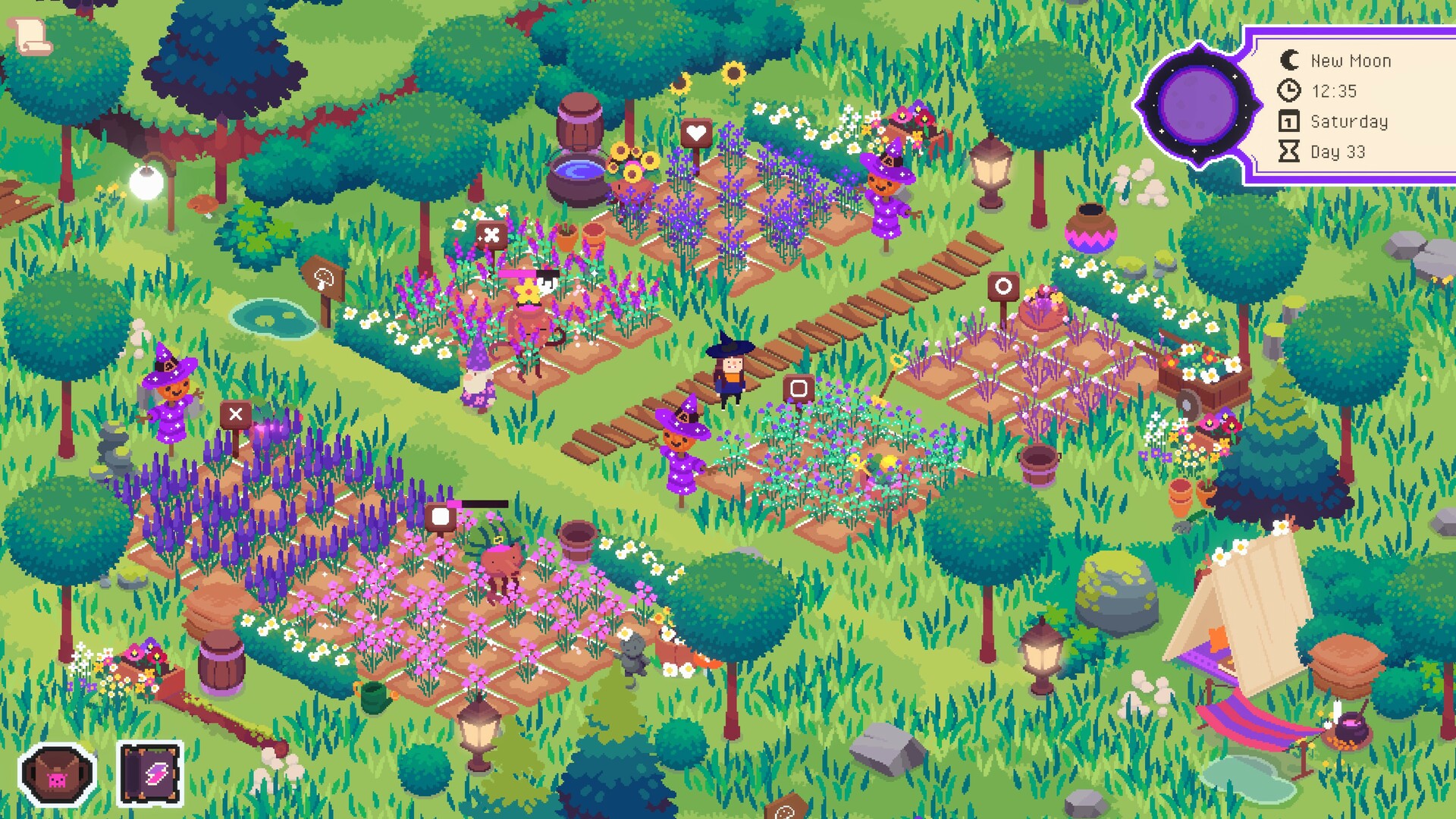
The main farming space, where automated Arcana Constructs tend rows of plants players still have to plan and organise by handTeam17 -
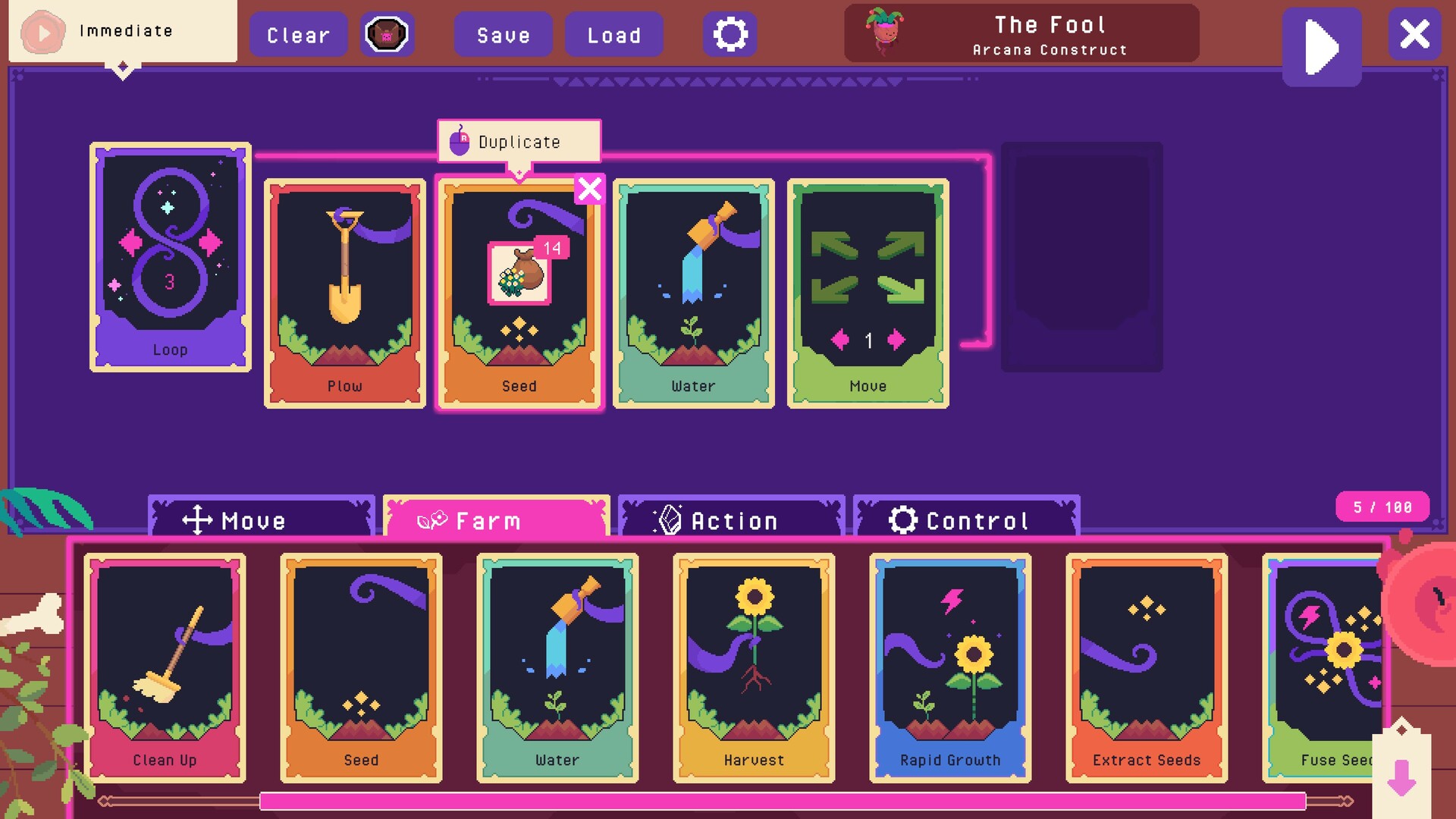
The card-based automation system players consistently single out as Ritual of Raven's best idea, and its most feature-starvedTeam17 -
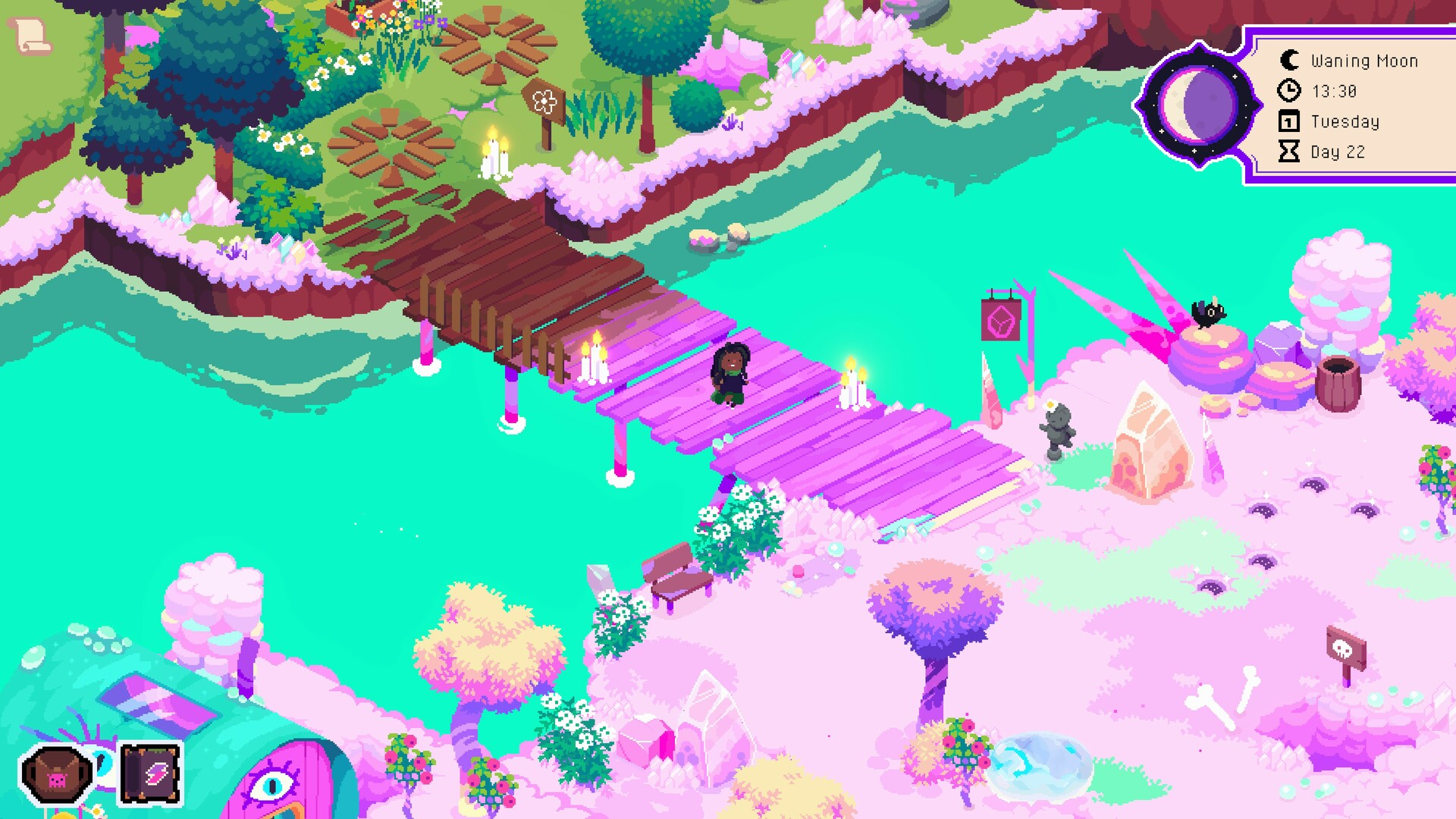
One of the game's several distinct biomes, reached as the portal-stabilising story progressesTeam17 -
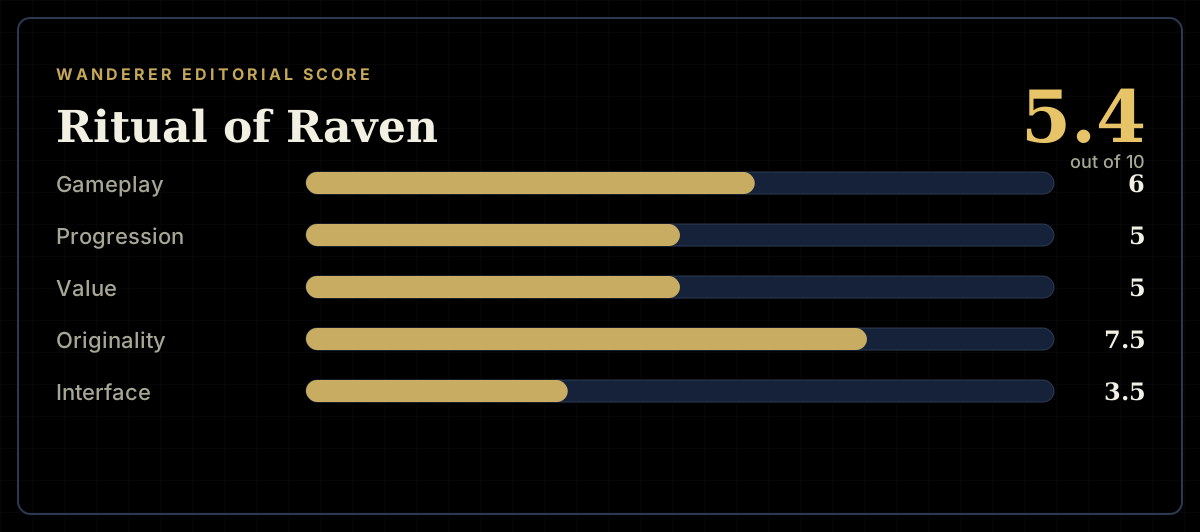
How the review scores each part of the gameWanderer Editorial -
The short versionWanderer Editorial