
Game review
Rhythm Witch: Beat Death
6 / 10
- Developer
- Dusklight CO., LTD.
- Publisher
- Dusklight CO., LTD., 2P Games
- Released
- 8 May 2025
- Platforms
- Windows
- Genre
- Action, Indie
- Players
- Single-player
The short version
Biggest strengths
- A genuinely fresh mechanical hook within an increasingly crowded genre, replacing the usual auto-attack of survivors-likes with beat-timed manual attacks reminiscent of Crypt of the Necrodancer
- Charming, well-liked pixel art and character designs that reviewers consistently single out as the game's clearest strength
- A cheap, non-grindy structure that several reviewers specifically praise for respecting players' time relative to other genre entries
Biggest weaknesses
- Repetitive beat patterns across different maps and stages, with at least one detailed reviewer noting the underlying rhythm doesn't always feel properly aligned to the on-screen visual cues
- Sluggish, specifically criticized vertical movement, and no dash ability, forcing unavoidable damage against certain same-speed enemies
- Progression depth runs thin in the mid-to-late game once weapons are maxed out, leaving only straightforward stat-stacking to chase
6 / 10
Attacking on the beat, in an increasingly crowded genre
Rhythm Witch: Beat Death sets out to add a genuinely distinct hook to the now-saturated survivors-like genre: rather than auto-attacking while dodging swarms, players must tap an action key precisely to the beat of the music to land hits, while monsters move and attack in their own beat-synced patterns. Based on the available English-language review sample of 49 reviews — 44 positive, 5 negative, landing at an overall Positive rating — that specific fusion draws consistent, favourable comparisons to a well-loved genre touchstone. "A cute game that can best be described as Crypt of the Necro-dancer mixed with vampire survivors. As you move around the arena you must press an action key to the beat of the metronome. If you like rhythm games as well as survivors type games, this game brings an interesting change to the genre with the rhythm mechanics," one reviewer writes, capturing the pitch precisely.
The character art draws particularly consistent, specific praise across nearly the entire review sample. "It's a super addictive mix of a survivor and rhythm game, especially in Frenzy mode. I love the aesthetic and soundtrack!" one reviewer writes, while a separate reviewer frames the visual appeal as the primary draw: "A unique take in a genre of vampire survivors-like games where instead of auto-attacking, your attack is based on the tap you do with the rhythm of the music. The mechanics are quite simple with 6 different characters to play which has their own playstyles and a meta-progression element for those who are struggling."
A hook that doesn't always land its own timing
Set against that praise, the most substantive criticism concerns whether the rhythm mechanic itself is executed consistently enough to fully deliver on its premise. "Core roguelike mechanics exist, nothing shiny and fancy. Therefore the only commenting point is the 'rhythm game' gimmick. The songs are... mediocre? The beats you tap to are largely identical across maps. Some of the beats doesn't even feel aligning," the most detailed negative review states, raising a genuinely important structural concern for a game whose entire identity depends on that beat-matching feeling precise and satisfying. The same reviewer identifies a separate, specific movement complaint: sluggish vertical traversal that makes navigating the arena feel needlessly restrictive compared to the genre's usual free movement.
A separate reviewer echoes the movement concern with a concrete suggestion: "You max weapons pretty quickly then it's just stacking stats. A dash button would be nice as some mobs/bosses move same speed as you so you're forced to get some speed upgrades" just to avoid otherwise unavoidable damage — a specific design gap rather than a vague difficulty complaint. That same reviewer's broader assessment is worth including for its balance: despite these specific criticisms, they still describe the roughly five-dollar purchase as "very worth" it, with polished presentation and no complaints about the tracks encountered so far.
Art carrying the game past a rough interface
A recurring, more cosmetic complaint concerns the game's user interface specifically, standing in stark contrast to how consistently the character art is praised. "I enjoy play this game, I love the character design so muchhh, and the art style is so coolll but I hate the UI looks, is looks like android free game or free UI assets... too bad for game with awesome design character and artstyle but with ugly UI and free asset," one reviewer writes, a complaint echoed by a separate, more disappointed reviewer who was specifically drawn in by the character designs: "The art style of the game is really cute! I was drawn into getting Rhythm Witch: Beat Death because I really liked the character's designs... Unfortunately, the game itself is lacking. I was truly looking forward to playing this but I was incredibly bored after a few minutes." That specific pattern — art quality significantly outpacing interface and long-term mechanical depth — recurs often enough to be treated as a genuine, consistent gap between the game's presentation and its underlying systems.
A specific, investigated question about the soundtrack's origins
One especially notable review raises a specific concern about music attribution worth reporting carefully and attributively. The reviewer describes reverse-engineering the game's files, extracting the music tracks directly, and running them through music-recognition tools, concluding that most of the soundtrack was actually composed by an outside artist credited elsewhere as PYKAMIA, casting doubt on how the game's own presentation frames the music's originality. This is a specific, methodologically-described investigation from a single reviewer rather than something this review can independently re-verify, but the level of concrete detail involved — extracting files and running them through recognition software, rather than simply asserting suspicion — makes it a meaningfully more substantiated claim than an ordinary unverified accusation, and it's included here on that basis while still being flagged as this one reviewer's account rather than an established fact.
The achievement data is consistent with reviewer reports of a quick, accessible full-completion experience: across 21 total achievements, the spread runs from 73.8% at the top down to 12.6% for the hardest goal, a moderate range that supports several reviewers' descriptions of an easy, low-friction path to 100% completion for anyone motivated to pursue it.
Where this leaves it
Rhythm Witch: Beat Death brings a genuinely distinctive mechanical idea to a crowded genre, backed by consistently well-liked character art and an addictive Frenzy mode, but its execution shows real gaps: repetitive and occasionally poorly-aligned beat patterns, sluggish movement without a dash option, thin mid-game progression, and a generic-feeling interface that undercuts the strength of its visual design. A specific, carefully-investigated concern about music attribution adds a further, worth-noting question mark. Worth a look at its low price for fans of rhythm-action hybrids willing to accept a short, mechanically simple experience over one with deep long-term progression; a middling pick for anyone expecting the rhythm mechanic itself to feel as polished as the genre's best dedicated entries.
Pros and cons
Pros
- A genuinely fresh mechanical hook within an increasingly crowded genre, replacing the usual auto-attack of survivors-likes with beat-timed manual attacks reminiscent of Crypt of the Necrodancer
- Charming, well-liked pixel art and character designs that reviewers consistently single out as the game's clearest strength
- A cheap, non-grindy structure that several reviewers specifically praise for respecting players' time relative to other genre entries
- An addictive, well-received Frenzy mode and multiple distinct playable characters with genuinely different playstyles
Cons
- Repetitive beat patterns across different maps and stages, with at least one detailed reviewer noting the underlying rhythm doesn't always feel properly aligned to the on-screen visual cues
- Sluggish, specifically criticized vertical movement, and no dash ability, forcing unavoidable damage against certain same-speed enemies
- Progression depth runs thin in the mid-to-late game once weapons are maxed out, leaving only straightforward stat-stacking to chase
- A UI widely described as generic or "free-asset" in appearance, a specific and jarring contrast against the strength of the character art and animation
- One detailed reviewer reports reverse-engineering the game's audio files and finding that most of the soundtrack was composed by an outside artist rather than being original to the credited team, a specific, investigated but not independently re-confirmed transparency concern
Screenshots
-

Rhythm Witch: Beat DeathImage: Dusklight CO., LTD. via Steam -

Rhythm Witch: Beat DeathImage: Dusklight CO., LTD. via Steam -

Rhythm Witch: Beat DeathImage: Dusklight CO., LTD. via Steam -
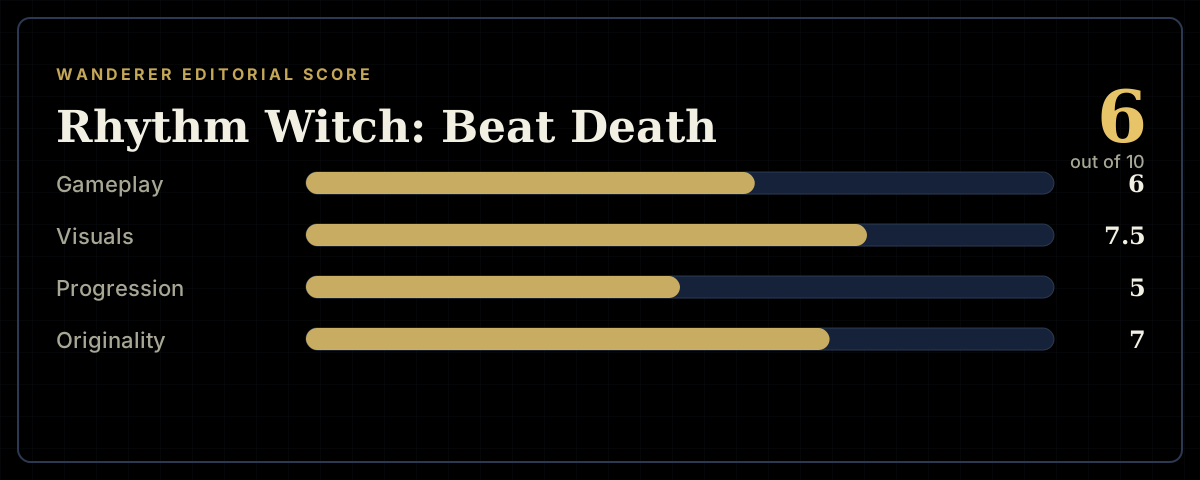
How the review scores each part of the gameWanderer Editorial -
The short versionWanderer Editorial