
Game review
Pulse://Void Review
6.5 / 10
- Developer
- Gamesforgames
- Publisher
- Gamesforgames
- Released
- 4 September 2026
- Platforms
- ["Windows"]
- Genre
- Action
A Neon Arena That Grows Teeth As You Survive
Pulse://Void is a synthwave-soaked entry in the bullet-heaven genre popularized by Vampire Survivors: you pilot a small ship (or, in one reviewer's more literal description, "a ball") through a living arena that expands, shifts biomes, and floods with enemies as the run drags on. Released September 4, 2026 for $9.99, it asks players to collect experience orbs, draft one of three random upgrades on each level-up, and chain weapon evolutions, passives, and stat boosts into a build capable of surviving increasingly overwhelming hordes. A daily challenge mode lets players compete against each other on a shared seed, giving the format a light competitive hook beyond the core survive-as-long-as-possible loop.
The pitch is not subtly original — the short description itself invites the comparison by leaning into "ride the synthwave pulse until the network cuts you out" framing — but the execution leans hard into a specific neon-arcade identity that separates it from the crowded field of Vampire Survivors clones currently flooding Steam's new-release lists.
A Small but Perfect Review Pool Built on Genre Comfort Food
Pulse://Void has accumulated 10 total Steam reviews, all of them positive, for a 100 percent rating; the English-language sample of 9 mirrors that record exactly. Reviewers consistently frame it in direct comparison to established genre touchstones rather than describing it as a wholly new experience. "A game in the Vampire Survivors genre. We control a ball, rolling around the arena and shooting at other opponents," one reviewer wrote, describing the loop plainly and favorably. Another was more effusive, calling it a "nice small fast-paced roguelike shooter that takes the addictive 'one more run' formula and wraps it in a vibrant, pulsing synthwave aesthetic," specifically praising the constantly shifting, biome-mutating arena design.
Not every review is glowing, though, and the pool is small enough that the one lukewarm voice carries real weight. "It's a so-so game. Boring. I got it in a bundle with another game for very cheap. So, I'm not offended," one reviewer wrote — still voting positive, but framing the purchase as acceptable filler rather than a genre highlight, which is a useful counterweight to the more enthusiastic praise sitting alongside it.
The Aesthetic and Upgrade Loop Are the Real Draw
Where Pulse://Void distinguishes itself from its many genre siblings is presentation. Multiple reviewers independently praised the "vibrant neon visuals" and "powerful synthwave soundtrack," and several specifically called out how the pulsing music is tied directly to the arena's own visual rhythm, giving runs a sense of audiovisual cohesion that's easy to promise in a bullet-heaven pitch and harder to actually deliver. The build-crafting itself draws steady praise too: drafting between new weapons, upgraded versions of existing ones, and passive stat boosters gives runs enough branching variety that reviewers describe genuine run-to-run differentiation, with unlockable pilots and a "wide variety of weapons, power-ups, and both passive and active skills" cited as reasons to keep coming back. The achievement list is reportedly straightforward to chip away at for genre newcomers, giving the game an accessible on-ramp even for players who bounce off harder roguelikes.
The living-arena concept — biomes that shift and mutate as a run progresses rather than a single static battlefield — is the single mechanical idea reviewers return to most often as evidence the game isn't a pure reskin, and it's the strongest argument in the game's favor: a bullet heaven where the environment itself escalates alongside the enemy waves, rather than just throwing more enemies at a fixed arena.
A Serious Performance Complaint Lurks Beneath the Neon
The most concerning piece of feedback in the pool is also the most specific and technical. "Achievements are easy to collect, but not all of them, because starting from the 10th–11th minute of the run, the FPS drops to almost zero even at the lowest graphics settings," one reviewer reported — a genuinely alarming claim for a game whose entire loop is built around runs that are explicitly designed to get longer and more chaotic the further a player survives. If accurate and not isolated to one specific hardware configuration, this would undercut the core "one more run" appeal at exactly the moment runs are supposed to become most exciting, turning the climax of a successful run into a slideshow rather than a payoff. With only nine English-language reviews to draw from, it's impossible to say from this pool alone how widespread the issue is, but its specificity — a precise time window, a claim that it persists even at minimum settings — makes it a red flag worth taking seriously rather than dismissing as one player's outlier hardware problem.
Verdict
Pulse://Void is comfort food for bullet-heaven fans: a familiar, well-executed loop of orb-collecting, card-drafting, and horde-surviving, dressed up in a synthwave neon aesthetic and a living arena concept that's genuinely more distinctive than most of its genre-mates. Its small review pool is perfect on paper, and the qualitative praise backs that up — reviewers consistently single out the music-and-visuals cohesion and the shifting-biome arena as real reasons to pick this over other similarly-priced genre entries. But a specific, credible report of a severe late-run FPS collapse, paired with at least one reviewer who found the whole experience merely "boring" despite recommending it, means this isn't an unqualified win. At $9.99 it's a reasonable ask for genre fans chasing the specific neon-arcade flavor on offer, but anyone sensitive to performance issues in long sessions should watch for further reports before diving into extended runs.
Screenshots
-

The arena fills with glowing hexagon and ring enemies as cyan pickups accumulate across the neon grid floor.Image: Gamesforgames via Steam -

A sustained beam weapon lances across the arena toward a cluster of small drone-like enemies.Image: Gamesforgames via Steam -
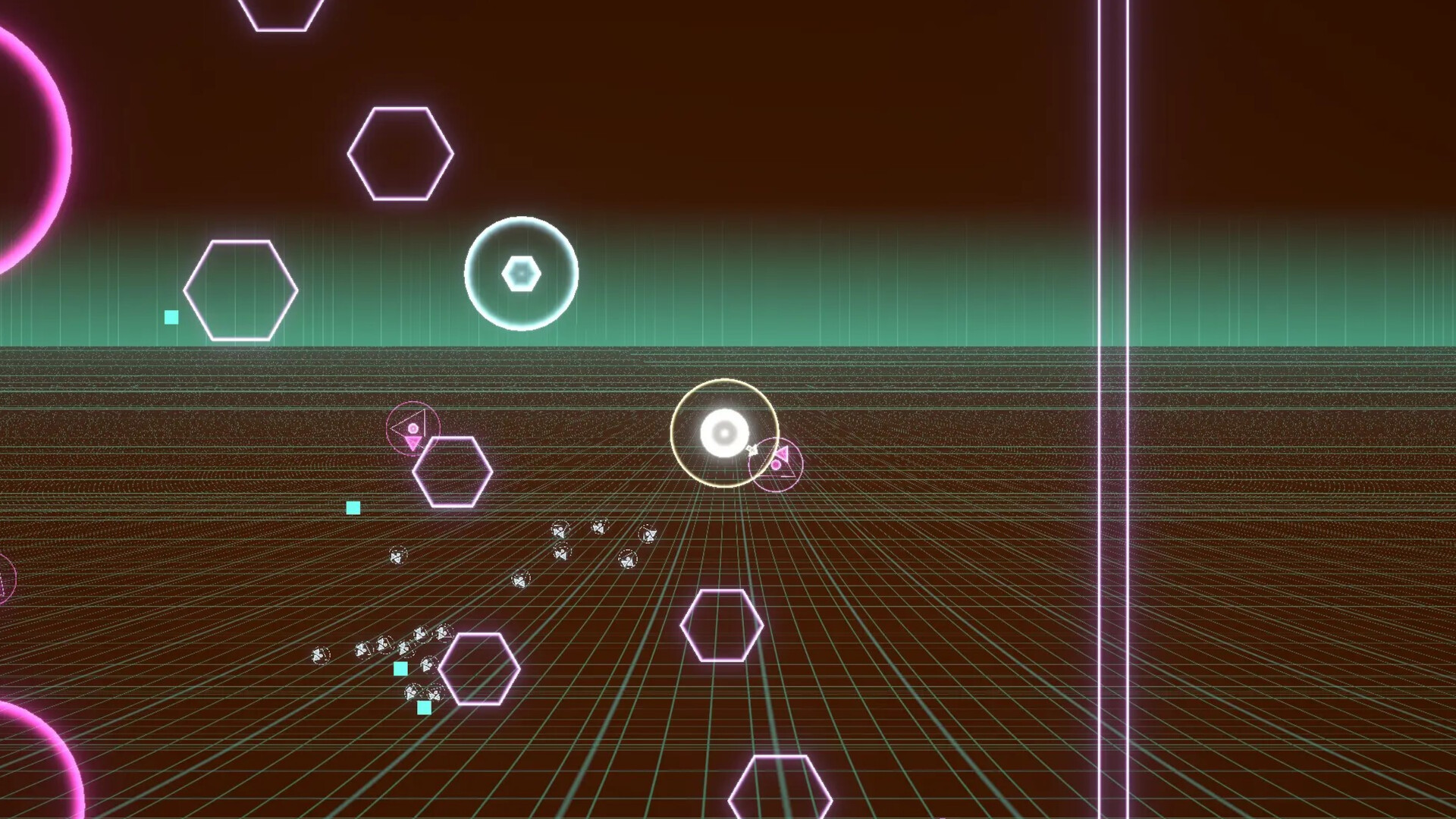
A later, greener biome shift shows orbiting triangle enemies and a bright ringed marker amid scattered hexagons.Image: Gamesforgames via Steam