
Game review
Psyvariar 3
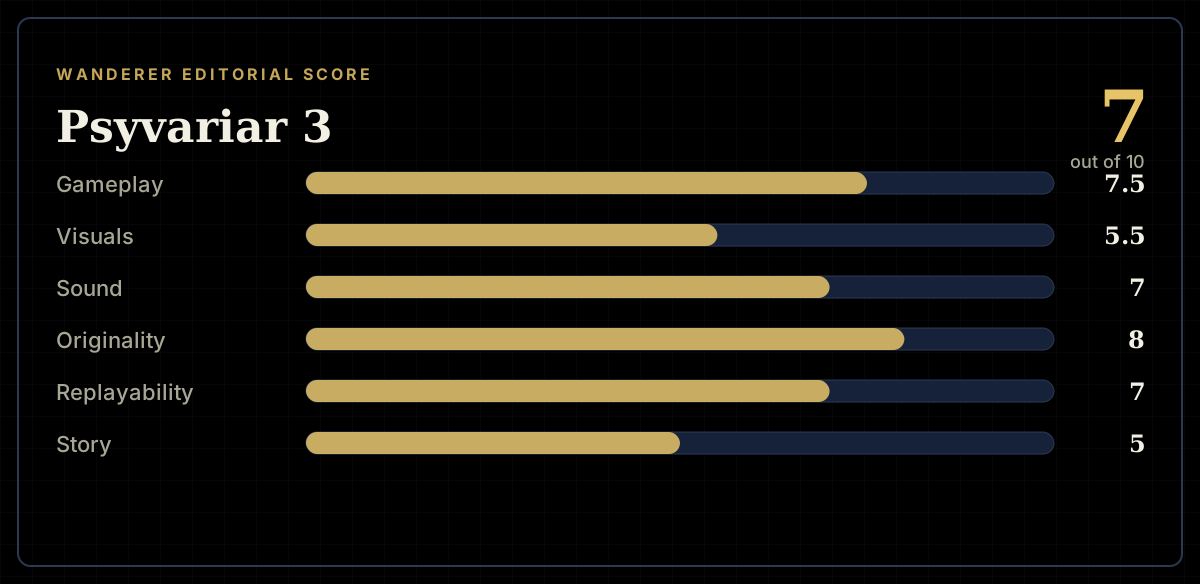
7 / 10
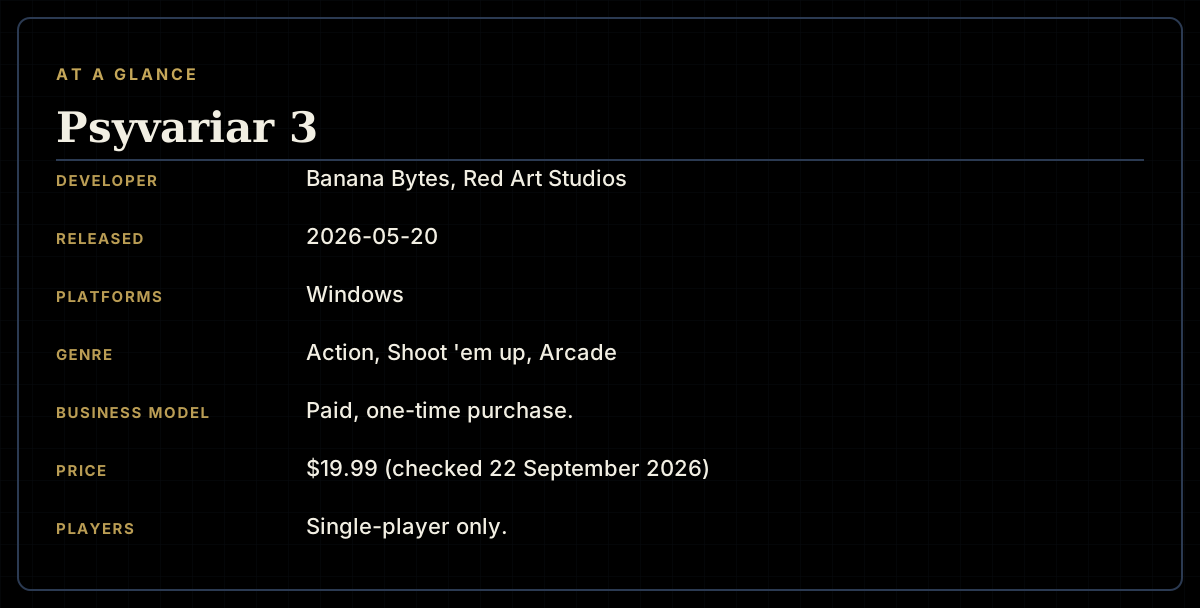
- Developer
- Banana Bytes, Red Art Studios
- Publisher
- Red Art Games, SUCCESS Corp.
- Released
- 20 May 2026
- Platforms
- Windows
- Genre
- Action, Shoot 'em up, Arcade
- Monetisation
- Paid, one-time purchase.
- Players
- Single-player only.
The short version
Psyvariar 3 is a niche grazing-focused vertical shoot-'em-up sequel that asks players to fly as close to enemy bullets as possible rather than avoid them entirely, offering seven distinct pilots and a reworked shield-chain scoring system. Its Mostly Positive review sample credits the game's innovative, risk-rewarding core mechanic and character variety, tempered by fair complaints about sparse visuals and reported Steam Deck performance issues.
Biggest strengths
- Praised for its innovative grazing/buzz mechanic, with one reviewer explaining the core loop rewards players who fly as close as possible to danger, calling the game "first-and-foremost a bullet grazing STG."
- Praised for its character and ship variety, with one reviewer noting "there are many pilots and ships to choose from this time, each with different weapons and traits," and rating it "8.5/10."
- Praised for continuing to improve post-launch, with one reviewer writing the game "started out a bit rough but it now feels pretty good and fun after the recent updates."
Biggest weaknesses
- A fair, corroborated complaint concerns sparse visuals, with one reviewer describing them as "quite simple (the backgrounds feel empty, the ships are really ugly, the bosses don't really react to your shots)," a critique echoed independently by a reviewer who found hitboxes hard to judge amid "almost impossible to see what you are doing."
- A fair complaint concerns Steam Deck performance, with one reviewer reporting "constant stutters and frame drops, which made the game very frustrating to try to play," ultimately refunding the PC version and switching to console.
- A fair complaint concerns hitbox feel for newcomers to the series, with one reviewer writing it "felt like it was way too easy to oversteer into bullets and my hitbox felt ginormous," despite otherwise praising the "great graphics and sound."
Who it's for: Shoot-'em-up veterans and fans of the Psyvariar series looking for an unconventional, risk-driven scoring system to master; players wanting flashy visuals or a beginner-friendly bullet-hell should look elsewhere.
Our recommendation: A niche but rewarding grazing shmup with a genuinely inventive core mechanic, best played on PC away from Steam Deck for now.
7 / 10
A Niche Within a Niche
Shoot-'em-ups are already a niche genre by modern AAA standards, but the Psyvariar series occupies a niche within that niche. Since the original Psyvariar Medium Unit hit Japanese arcades in 2000 before making its way to PlayStation 2, the series has built a small but devoted following around a mechanic that inverts the genre's core instinct: instead of dodging bullets, you're rewarded for flying as close to them as possible without actually getting hit, "grazing" or "buzzing" them to fill a meter that grants temporary invulnerability and score multipliers. Psyvariar 3, developed by Banana Bytes and Red Art Studios and published by Red Art Games and SUCCESS Corp., is the newest entry in that lineage, released 20 May 2026 for $19.99. This review draws on the full English review sample available at the time of research, 15 reviews out of 15 total, split 13 positive to 2 negative, alongside a broader all-language sample of 30 reviews split 25 positive to 5 negative, both landing the game comfortably in Mostly Positive territory.
The Buzz Mechanic, Explained (and Defended)
Understanding why this game clicks for its fans requires understanding what makes it different from a typical bullet-hell shooter. One reviewer, writing what amounts to a mini-guide for newcomers struggling with the concept, explains that Psyvariar 3 is "first-and-foremost a bullet grazing STG," and that the entire scoring and difficulty curve is built around rewarding players willing to fly dangerously close to enemy fire rather than staying safely at range. This isn't a cosmetic wrinkle on a standard shmup formula; it fundamentally changes the calculus of every encounter, turning bullet patterns from pure hazards into resources to be harvested for invulnerability windows and multipliers. A separate reviewer, more familiar with the series' history, frames Psyvariar 3 against its two direct predecessors, Psyvariar: The Will to Fabricate for the original arcade release, and Psyvariar 2 for its 2003 arcade sequel, later ported to Sega Dreamcast, noting the series has "unique mechanics that make them play in unconventional ways," and that fans of "the simple joy of dodging and shooting" in games like Mushihimesama should look elsewhere, while players drawn to systems that "recontextualise" genre conventions with new mechanics will find exactly what they're after here.
Seven Pilots, One Shared Mechanic
Psyvariar 3 expands its roster to seven playable pilots and ships, each bringing different weapons and traits to the shared grazing core. One reviewer specifically calls out this expansion as a highlight, writing "there are many pilots and ships to choose from this time, each with different weapons and traits, while keeping (of course) the main bullet scratching mechanic," and rating the overall package 8.5 out of 10. Another reviewer details the mechanical evolution more specifically, explaining that the game's neutrino rate, the resource governing how the buzz mechanic scales, is no longer tied rigidly to individual stages but instead "changes dynamically throughout stages," and that the game emphasizes "shield chains" as a new layer over the traditional linear grazing and health management of earlier entries. For returning fans, this represents a genuine mechanical iteration rather than a reskin; for newcomers, it's a system deep enough to reward real study, with one reviewer explicitly producing a video guide "to break down the mechanics" given how "confusing" vertical shmup scoring systems can appear from the outside.
A Fair Complaint About Visual Presentation
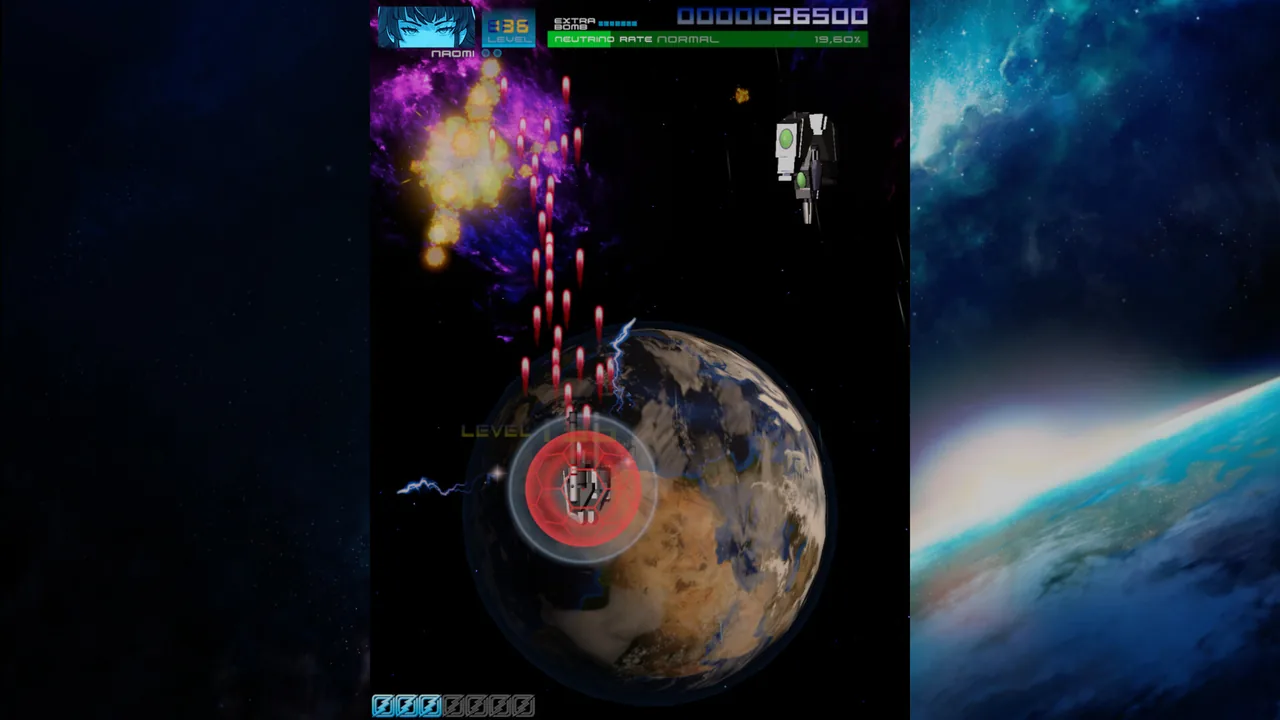
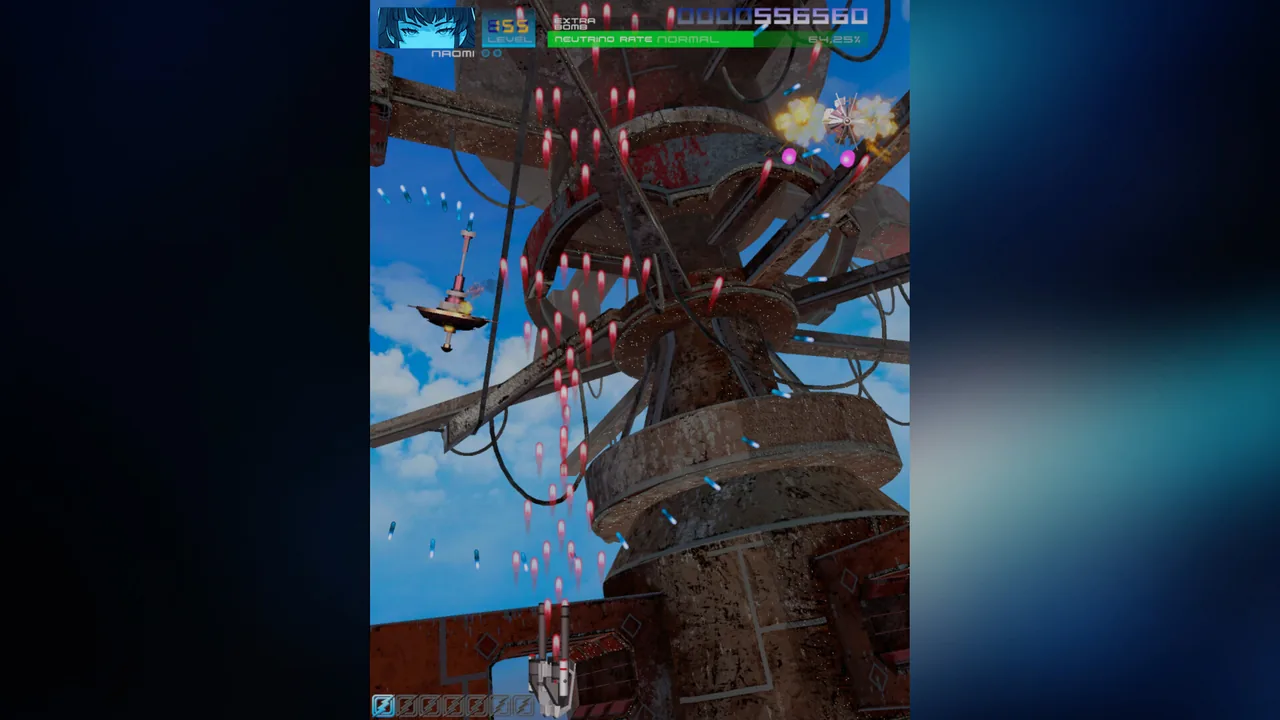
Not every part of the package lands as well as the mechanics. A clear and fair complaint recurring across the review sample concerns the game's visual presentation, which several reviewers describe as underwhelming relative to its genre peers. One reviewer writes bluntly that the "visuals are quite... simple (the backgrounds feel empty, the ships are really ugly, the bosses don't really react to your shots)," while still concluding the game "remains interesting. Good, not great!" This isn't an isolated complaint about the graphics being merely modest; a separate, more frustrated reviewer independently reports that it's "almost impossible to see what you are doing most of the time," directly connecting the visual clarity issue to actual gameplay legibility rather than just aesthetics. For a genre that lives and dies by split-second pattern reading, backgrounds and enemy silhouettes that don't clearly separate from the bullets you're supposed to be grazing are a legitimate, not merely cosmetic, shortcoming.
Performance Problems on Steam Deck
A second fair complaint concerns technical performance, specifically on Valve's Steam Deck. One detailed reviewer reports encountering "several performance issues such as constant stutters and frame drops, which made the game very frustrating to try to play" when playing on Deck, describing it as "a shame" given that the underlying game clearly "had a lot going for it" in the moments the stutter wasn't present. That reviewer ultimately refunded the Steam version and picked the game up again on PlayStation 5, where they report "it's been a great time," additionally noting the Nintendo Switch 2 version, while "not as polished as the PS5 version," remained "very playable." This is a useful, concrete data point rather than a vague complaint: the game's core design appears sound across platforms, but the PC release specifically, and Steam Deck compatibility in particular, has room to improve, and prospective buyers gaming primarily on handheld hardware should factor that in.
Hitboxes and the Learning Curve
A third recurring theme, somewhere between a genuine complaint and simple genre unfamiliarity, concerns how the grazing mechanic feels for players new to the series. One reviewer, candid about not fully understanding the system, writes that "it was way too easy to oversteer into bullets and my hitbox felt ginormous," making risky plays and close grazes feel punishing rather than rewarding, ultimately concluding "this is a Mixed game for me" despite crediting the "great graphics and sound" elsewhere in the same review. A separate, far less measured negative review simply calls the game "almost impossible to see what you are doing most of the time" before reporting an uninstall. Taken together with the visual-clarity complaint above, there's a real pattern here: Psyvariar 3's core mechanic asks for a level of precision and pattern-reading that a meaningful minority of players find the presentation doesn't adequately support, even as the majority of reviewers report the system clicking for them once they adjust to it.
The Majority Report: It Clicks
Despite those complaints, the dominant thread running through this review sample is enthusiasm, often from reviewers explicitly comparing the game favorably, if not glowingly, against its own series history. One veteran of the franchise writes that while they "don't think the game is as good as Psyvariar Delta, which is also on Steam," they acknowledge "that's a high bar to clear" and that Psyvariar 3 "still has a decent amount to offer," framing the entire series as "something of a niche within a niche" built for players seeking mechanical innovation over pure dodge-and-shoot simplicity. Another reviewer, who admits the game "initially wasn't really feeling it," reports it "grew on me" over time, crediting the ways the third entry differentiates itself from its predecessors. A newcomer to the series entirely writes "I'm not a huge fan of the genre so this is the first in the series I've played but it's a really good game," specifically praising the music, visuals (in direct contrast to the complaints above), and character variety, and expressing interest in seeking out the earlier entries as a result. That range of reactions, from lifelong series veterans to genre newcomers, both broadly landing on recommend, speaks to a game whose fundamentals are sound even where its edges are rough.
Final verdict
Psyvariar 3 is a niche shoot-'em-up built around a genuinely distinctive mechanic, rewarding players for embracing risk rather than avoiding it entirely, and this review found its Mostly Positive reception, thirteen positive against two negative in English, twenty-five against five across all languages, to be well earned by that core idea. Seven pilots with distinct traits, a reworked shield-chain scoring system, and a developer team that has clearly kept patching and improving the game post-launch all point to a studio invested in its niche audience rather than a one-and-done cash-in. The fair complaints here, sparse and sometimes hard-to-read visuals, reported Steam Deck stutter, and a hitbox feel that some newcomers find unforgiving, are real and worth factoring into a purchase decision, but none of them undermine the core appeal for the audience this game is built for. If you're a shmup veteran or a fan of the Psyvariar series looking for a fresh, risk-driven scoring system to master, this is an easy recommendation on PC or console; if flashy, generous visuals or beginner-friendly bullet-hell are what you're after, this specific entry may not be the best starting point.
Pros and cons
Pros
- Praised for its innovative grazing/buzz mechanic, with one reviewer explaining the core loop rewards players who fly as close as possible to danger, calling the game "first-and-foremost a bullet grazing STG."
- Praised for its character and ship variety, with one reviewer noting "there are many pilots and ships to choose from this time, each with different weapons and traits," and rating it "8.5/10."
- Praised for continuing to improve post-launch, with one reviewer writing the game "started out a bit rough but it now feels pretty good and fun after the recent updates."
Cons
- A fair, corroborated complaint concerns sparse visuals, with one reviewer describing them as "quite simple (the backgrounds feel empty, the ships are really ugly, the bosses don't really react to your shots)," a critique echoed independently by a reviewer who found hitboxes hard to judge amid "almost impossible to see what you are doing."
- A fair complaint concerns Steam Deck performance, with one reviewer reporting "constant stutters and frame drops, which made the game very frustrating to try to play," ultimately refunding the PC version and switching to console.
- A fair complaint concerns hitbox feel for newcomers to the series, with one reviewer writing it "felt like it was way too easy to oversteer into bullets and my hitbox felt ginormous," despite otherwise praising the "great graphics and sound."
Screenshots
-

Psyvariar 3Image: Red Art Games via Steam -
Psyvariar 3Image: Red Art Games via Steam -
Psyvariar 3Image: Red Art Games via Steam -
How the review scores each part of the gameWanderer Editorial -
The specs at a glanceWanderer Editorial -
The short versionWanderer Editorial