Game review
Project Threshold
5 / 10
- Developer
- Murushii Studios, Kyronaught Games
- Publisher
- Murushii Studios
- Released
- 25 June 2026
- Platforms
- Windows
- Genre
- Adventure, Indie, Horror
- Monetisation
- paid
- Players
- false
The short version
Biggest strengths
- A genuinely engaging premise for players with the specific phobias the game targets, with at least one reviewer describing real, effective discomfort tied to a personal fear
- A very low price point that most reviewers, even critical ones, agreed matched the short scope of the experience
- Voice-acted content and a few standout rooms with more developed mechanics that reviewers singled out as highlights
Biggest weaknesses
- A heavily chance-based door-choice structure that multiple reviewers said amounts to guessing rather than meaningful decision-making
- Repetitive room design, with several reviewers wishing for a checkpoint or sprint system to avoid re-walking already-seen corridors after repeated deaths
- Thin atmosphere and psychological horror elements, according to one structured critical review that rated most of the game's intended horror qualities as absent
Who it's for: Players curious about a cheap, short phobia-themed horror curiosity who won't mind a heavily chance-based door-guessing structure with limited variety
Our recommendation: recommended with caveats
5 / 10
An experiment built on blind choices
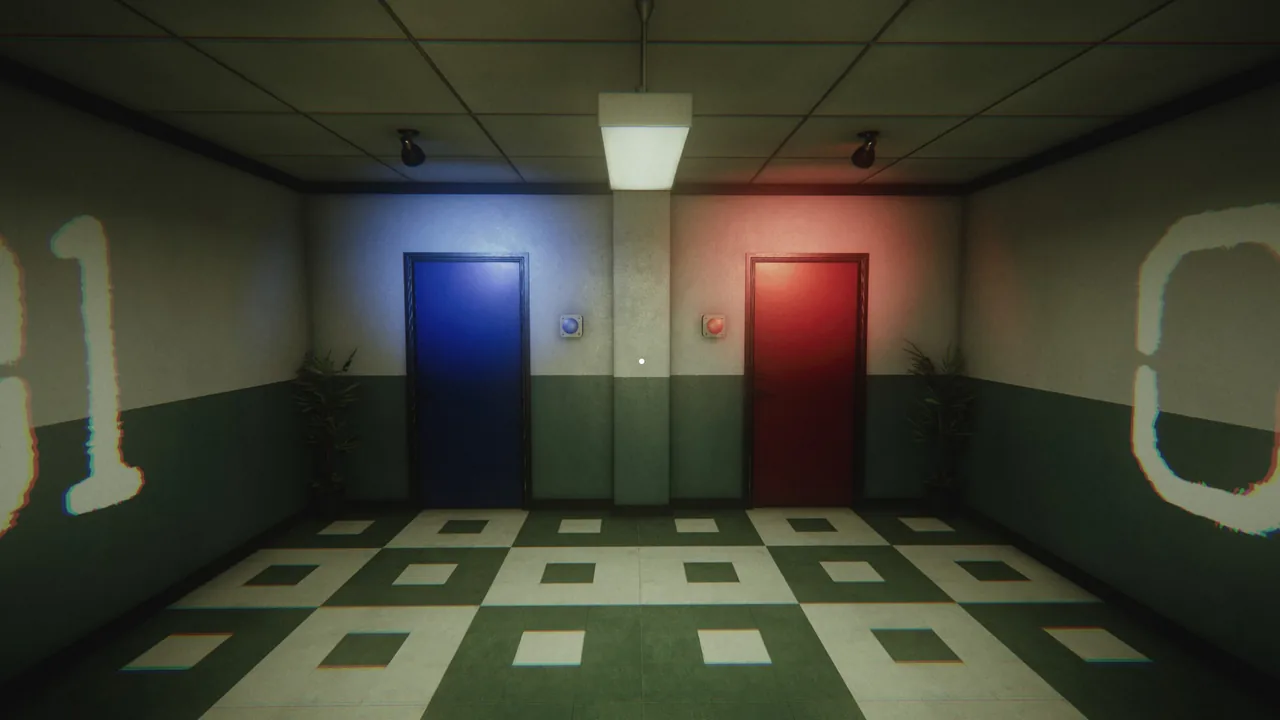
Project Threshold casts players as a participant in an experiment designed to confront specific phobias, working through sequences of blue and red doors where survival depends on picking correctly, or getting lucky. That structure is the entire game, and reviewers were sharply divided on whether it works. One detailed reviewer put it bluntly: "so, you just do a 50/50 with no real hint on most of them. it's not really a game, you just guess. no luck at all, each door is the same, so just brute force it until you win." Another reviewer offered a similar, more detailed breakdown of the odds: "Gameplay wise, its not very good, as its just a walking simulator, with a 70/30 chance of instant death, or possible survival. reason it being 30% of survival is because even if you choose the right door, you can still die if played incorrectly."
Phobias that land, for the right player
Despite the structural criticism, several reviewers credited the game with real, effective moments when its targeted phobia actually matched their own fears. One wrote a full breakdown titled "A Great Horror Experience That Helped Me Face My Fears," saying, "I really enjoyed playing Project Threshold! It's a great horror experience and, honestly, a fun way to overcome some of my phobias." Another reviewer, more mixed overall, still acknowledged the concept's potential: "there is one thing this game was designed for, and its phobias. The phobias are what make the game scary, The only one i had was at the beginning, and unfortunately it was for progression too, so you can imagine my reaction every time I had to redo it." That reviewer's frustration points at a real design tension: the game's most effective moments are tied to specific personal fears that won't land the same way for every player, and repeated exposure to the same fear through failed attempts can blunt its impact rather than sustain it.
A structured, skeptical takedown
One of the pool's most useful negative reviews takes a checklist format that's worth reading in full for how specifically it isolates its complaints: "Door Choice Mechanic (yes), Memory Game (yes), Walking Simulator (yes), Psychological Horror Elements (no), Immersive Storytelling (no), Eerie Atmosphere (no), Terrifying Jumpscares (no), Realistic Visuals (maybe), Atmospheric Sounds (no), English Voice Overs (yes)." That reviewer concluded plainly, "The game is not scary, maybe if you have the phobias... For the current price it's not worth it." It's a rare case of a reviewer explicitly separating out which of a horror game's expected ingredients are actually present, and the result is a fairly damning inventory of missing atmosphere and storytelling.
Repetition is the most common complaint
Beyond the chance-based structure, the most frequently repeated criticism concerns having to re-walk the same corridors after every death. One reviewer suggested a specific, reasonable fix: "Decent game for the price point, but can get boring due to repetition. I think the creator should have implemented a checkpoint system or sprint system for rooms you have already passed, just so you don't have to walk through rooms you've already see[n]." Another reviewer's account of an early run described the same friction directly: "Not allot of mechanics, One room has some good mechanics and I feel like the rest of the rooms should have had s[imilar depth]." That specific, repeated ask for a checkpoint or sprint system across multiple independent reviews suggests it's a genuinely missing quality-of-life feature rather than an isolated complaint.
Where the game does show some craft
Not every review was dismissive of the game's design. One reviewer specifically praised a standout room's mechanics: "So First run 14 mins. Found 1 Death door, Died only a few times but it was very easy to find the right way out after the 2nd thresh[old]. Not allot of mechanics, One room has some good mechanics." Another reviewer, coming in with low expectations shaped by short-form social media horror content, was pleasantly surprised: "Came into this game with no expectations at all, i thought it would be the same as the tiktok versions... this game surprised me in a good way, Good graphics nice and creative gameplay although Its a pretty short game." A separate reviewer praised the overall package more directly: "The visuals, sound design, and storytelling combine to create a tense and immersive experience that remains engaging throughout its Short playtime."
Fair value at a low price, mostly
Price came up consistently as the game's saving grace even among critical reviewers. One reviewer whose review was ultimately marked negative still conceded, "Despite my recommendation, It's actually still aight for a one time playthrough and the game is cheap, although very short which is to be expected." Another reviewer suggested a specific improvement that would meaningfully extend the experience: "i would love to see a future version where there are more phobias and where the phobias are randomly generated rather than in one specific order, it would also be much more [replayable]." At under three dollars, most reviewers, even those who found the core mechanic frustrating, framed their disappointment as wanting more from a cheap curiosity rather than feeling ripped off by it.
Verdict
Project Threshold is a cheap, short horror experiment whose central door-choice gimmick lands as genuinely unsettling for players whose specific phobias it happens to target, but reads as a repetitive, largely luck-based guessing game to a substantial share of the review pool. Its atmosphere and storytelling are thin by most accounts, and the lack of a checkpoint system makes repeated failures feel more tedious than tense. At its very low price, it's a reasonable curiosity for horror fans specifically interested in phobia-themed content, but it's hard to recommend broadly given how consistently reviewers flagged its chance-based structure and repetition as real design shortcomings rather than matters of taste.
Pros and cons
Pros
- A genuinely engaging premise for players with the specific phobias the game targets, with at least one reviewer describing real, effective discomfort tied to a personal fear
- A very low price point that most reviewers, even critical ones, agreed matched the short scope of the experience
- Voice-acted content and a few standout rooms with more developed mechanics that reviewers singled out as highlights
- Quick to finish in a single short sitting, making it a low-commitment curiosity rather than a major purchase
Cons
- A heavily chance-based door-choice structure that multiple reviewers said amounts to guessing rather than meaningful decision-making
- Repetitive room design, with several reviewers wishing for a checkpoint or sprint system to avoid re-walking already-seen corridors after repeated deaths
- Thin atmosphere and psychological horror elements, according to one structured critical review that rated most of the game's intended horror qualities as absent
- A narrow, fixed set of phobias rather than randomized or expanded scenarios, which several reviewers said limited the experience's replay value and overall scope
Screenshots
-
Project ThresholdImage: Murushii Studios via Steam -
Project ThresholdImage: Murushii Studios via Steam -
Project ThresholdImage: Murushii Studios via Steam