Game review
Papabile Review
7.3 / 10
- Developer
- Lacking Finesse Games
- Publisher
- Lacking Finesse Games
- Released
- 1 September 2026
- Platforms
- ["Windows"]
- Genre
- Simulation
Rome, 1492: The Holy Father Is Dead, and So Is Your Chance at Mercy
Papabile drops you into the papal conclave of 1492 as one of five papabili — candidates for the papacy — locked in the Sistine Chapel with four rivals and a deck of dirty tricks. You build your cardinal from scratch, picking nationality, age, faction, and a handful of personality traits that shape which tools of persuasion work best: charm, blackmail, flattery, outright bribery. Thirty procedurally generated fellow cardinals populate the conclave's voting pool, each with their own private agenda to exploit, and every round of voting eliminates one of the five papabili until only a single Holy Father remains. Between rounds, nine categories of random events — lavish banquets, whispered rumors, offers of alliance from rival factions — force snap decisions that can make or break a candidacy. It's a tight, replayable political strategy game wrapped in genuine historical texture, right down to a Gregorian chant soundtrack scored for exactly this kind of Vatican scheming.
Released free on September 1st by solo-ish studio Lacking Finesse Games, Papabile has built a small but enthusiastic review base: 7 of 8 English-language reviews positive, and 8 of 9 across all languages — a strong showing for a first release with essentially no marketing push behind it. What stands out most in the review pool isn't any single mechanic but how consistently players describe the game as something they haven't quite played before.
Bribery, Blackmail, and a Cast That Writes Its Own Stories
"A really fun and unique game!" is the kind of praise that shows up over and over in the review pool, usually paired with specific enthusiasm for the character-building step at the start of each run. One reviewer singled out the trait system directly, noting how much a cardinal's assigned nationality, faction, and personal quirks change the texture of an otherwise familiar elimination structure from playthrough to playthrough. Another kept it simple and specific: a successful run built around throwing a banquet and blackmailing a French rival was enough to sell them on a second attempt. The procedurally generated cast of thirty cardinals means no two conclaves play out with quite the same cast of targets and allies, and reviewers clearly appreciate that the game leans into the messiness of ambition rather than offering a single clean path to the throne.
The comedy writing draws its own dedicated praise. Several reviewers highlighted the game's willingness to let its historical premise get genuinely silly — corrupt, gossiping, thoroughly human cardinals rather than solemn historical wallpaper — and more than one review credited the soundtrack specifically as punching well above what a free release usually delivers. Some of the community's own reviews lean into the game's irreverent sense of humor with equally irreverent jokes of their own about the personalities and secret lives their cardinals end up with over a run, which says something about how much personality the character generator manages to inject into what's structurally a fairly small elimination-and-voting loop.
A Legibility Problem That Undercuts a Free Recommendation
The game's most consistent and most serious complaint has nothing to do with its writing or its systems and everything to do with basic readability — a look at the actual interface screens shows just how much of the game is conveyed through dense columns of small type, from faction affinity breakdowns to cardinal dossiers to vote tallies. One reviewer flatly called portions of the game unplayable because of how small the in-game text renders, framing it as part of a broader, frustrating trend across both indie and AAA releases of shipping interfaces that simply aren't legible at a comfortable viewing distance. That's a real accessibility gap for a game whose core loop is built entirely around reading trait descriptions, event text, and cardinal dossiers quickly enough to make informed choices between voting rounds — if the text can't be read, the strategy layer effectively breaks down regardless of how well-designed the underlying systems are.
To the developer's credit, the response time on other issues has been fast: a same-day launch patch added a missing volume mixer and fixed an unspecified bug, and a follow-up patch a week later reworked an achievement's unlock conditions after players discovered it was easier to earn than intended. That's a developer actively watching feedback and adjusting quickly, which makes the absence of any stated fix for the text-size complaint in either patch notably conspicuous — it's the kind of issue that should be near the top of a solo developer's list precisely because it undermines everything else the game is trying to do well.
A Small, Confident Debut
There's a particular kind of satisfaction in watching a tiny studio nail a premise this specific on its first outing. Papabile doesn't try to be a sprawling grand strategy game or a deep management sim — it commits fully to being a fast, punchy elimination format about ambition, secrets, and the specific texture of Renaissance-era Vatican politics, and that narrow focus is exactly what makes each individual run feel tight rather than padded. A full conclave can be played through in well under an hour, which suits its free price point nicely: this is a game built for a lunch break or a quick second attempt after a rival outmaneuvers you, not an epic afternoon-consuming session. Whether that brevity reads as a strength or a limitation will likely depend on how much a player wants out of a free release, but for what it's attempting, the pacing rarely drags.
Verdict
Papabile is a genuinely clever, genuinely funny slice of historical political strategy that punches well above its zero-dollar price tag — a tight elimination format dressed up with real personality, real replayability through its procedural cast, and a soundtrack doing more heavy lifting than most free releases bother with. The interface legibility complaint is a real problem rather than a minor nitpick, given how text-dependent the core decision-making loop is, and it's the one thing keeping this from being an unreserved recommendation. But a developer already shipping fast patches within a week of launch is a good sign for anyone hoping that gap gets closed soon. At a price of free, there's very little reason not to spend a conclave or two finding out whether you have what it takes to wear the mitre — just be ready to squint.
Screenshots
-
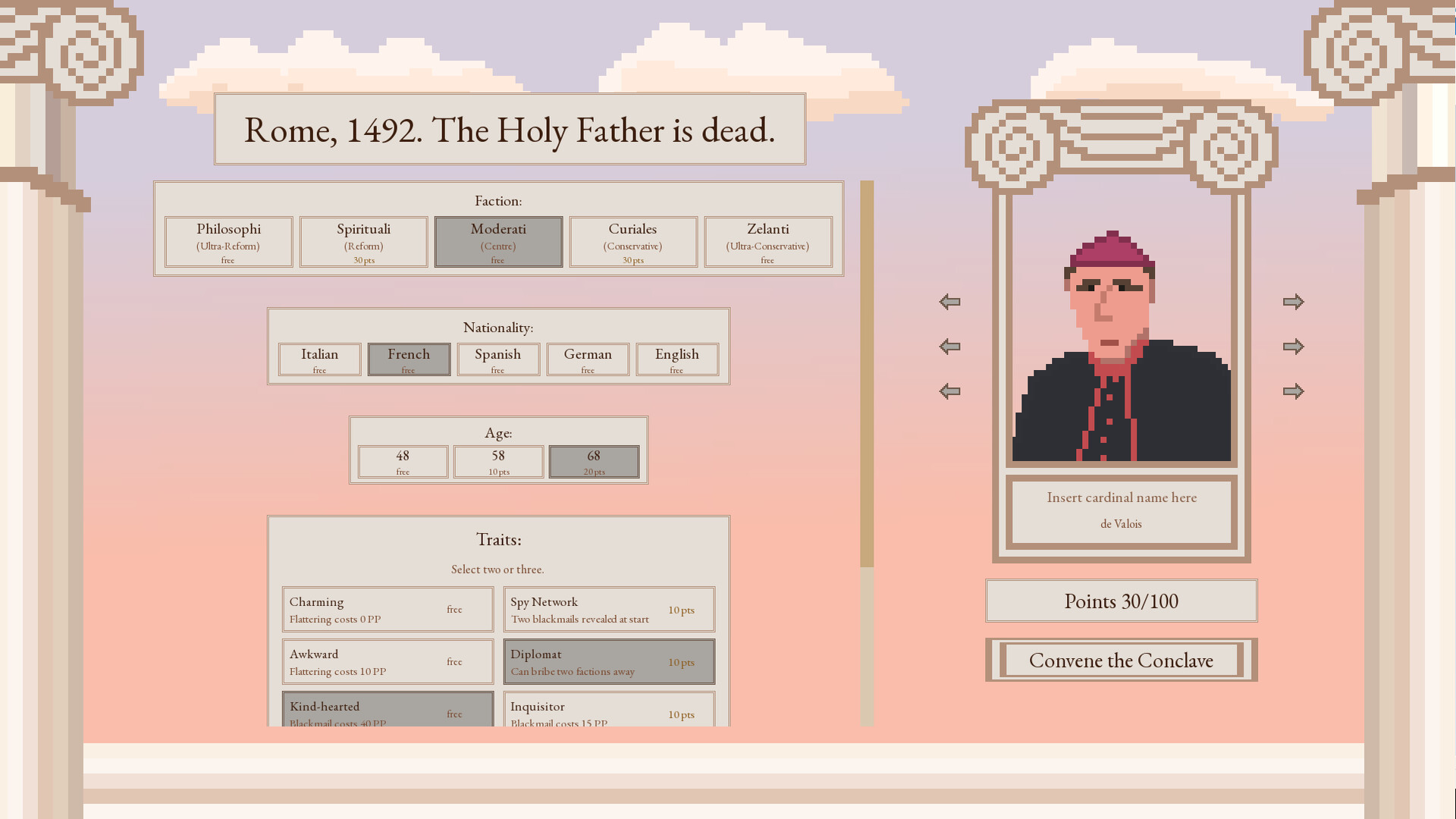
Building a cardinal at the start of a run, choosing faction, nationality, age, and personality traits.Image: Lacking Finesse Games via Steam -
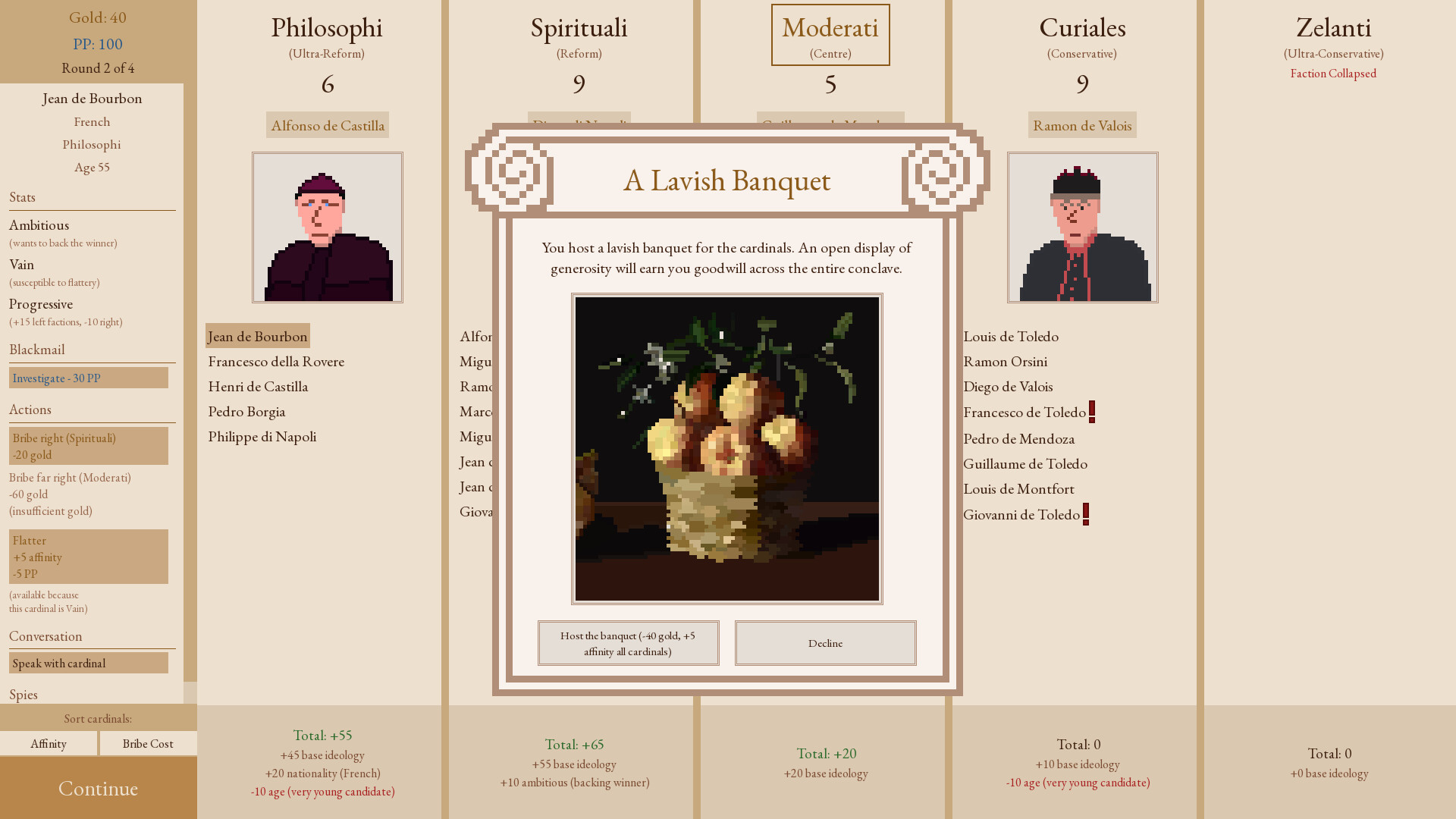
A between-rounds event offering the choice to host a lavish banquet for a conclave-wide boost in goodwill.Image: Lacking Finesse Games via Steam -
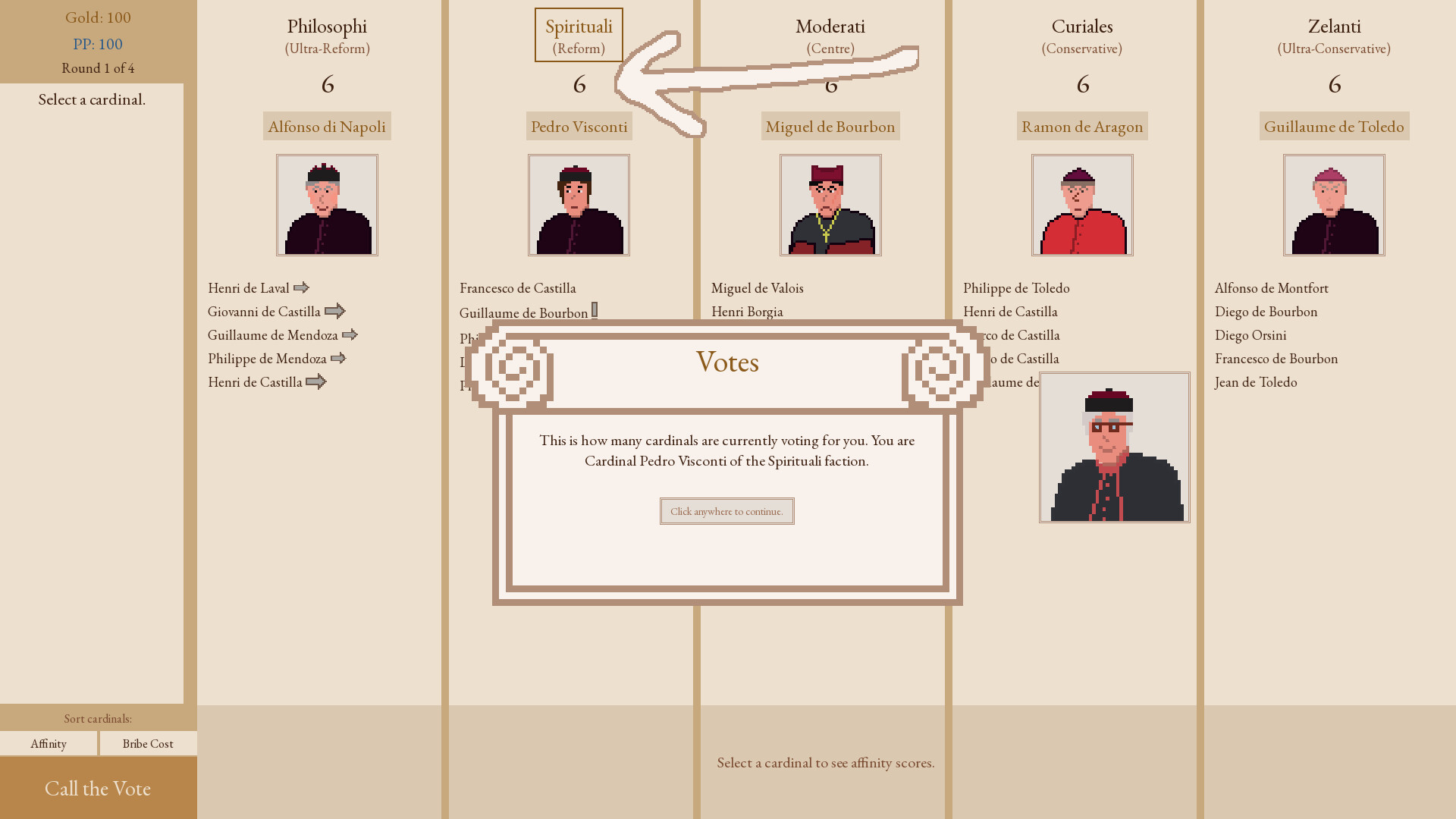
Calling a vote, with cardinals organized by faction and a running tally of support.Image: Lacking Finesse Games via Steam