
Game review
Moo Who? Review
5.9 / 10
- Developer
- SAT Productions
- Publisher
- SAT Productions
- Released
- 21 August 2026
- Platforms
- ["Windows"]
- Genre
- Casual
A Voice-Mimicry Hide-and-Seek Party Game
Moo Who? is a small-lobby party game built around a genuinely unusual hook: hidden players disguised as farm animals have to make convincing animal noises into their microphone to survive, while hunters armed with a shotgun try to sniff out which "cow" or "chicken" in the herd is secretly a person. Rounds run 2 to 8 players, and every hidden player is periodically forced through a "sound-pressure moment" where they must moo, cluck, oink, or baa convincingly — fail to make a sound in time, and buzzing flies swarm your position and give away your location to the hunters. It's a lightweight, chaotic social-deduction format layered on top of a familiar hide-among-NPCs structure, priced at $6.99 by solo-adjacent studio SAT Productions, who reported 150,000 wishlists in the month leading up to launch — a genuinely strong pre-release signal for a game this small in scope.
A Mixed Reception, Split Almost Exactly Down the Middle
Moo Who? launched to 221 reviews and a 70% positive score, landing it squarely in Steam's "Mixed" bracket — a meaningfully more contested reception than most titles covered in this space. English makes up the largest single language group in the review pool at roughly 64% of a representative sample, giving this review a solid, decisive base of reactions to draw from rather than a thin slice. What stands out immediately on reading through the pool is how polarized it is: reviewers either found the core gimmick riotously funny with friends, or came away actively frustrated by rough execution and a launch-week controversy that clearly colored a chunk of the negative reviews (more on that below).
The Genuinely Fun Core Loop, According to Its Fans
Among the positive reviews, the consistent throughline is that Moo Who? is best experienced in a full lobby of friends rather than solo with strangers. "We have played this for a couple of hours in a large group and have laughed till we cried," one reviewer writes, describing it as "the perfect game to unwind with" despite going in skeptical after reading the mixed review score. Another reviewer recounts a specific match highlight: "ran out of bullets as the hunter then got told I was ass by a bunny. I proceeded to shoot him and got cursed in Arabic. Peak" — the kind of chaotic, screenshot-worthy moment the genre lives on. Several reviewers also credit small touches for the game's charm, including a throwaway ability to have your animal poop mid-round, and note that the developer has kept up a visible post-launch cadence: a scoreboard and scoring system update landed five days after release, followed roughly three weeks later by a new map called "The Island." One reviewer with over 500 minutes played specifically praises the skill ceiling around proximity-chat positioning, describing how skilled hidden players learn to make just enough sound to satisfy the flies mechanic without fully giving away their voice to nearby hunters.
A Launch Overshadowed by AI-Development Allegations and a Rival-Game Controversy
The negative side of the review pool is dominated by two intertwined controversies rather than by the core hide-and-seek loop itself. A cluster of reviewers allege that Moo Who? was built using generative AI tools, pointing to what they describe as generic-feeling menus, mobile-game-style visuals, and inconsistent performance as evidence — one of the more heavily upvoted negative reviews states bluntly that "most parts of the game you see looks AI generated, from menus, to animals to mechanics," while another calls it "vibe coded" and says "the UI is designed in only a way an AI would." A second, related cluster of reviews accuses SAT Productions of copying a competing game called "Hide and Moo," released around the same window, with one reviewer writing "these people completely stole their work and used AI for a quick profit." It's worth noting this dispute runs in both directions: several of Moo Who?'s own positive reviews push back directly on that narrative, with one describing the accusation as "a rumor" and arguing that "there is an internet footprint for Moo Who that precedes Hide and Moo by quite a bit," and another stating flatly after playing both games that "Hide and Moo felt cheaper, less feature-rich, and more thrown together." This review can't independently adjudicate which game came first or verify the AI-development claims — that's a dispute playing out in the review threads themselves — but it's clearly a significant factor behind the Mixed score, separate from complaints about the game on its own terms. Those on-its-own-terms complaints do exist too: a nauseating, stuttery spectator camera during five-minute matches, reports of players teaming and callout-sharing over Discord to undermine the hidden-role structure, and a general sense among some critics that the visual presentation looks more like a mobile shooter than a premium $6.99 PC release.
Verdict
Moo Who? has a genuinely funny, novel core idea — mimicking animal sounds under pressure while hunters circle a herd of NPCs — and its fans clearly get real mileage out of it in full lobbies of friends, backed by a developer that's kept shipping content updates in the weeks after launch. But it arrived into a messy, contested reception: allegations of AI-assisted development, a public dispute with a similarly-themed rival game, reports of Discord-enabled teaming, and rougher production values than the concept probably deserves all show up prominently in its review section. At $6.99 for a 2-to-8-player party game, it's a low-risk pickup if the premise makes you laugh and you have friends willing to make animal noises into a microphone — just go in aware that this is a contested launch, not a clean, universally beloved one, and read a few of the recent reviews yourself before deciding which side of the argument you land on.
Screenshots
-
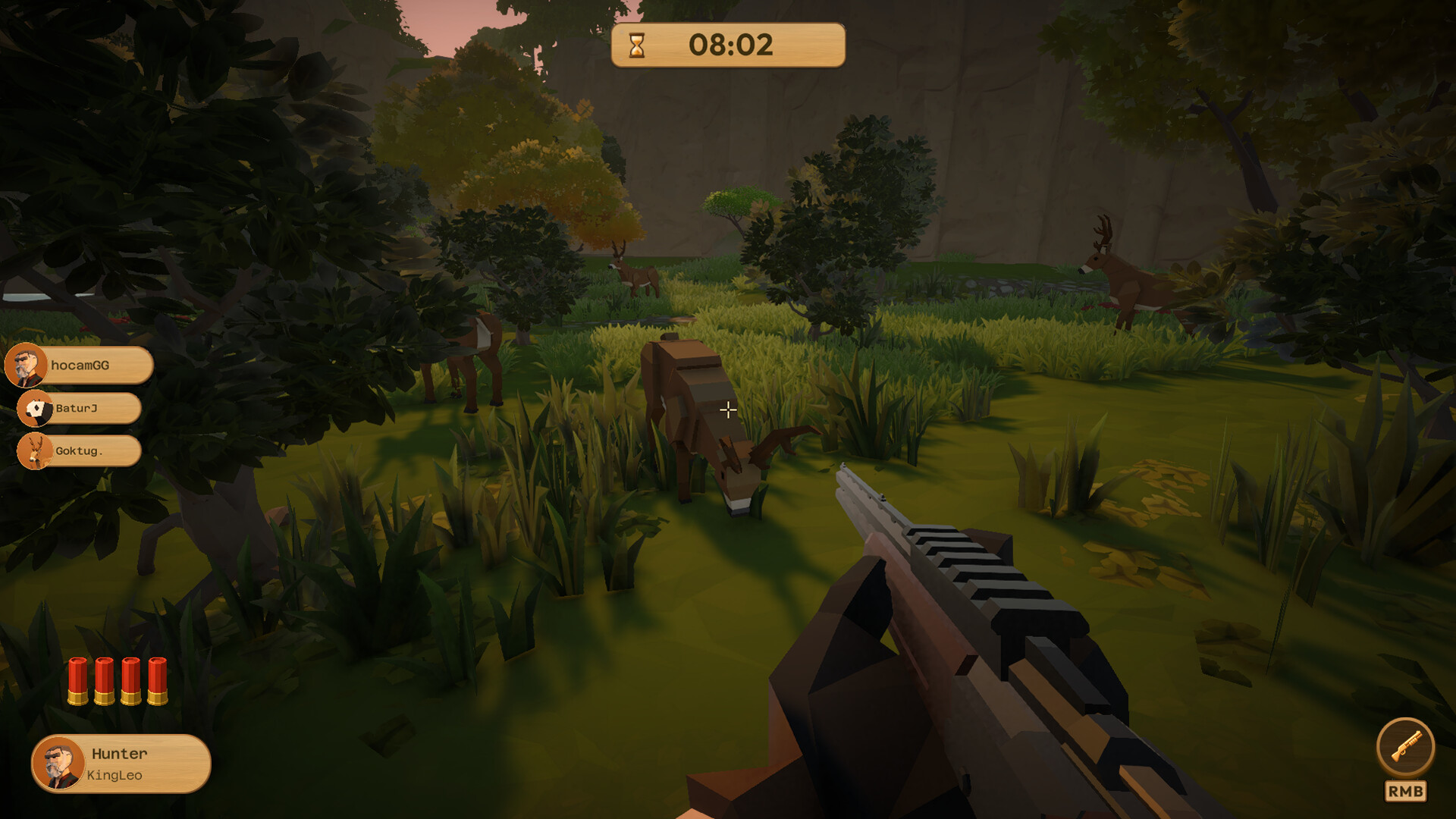
Playing as the Hunter, tracking disguised players among a herd of deer with a shotgun and a ticking clockImage: SAT Productions via Steam -
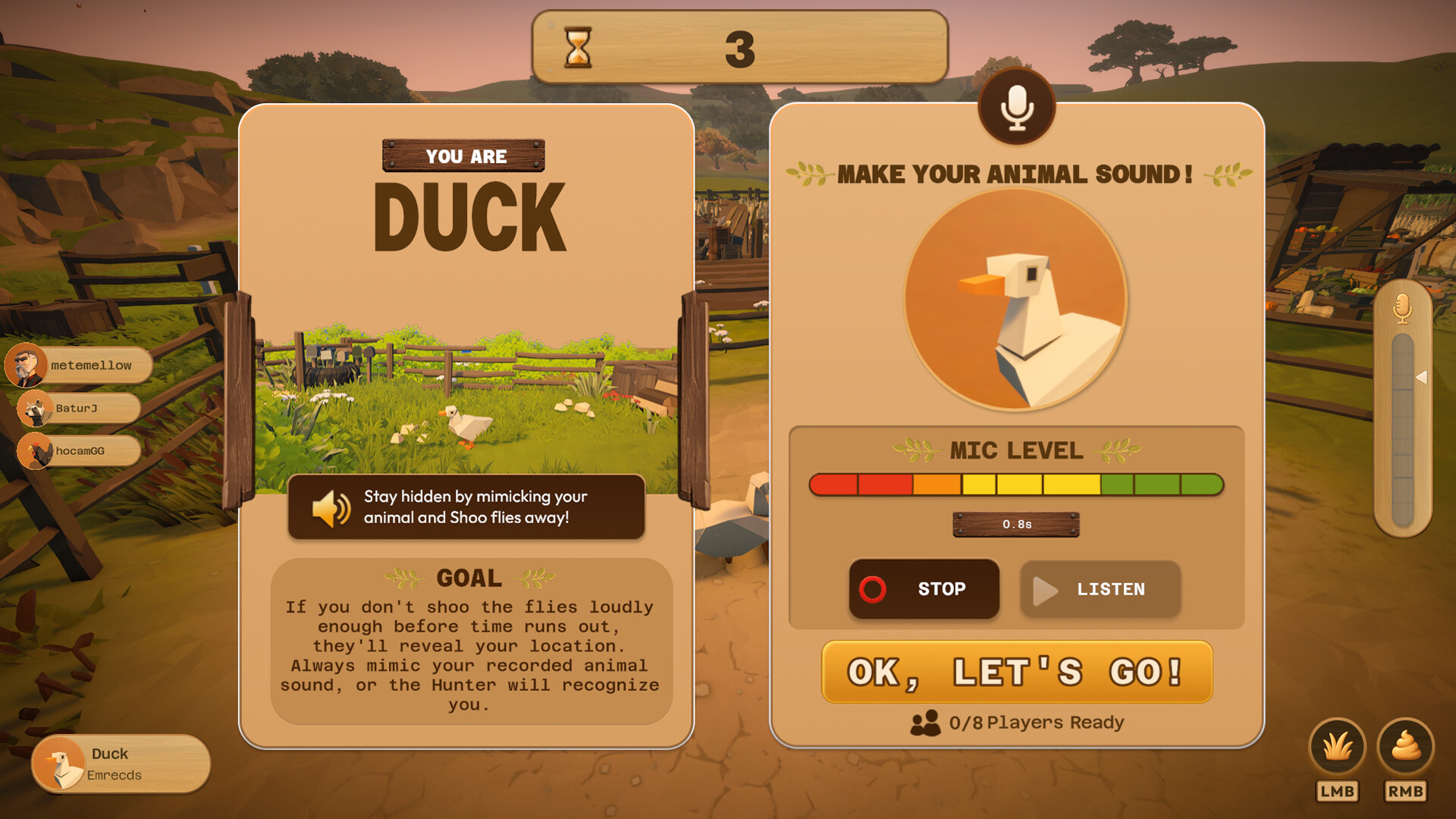
A hidden player learns their disguise and records a duck call before the round beginsImage: SAT Productions via Steam -

Blending into a flock of ducks while the flies meter creeps toward giving away the hidden player's positionImage: SAT Productions via Steam