Game review
MEGACITY Review
6.5 / 10
- Developer
- Luke Wood
- Publisher
- Green Kamino
- Released
- 28 June 2026
- Platforms
- ["Windows", "Mac", "Linux"]
- Genre
- Strategy
A Dystopian Bureaucracy Simulator, Solo-Developed
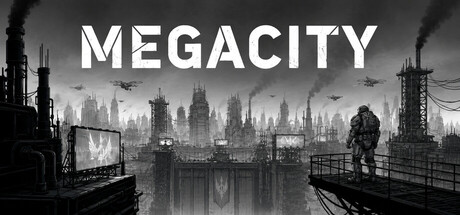
MEGACITY drops the city-builder premise on its head: you don't build the megacity, you inherit it, already crumbling, and your job for the rest of the game is to stop a "part mayor, part warlord, part bureaucrat" inheritance from collapsing under its own weight. It's a dystopian strategy-management sandbox from solo developer Luke Wood, published by Green Kamino, that tracks an enormous list of interlocking systems — food, water, power, industry, trade, housing, employment, health, crime, corruption, morale, unrest, infrastructure, weather, radiation, and the biosphere — with a tone the store page describes as "the depth of a spreadsheet and the soul of a comic book." Reviewers back that dark-comic pitch up: one 100-plus-hour player calls it a "fan of 2000 AD comics"-style setting they "love," and another describes the whole experience as "a micro-management nightmare, and I love it."
It launched into Early Access on 28 June 2026 with no prior graduated release to speak of — the storefront's Early Access date and release date are the same day, so what's being reviewed here is genuinely the game's original public entry point, still openly under construction.
Real Time or Turn-Based: Idle Progression Done Two Ways
MEGACITY's most distinctive structural choice is offering two full playstyles from the same city. In real-time mode, the simulation runs on its own clock, crises erupt on a schedule, and progress continues while the game is closed — Steam Cloud syncs the save and commander profile across devices, and returning players get a configurable offline catch-up covering however long they were away. In turn-based mode, nothing advances until the player explicitly ends the turn, which turns the same systems into a slower, more deliberate puzzle. That's a genuinely useful bit of design for this site's readers specifically: it lets the same city support both the walk-away idle sessions this site typically covers and a much more hands-on strategy-game pace, without forcing a choice between two different products.
Player reports back up that idle framing. One reviewer with over 600 minutes logged says they "closed the program" and "woke up to 3m dollars a severely collapsed city," a fairly literal demonstration of the offline simulation running unattended and generating real consequences rather than just idling in place.
Factions, Faith, and a City That Remembers Who You Are
Beyond the resource-management spine, MEGACITY layers in internal factions — the order-seeking Authority, profit-driven corporate interests, territorial criminal networks, a rights-seeking Mutant Collective, and the infrastructure-controlling Rust Wardens — each with their own leaders, demands, and shifting relationships that can be negotiated, appeased, or left to boil into open conflict. A parallel faith system lets players sponsor, tolerate, or suppress religious movements moving through the districts, up to and including building a personal leader cult, with the influence gains balanced against schisms and assassination risk. Military command adds squad composition, deployment doctrine, and persistent casualties, while wasteland expeditions beyond the city walls handle trade, salvage, and ecological recovery. It's an unusually dense feature list for a solo-developed Early Access title, and reviewers generally treat that density as the game's core appeal rather than bloat — one calls it "as wide as an ocean," though notably as a criticism of shallow individual systems rather than praise (more below). The scale on display in the game's own promotional screenshots backs up the ambition: one shows a followers roster running to dozens of named individuals, each tagged with a distinct role — gang lieutenants, tycoons, journalists, preachers, union bosses — for targeted influence operations rather than an anonymous population bar.
The AI-Generated Content Controversy, and the Developer's Response
A specific, recurring thread runs through this game's review history: several players flagged writing and artwork they identified as AI-generated, with one detailed negative review stating flatly that it was "almost hard to find some aspect of the writing in this game that wasn't made by genai," and a separate reviewer calling the game "as wide as an ocean but as deep as a puddle," questioning whether "the game design itself" was generative rather than just the text. That's a real, substantive complaint about content quality and authenticity, not a stylistic nitpick, and worth stating plainly rather than smoothing over.
What's notable is the response: multiple more recent reviews specifically credit the developer with removing the AI-generated prose. One 100-plus-hour reviewer calls it "a great decision," and another says they're "pleased to see the ai slop is being removed, seemed unnecessary anyway." Read together, the review history reads less like a static verdict and more like a mid-course correction still in progress — a legitimate thing to flag for anyone deciding whether to buy into an Early Access build today versus wait for a few more patches.
Rough Edges: A Clanky, Text-Heavy Early Access Interface
The interface is the most consistently criticised part of the game across otherwise positive reviews. Complaints include font sizes that are hard to read at 2K/4K resolutions, no dark or night mode, a distracting top-of-screen stats ticker that can't be turned off, unclear naming between menu hierarchies (one reviewer points out the military "supreme command" is labelled "defense high commander" in a different tab), and UI scaling problems on 1440p monitors. None of this is unusual for a text-and-menu-heavy management sim in early Early Access, and several reviewers explicitly frame it as forgivable for the stage of development the game is at, but it's a real, current barrier to entry — this is a game that asks a lot of reading and cross-referencing from its interface, and right now that interface doesn't always make it easy.
Verdict
MEGACITY is an ambitious, unusually dense dystopian management sim from a single developer, with a genuinely clever real-time/turn-based split that lets it work as either an idle-progression game or a deliberate strategy puzzle. The systems on offer — factions, faith, military command, wasteland expeditions, a fully mortal citizenry — go well beyond what most solo Early Access city-management games attempt, and the pricing model (one-time purchase, explicitly no microtransactions or pay-to-win) is about as clean as this genre gets. Set against that: a real, documented controversy over AI-generated writing that the developer appears to be actively walking back, and an interface that multiple reviewers find genuinely hard to read and navigate in its current state. Worth watching closely for readers who like deep, systems-heavy management sims and don't mind rough Early Access edges; worth waiting on for anyone who wants a polished interface on day one.
Screenshots
-
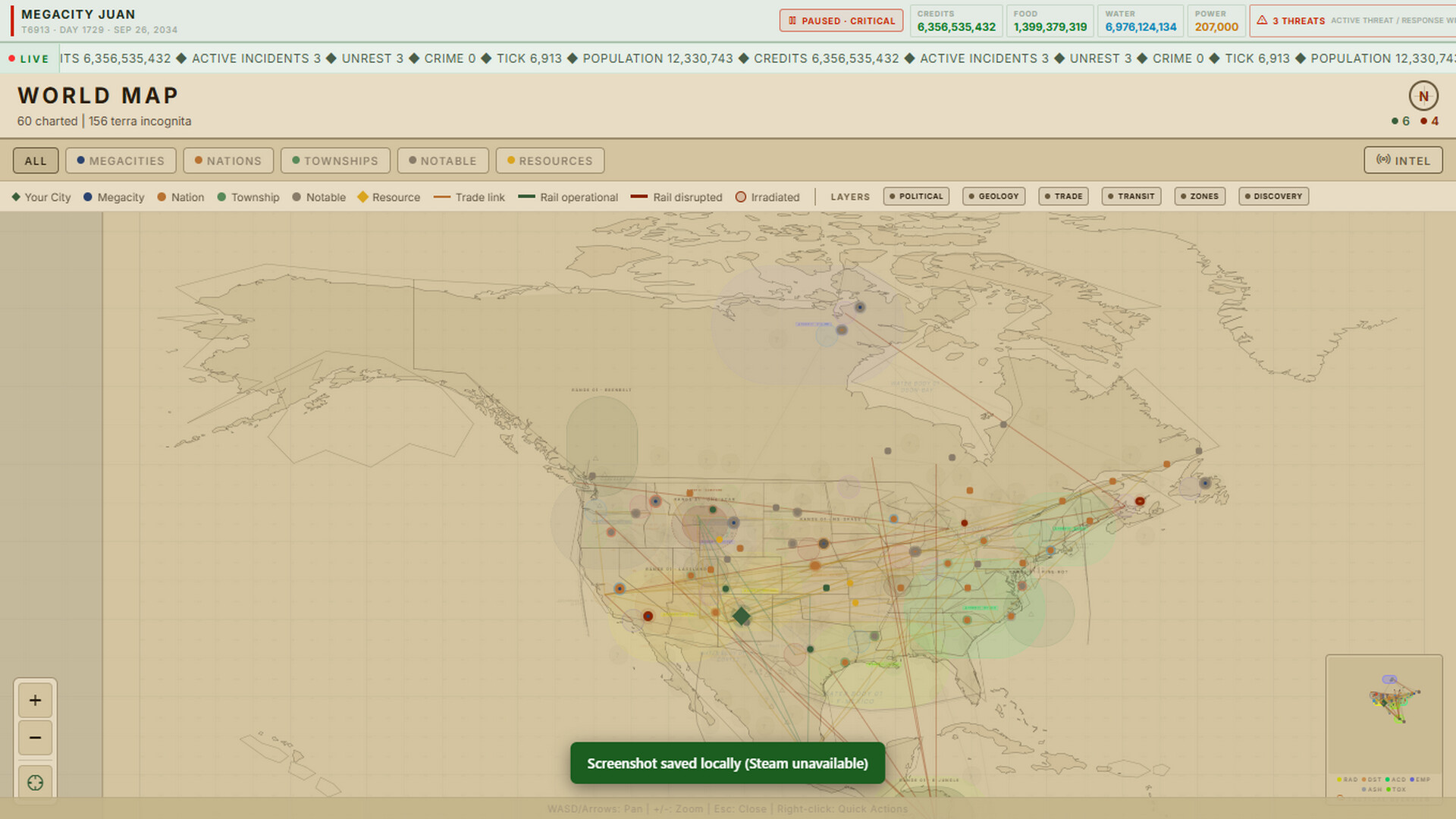
The world map, tracking rival megacities, trade routes, and rail infrastructure across a charted and still-uncharted wastelandImage: Green Kamino via Steam -
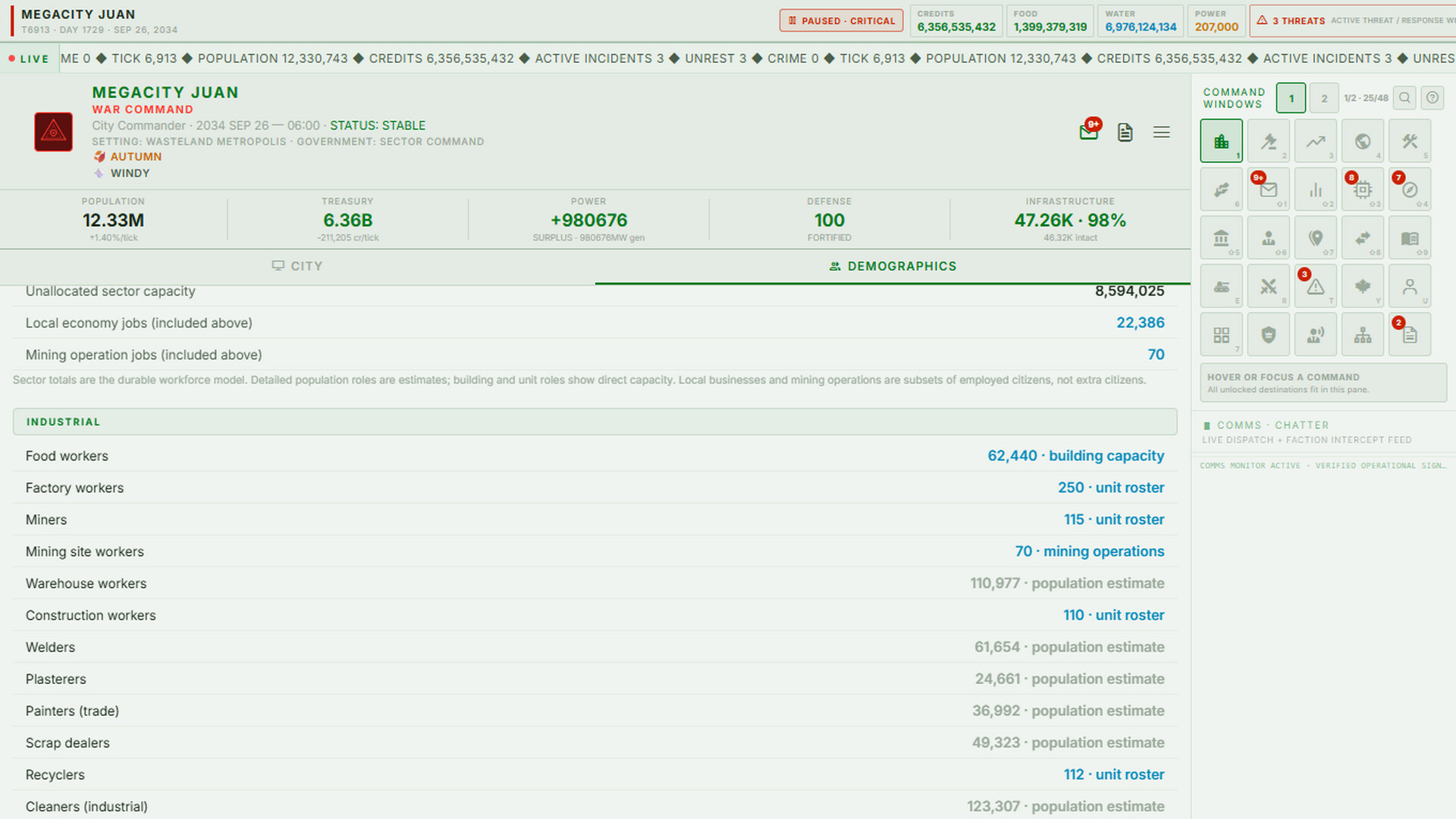
The city dashboard for Megacity Juan — population past 12 million, with a workforce breakdown down to individual job categoriesImage: Green Kamino via Steam -
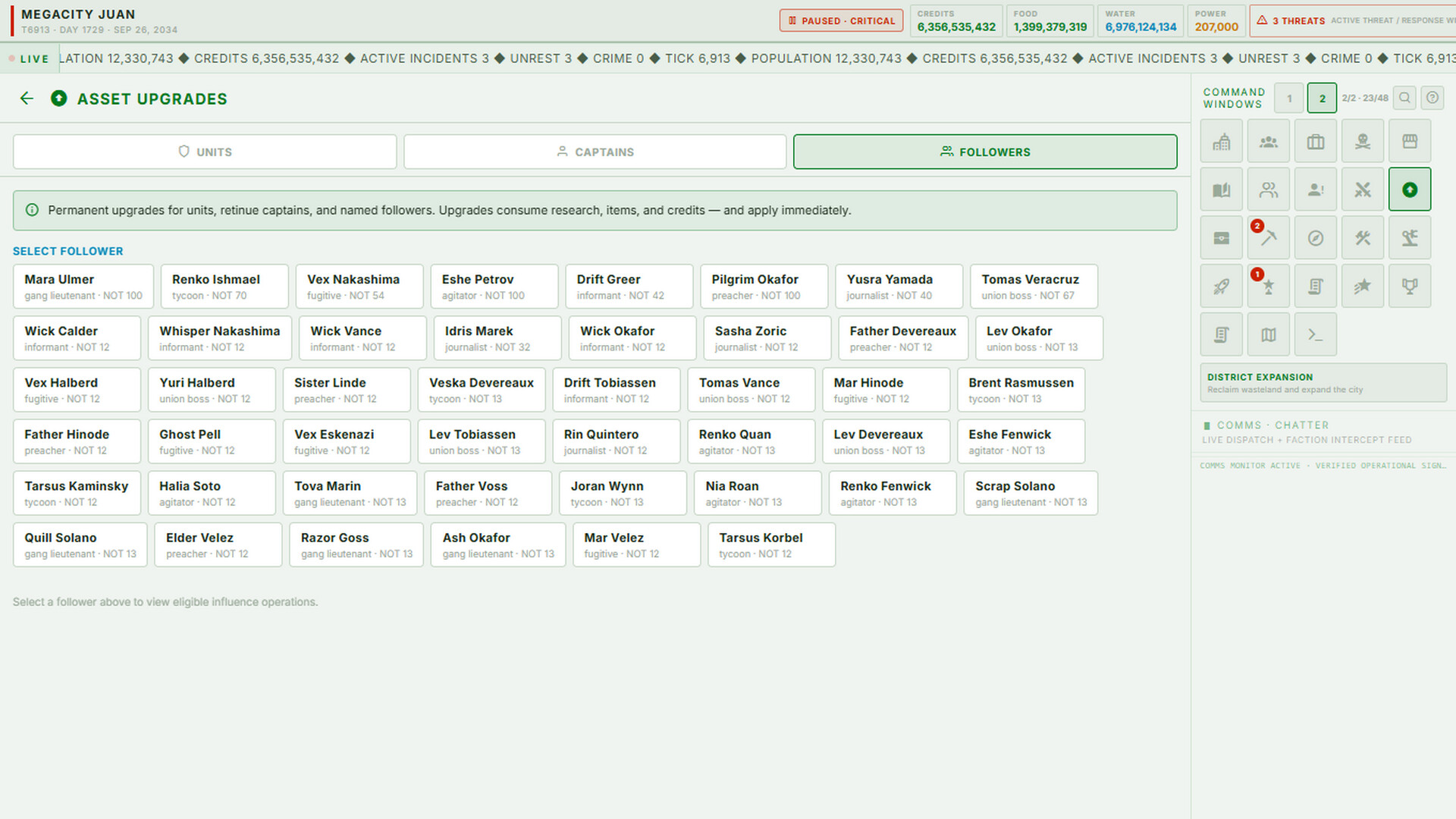
The followers roster for influence operations — named NPCs with distinct roles rather than an anonymous population barImage: Green Kamino via Steam