
Game review
Loop 9 Review
5.2 / 10
- Developer
- SMENA
- Publisher
- SMENA
- Released
- 11 September 2026
- Platforms
- ["Windows"]
- Genre
- Adventure
A Government Office That Won't Let You Clock Out, and a Coworker Who Might Be Lying
Loop 9 is set in a fictional 2003 government office where your shift refuses to end: the second floor loops endlessly, and each time you return something may have quietly shifted — an object missing, a chair turned the wrong way, a light flickering when it shouldn't. The core loop, appropriately, is observation. Learn what "normal" looks like, memorize the room, then choose one of two elevators: the lit one resets the loop because something changed, the dark one moves you forward because everything checked out. Guess wrong and you're back at the start. The developer lists sixteen distinct categories of anomaly spread across the run, from cosmetic set-dressing changes to outright dangerous ones, which is meant to keep repeat playthroughs from feeling identical.
The game's headline feature is Dragojlo, a fellow trapped coworker reachable only by phone, who the store page discloses is powered by a language model responding in character in real time rather than through pre-written dialogue trees. He's advertised as noticing kindness, contempt, trust, and suspicion in how you talk to him, with that relationship steering which of six possible endings you land on. It's a disclosed, deliberate design choice on the developer's part — an AI conversational NPC as the horror hook, not a hidden production shortcut — and it's specific enough as a pitch that it's the single thing every reviewer in the small launch pool chooses to comment on, for better or worse.
A Handful of Reviews, One Genuinely Split on the AI Hook
Loop 9 launched September 11, 2026 to a tiny pool — five total reviews, four positive — and unusually for a launch this small, the developer shipped a visible run of patches across launch week itself: new anomalies, a "bigger almanac" (an in-game log of what's been observed), a quieter phone, a pause fix, ending-progress tracking, and rebranding touches, all dated within days of release. That's a level of immediate post-launch attention that suggests a developer actively responding to early feedback rather than a launch-and-abandon release.
The reviews themselves split along a predictable line: the atmosphere and observation gameplay get straightforward praise — "eerie atmosphere is fantastic, smooth gameplay" from one, a five-part scorecard rating it middling-to-decent on scariness from another — while the Dragojlo conversations draw the most pointed reactions in either direction. One reviewer frames the whole game as being "not about hunting for anomalies, but about how successfully you can interact with an AI chatbot," pitching it directly at players who already enjoy talking to language models. A different reviewer's advice reads almost as a warning label: don't tell Dragojlo anything personal, a note that only makes sense if the character convincingly invites that kind of disclosure. The one negative review is purely a length complaint — "completed in 0.3 of an hour," with a refund request attached.
The Observation Loop Is Legible, and the AI Conversations Are the Real Differentiator
Where Loop 9 succeeds is in making its central gimmick immediately readable: the first loop is explicitly "clean," giving you an uncontaminated baseline before anomalies start appearing, and reviewers confirm the difficulty curve is gentle rather than punishing — this is closer to a spot-the-difference puzzle box than a stealth-horror survival game. The elevator-choice structure turns every anomaly check into a concrete, low-friction decision point rather than an abstract meter to manage, which likely explains why more than one reviewer describes the loop as smooth and approachable despite the horror framing.
The Dragojlo conversations are the part that can't be found in a hundred other looping-horror indies, and the reception bears that out: reviewers who enjoy the chatbot format are enthusiastic specifically because the responses feel unscripted and reactive to their own phrasing rather than menu-driven. Six branching endings tied to how that relationship develops gives the loop-and-repeat structure a reason to exist beyond simply solving the same puzzle twice.
A Very Short Runtime, a Required Internet Connection, and a Visibility Complaint
The game's most consistent weakness across this small sample is length. One completionist reviewer's playtime sits at 20 minutes with an explicit "give me my money back," and even the more forgiving reviews describe finishing within an hour, with one saying their own total logged playtime is close to the actual time it took to beat the game outright. At $4.99 with sixteen anomaly types and six endings on paper, the promise of replayability is real, but nothing in the review pool suggests players are actually returning for multiple runs rather than treating it as a single sit-down experience. The store page's own fine print that "internet connection is required for AI conversations" is worth flagging plainly: Dragojlo isn't a local scripted character, so the game's signature feature depends on a live connection working correctly, a dependency absent from the vast majority of narrative horror games in this price bracket. A separate, more conventional complaint concerns visibility — flashlight-lit environments that one reviewer found genuinely difficult to parse while trying to memorize room details, undercutting the observation mechanic the whole game is built around.
Verdict
Loop 9's premise — memorize a looping office, catch what's changed, and decide how much to trust an AI coworker who's actually listening — is a genuinely interesting hook for a $4.99 indie horror game, and the developer's rapid string of launch-week patches suggests real investment in the release rather than a one-and-done drop. But the small review pool converges on the same problem from different angles: this is a very short experience whose replay value rests entirely on wanting to have a different conversation with Dragojlo, its central mechanic depends on an internet connection that most horror games in its price range don't require, and at least one reviewer found the flashlight visibility actively worked against the spot-the-difference gameplay it's asking you to do. Worth a look if the AI-conversation horror angle specifically appeals to you; otherwise, brace for a very brief loop.
Screenshots
-

Anomaly-hunting means noticing small object-level details like this desk book — present, absent, or subtly altered between loops.Image: SMENA via Steam -

Environmental storytelling props like this newspaper hint at the office's backstory between anomaly checks.Image: SMENA via Steam -
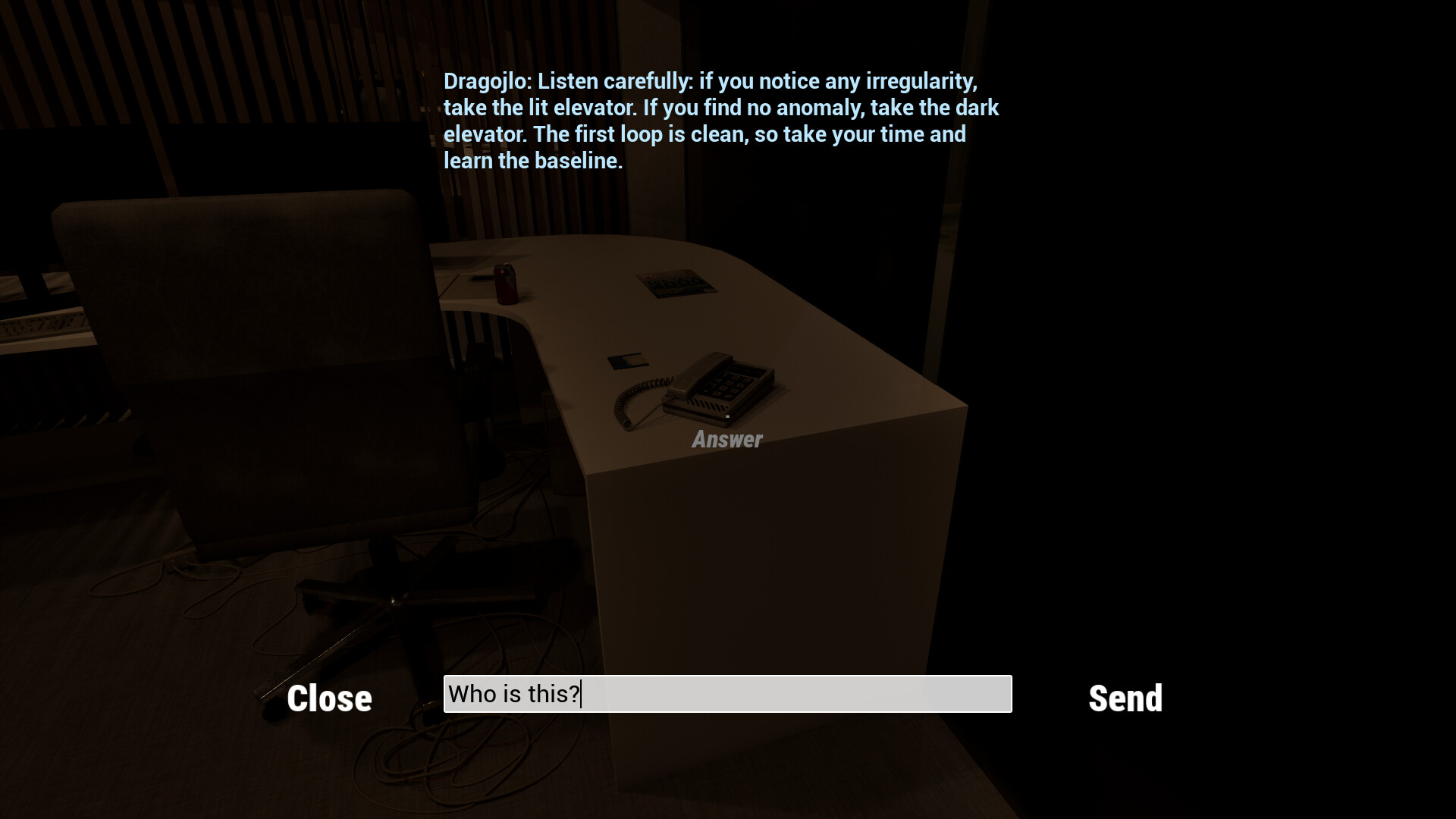
The Dragojlo conversation in action: a real chat box you type into, not a dialogue-tree menu, with the elevator rule laid out here as the game's core instruction.Image: SMENA via Steam