
Game review
LOGBOOK: Beneath the Storm Review
3.5 / 10
- Developer
- Pink Iceberg Games
- Publisher
- Pink Iceberg Games
- Released
- 3 September 2026
- Platforms
- ["Windows", "Linux"]
- Genre
- Adventure
A Very Familiar Premise
LOGBOOK: Beneath the Storm launched September 3, 2026 from developer and publisher Pink Iceberg Games, dropping the player into the role of a detective reconstructing a series of grim incidents aboard a ship, piecing together names, motives, and events from scattered clues by dragging words into fill-in-the-blank narrative summaries. It's priced at $13.99 with no active sale at review time, and its reception was rocky: 13 all-language reviews (4 positive) with an English subset of 12, 3 positive and 9 negative, "Mostly Negative," 11 of which were clearly written in English and read in full for this review.
The Golden Idol Comparison Nobody Can Avoid
Every single reviewer in the pool, positive or negative, frames LOGBOOK against the same two touchstones: Return of the Obra Dinn and, especially, The Case of the Golden Idol. For some that comparison is a selling point. "Lovecraft and Case of the Golden Idol had a baby. Loving the atmosphere and story," one reviewer wrote, reporting they "finished the game after 12 hours and had a great time" and were "looking forward to future games from Pink Iceberg Games." For most of the pool, though, the comparison reads as an indictment rather than a compliment. "This game is The Case of the Golden Idol - The exact story, the characters, the pacing, the plot," one negative reviewer wrote bluntly, while another called it "just a cheap copy of the Case of the Golden Idol." A third put a number on the gap: "if the golden idol is a 10/10 then this is a 4 or 5. Probably one of the worse out of these types of games." The word-dragging deduction mechanic itself, the genre's signature hook, isn't in serious dispute; what reviewers dispute is whether LOGBOOK does anything with it that its clear inspirations hadn't already done first and better.
The AI Question Reviewers Keep Raising
The single most-repeated specific complaint across the negative reviews concerns the game's use of AI-generated art and writing, something multiple reviewers describe as openly acknowledged by the developer rather than hidden. "Going into the game, I was aware of the AI-generated images as disclosed by the developer," one detailed review explained, before laying out a concrete consequence of that choice: "one of the very most important rules for an Obra Dinn or Golden Idol-style game is that the characters remain distinguishable between scenes, unless their appearance changed dramatically for story reasons. LOGBOOK breaks that rule repeatedly," citing a specific character whose hair length and facial hair changed inconsistently between chapters, a serious problem for a genre built entirely around visually recognizing the same faces across dozens of scattered scenes. Other reviewers were blunter still: "Taking inspiration from a game is fine, but when you have the same gameplay, similar style, the exact same story and simply slap AI art and music on top of it it is just insulting," wrote one, while another summarized the game in three words as "AI slop clone." A reviewer who ultimately gave the game a thumbs-up still couldn't get past it entirely: "This game has no soul, that's the biggest problem. AI assets and some writing feel WAAAY out of place. But props to dev to finishing the game and publishing it. Even though it's ai slop." Even a reviewer who recommended the game with heavy qualification opened by conceding "it's very AI generated in the graphics" before getting into anything else. That's an unusually consistent, independently-corroborated thread running through a small review pool, and it's clearly the dominant factor driving the "Mostly Negative" score rather than any single reviewer's outlier complaint.
A Puzzle Mechanic That Wears Thin
Separate from the AI question, several reviewers who engaged seriously with the deduction gameplay itself found it buckled under its own complexity as the case files piled up. "At first it's interesting with the starting 2-3 chapters, but over time the word puzzles get bogged down by so many additional verbs, nouns, and names that it becomes noise," one reviewer wrote, describing how "the rush of names becomes frustrating because it breaks the immersion" and eventually leads to just "dragging a lot of words in" without real engagement, more busywork than deduction by the later chapters. That specific critique, about escalating word-count noise rather than escalating puzzle cleverness, didn't come up in the pool's more positive reviews, suggesting it may depend heavily on how far into the game's later chapters a given player pushed.
The Reviewers Who Still Recommended It
Despite the dominant negative thread, LOGBOOK isn't entirely without defenders, and their praise is worth taking seriously rather than dismissing alongside the rest. Beyond the reviewer who compared it favorably to Lovecraft and Golden Idol and finished all 12 hours satisfied, one heavily-qualified positive review still found real value: "The mechanic is solid but the mechanic wasn't created here... I spent 4 hours on it and I paid $18.45 AUD for it. I don't feel I was cheated," even while admitting the game's downbeat ending left them feeling "not uplifting... more sad" than triumphant. None of the three positive reviewers denied the AI-art and derivative-design criticisms outright; they simply weighed them differently against a deduction mechanic they found satisfying regardless of its provenance.
Verdict
LOGBOOK: Beneath the Storm borrows its core mechanic, its structure, and by multiple independent reviewers' accounts its story beats wholesale from The Case of the Golden Idol, then layers openly AI-generated art and writing on top in a way that several reviewers found actively damaging to a genre that depends on consistent, recognizable character art to function at all. That's a serious, corroborated criticism from a genuine slice of a small review pool, not a single disgruntled outlier, and it's clearly the reason the game sits at "Mostly Negative" despite a functional, occasionally well-regarded deduction mechanic underneath. A minority of players found enough atmosphere and puzzle satisfaction to look past all of that and recommend it anyway, one finishing a full 12-hour playthrough happily. For genre newcomers with no attachment to its clear inspirations, there may be a passable few hours here; for anyone who has already played Golden Idol or Obra Dinn, or who cares about how a game's art and writing were actually made, this is a hard one to recommend at $13.99 when the games it's so directly drawing from are still readily available.
Screenshots
-
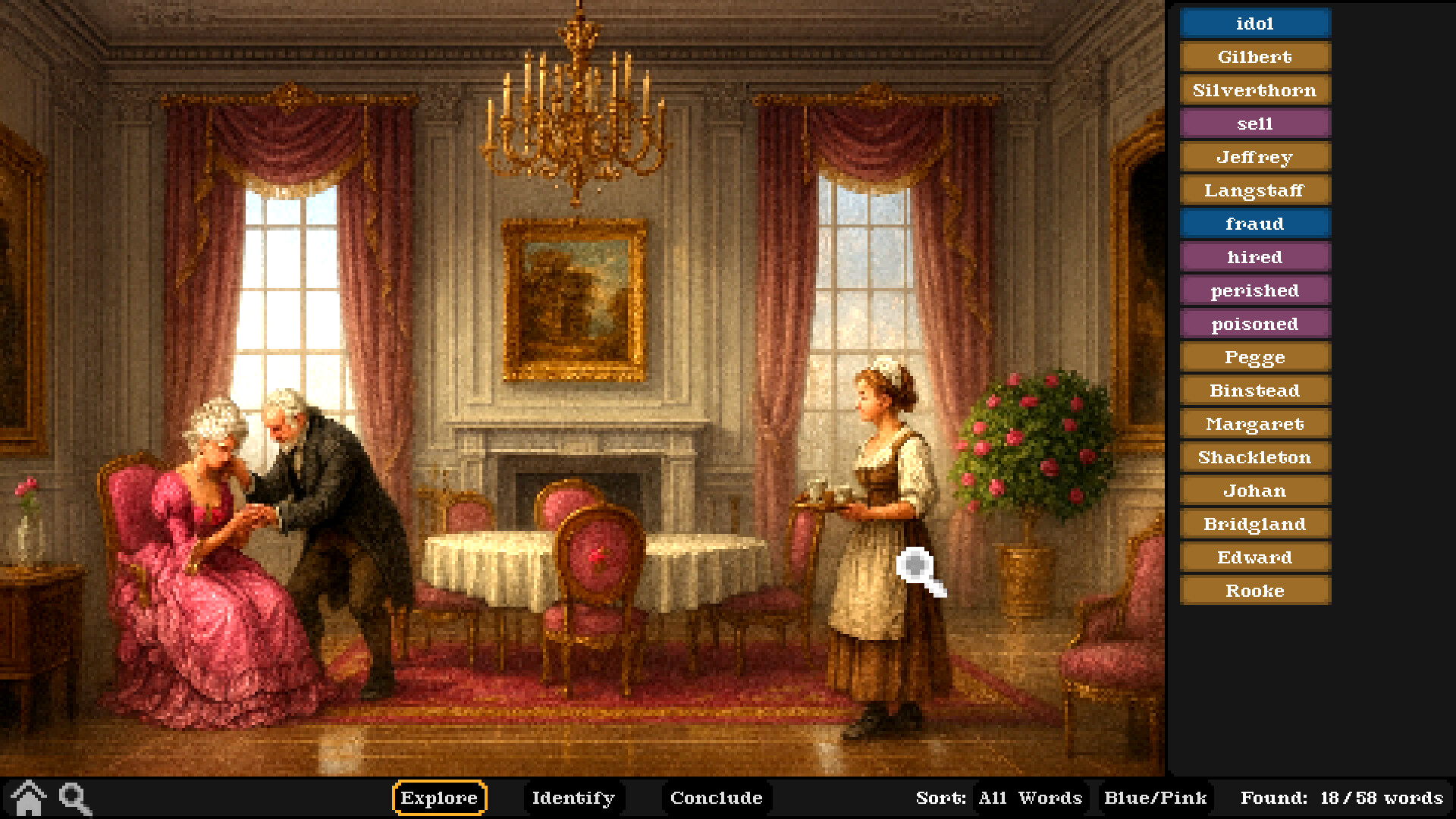
The core deduction interface: a static story scene on the left, a growing word bank of names and verbs on the right, exactly the word-dragging mechanic several reviewers said became overwhelming noise by the later chapters.Image: Pink Iceberg Games via Steam -
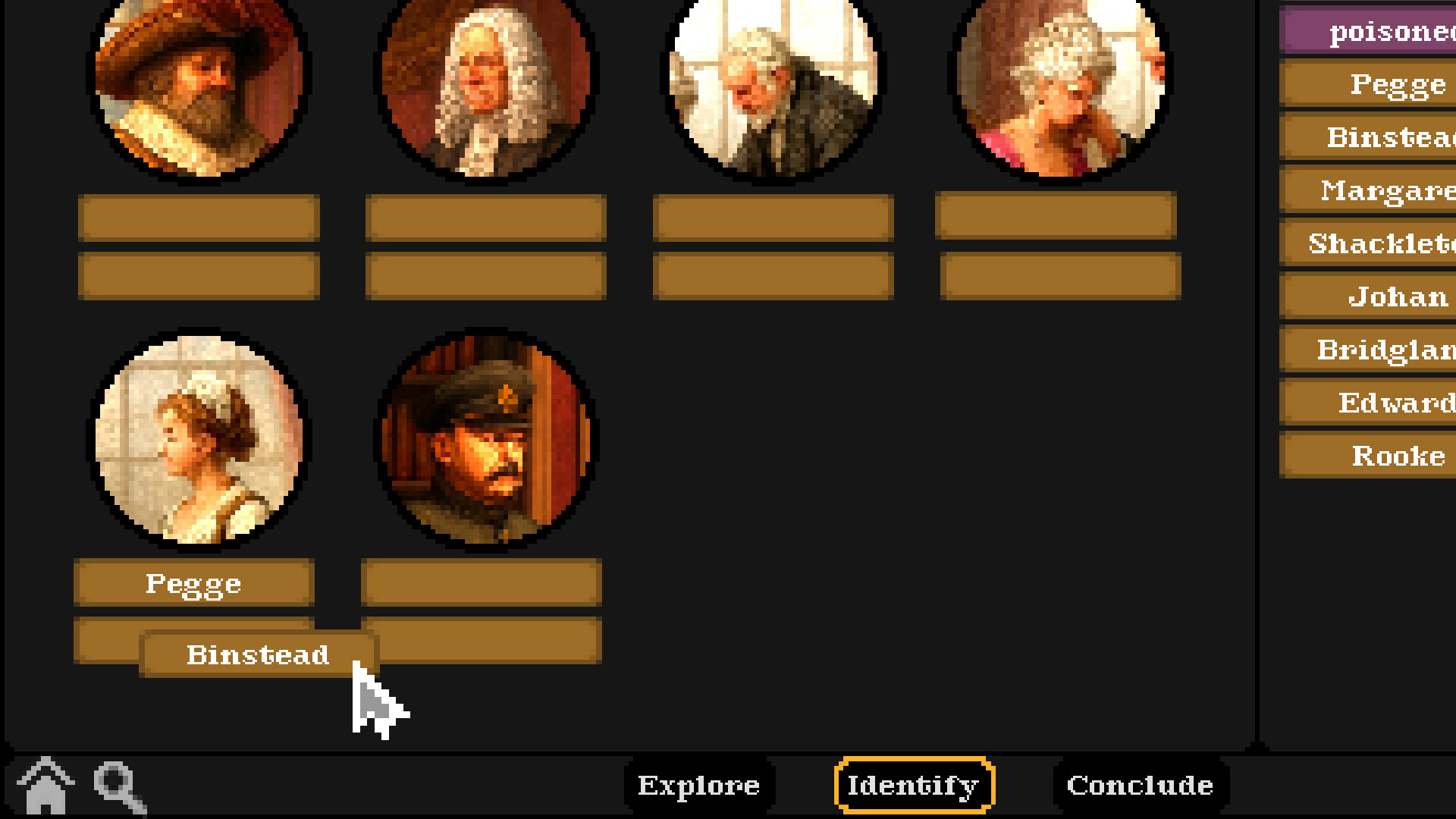
The character-identification stage, where players match portraits to names and roles, the exact genre convention that reviewers said depended on consistent character art the game didn't always deliver.Image: Pink Iceberg Games via Steam -
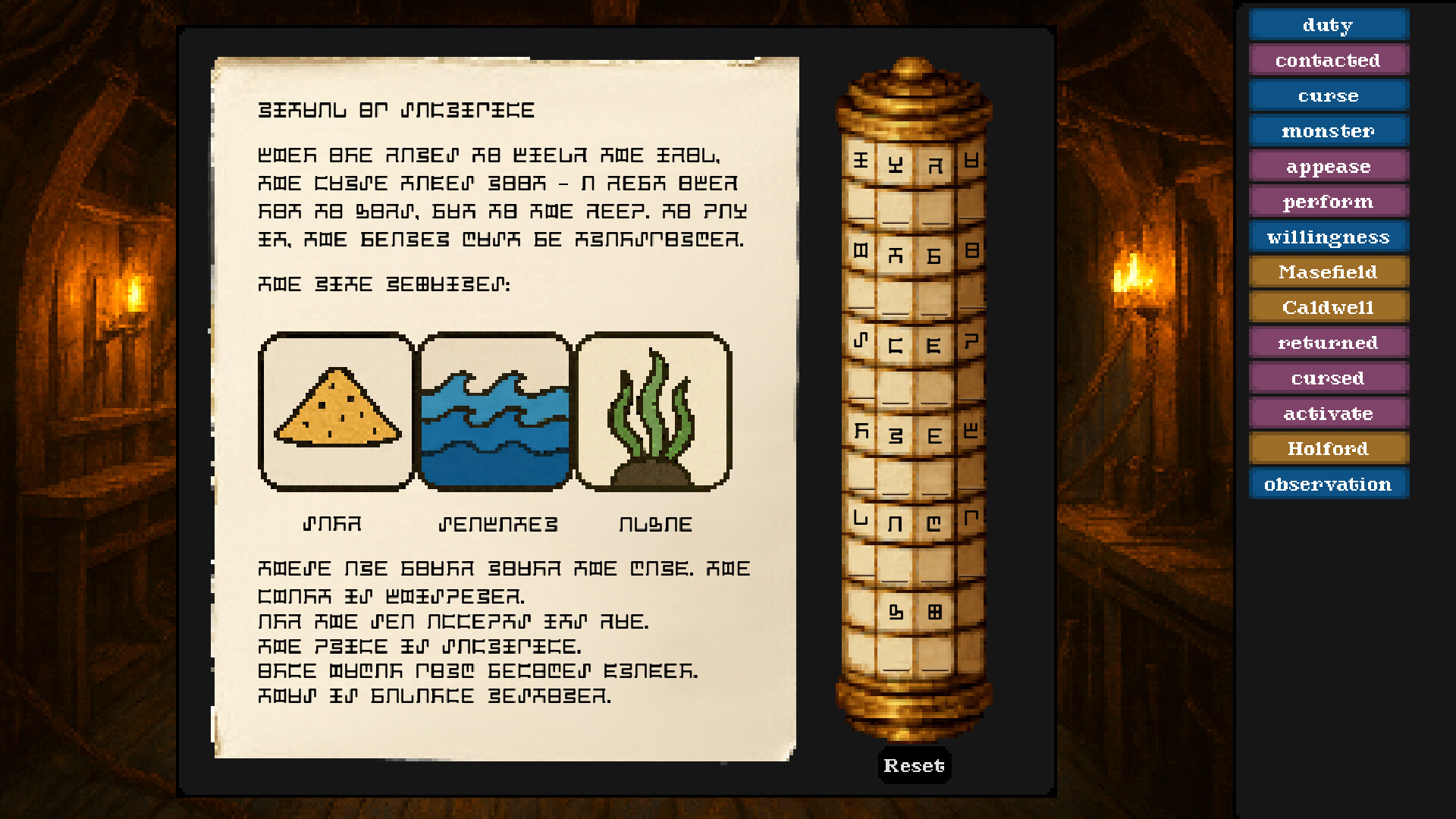
One of the game's coded-ritual-document puzzles, layering a cipher wheel on top of the same word-bank deduction system used throughout.Image: Pink Iceberg Games via Steam