Game review
Kingdom of Assetia: The Clicker Game
4.5 / 10
- Developer
- Chatty Pillow
- Publisher
- Chatty Pillow
- Released
- 25 January 2022
- Platforms
- Windows
- Genre
- Idle/Clicker
- Monetisation
- One-time purchase, no in-app purchases
- Players
- Single-player
The short version
Kingdom of Assetia casts you as the mayor of a flooded village, rebuilding it one click and one idle-income tick at a time, using nothing but free Unity Asset Store scenery and a genuine amount of solo-developer effort. For the first quarter of an hour it does exactly what a clicker should: buildings go up, upgrades feel cheap and frequent, and the loop is easy to follow. Then, by the review corpus's own account and Steam's global achievement curve alike, the pacing collapses into a wall that some players clock in months rather than minutes.
At NZ$1.29 with no in-app purchases anywhere in it, that collapse costs you very little money. It still costs you the thing a clicker is supposed to give back: the feeling that progress is still happening.
Biggest strengths
- NZ$1.29 one-time price with no in-app purchases, ads or premium currency of any kind
- Each rebuilt building carries its own dedicated upgrade track rather than one shared multiplier
- Idle income keeps accruing while you're away, and even the game's harshest reviewers confirm the underlying achievement and offline-earning math actually functions
Biggest weaknesses
- Progression falls off a cliff early: Steam's own achievement data shows completion drop by roughly 18 points between an easy early cluster and the first mid-game building unlock
- No options menu beyond a credits button, and no way to resize the window
- No prestige, reset or "new game plus" loop, so post-launch reviewers describe the endgame as logging in once a day and waiting
Who it's for: Genre completists curious about a cheap, honestly-priced clicker curiosity, and players who specifically enjoy watching a solo developer's asset-store project take shape — not anyone looking for a clicker with real long-term legs.
Our recommendation: Fine for the price of a coffee if you just want the achievement pop and the opening hour; skip it if you want a clicker you'll actually keep opening.
4.5 / 10
A flood, one surviving house, and a lot of clicking
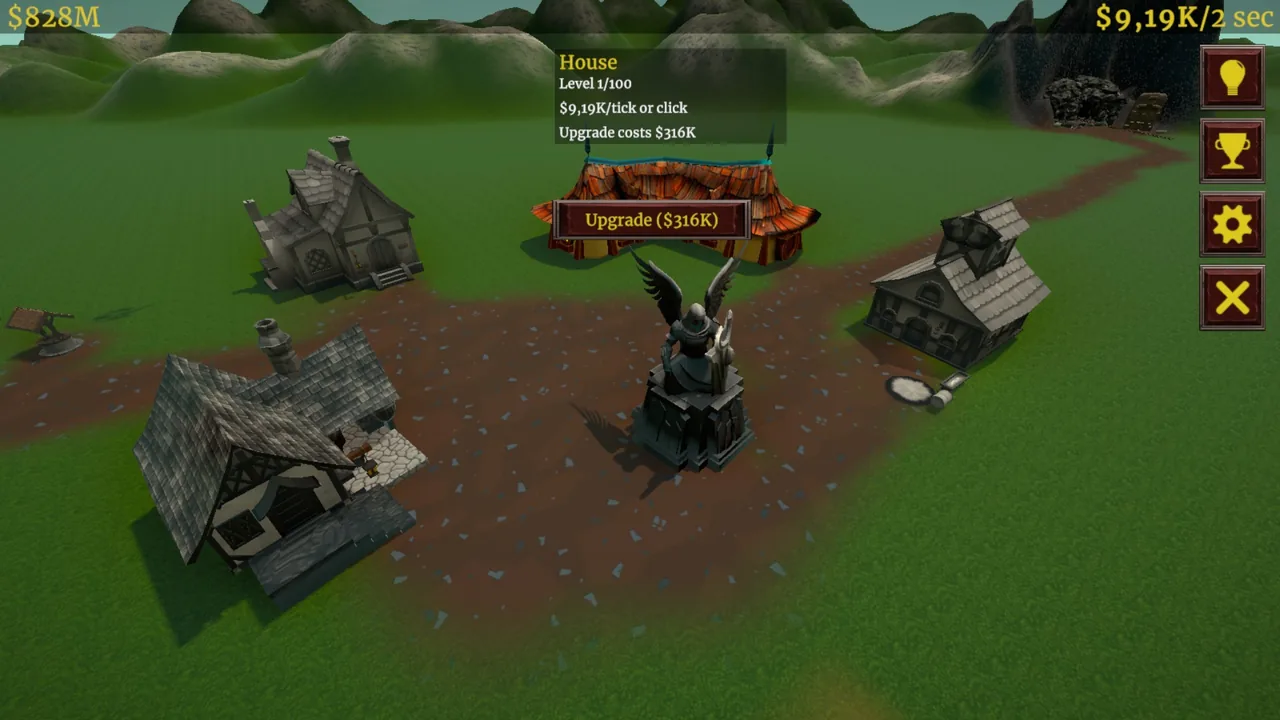
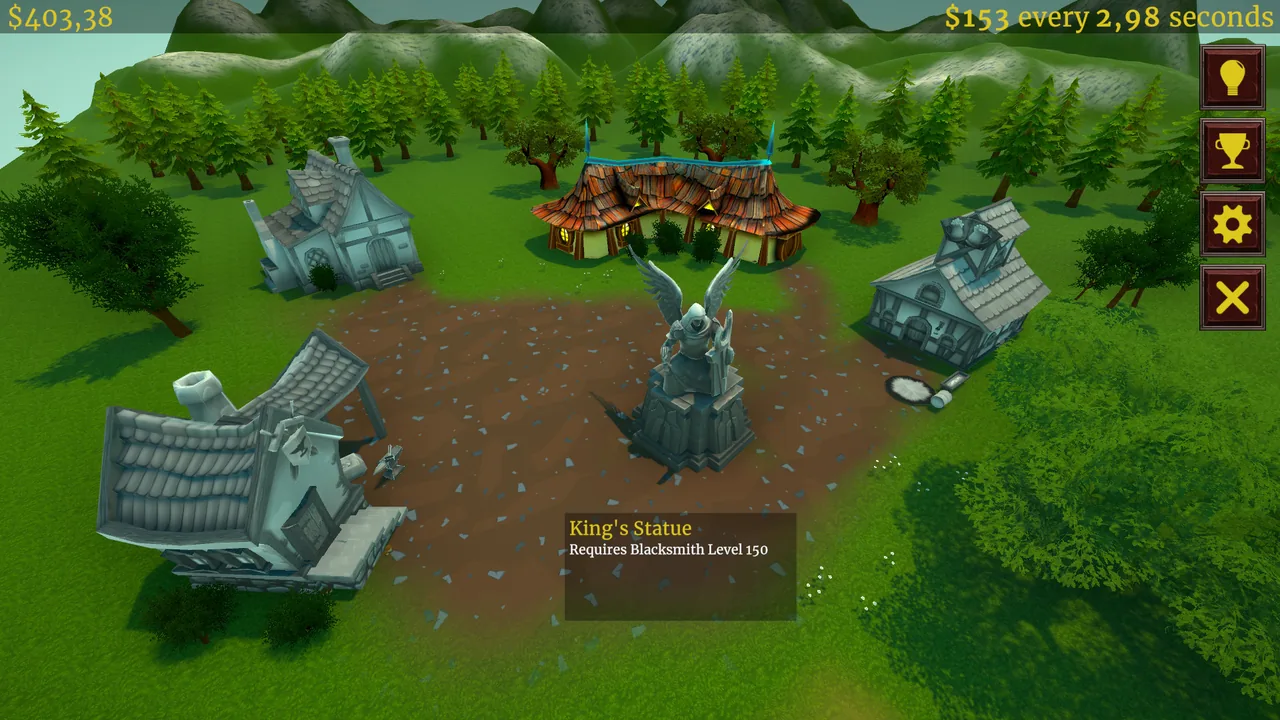
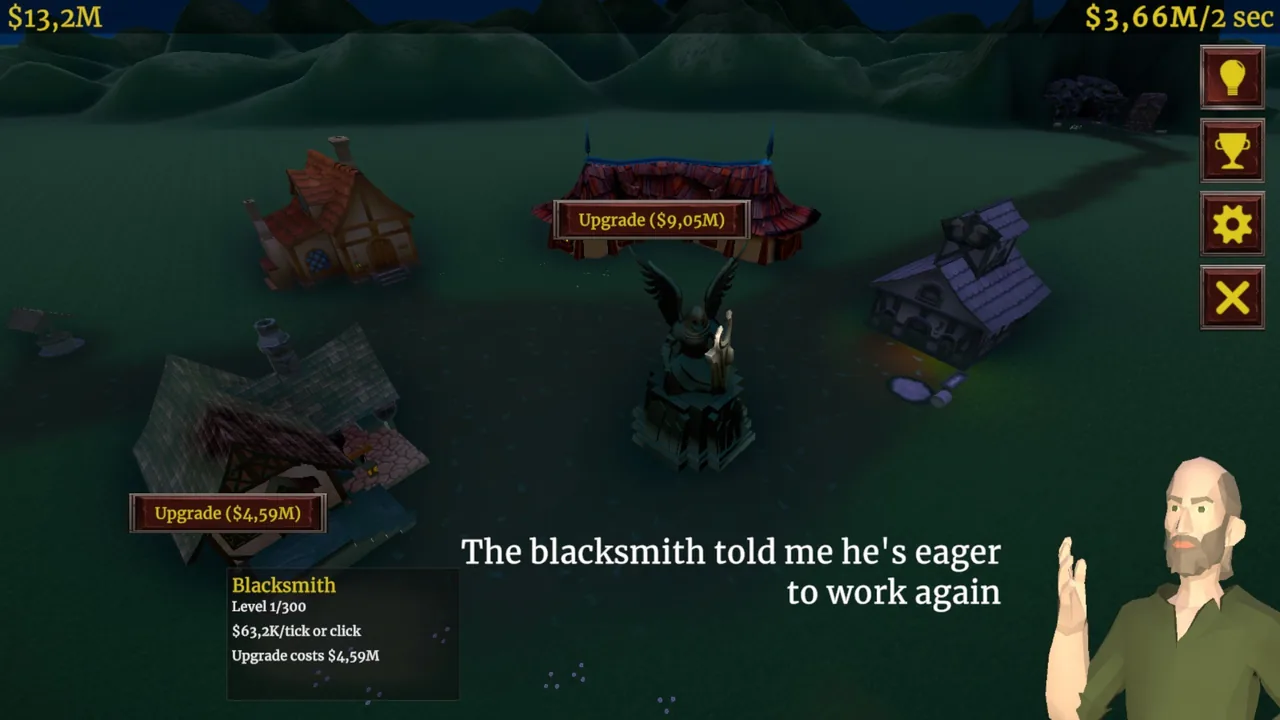
Kingdom of Assetia: The Clicker Game puts you in charge of Anywhere, a village once known as a premier adventuring hub, after a flood levels everything but a single house. As mayor, you click that house to generate income, spend it on upgrades, and gradually unlock the rest of the settlement — a blacksmith, a tavern, a bakery, a statue, and further buildings each with their own progression track. After enough clicking, a second layer opens up: idle resource production that keeps paying out while you're not actively playing, which is the part that pushes the game from pure clicker into idle/clicker hybrid.
The whole thing is the work of one developer, built — by the developer's own account on the store page — almost entirely from free Unity Asset Store scenery, because they had access to code tools but not to an artist. That's a genuinely sympathetic starting point for a NZ$1.29 game, and it's worth saying up front, because a lot of what follows is about where the ambition outran the budget rather than about a cash grab.
The loop, and where it stops working
The early reviews — several written during the game's Early Access period in 2021, before the 25 January 2022 full release — describe a rough but earnest clicker with an unusually responsive developer: bugs reported and fixed quickly, balance passes made in response to community feedback, buildings each getting their own specific purpose rather than existing as reskinned progress bars. One Early Access reviewer with over 2,500 minutes logged calls it simply "not as bad as many i've played on Steam," while acknowledging the grind was still hard at the time.
The reviews written after the 1.0 release tell a more consistent and more negative story, and they converge on the same specific complaint: the game gives up its pacing almost immediately. One reviewer reports reaching the halfway point on an early statue upgrade (250 of 500) in about fifteen minutes, at which point "things slow down to a crawl" and the same upgrade's second half becomes, in their words, a matter of months rather than minutes — with an auto-clicker running the whole time. A more detailed review goes further, estimating that at the game's then-current offline-earning and per-click rates, reaching 100% completion would realistically take "hundreds (if not thousands) of years." Both are describing the same shape: a clicker that hands you everything reachable in the first act and then asks for geological patience for everything after.
What the achievement curve actually shows
Steam's global achievement statistics back this specific complaint up better than any single review can, because they're a record of what every owner who bothered to check actually did. The three currency milestones — earning $1B, $5B and $10B — sit at 88.1%, 86.6% and 85.1% respectively, essentially free. A cluster of cosmetic and building unlocks (Magic Mushrooms, Flower Power, Forestation, Bushes, Pine-acle, and several more) holds steady in the 60s and low 70s. Then the curve breaks: the last achievement above 60% sits at 61.2%, and the next one down — unlocking the blacksmith — drops to 43.2%, an 18-point cliff in a single step. From there the numbers keep sliding in smaller increments through the tavern (37.2%), the statue (34.4%) and a run of mid-game unlocks in the 20s and low 30s, bottoming out at 18.9% for the game's last listed achievement. That's not a smooth difficulty curve; it's a wall that roughly four in ten players who cleared the early game never get past, which lines up precisely with what the written reviews describe.
Presentation, interface, and one specific technical complaint
The store page describes "pretty decent 3D graphics using free assets only" and "lovely music," and that's a fair, modest claim for what it is — recognisable Unity Asset Store scenery arranged into a small village, not an art direction of its own. Reviewers are split on it: some find it perfectly serviceable for a solo project, one calls it flatly "ugly." The one interface detail that shows up independently in more than one review is more concrete: there's no window-resize option and no options menu beyond a credits button, which for a game meant to be left running in the background is a real omission. One detailed review also reports the game's CPU usage running unexpectedly high for what it is — describing an increase "equivalent to" running a full open-world action RPG on the same machine. That's a single player's measurement rather than a verified benchmark, but it's specific enough, and consistent enough with "a lot of idle calculation running with no throttling," to flag rather than dismiss.
The single harshest review in the corpus, written roughly seven months after the 1.0 launch, argues the writing amounts to "a collection of few sentences" functioning more as a blocked tutorial prompt than an actual story, and that locked and unlocked achievement art look identical on Steam. The same review is also the one that confirms, more usefully, that the achievements and the underlying systems do all technically work — the reviewer reports finishing all of them in about three weeks by logging in once a day, with no reset or prestige mechanic waiting at the end, just the choice to stop checking in.
Monetisation and value: the one clean win
This is where Kingdom of Assetia has nothing to apologise for. It's a NZ$1.29 one-time purchase with no in-app purchases, no ads, and no premium currency of any kind — the entire monetisation story is the price on the store page. For a library whose readers are routinely burned by mobile-adjacent clicker monetisation, a solo developer shipping a straightforward premium release at coffee-money pricing, with 29 achievements that a reviewer confirms genuinely all fire, deserves credit on its own terms. It just doesn't change what the content underneath that price actually offers once the opening rush is spent.
The review corpus
Kingdom of Assetia has nine total user reviews on Steam — four positive, five negative — few enough that Steam doesn't display a percentage score at all, just "9 user reviews." That's a small enough sample that this review reads every one of them rather than any statistical summary, and it does exactly that: all nine, positive and negative alike, inform everything above. Most of the positive reviews date to the 2021 Early Access period and specifically praise the developer's responsiveness rather than the finished balance; the negative reviews are split between that same Early Access window and the period after full release, with the harshest read landing seven months after 1.0 shipped. There's no sign of a live controversy or an ongoing patch cycle to weigh against the older reviews — just a small, consistent record of a clicker that impressed people with its developer's effort and disappointed them with its pacing.
Final verdict
Kingdom of Assetia: The Clicker Game is a solo developer's honest, cheaply priced attempt at the genre, and it deserves credit for what it is: no predatory monetisation, buildings that genuinely each do their own thing, an idle-income layer that works as advertised, and a developer who — at least during Early Access — visibly listened to feedback. What it doesn't survive is its own pacing. The achievement curve, the written reviews from both 2021 and 2022, and the complete absence of any reset or prestige system all point at the same problem: a game that hands you its first act in minutes and its second act in, credibly, months. At NZ$1.29 that's a low-stakes disappointment rather than an expensive one, which is the only reason this lands in "poor" rather than lower. It's a fair curiosity purchase for genre completists or anyone who wants to see what one person can build from free assets and real effort. It is not a clicker worth keeping installed.
Pros and cons
Pros
- NZ$1.29 one-time price with no in-app purchases, ads or premium currency of any kind
- Each rebuilt building carries its own dedicated upgrade track rather than one shared multiplier
- Idle income keeps accruing while you're away, and even the game's harshest reviewers confirm the underlying achievement and offline-earning math actually functions
Cons
- Progression falls off a cliff early: Steam's own achievement data shows completion drop by roughly 18 points between an easy early cluster and the first mid-game building unlock
- No options menu beyond a credits button, and no way to resize the window
- No prestige, reset or "new game plus" loop, so post-launch reviewers describe the endgame as logging in once a day and waiting
Screenshots
-
Kingdom of Assetia: The Clicker GameImage: Chatty Pillow via Steam -
Kingdom of Assetia: The Clicker GameImage: Chatty Pillow via Steam -
Kingdom of Assetia: The Clicker GameImage: Chatty Pillow via Steam -
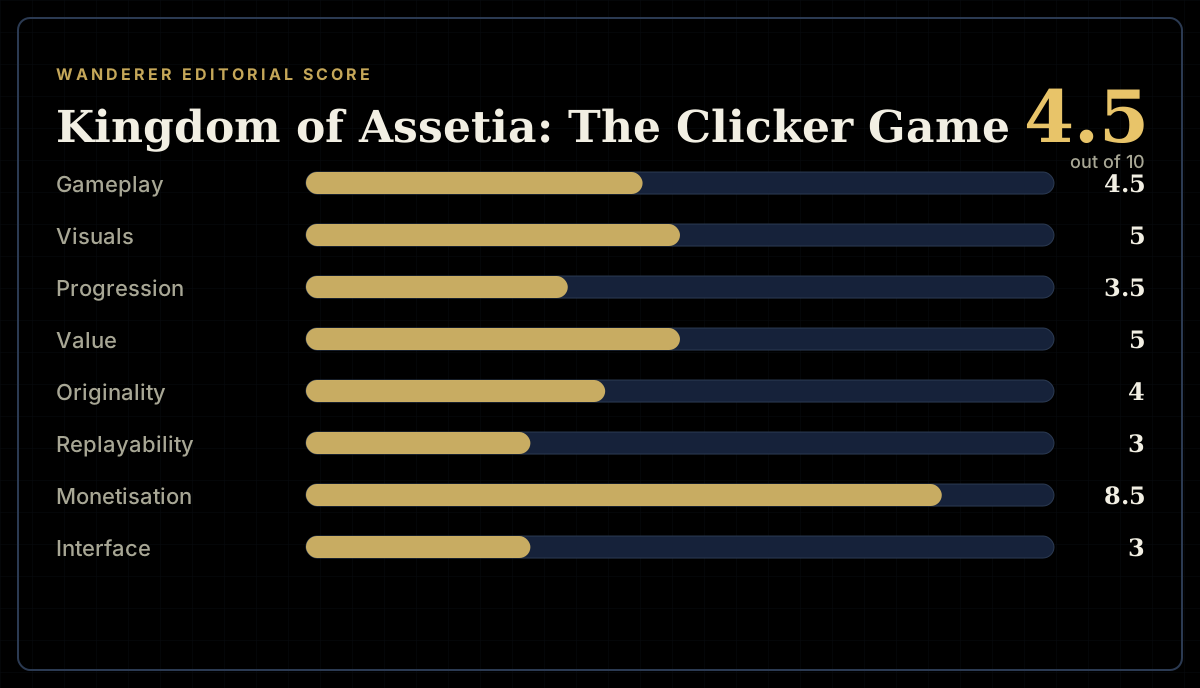
How the review scores each part of the gameWanderer Editorial -
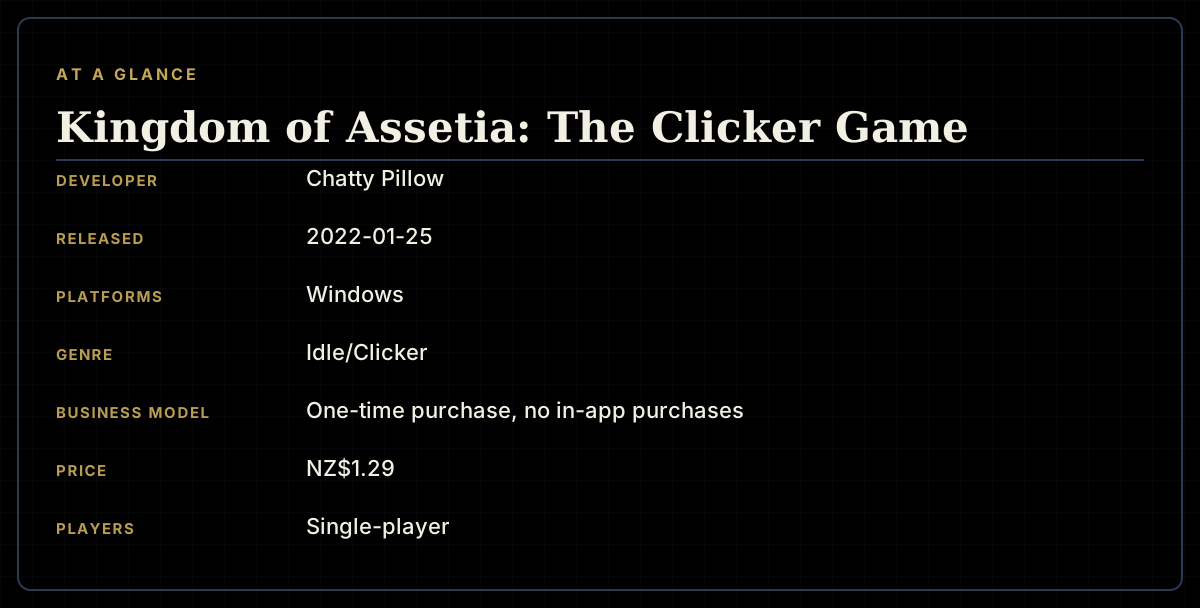
The game at a glanceWanderer Editorial -
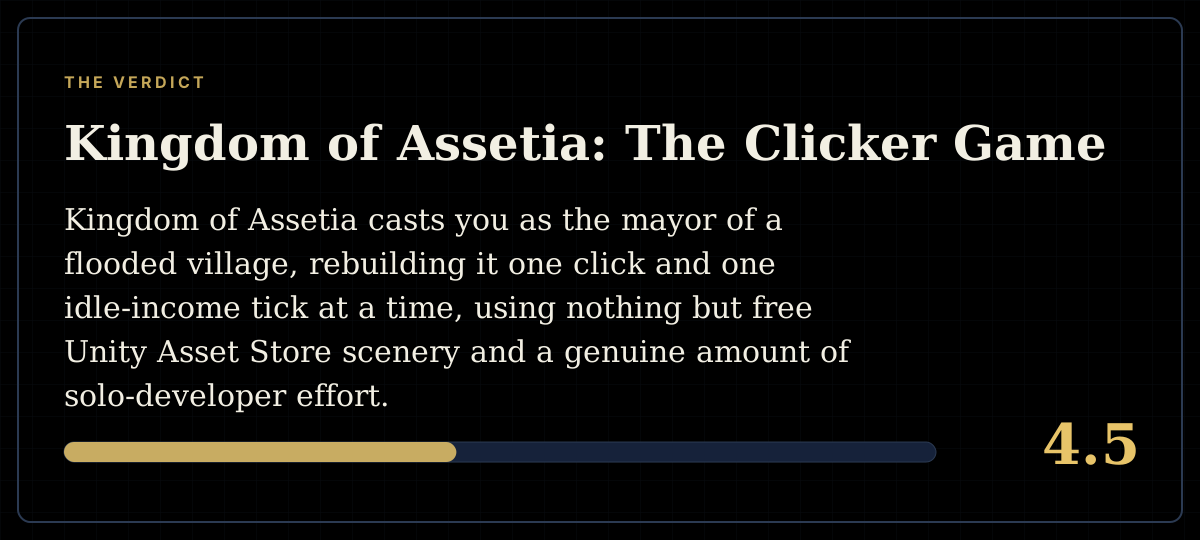
The short versionWanderer Editorial