Game review
Idle Catfarmia
5.5 / 10
- Developer
- RainbowStudio
- Publisher
- RainbowStudio
- Released
- 4 October 2023
- Platforms
- Windows
- Genre
- Idle Management Sim
- Monetisation
- One-time purchase. No in-app purchases, ads or premium currency.
- Players
- Single-player only
The short version
Idle Catfarmia asks you to arrange 24 kinds of crops, animals and minerals across a farm tended by five cat fairies, letting production run whether or not you're at the keyboard. It sits at Mostly Positive, 45 of 61 reviews (73.8%), and the praise is specific and consistent: this is a true idler, not a disguised clicker, and reviewers say so approvingly -- "you don't need to click all the time, it does what it says on the tin."
What the same review sample says just as consistently is that the content doesn't last as long as the price tag implies. Steam's own global achievement data confirms it in a way no review text can argue with: completion holds a steady, gentle slope from 97% down to roughly 33% across the first several achievement tiers, then falls off a cliff to around 5-6% for the tiers after that. Most players who buy this game never get near its back half.
Biggest strengths
- A genuinely hands-off idle game -- production runs on its own, and several reviewers specifically praise it for not disguising a clicker as an idler
- A distinctive, charming presentation built around five cat fairies and 24 placeable resource types across plants, animals and minerals, with production bonuses for smart placement
- Real Steam achievement support (235 achievements) that gives structure to a genre that often has none
Biggest weaknesses
- Global achievement data shows completion falling from roughly 97% to 33% across the early tiers, then cratering to about 5-6% for everything after -- the overwhelming majority of buyers never reach the game's back half
- No prestige or reset system, so reviewers describe doing "one run and you're done" rather than a loop that invites returning
- "Not worth full price" is the single most repeated phrase across both positive and negative reviews in the sample gathered for this review
Who it's for: Fans of gentle, genuinely hands-off idle games who want a short, pleasant few hours with a cat-fairy farm theme. A poor fit for anyone wanting long-term idle progression, a prestige loop, or a game that justifies repeated return visits.
Our recommendation: Worth a look on sale for a handful of relaxed sessions; several reviewers who enjoyed it specifically say it isn't worth full price, and the achievement data backs up why -- most of what the price buys goes largely unused.
5.5 / 10
A true idler, for a while
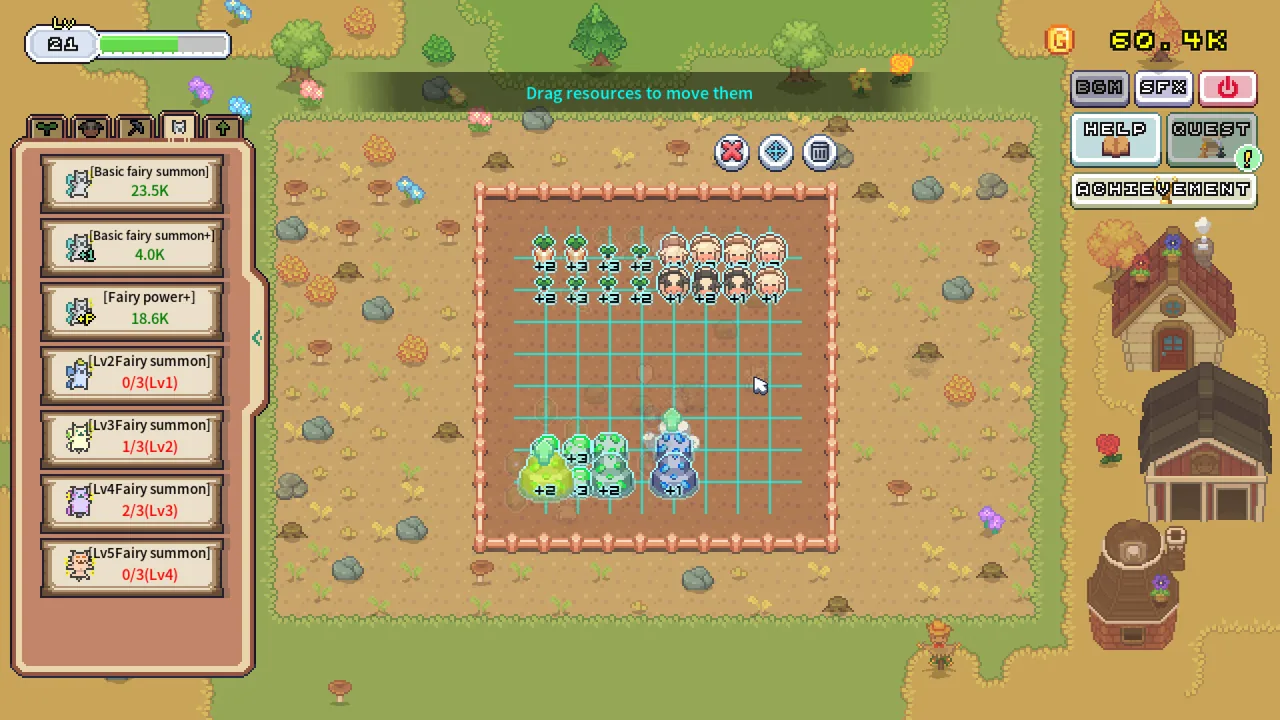
The thing Idle Catfarmia gets right, and gets right consistently enough that it's the backbone of every positive review in the sample gathered for this piece, is that it actually is an idle game. Production ticks along whether you're watching or not, offline gold accrues properly, and there's no hidden requirement to tap the screen every few seconds to keep numbers moving. "It's a true idler. You don't need to click all the time. It does what it says on the tin," reads one representative review. That's a real distinction worth stating plainly, because plenty of games marketed as idle games quietly aren't — Idle Catfarmia is. Around that honest core sits a genuinely pleasant, low-stakes presentation: five cat fairies assist production, 24 resource types split across plants, animals and minerals can be placed freely across the farm grid, and placement itself affects output, giving the early hours a light layer of spatial planning on top of the pure idle math.
The presentation carries a fair share of the early goodwill too. The cat-fairy theme is consistently the thing reviewers reach for first when they're being positive — "fun with cats," "such a fun idle game with a fun, farm twist," "cute, fun, and highly addictive" — and it's a reasonable pitch on its own merits: the idle-management space is crowded with generic factory and tycoon reskins, and a small, cosy farm run by fairy caretakers is a distinct enough hook to stand out in a storefront scroll. RainbowStudio also shipped the game with English, Japanese, Simplified and Traditional Chinese and Korean support at launch, which is more localisation effort than many games at this price point bother with, and helps explain why the review base skews less lopsided by language than some of its genre peers.
Where the content runs out
The problem is what happens after those early hours, and Steam's own numbers make the case more convincingly than any review text could. Pulled from the public achievement API, completion percentages hold a smooth, expected slope through the early tiers — 96.8% down to roughly 33% by the fifth achievement group — the normal shape of players gradually dropping off as a game asks more of them. Then, between that fifth tier and the next, completion collapses: every achievement in tiers six through ten sits at roughly 4-6%, essentially flat, meaning whatever content those tiers gate is functionally unseen by the overwhelming majority of buyers. That data lines up exactly with what reviewers describe in words: "I played around 4 hours of the game and reached a point where you're just waiting to get from level 65 to 100," reads one; "there is... NOTHING to do here... all 3 of the crops are just higher tiers of their class... excruciatingly linear... no synergy," reads another, from a reviewer with 11 hours logged. A third, more blunt: "I did 100% the game but it's not worth 7 euro." Growth, several reviewers agree, doesn't lead anywhere new — it just re-skins the same three resource categories at higher numbers, with no prestige or reset system to give a second run a different shape.
Price versus what's actually there
That content shortfall directly drives the review sample's most repeated single complaint: value for money. It shows up across both positive and negative reviews alike, which is unusual and worth noting — this isn't a case of angry refund-seekers dragging the score down while happy players stay quiet. A reviewer who otherwise enjoyed it writes "I do not think it is worth full price, but discounted it's ok." Another: "not sure if the rather small amount of content was worth the $6 I paid for it though." A third describes the game explicitly as "an achievement game to drag out the 2 hour refund window," suggesting at least some buyers found themselves padding playtime just to decide whether to keep it. None of this reads as review-bombing or coordinated criticism — it's the same specific, reasonable complaint arrived at independently by reviewers with wildly different playtimes, from 20 minutes to 78 hours, which is a stronger signal than any single loud complaint would be.
A smaller, practical friction
One recurring quality-of-life gripe compounds the pacing problem rather than causing it: there's no batch move or delete option for placed resources, so reorganising a filled-in farm grid late in a run means clicking and dragging pieces individually. For a game whose whole pitch is "you don't need to click all the time," a UI gap that forces exactly that at the point where players are already losing patience with the content is a fair thing to flag, and multiple reviewers do.
Wanderer's own gathering and crafting skills run on the same underlying premise as any idle game — visible, steady numbers that go up whether or not you're watching closely — and the contrast is instructive. The systems that keep a longer-running idle loop alive are the ones that give a player a reason to keep making decisions well past the first few sessions: new recipes, deeper skill trees, something that changes shape rather than just scaling up. Idle Catfarmia's achievement curve reads like a case study in what happens when that layer is thin: the mechanical hook lands immediately and lands well, but there's little pulling a player back once the initial charm of placing cat fairies and watching crops tick over has been seen once.
Verdict
Idle Catfarmia is a well-made example of a genuinely rare thing — an idle game that doesn't secretly want you clicking constantly — wrapped around a cute, cat-fairy farm theme that a fair number of players clearly enjoyed for a few sessions. Its ceiling, though, is real and measurable: the achievement data shows almost nobody reaches its back half, the growth those reviewers do reach is described consistently as linear and synergy-free, and "not worth full price" is close to a consensus position among the people who otherwise liked it. Pick it up on a sale for a handful of relaxed evenings rather than expecting a long-term idle project.
Pros and cons
Pros
- A genuinely hands-off idle game -- production runs on its own, and several reviewers specifically praise it for not disguising a clicker as an idler
- A distinctive, charming presentation built around five cat fairies and 24 placeable resource types across plants, animals and minerals, with production bonuses for smart placement
- Real Steam achievement support (235 achievements) that gives structure to a genre that often has none
- Short and inexpensive enough that even reviewers who call it thin still describe getting a fair "time waster" out of the NZ$11.29 asking price
Cons
- Global achievement data shows completion falling from roughly 97% to 33% across the early tiers, then cratering to about 5-6% for everything after -- the overwhelming majority of buyers never reach the game's back half
- No prestige or reset system, so reviewers describe doing "one run and you're done" rather than a loop that invites returning
- "Not worth full price" is the single most repeated phrase across both positive and negative reviews in the sample gathered for this review
- Growth is described by multiple reviewers as strictly linear -- higher crop tiers replace lower ones with no synergy or meaningful build variety between them
- No batch move or delete tools for resources, which several reviewers say makes late-game farm reorganising a chore despite the game's otherwise hands-off design
Screenshots
-
Idle CatfarmiaImage: RainbowStudio via Steam -
Idle CatfarmiaImage: RainbowStudio via Steam -
Idle CatfarmiaImage: RainbowStudio via Steam -
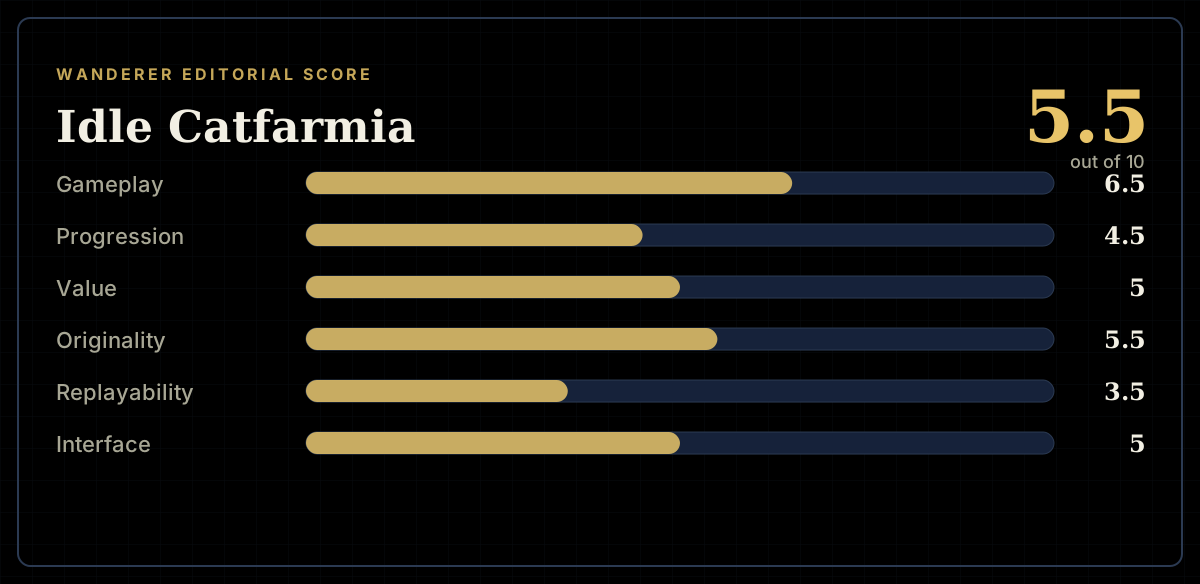
How the review scores each part of the gameWanderer Editorial -
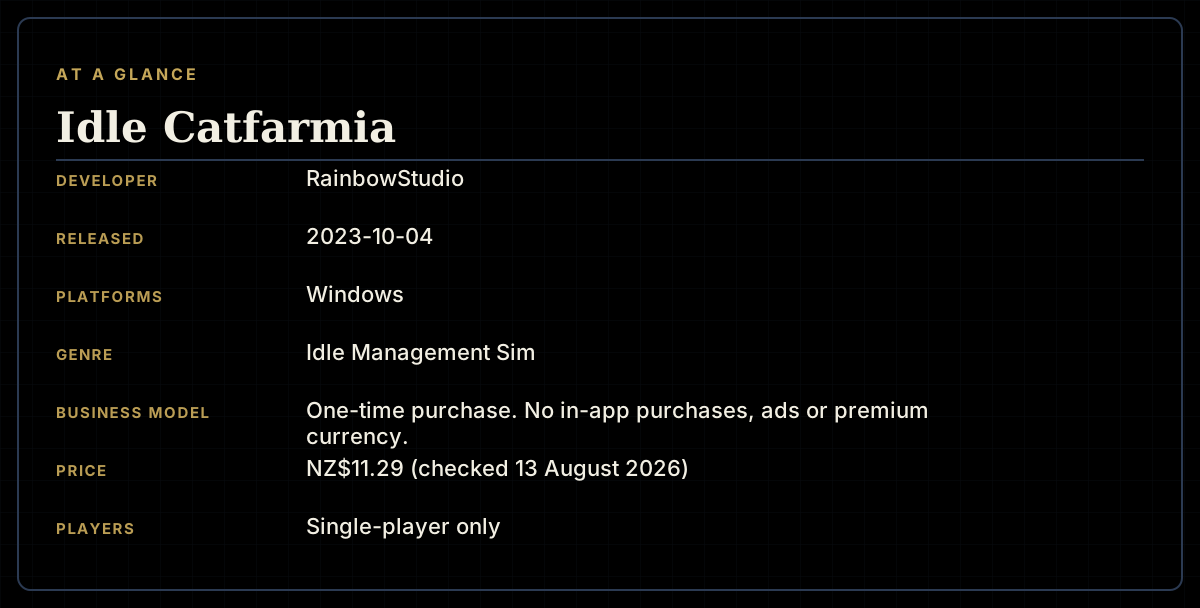
The essentials at a glanceWanderer Editorial -
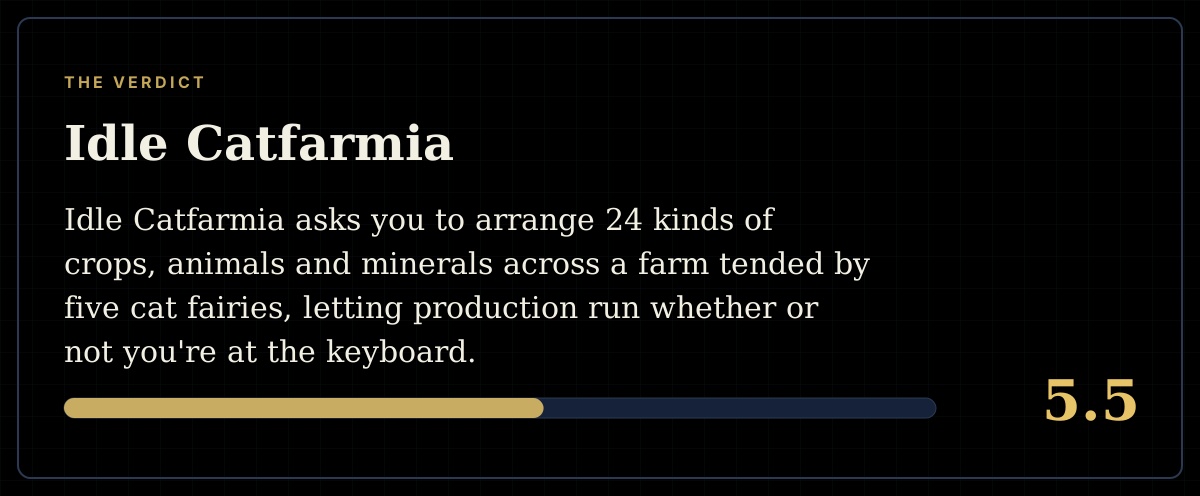
The final verdictWanderer Editorial