
Game review
How To Grow a Black Hole
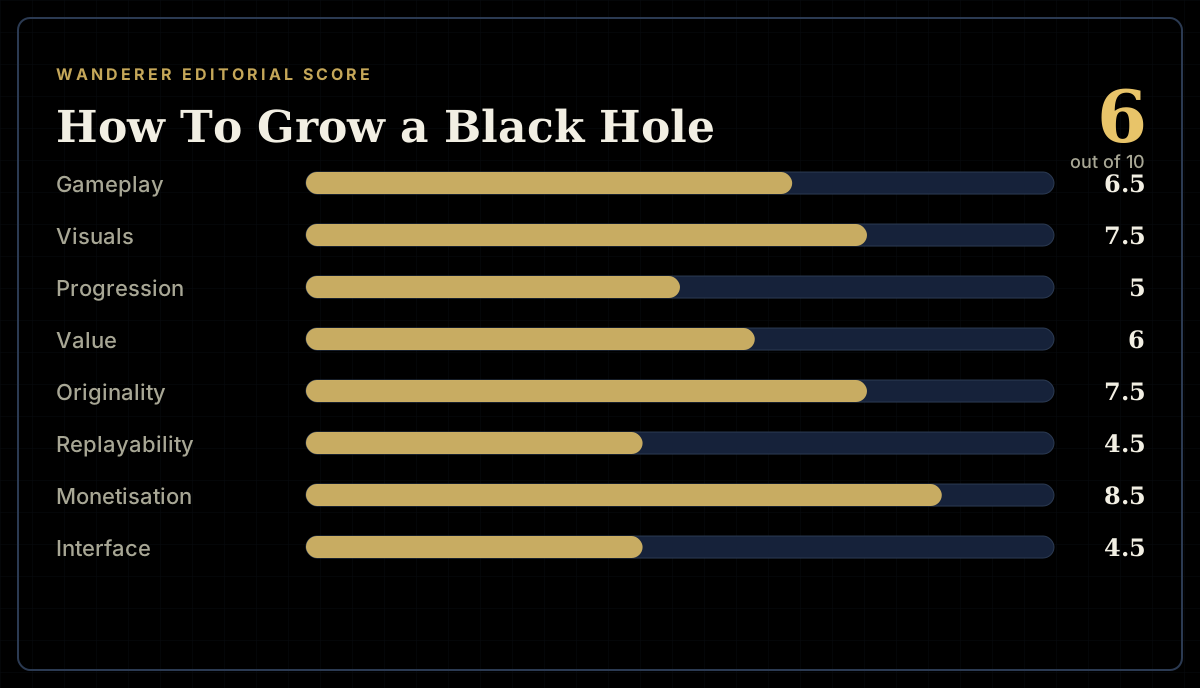
6 / 10
- Developer
- Desolation Digital
- Publisher
- Desolation Digital
- Released
- 23 June 2026
- Platforms
- Windows
- Genre
- Incremental Simulation
- Monetisation
- One-time purchase, no in-app purchases, no ads, no subscription
- Players
- Single-player only, with online leaderboards for comparing black hole mass against other players
The short version
How To Grow a Black Hole nails its pitch in the first ten minutes: feed a black hole matter, watch its accretion disk swell, and manage the tension between growing fast and collapsing under your own instability. It's a genuinely striking idea for an incremental game and the visuals sell it. What doesn't hold up is everything underneath the hook — a research tree that frequently doesn't explain what its own upgrades do, a content loop that runs dry within a few hours, and a stretch of recent reviews turning on the game over performance problems and suspicions about how much of it was actually built by hand.
Biggest strengths
- The core feed-and-balance loop is a genuinely distinctive hook for an incremental game — few other games in the genre make instability itself the thing you're managing
- The black hole and its accretion disk are the best-looking thing about the game, and reviewers consistently single out the visuals and sound design as worth the price alone
- Bite-sized facts comparing your black hole's mass to real astronomical objects give the loop an educational hook that lands well early, even if the game leans into it a little too hard
Biggest weaknesses
- Several upgrades and research nodes don't explain their actual effect, and a recurring complaint is that some upgrades measurably hurt progress rather than help it
- The content loop is short — once the main upgrade paths are exhausted, growing further mass mostly means repeating the same feed-and-stabilise cycle without new systems to engage with
- Performance complaints are widespread and specific: frame-rate drops and crashes that get worse as the black hole (and its particle effects) grow larger, with some players reporting crashes around the two-hour mark
Who it's for: Incremental-game regulars who want something to run in a second monitor for an afternoon, and anyone drawn to the novelty of a black hole management sim over another factory or fantasy theme.
Our recommendation: Worth the low asking price for a short, visually satisfying session if you go in expecting a snack rather than a meal — don't buy it expecting the research tree or the leaderboard chase to hold your attention for long, and check current reviews before buying if stability and trust in the build matter to you.
6 / 10
Most incremental games ask you to imagine what you're building — a factory you never see, a kingdom rendered as a progress bar. How To Grow a Black Hole skips the abstraction and puts the thing itself on screen: a churning accretion disk that visibly swells every time you feed it, sitting at the centre of a management loop where growing too fast is exactly as dangerous as growing too slowly. It's a sharp, simple idea, dressed in genuinely good-looking visuals, and for the first hour or two it's easy to see why Desolation Digital's pitch generated real buzz before launch. The problem is what happens once that first hour ends.
Feed it, stabilise it, don't let it collapse
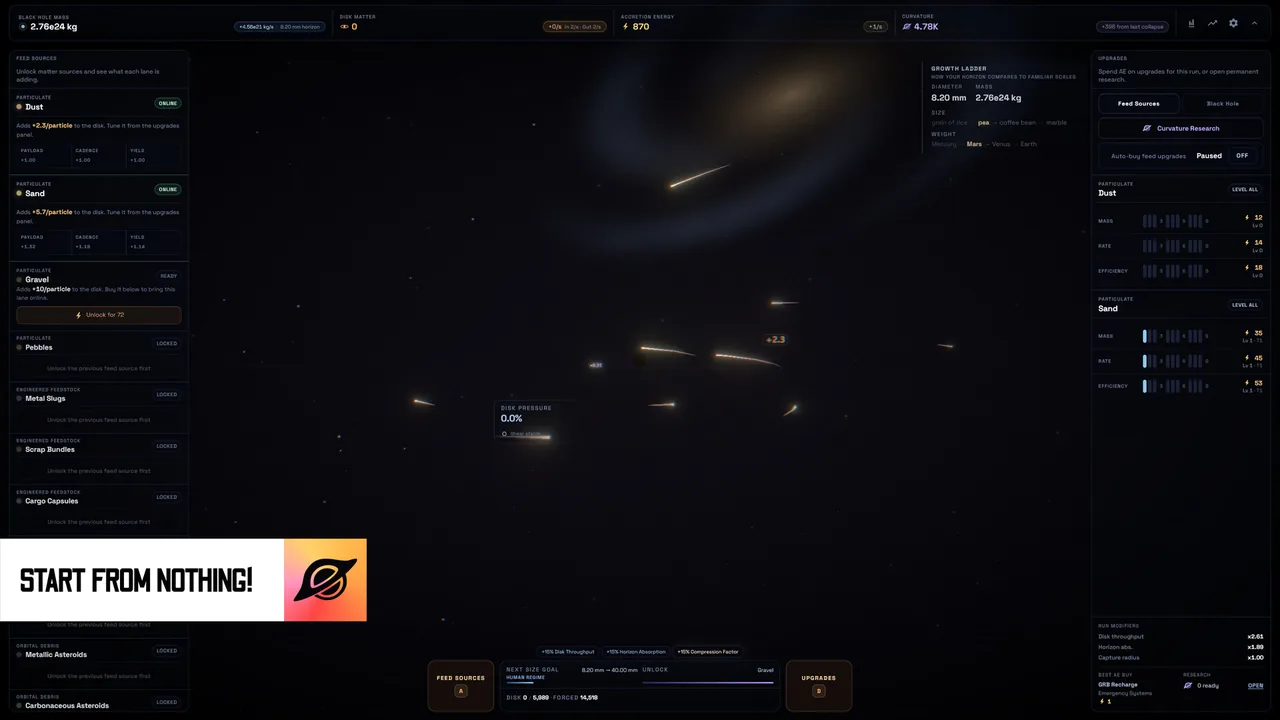
The loop is straightforward on paper. You feed your black hole matter to increase its mass, spend that mass and whatever currency the game generates on upgrades and research, and keep an eye on a rising instability meter that punishes growing too aggressively with a collapse — the incremental genre's usual soft-reset, reframed here as an actual physical catastrophe rather than a prestige button. Early research unlocks faster feeding and some automation, and the game clearly wants you thinking about the trade-off between raw growth speed and staying in one piece, which is a more interesting central tension than a lot of incremental games bother building.
Where it falls down is in how well that tension is actually communicated. A consistent complaint across negative reviews is that upgrade and research descriptions don't reliably tell you what they do, and in some cases the effect runs backwards from what the description implies — an upgrade that reads as beneficial but measurably slows or destabilises your black hole instead. For a game built entirely around weighing one number against another, opaque upgrade text isn't a minor annoyance; it undermines the one decision the whole loop is asking you to make well.
A short tree with not much at the end of it
Beyond the opening research nodes, the content thins out quickly. Players who push past the first few hours describe a game with comparatively few upgrade paths and not much new to unlock once the early systems are online — growing further mass becomes a matter of repeating the same feed-and-stabilise cycle rather than encountering fresh mechanics. That's a real problem for a genre that lives or dies on giving players a reason to keep opening the tab, and it shows up directly in how the game is talked about: praise clusters around the first sitting, criticism clusters around what's left to do after it.
The leaderboard system is the game's answer to that gap — compete globally for the largest stable black hole — and it's a reasonable idea that doesn't quite compensate. Chasing a leaderboard position only motivates a slice of the incremental audience, and reports of unaddressed leaderboard exploits undercut the "compete fairly for the biggest black hole" pitch for the players who do care about the ranking.
The best part of the game is what it looks like
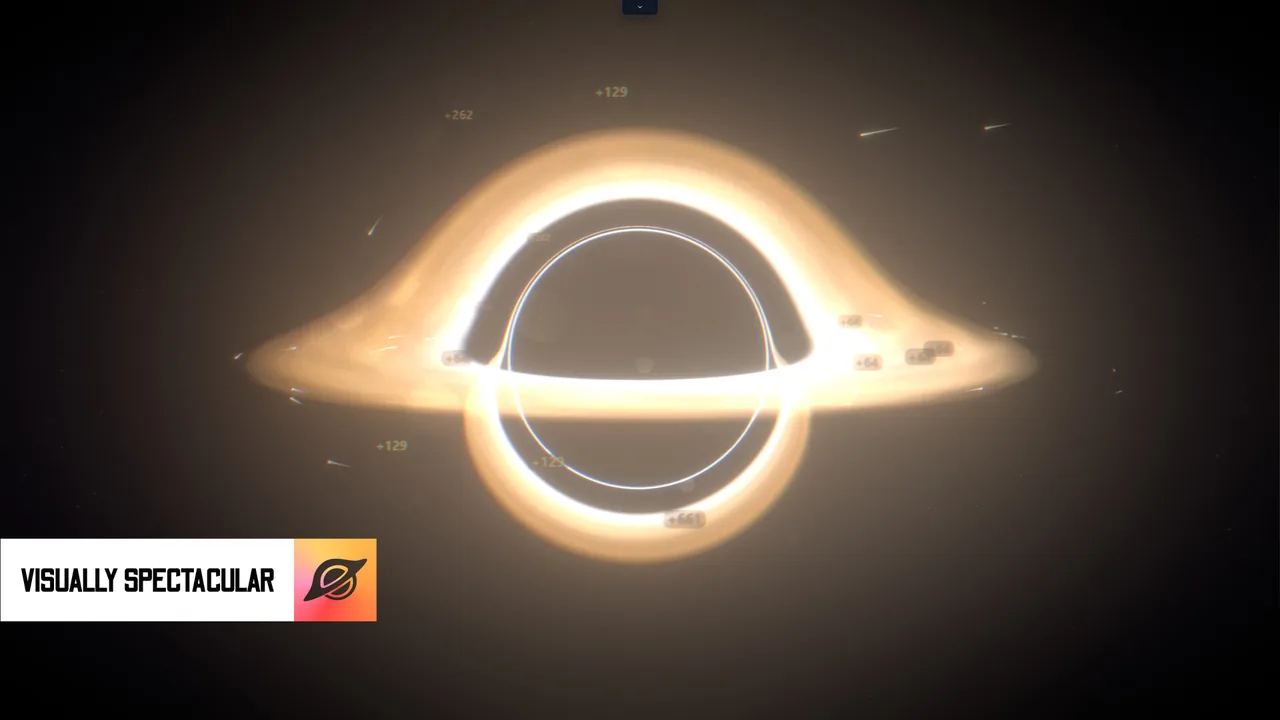
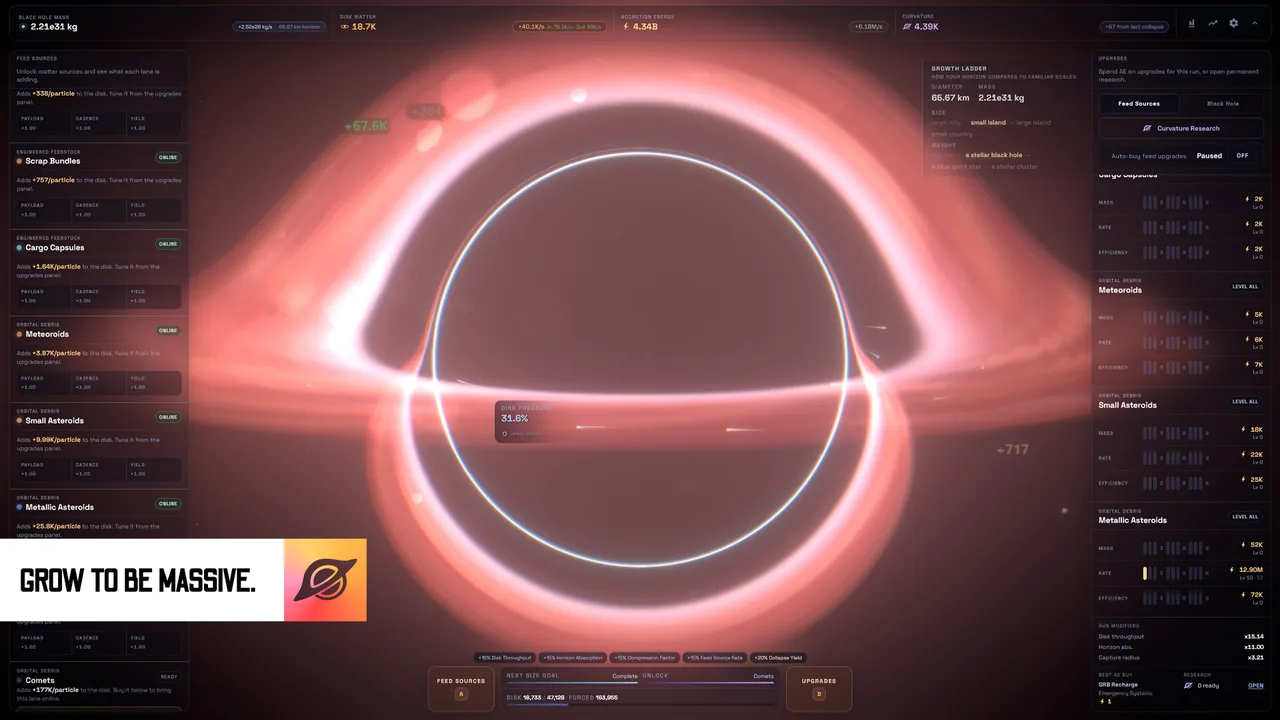
Visually, How To Grow a Black Hole earns its praise. The accretion disk rendering, the sense of scale as your black hole climbs from a curiosity to something genuinely massive, and the sound design around it are the most consistently complimented elements in player feedback, across both positive and negative reviews. The game backs that up with a nice educational hook — short facts comparing your black hole's mass to real astronomical objects, framed by the store page itself as starting out interesting and getting unsettling fast as the numbers climb. It's a smart bit of writing that gives an otherwise abstract number some actual weight, even if it can't carry a progression system that isn't holding up its end.
Performance problems and a trust problem
The most damaging pattern in recent feedback isn't about balance — it's technical. Multiple players report meaningful frame-rate drops and outright crashes as a black hole grows larger and its particle effects get busier, with a specific complaint about crashes appearing around the two-hour mark of a session. For a game explicitly pitched as something to leave running in the background on a second monitor, instability that gets worse the longer it runs is a serious flaw, not a launch-week rough edge.
That technical criticism has fed into something harder to quantify: a growing number of negative reviews accuse the game of being substantially AI-generated, pointing to an interface that behaves inconsistently, a frame-rate cap that doesn't reliably hold, and general polish that reads as uneven for a game asking a real price. Those are player allegations rather than confirmed facts — the developer hasn't made a public statement addressing them — but the pattern is specific enough, and repeated by enough independent reviewers, that it's shaping the game's reception rather than sitting on the sidelines as a fringe complaint. The clearest evidence that something is going wrong is in the numbers themselves: the game sits at 69% positive across its lifetime total, but the last 136 reviews have dropped to 55% positive, a meaningfully worse ratio than the game launched with. That's not a game recovering from early hiccups — it's one trending in the wrong direction.
Value and monetisation
There's nothing to fault here. How To Grow a Black Hole is a flat NZ$6.39 one-time purchase with no in-app purchases, no advertising and no energy system dressed up as a paywall. Steam Cloud saves, achievements and leaderboards are all in place for a game this size, and reviewers who like the core hook consistently describe it as good value at that price regardless of their other complaints. The monetisation model was never the issue here — the amount of game behind it is.
Final verdict
How To Grow a Black Hole has a genuinely good idea at its centre, and the moment-to-moment act of feeding and stabilising a growing black hole is satisfying enough to justify its low price for a short session. It doesn't climb higher than a 6.0 because the systems wrapped around that idea don't hold up past the first couple of hours — a research tree that regularly fails to explain its own effects, a content loop that runs out of new things to show you, and a wave of recent performance complaints and AI-authorship allegations that have visibly dragged the game's own review trend downward since launch.
If you want a striking visual novelty to run for an afternoon at a price that barely registers, it's an easy pickup. If you're hoping for an incremental game with a research tree deep enough to hold your attention for weeks, look elsewhere until — or unless — Desolation Digital addresses the stability and clarity issues its own recent reviews keep raising.
Players who'd rather their numbers keep climbing inside a persistent world with other people in it, instead of a solo leaderboard chase, might also want to look at Wanderer.
Pros and cons
Pros
- The core feed-and-balance loop is a genuinely distinctive hook for an incremental game — few other games in the genre make instability itself the thing you're managing
- The black hole and its accretion disk are the best-looking thing about the game, and reviewers consistently single out the visuals and sound design as worth the price alone
- Bite-sized facts comparing your black hole's mass to real astronomical objects give the loop an educational hook that lands well early, even if the game leans into it a little too hard
- A flat NZ$6.39 one-time price with no in-app purchases, ads or premium currency makes it an easy, low-risk pickup regardless of how the rest of the review lands
- Steam Cloud saves, achievements and leaderboards are all present and functioning for a game this small
Cons
- Several upgrades and research nodes don't explain their actual effect, and a recurring complaint is that some upgrades measurably hurt progress rather than help it
- The content loop is short — once the main upgrade paths are exhausted, growing further mass mostly means repeating the same feed-and-stabilise cycle without new systems to engage with
- Performance complaints are widespread and specific: frame-rate drops and crashes that get worse as the black hole (and its particle effects) grow larger, with some players reporting crashes around the two-hour mark
- A large and growing share of negative reviews accuse the game of being built with AI-generated code or assets, citing an interface that behaves inconsistently and performance quirks like frame caps not holding — allegations the developer has not publicly addressed
- Recent review sentiment has dropped well below the game's lifetime average, suggesting the problems above are getting worse rather than settling down after launch
Screenshots
-
How To Grow a Black HoleImage: Desolation Digital via Steam -
How To Grow a Black HoleImage: Desolation Digital via Steam -
How To Grow a Black HoleImage: Desolation Digital via Steam -
How the review scores each part of the gameWanderer Editorial -
The short versionWanderer Editorial