
Game review
Gun Shop: Tidy Up Review
4.9 / 10
- Developer
- kotcool
- Publisher
- kotcool
- Released
- 1 September 2026
- Platforms
- ["Windows"]
- Genre
- Simulation
A Familiar Tidying Formula, Reskinned as a Gun Shop
Gun Shop: Tidy Up takes the now-crowded "tidy-up simulator" formula — pick up scattered objects, sort them onto the correct shelves, watch a cluttered space become orderly — and reskins it around a gun store, tasking players with organizing more than 2,700 rifles, pistols, shotguns, and accessories back into their proper places. Reviewers describe the underlying loop as competent but entirely unsurprising, with one summing it up plainly as "nothing new, but good enough to kill a few hours." The theme is the one genuine hook: several reviewers who say they have no personal interest in firearms still found the sorting satisfying, with one writing that despite not caring about weapons at all, they "found the whole experience surprisingly fun and satisfying," pointing specifically to the relaxing feeling of watching a chaotic shop click into order.
That said, the loop is short. Reviewers consistently clock full completion, including all achievements, at somewhere between two and four hours, and treat that runtime as reasonable rather than disappointing largely because of the price — one reviewer's cost-benefit comparison, that the game "costs slightly more, or less in some areas, than a McDouble," captures the pool's general attitude that $2.99 buys exactly what it promises and nothing more.
A Poorly Explained Stamina Mechanic Draws the Sharpest Complaints
The single most consistent complaint across the review pool targets a stamina system that drains every time the player picks up an item, with no passive regeneration and no in-game explanation of how it works. One reviewer's frustration is representative: "there's a stamina feature with no explanation and no regen even if you stand still, this needs to be removed entirely." Another reviewer, writing a more detailed critique, calls the mechanic's implementation backwards, arguing the drain should come from sprinting rather than from the core sorting action itself, and that the only two recharge stations on the map recover stamina far too slowly for how quickly it depletes.
To the developer's credit, this is also the clearest example of responsiveness in the review pool: a patch roughly a week and a half after launch added a second map built entirely around a "No Stamina Mode," and reviewers who tried it are unambiguous that it's the better way to play, with one writing flatly that "the no stamina map is DEFINITELY much better." That fix doesn't erase the complaints from players who bought before the patch landed, but it does show a developer actively responding to the pool's loudest specific criticism rather than ignoring it.
Shelf Math, Translation Gaps, and Thin Interface Feedback
Beyond the stamina debate, several reviewers raise more granular usability complaints that point to a game still finding its footing. One detailed negative review walks through a specific inventory-math problem: shelves are laid out in fixed grids, but item counts per shelf don't line up cleanly with how many units of each weapon type actually exist, leaving players juggling awkward overflow. Others want basic quality-of-life features that are simply missing — name tags for items already placed on shelves, and a way to identify an item's name when the player's inventory is full and its icon isn't immediately recognizable.
Placement feedback is also a specific point of friction: the game signals correct versus incorrect shelf placement using red, yellow, and green color cues alone, which one reviewer flags directly as an accessibility gap, noting "this isn't very helpful if you're colorblind." A separate, more severe complaint calls the game a "low effort quick asset flip," citing untranslated Russian text still present throughout the game and generic, unnamed weapon categories like "Pistol A" and "Pistol B" as evidence of a rushed release — a view not widely echoed elsewhere in the pool, but specific and detailed enough to note rather than dismiss outright.
A Simple Progression Loop Keeps Things Moving, When It's Not Fighting the Player
What keeps most reviewers positive despite these complaints is a straightforward but functional progression system: cash earned from tidying unlocks skills and upgrades, including a magnet ability that pulls nearby items toward the player, giving the otherwise repetitive sorting loop a light sense of momentum. Reviewers generally describe this system as adequate rather than exciting, with one calling the game simply "fine" and "not a horrible addition to the genre," but not one that stands out either. A few reviewers do flag rough execution details even within this system — the magnet skill pulling from the wrong direction, and the character's starting walk speed described by one reviewer as "almost like you're crawling" before upgrades kick in.
Presentation draws mild, unenthusiastic praise rather than criticism: reviewers describe the visuals as pleasant if unremarkable, and the music as a genuine, if minor, highlight. Nobody in the review pool reports crashes or major technical failures, and several reviewers who otherwise criticize specific mechanics still describe the overall experience as bug-free — the complaints here are about design choices and missing polish, not instability.
Verdict
Gun Shop: Tidy Up delivers exactly what its title promises — a short, mostly relaxing tidy-up simulator with an unusual theme that a fair number of reviewers found more engaging than they expected going in. It's held back by a stamina mechanic that launched confusing and poorly balanced enough to draw the pool's most consistent complaints, along with smaller but real friction points: color-only placement cues with no colorblind accommodation, missing item-identification tools, and a shelf-capacity system that doesn't always add up. The developer's quick patch adding a dedicated no-stamina map is a genuine point in its favor, showing a studio willing to respond to specific, repeated feedback rather than let it sit. At $2.99 for two to four hours of content, it's priced to match its ambitions, and reviewers who go in expecting a brief, unremarkable but generally pleasant tidying session are largely satisfied; anyone hoping for a genre standout, sharper accessibility, or more polish out of the gate should wait to see whether further patches close the remaining gaps.
Pros:
- A relaxing, functional core tidy-up loop that wins over players regardless of interest in the gun-shop theme
- Low $2.99 price matched reasonably well to a short two-to-four-hour completion time
- A simple but serviceable progression system with skills and upgrades, including a useful magnet ability
- Developer responsiveness shown through a post-launch patch adding a dedicated no-stamina map
- No reported crashes or major technical instability
Cons:
- The original stamina mechanic launched confusing, poorly explained, and too punishing before the no-stamina patch arrived
- Placement feedback relies on red/yellow/green color cues alone, with no colorblind accommodation
- Missing quality-of-life tools, like name tags for placed items and identification for a full inventory
- Shelf capacity and item-count math don't always line up cleanly
- One detailed reviewer flags untranslated Russian text and generic, unnamed weapon categories as signs of a rushed release
Screenshots
-
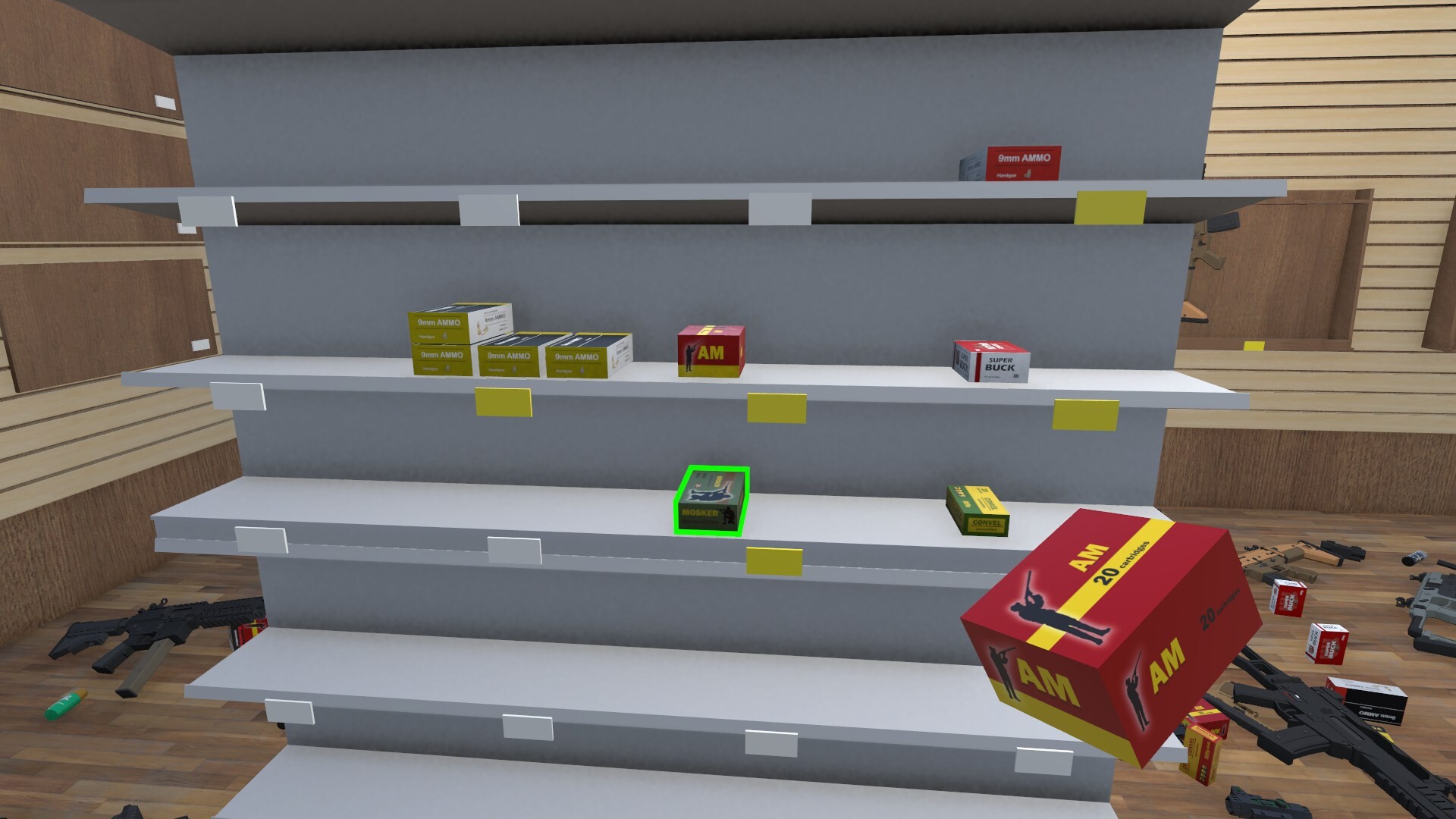
Color-coded outlines mark correct shelf placement, a system one reviewer flagged as inaccessible to colorblind playersImage: kotcool via Steam -
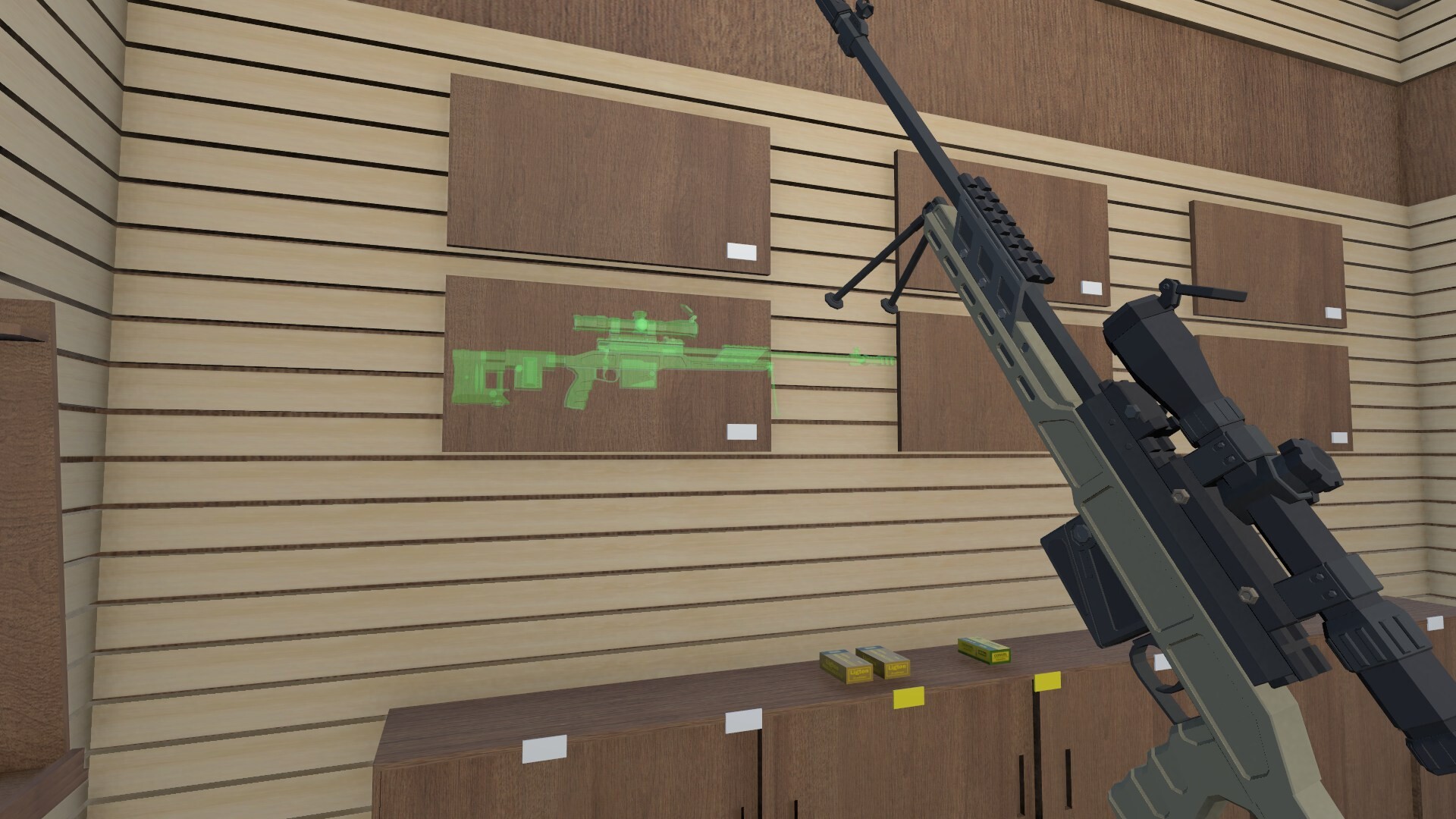
Ghost outlines guide players toward the correct wall mount for each weaponImage: kotcool via Steam -
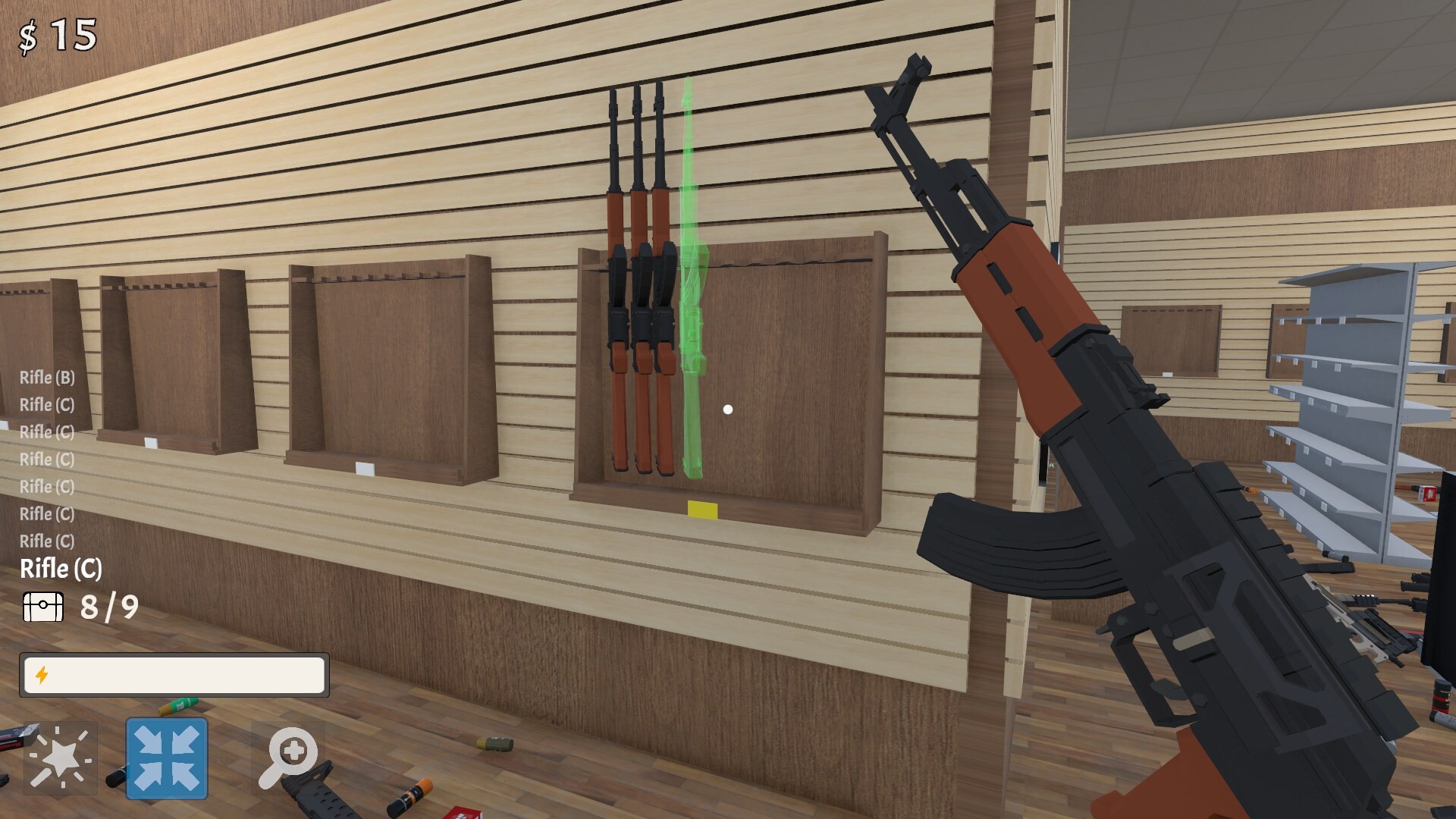
Generic weapon labels like Rifle (B) and Rifle (C) are the detail one reviewer cited as a sign of rushed namingImage: kotcool via Steam -
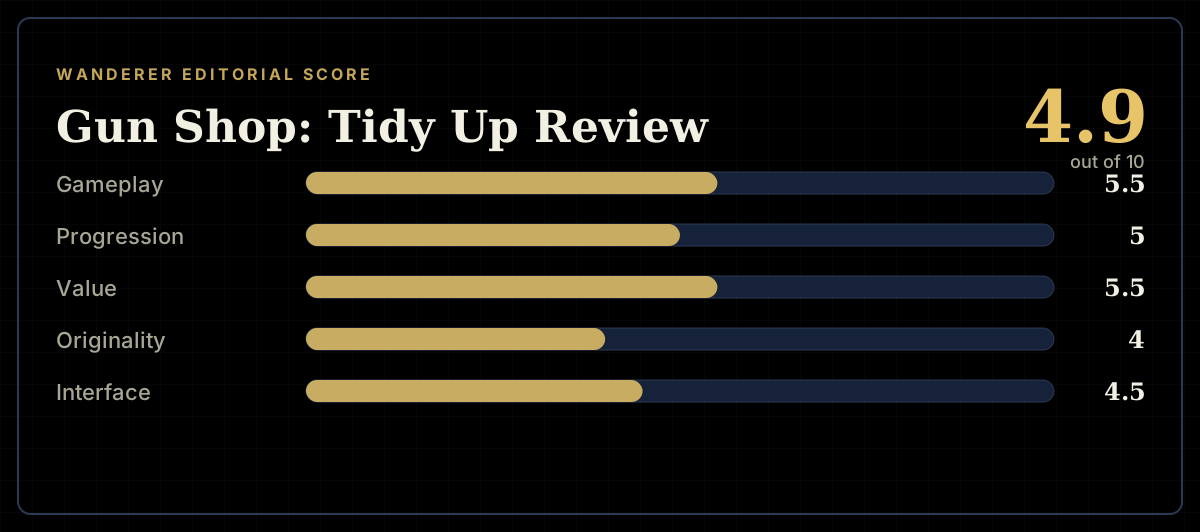
How the review scores each part of the gameWanderer Editorial -
The short versionWanderer Editorial