Game review
Global Protocol: New World Order
6 / 10
- Developer
- Dorlion Interactive
- Publisher
- Dorlion Interactive
- Released
- 1 June 2026
- Platforms
- Windows
- Genre
- Indie, Simulation, Strategy, Early Access
- Monetisation
- paid
- Players
- false
The short version
Biggest strengths
- An unusually broad scope for Early Access, letting players run any of 261 countries through interconnected economy, military, diplomacy, research, and espionage systems
- A genuinely addictive "one more turn" gameplay loop that multiple reviewers said swallowed hours without them noticing
- Real freedom in how to play, from peaceful economic builders to aggressive expansionists, with reviewers praising how differently a session can unfold
Biggest weaknesses
- Multiple systems, including research, trade deals, and diplomatic pacts, that reviewers said the game explains poorly or not at all, leaving their actual effects unclear
- Geopolitically implausible AI behavior, such as wars between unrelated countries or construction options that ignore basic geography, that even positive reviewers flagged as undermining the simulation's credibility
- A vocal minority of experienced strategy-game reviewers who described specific mechanics, particularly around war and invasion, as having been made worse rather than better across updates
Who it's for: Grand strategy fans willing to tolerate real Early Access roughness, unclear system explanations, and an actively-updating (but not always improving, according to some) developer in exchange for genuinely broad scope and an addictive core loop
Our recommendation: recommended with caveats
6 / 10
An enormous scope, right out of the Early Access gate
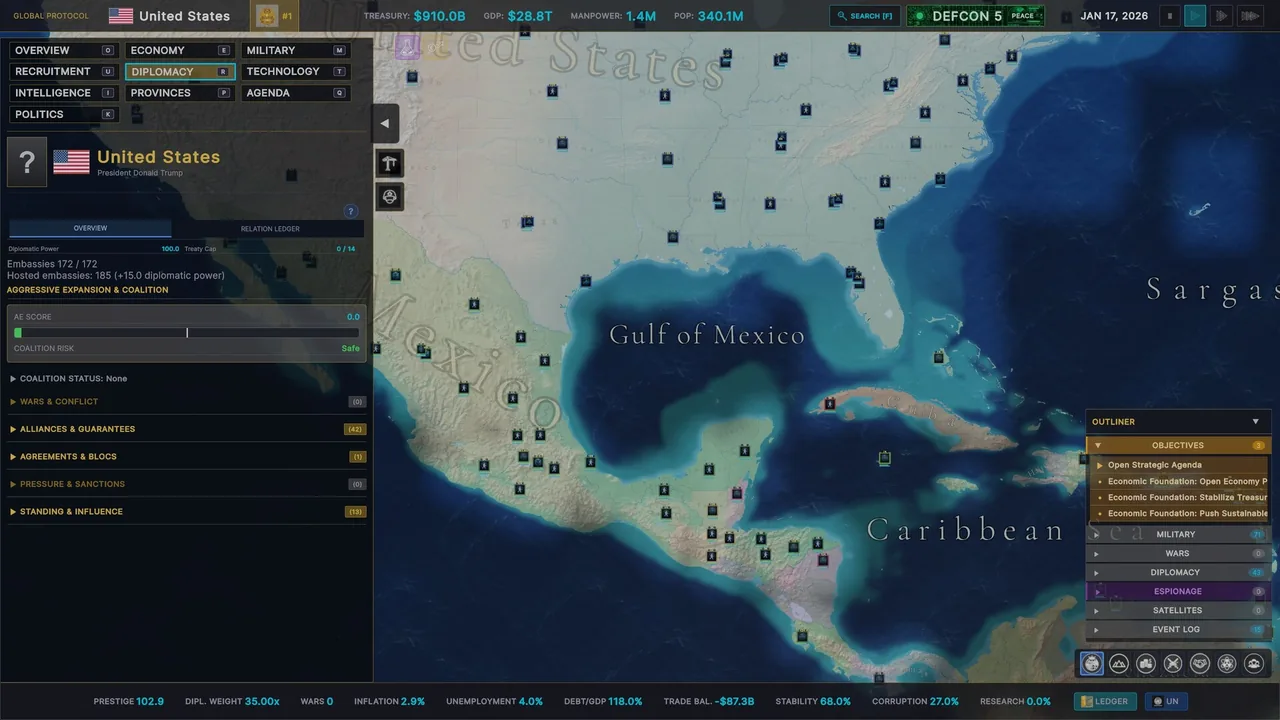
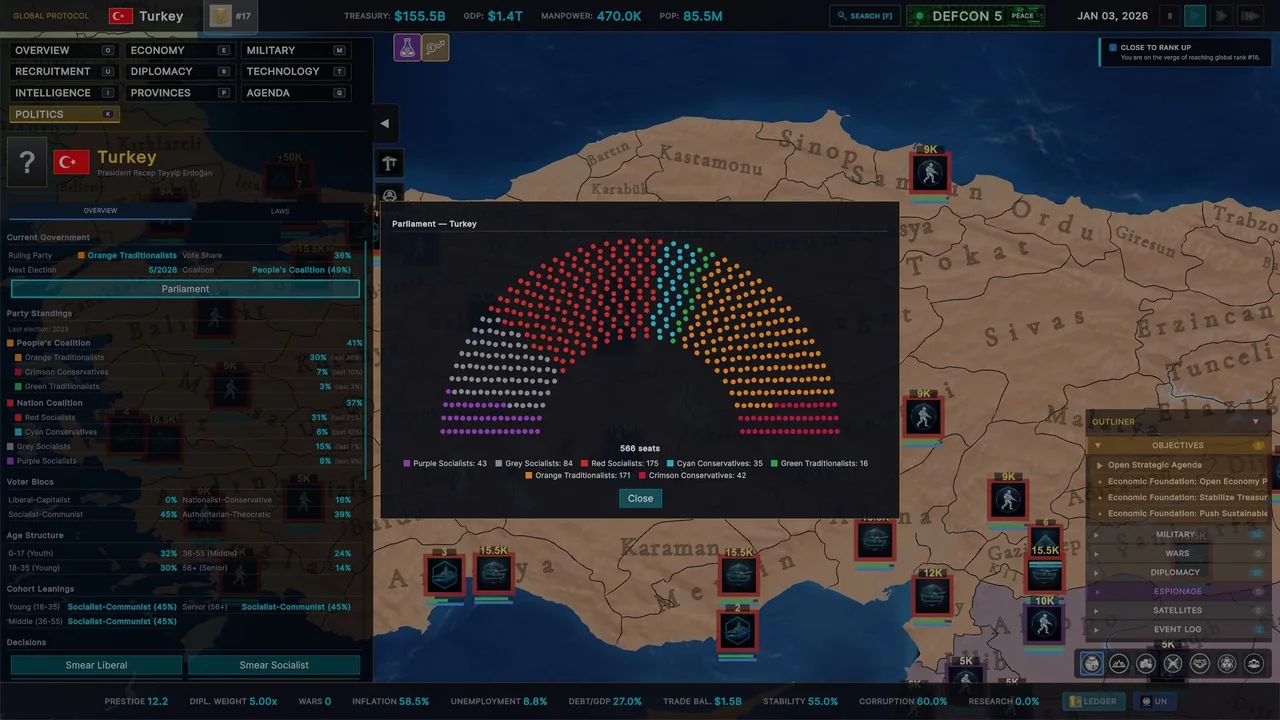
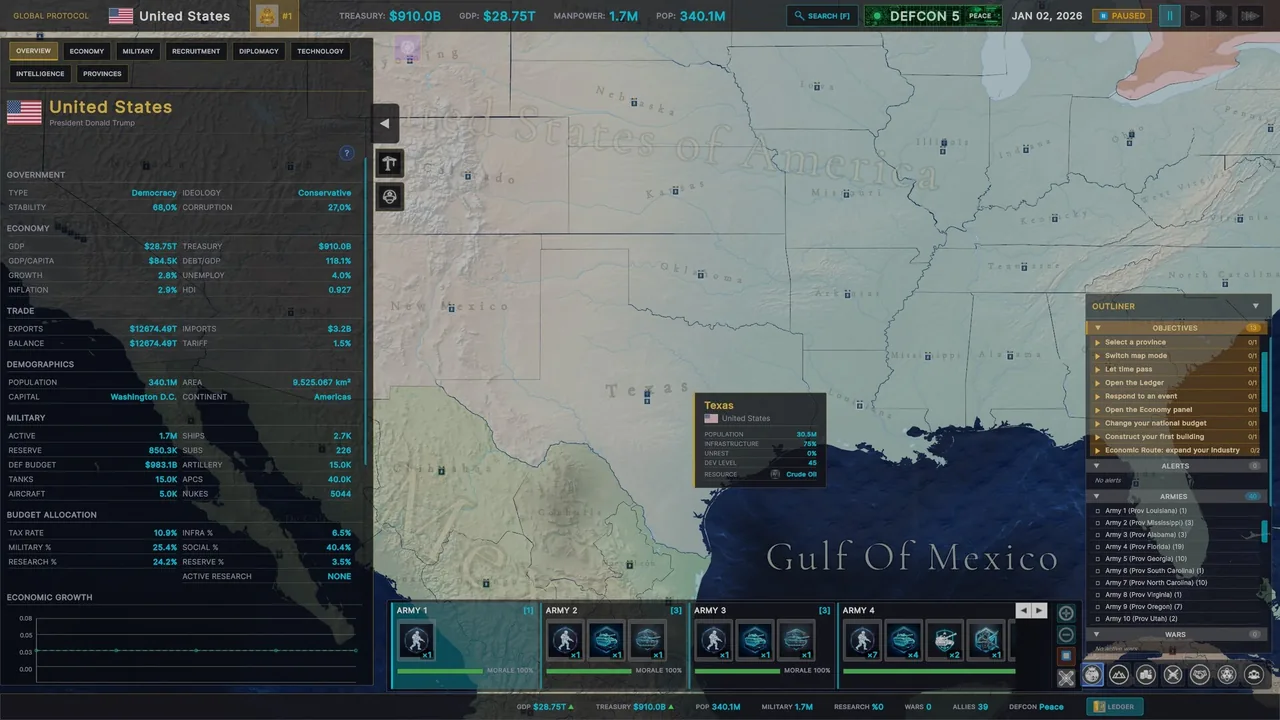
Global Protocol: New World Order lets players take direct control of any of 261 real-world countries, managing economy, military, research, diplomacy, and espionage in pursuit of whatever kind of global power they want to build. Several reviewers were struck by just how much is already present this early. One wrote, "For an Early Access game, there's already a surprising amount of content. The economy, military, research, diplomacy, and espionage systems all give you plenty to do, and I keep finding myself saying 'one more turn' and suddenly realizing a few hours have passed." Another reviewer echoed the same addictive quality: "It's one of those rare titles where you sit down for 'just 30 minutes' and suddenly realize several hours have passed. The gameplay loop is highly addictive, not because of artificial grinding, but because you're always making meaningful decisions and planning your next move."
Real freedom in how you play
Reviewers consistently praised the game for not funneling players toward a single strategy. One wrote, "The thing I like most is the freedom. You can jump into pretty much any country and play however you want. Want to build a strong economy? Go for it. Want to focus on diplomacy and alliances? That's an option too. Or you can just throw the world into chaos and see what happens." That openness extends to genuinely different playthroughs depending on the country chosen, with reviewers noting that playing a superpower like the US or China feels meaningfully different from taking on a small or economically dependent nation.
Systems that don't explain themselves
The most detailed critical review in the pool, written from the perspective of playing as the UK, focuses almost entirely on the game's failure to communicate what its own mechanics actually do. It lists a long series of specific complaints: "You can research something, but the game will not tell you what it does or what it is for. You can sign a trade deal, but the game will not tell you how it benefits your nation. You can sign a non-nuclear proliferation pact, but the game does not bother explaining what that actually means. You can vote on U.N. resolutions, but the game does not tell you what you are actually voting on." The same reviewer flagged specific geographic absurdities, like being prompted to build a naval base or oil rig in a landlocked region, as evidence the underlying systems aren't grounded in the countries they're meant to represent.
Even fans want the world to make more sense
Notably, some of the sharpest critique of the game's geopolitical logic comes from a reviewer who ultimately marked their review positive. They wrote, "The main issue for me is that the game still does not feel like a convincing geopolitical simulation. International relations can become very unrealistic. You may see wars such as Canada vs Cyprus or Belgium vs Italy without any believable geopolitical reason behind them." That same reviewer argued international bodies like NATO, the EU, and the UN should carry far more weight in shaping outcomes, and that a war between two NATO members should register as an exceptional crisis rather than "just another war on the map." Their broader point, that the game should give players freedom to act irrationally but attach realistic consequences to those choices, is a specific and constructive framing of where the simulation currently falls short.
Accusations of stalled or regressing development
A smaller but pointed set of reviewers, self-described as long-time strategy and management game players, described specific mechanics getting worse across updates rather than better. One wrote, "In the first version you could create a large 100k unit army, declare war on a neighboring country, and invade in just a few days using an auto-fleet... The developer decided this made too much sense so they removed the auto-fleet feature," and argued the game is currently far more playable as a superpower than as a smaller or island nation, where trade and naval invasion mechanics reportedly don't function well. That reviewer also accused the developer of using AI-assisted development and of the review section being astroturfed with fake positive reviews, an allegation the review pool itself doesn't independently substantiate but is worth noting as a genuinely held, strongly worded minority position rather than a fringe complaint.
Rough edges most reviewers accept as part of Early Access
Even reviewers who flagged real problems tended to frame them as expected for the current development stage rather than disqualifying. One wrote, "That said, this is classic Early Access. The UI is barebones, balance can swing depending on your starting country, and global politics sometimes escalate faster than feels realistic... But despite those rough edges, I'm having a good time. The foundation is strong, the systems are interesting, and it's clear Dorlion Interactive has big ambitions for where this can go." Another reviewer summarized the same trade-off concisely: "Very, very, rough around the edges, but the dev is active and the core gameplay loop is fun enough if a modern sim is what you're looking [for]."
Verdict
Global Protocol: New World Order is an ambitious Early Access grand strategy game with a genuinely broad scope and an addictive core loop that most reviewers found compelling despite real, specific shortcomings. Its systems frequently fail to explain themselves, its geopolitical AI produces outcomes that undercut the simulation's credibility, and a vocal minority of experienced strategy players describe specific mechanics regressing across updates rather than improving. For genre fans comfortable with early, unpolished systems and willing to bet on continued development, it's a reasonable pickup; players wanting a finished, well-explained simulation should wait for the game to mature further.
Pros and cons
Pros
- An unusually broad scope for Early Access, letting players run any of 261 countries through interconnected economy, military, diplomacy, research, and espionage systems
- A genuinely addictive "one more turn" gameplay loop that multiple reviewers said swallowed hours without them noticing
- Real freedom in how to play, from peaceful economic builders to aggressive expansionists, with reviewers praising how differently a session can unfold
- An active developer regularly shipping updates, which most reviewers treated as a meaningful point in the game's favor even when criticizing its current state
Cons
- Multiple systems, including research, trade deals, and diplomatic pacts, that reviewers said the game explains poorly or not at all, leaving their actual effects unclear
- Geopolitically implausible AI behavior, such as wars between unrelated countries or construction options that ignore basic geography, that even positive reviewers flagged as undermining the simulation's credibility
- A vocal minority of experienced strategy-game reviewers who described specific mechanics, particularly around war and invasion, as having been made worse rather than better across updates
- Balance that reviewers said varies heavily by starting country, with small or non-superpower nations reportedly struggling against broken or overly punishing systems
Screenshots
-
Global Protocol: New World OrderImage: Dorlion Interactive via Steam -
Global Protocol: New World OrderImage: Dorlion Interactive via Steam -
Global Protocol: New World OrderImage: Dorlion Interactive via Steam