
Game review
Generation Zero
5.5 / 10
- Developer
- Systemic Reaction
- Publisher
- Avalanche Studios
- Released
- 26 March 2019
- Platforms
- Windows
- Genre
- Action
- Monetisation
- Paid, with multiple paid DLC weapon and cosmetic packs
- Players
- true
The short version
Generation Zero drops players into an eerily depopulated 1980s Swedish archipelago, now overrun by hostile robotic machines, to survive and fight back solo or in co-op. Its atmosphere, sound design and open-world exploration have earned it a genuinely devoted fanbase with playtimes running into the thousands of hours for some players. That devotion exists despite — not because of — a mandatory account and privacy policy requirement that a huge, independently corroborated share of its review corpus considers a serious overreach, and despite the developer having now formally ended all future support after a final update reviewers say broke as much as it fixed.
Biggest strengths
- A genuinely distinctive, atmospheric setting — a depopulated 1980s Swedish landscape overrun by hostile machines — that reviewers consistently credit as one of the strongest reasons to play
- Strong sound design and robot enemy design that draw specific, repeated praise even from otherwise critical reviewers
- Real, substantial replayability and co-op appeal, with numerous reviewers logging hundreds to (in at least one documented case) several thousand hours
Biggest weaknesses
- A mandatory account-creation and privacy-policy acceptance process that a large, independently corroborated share of reviewers say goes well beyond what's necessary, with a quoted excerpt from the publisher's own privacy policy confirming collection of home address, email, phone number, IP address and payment details, plus a clause permitting transfer of that data in the event of a business sale
- The game requires an always-online connection even to play in single-player mode, a specific complaint tied directly to the account requirement above
- The developer has now formally ended all future support, confirmed via an official "Final Dev Letter and FAQ" following what reviewers describe as a broken final content update that left parts of the base game and paid DLC in a worse state than before
Who it's for: Open-world survival and co-op shooter fans specifically drawn to a distinctive, unsettling 80s-Scandinavia-versus-machines setting, who are comfortable with the game's data collection requirements.
Our recommendation: Worth it on a steep discount for the atmosphere and co-op play if the privacy policy doesn't concern you — read that policy yourself before buying rather than taking either side's characterization on faith.
5.5 / 10
What it is
Generation Zero sends players into a version of 1980s Sweden where the human population has vanished and hostile robotic machines now patrol the countryside, forests and small towns. Playing solo or in co-op with up to three others, players scavenge weapons and resources, choose between stealth and direct confrontation, and gradually push back against escalating machine threats across a large, open archipelago setting. Developed by Systemic Reaction, a studio under publisher Avalanche Studios, it released on 26 March 2019 at NZD 34.99. Its review corpus is enormous for a title this lane has covered — 18,334 English-language reviews sitting at a genuine Mostly Positive 76.9% (14,093 to 4,241) — and reading through it reveals two very different, largely separate conversations: one about a genuinely well-liked survival game, and one about a specific, serious concern regarding what that game requires from players before they can even start.
A privacy and account requirement independently confirmed by multiple reviewers
The single most-upvoted review in this entire corpus, by an enormous margin, concerns something other than gameplay entirely. "In order to play the game, you are forced to accept the publisher's abusive 'privacy policy,' which involves gathering, sharing and even selling to third parties A LOT of your personal data, including (but not limited to) your home address," the review states, adding that players are "forced to create an account" and remain "always online to play even in single-player mode." That review includes a directly quoted excerpt from Avalanche Studios' own published privacy policy, confirming collection of "home address," "email," "phone," "IP," "name," "username" and payment details, alongside language permitting the transfer of that personal data "if we sell or transfer all or a portion of our business assets." This isn't a single reviewer's interpretation — at least two other independently-written reviews in the corpus, carrying hundreds of votes each, raise the identical complaint using near-identical language, describing the same mandatory account prompt and objecting to data collection they consider unnecessary for a single-player-capable game.
This is worth treating with real weight rather than as an exaggerated one-off complaint: the quoted policy language traces directly back to the publisher's own website rather than a reviewer's paraphrase, and its recurrence across multiple independent, highly-upvoted reviews suggests broad recognition of the same concern rather than a single loud voice. Anyone considering this purchase should read Avalanche Studios' actual privacy policy directly before installing, rather than relying on either this review or the corpus's characterization of it secondhand.
A confirmed, formal end to development
Beyond the privacy concern, this review needs to flag something else with real specificity: Systemic Reaction has now formally ended all future support for Generation Zero. One detailed reviewer states that "the developer has formally stated there will be no further patches or bugfixing," describing a final major update that broke "substantial portions of both the base game and DLCs," leaving them "unusable or worse than prior to the last update." That account is independently corroborated by the game's own documented news history: an official post titled "Generation Zero dev says co-op FPS' next update will be its last" preceded a final "Showdown" content update, followed by a "Final Dev Letter and FAQ" closing out the game's development cycle entirely. That's about as complete a confirmation of an abandonment complaint as this lane has documented — not inferred from silence, but stated directly and repeatedly by the developer in its own official channels.
What keeps players coming back anyway
None of this has stopped Generation Zero from building a genuinely devoted following. Reviewer playtimes in this corpus run remarkably high — one account shows 303,269 minutes logged, over 5,000 hours, from a 67-year-old player who specifically credits the game's accessible pacing and describes finding real comfort in it "with the Covid situation" during isolation. Others report hundreds of hours built around the open-world flexibility of choosing "stealth" one moment and finding themselves "in a ruckus with 8 hunters" the next. The atmosphere and sound design draw essentially unanimous praise even from the corpus's harshest critics — one reviewer explicitly separates their privacy complaint from an otherwise glowing assessment of "atmosphere, fun locations to explore... cool weapons" and "amazing" sound design.
What the achievement data suggests about the base experience
Generation Zero's achievement completion curve shows a genuinely healthy shape for a game this old and this large in scope. Early achievements sit remarkably high — 94.7% and 87.5% for the top two — descending through a real, gradual middle tier (74.2%, 62.1%) before tapering to under 1% for the hardest, most specific late-game and completionist achievements. That's a smooth, well-populated curve rather than a game losing its audience early, which corroborates the reviewer testimony about genuine, sustained engagement: a large share of buyers don't just install and bounce off, they push substantially into the game's content before the usual long tail of dedicated completionists takes over. Given the privacy policy complaint that dominates the corpus's most-upvoted reviews, that's a meaningful data point — plenty of players who were aware of, or encountered, the mandatory account requirement still engaged deeply and repeatedly with what's underneath it.
The story's limits, separate from the technical concerns
Beyond the privacy policy and end-of-support issues, it's worth noting a real, more conventional critique from a detailed, moderately positive review: "there is a story to follow" early on, but "past the first few hours... the story just kind of stops," leaving an open world that becomes repetitive in structure once the initial narrative hook fades. That's a fair, more typical open-world survival game complaint distinct from the controversies dominating the rest of the corpus, and it's worth naming plainly for buyers primarily motivated by narrative rather than sandbox survival and co-op play — Generation Zero's strongest asset, by wide agreement, is atmosphere and emergent moment-to-moment encounters rather than a sustained, plotted campaign.
Verdict
Generation Zero built a real, devoted audience around a genuinely atmospheric premise and flexible open-world co-op survival gameplay — that part of its reputation is earned and well-documented across tens of thousands of hours of collective playtime. But a mandatory, independently-verified data collection requirement and a now-official end to all future development are serious, concrete factors that deserve equal weight in any purchase decision, not asterisks beneath the praise. Read the privacy policy yourself, and go in knowing whatever state the game is in now, per the developer's own final statement, is the state it will permanently remain in.
Pros and cons
Pros
- A genuinely distinctive, atmospheric setting — a depopulated 1980s Swedish landscape overrun by hostile machines — that reviewers consistently credit as one of the strongest reasons to play
- Strong sound design and robot enemy design that draw specific, repeated praise even from otherwise critical reviewers
- Real, substantial replayability and co-op appeal, with numerous reviewers logging hundreds to (in at least one documented case) several thousand hours
- Flexible open-world approach to encounters, letting players choose stealth or direct confrontation depending on the situation and squad size
Cons
- A mandatory account-creation and privacy-policy acceptance process that a large, independently corroborated share of reviewers say goes well beyond what's necessary, with a quoted excerpt from the publisher's own privacy policy confirming collection of home address, email, phone number, IP address and payment details, plus a clause permitting transfer of that data in the event of a business sale
- The game requires an always-online connection even to play in single-player mode, a specific complaint tied directly to the account requirement above
- The developer has now formally ended all future support, confirmed via an official "Final Dev Letter and FAQ" following what reviewers describe as a broken final content update that left parts of the base game and paid DLC in a worse state than before
- A specific, recurring complaint that paid DLC, including weapon packs, was prioritised over fixing pre-existing bugs, with some reviewers explicitly recommending against purchasing any DLC given the state of the base game post-update
- A clunky, unintuitive inventory and equipment-switching interface criticised as slow and cumbersome to use in active combat
Screenshots
-

Generation Zero®Image: Avalanche Studios via Steam -

Generation Zero®Image: Avalanche Studios via Steam -

Generation Zero®Image: Avalanche Studios via Steam -
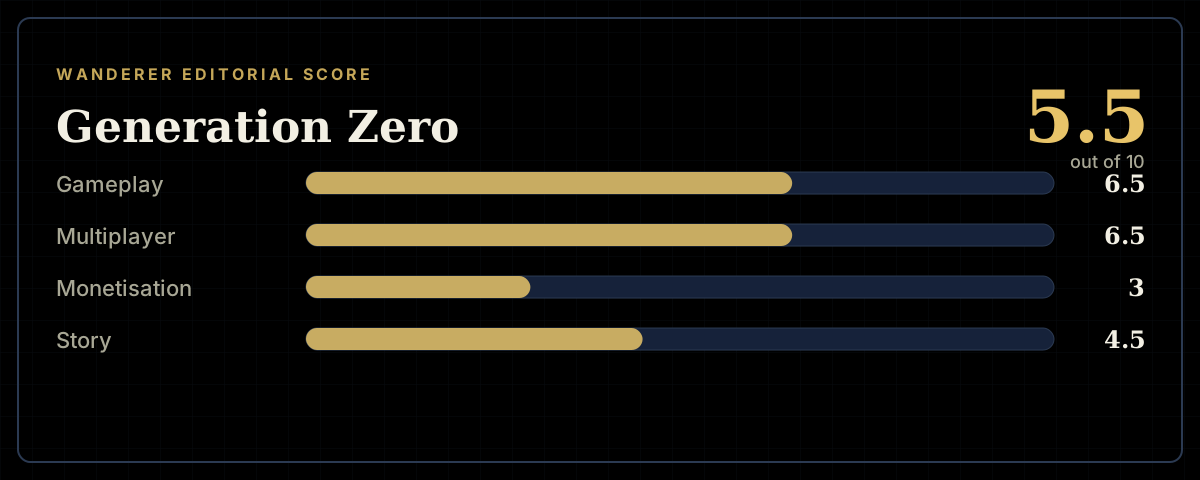
How the review scores each part of the gameWanderer Editorial -
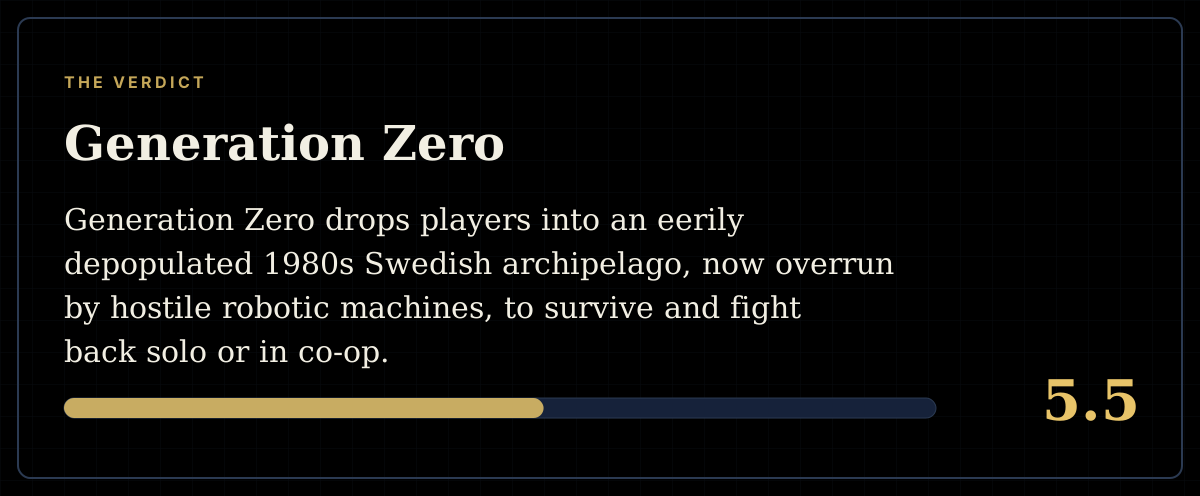
The short versionWanderer Editorial